

200 000+ readers learn art the fun way.
This is a preview. Paid subscribers get the full story.
You’ll also get:
10 new stories / month
The full archive (140+ Art stories)
Your personal art guide. Comment, ask questions, DM me anytime
Apple user? Subscribe at coolstoriesabout.art, not via the app. Apple adds 30% to the price.
In Disney's animated film Hercules, the hero skips a stone across a pond. It bounces twice and snaps both arms clean off a statue of a woman. The young woman with him looks at the result and finds the statue more beautiful this way. That is the whole joke.
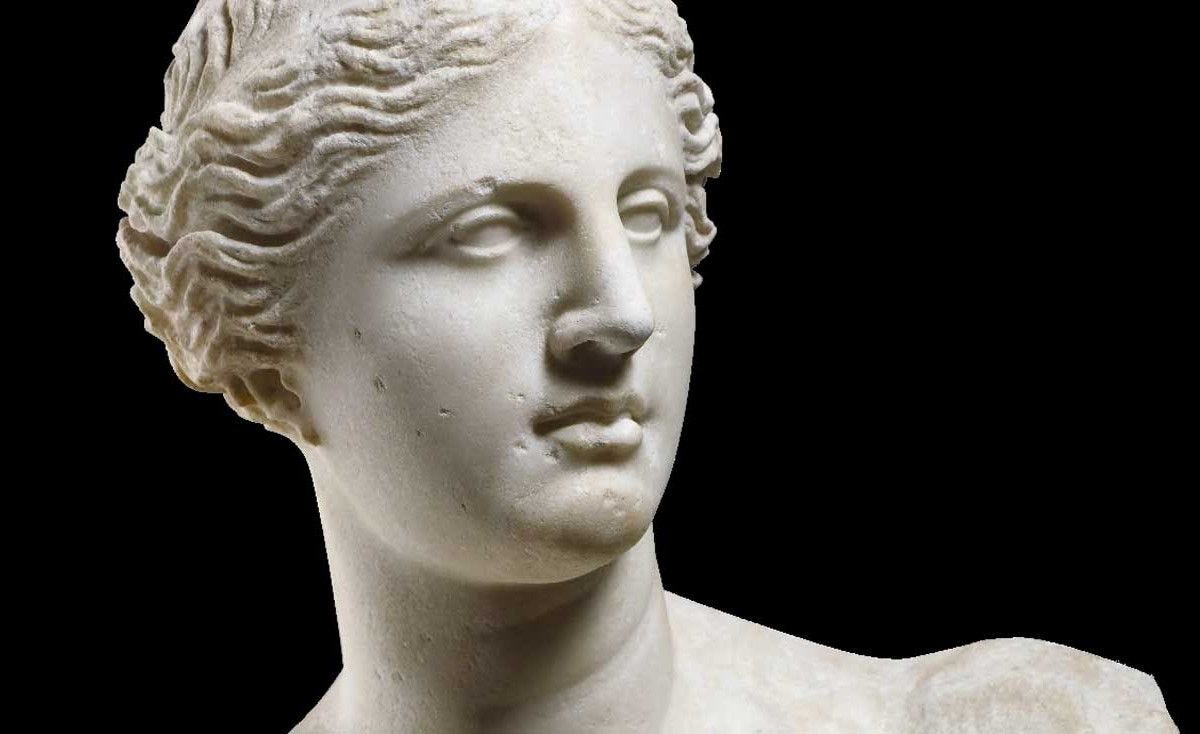
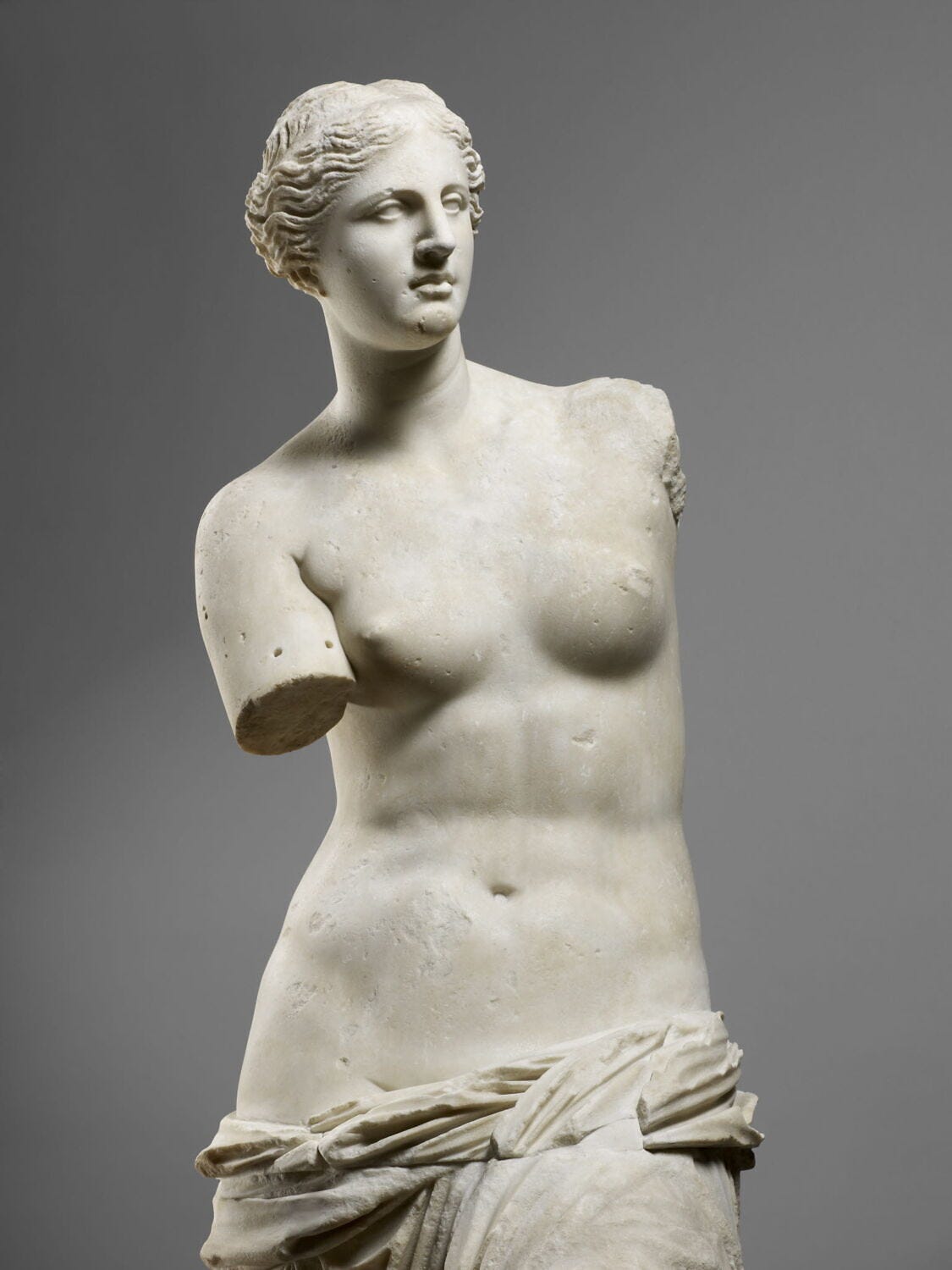
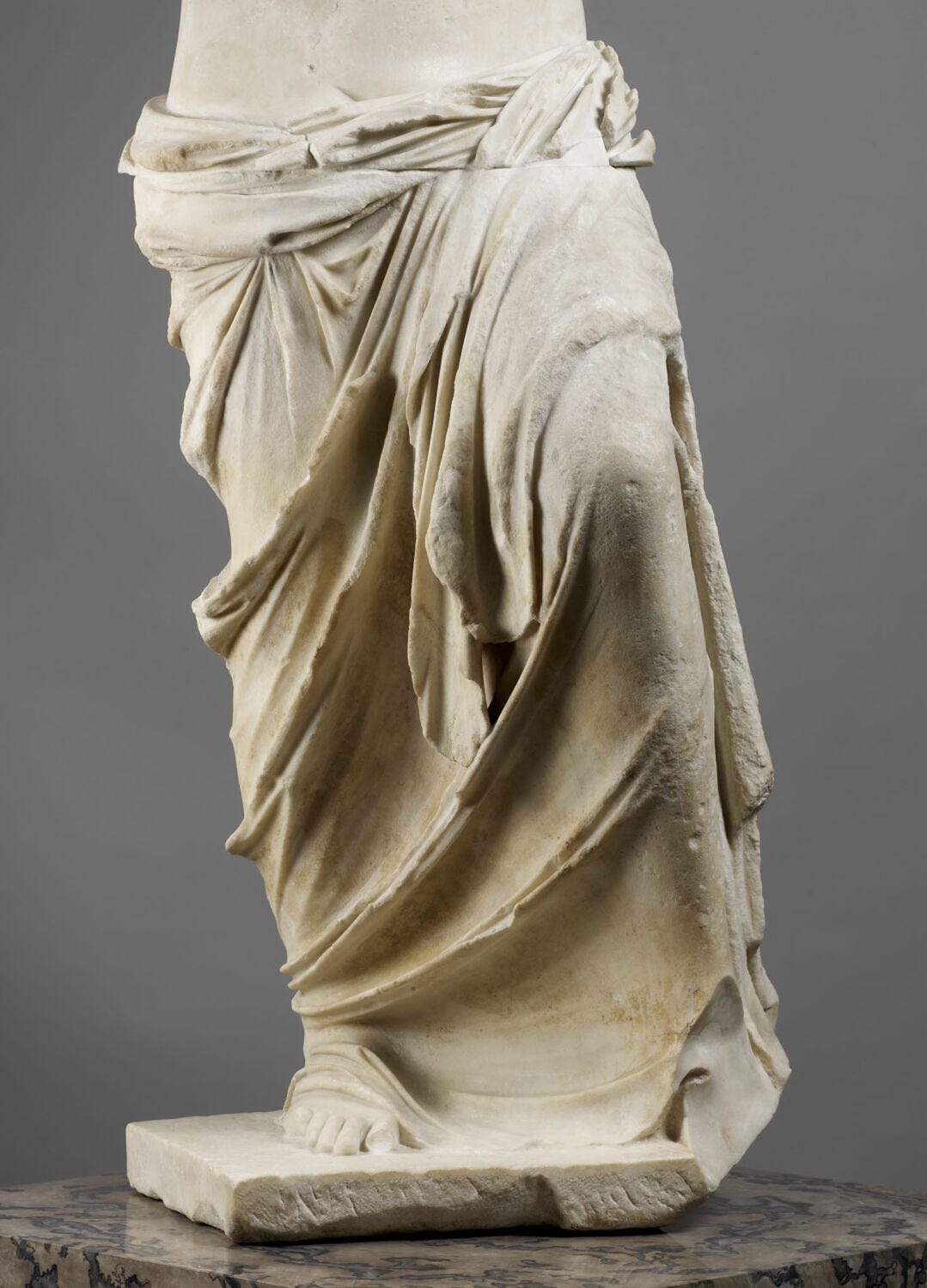
In the video for "Apeshit," Beyoncé dances in a flesh-colored leotard in front of a white marble statue: a woman larger than life, bare to the hips, with drapery knotted low across the belly, and no arms.
That figure is everywhere. Plaster casts in art schools, parodies in cartoons, T-shirts, corkscrews.
So why did this statue, which looks like so many other Greek statues, become so famous?
And where did its arms go?
The Field
The island of Milos, in the Aegean Sea. April 1820. At the edge of a sloping field, above a round bay where a few ships lie at anchor, a farmer is tearing down an old wall with a pickax. On the island, people build new houses out of the stones of old ones, and whatever they don't use gets resold.
The farmer's name is Yorgos. The blade rings against cut stone. One stone shifts, then another. One more blow, and the pickax plunges into empty space. Yorgos pulls the pickax out and leans in. Behind the wall is a small niche built of stone, and at the far end of it, under the dirt, a patch of white.
He crouches and gently clears the dirt away by hand. A face appears under his fingers, then hair knotted at the back of the head, a neck, a chest. The upper half of a marble woman, larger than life, bare to the hips.
He calls his son and his nephew. The three of them drag the marble out of the niche, haul it across the field to the stable in the corner, and lay it down in the straw.
In the days that follow, the son and the nephew go back and dig out of the niche the lower half of the statue, a length of marble skirt draped from the hips to the feet. They lay it beside the upper half.
Yorgos's neighbor is a man named Brest. The only Frenchman on the island, he represents the king of France there, and when he pushes open the stable door, he stands for a long time in front of the marble lying in the straw.
The face, the hair knotted at the nape, the bare torso: a Venus, the goddess of love, whom Greek sculptors portrayed nude. He wants it for his king.
"Islanders have already been by," Yorgos says. "They're offering me a thousand piastres for it."
"I don't have that. Whatever you do, don't sell to anyone. I'll buy it from you at a fair price."
Yorgos promises, and the two men shake on it. Brest hurries home to write to the French ambassador in Constantinople, the sultan's capital, and ask for the money. The letter leaves on the first ship out of the bay.
Discover my new newsletter !

The Cassock
The weeks go by. One morning a boat pulls up to the quay of the little port, and a man in a black cassock jumps onto the stones. A priest from the island. He is back from Constantinople, and back under a cloud: his superiors accuse him of embezzling funds.
He needs a protector, and he has one in mind. All of Greece belongs to the Ottoman Empire at this time, Milos included, and in Constantinople a high Ottoman official has authority over all the Greek islands. The priest knows one thing about him: the man is after antiquities.
On the quay, everyone is talking about Yorgos's statue. The priest doesn't stay to hear any more. He takes the road up to the field and knocks on the door.
"I've come about the statue."
"It's promised. To the Frenchman."
The priest goes in anyway, crosses the yard to the stable, and in front of the marble he says the official's name. A man like that, he says, can make life very hard for a farmer on Milos. Yorgos lowers his eyes and gives in. The priest buys the statue from him.
On May 10, the statue goes down toward the sea. Men from the island have hoisted the two halves straight onto the planks of a cart, with no crate and no straw, and roped them down. The cart sets off along the stony track to the bay.
At every rut, the bare marble lifts and drops. The priest walks alongside. At the water's edge, the statue is unloaded onto the beach, and there it stays.
It stays there a long time. The priest takes a boat and goes from one anchored ship to the next, from captain to captain. All of them refuse, and each one shows him the same note: Brest has written to every one of them, telling them not to take this statue on board.
So the priest writes too. His letter leaves for Constantinople, addressed to the official: the gift is ready and waiting on a beach on Milos; all that's missing is a ship.
Two letters are sailing toward the same city.
Pera
In Constantinople, the French embassy sits at the top of the hill of Pera, above the city, and that is where Brest's letter arrives. The ambassador reads it, sets it down, and makes a decision Brest never asked for: no money will be sent to Milos. He will buy the statue himself, out of his own pocket.
The mission falls to his secretary, Marcellus, a young man of 25 who speaks Greek. To take him to Milos, the ambassador gives him a warship armed with 10 guns.
On May 15, the wind shifts to the north and pushes black clouds over the minarets. At six in the evening, the French warship weighs anchor with Marcellus on board and heads out to sea.
At the foot of the same hill, on the waterfront, stands the arsenal of the sultan's fleet, only a few streets from the embassy. That is where the Ottoman official opens the priest's letter.
He, too, sends a ship for the statue: a two-masted merchant ship, with a captain and crew under his orders. This Ottoman ship sets course for Milos.
Meanwhile, word runs across the sea, from deck to deck: a farmer on Milos has found a Greek statue. At Malta, where the British Mediterranean fleet has its base, a British warship sets sail at once with a single order: buy the statue.
At Smyrna, the great port on the Ottoman coast, Dutch merchants have a trading house, a consul, and ships, and one of those Dutch ships puts to sea as well.
The Bay
The Ottoman ship is the first to enter the bay of Milos. It drops anchor at the far end and lowers its boats, and the sailors row toward the beach where the statue waits.
The French warship has taken eight days, with several stops along the way. On May 23, at dawn, it rounds the point and enters the bay.
Standing on deck, Marcellus scans the far end of the bay. Boats loaded with white marble shuttle back and forth between the beach and the Ottoman ship. The statue is being taken aboard.
But a violent wind is blowing straight into the mouth of the bay, and the Ottoman ship cannot get out. It is stuck at anchor with the statue on board. Marcellus goes ashore and spends the day trying to buy the statue. Everywhere he gets the same answer: the priest will not give it up.
That evening, he decides to go and demand the statue from the captain of the Ottoman ship in person. The longboat, the warship's big rowboat, is lowered over the side.
Marcellus takes a seat in the bow, a few officers behind him, and the sailors lean into the oars. It takes a long time to cross the bay, and the Ottoman ship, anchored at the far end, slowly grows larger.
On the beach, a rider gallops along the water's edge. Marcellus watches him. The man is racing toward the spit of land that juts out closest to the Ottoman ship, and he is faster than the rowers. It is the priest. At the end of the beach, he leaps off his horse, pushes a boat into the water, and his boat reaches the Ottoman ship before the longboat does.
The rowers pull harder. The longboat comes within musket range. Marcellus can now make out every man on deck, and at the top of a mast a red flag goes up. The sultan's. To board that ship now is to attack the Ottoman Empire.
The Ottoman sailors pick up their muskets. They line up along the rail. They aim at the longboat.
What You’ll Discover
Why all those countries wanted this statue.
Who carved it, and when.
Whether it has always been armless.
The day it nearly burned.
Why it became so famous.
Where its arms went.