Venus in Art: 12 Faces of the Goddess of Love

Venus, the goddess of love, has been shaped by artists for 25,000 years, from a prehistoric fertility figurine to Botticelli's shell, Titian's reclining nude and Cabanel's Salon sensation.

No figure in art has been undressed more often, or for more different reasons.

Small carved Ice Age figure of a full bodied woman
The Venus of Willendorf, about 25,000 BC (a cast; the original is in the Natural History Museum, Vienna).

Venus is a container. Painters have used her to celebrate the body, to smuggle in eroticism under a respectable name, to flatter a duke or a king, and sometimes to warn against desire itself.

I have lined up twelve, roughly in order of age, so you can watch what each era wanted her to mean.

Four disguises Venus has worn:

  • The idol. A fertility figure, all body, made long before anyone wrote her name down.

  • The ideal. A perfect nude that let Greeks and Renaissance masters study beauty out loud.

  • The excuse. A mythical label that made a frankly sexual picture acceptable to hang.

  • The warning. A tempting body wired to a moral about vanity, folly or love gone wrong.


Learn art the fun way. Free stories every week, no boring lectures.


Beyond the list

Three worth opening next:


1. The Venus of Willendorf (about 25,000 BC)

She fits in your palm, a small limestone woman with a heavy body, braided hair and no face at all. Carved in the Ice Age, tens of thousands of years before Rome, she is the oldest thing on this list by a wide margin.

She was not called Venus by the people who made her. Archaeologists gave her the name much later, half as a joke, borrowing the goddess of love for a fertility charm whose real meaning is long lost.

Her body is the whole message. Wide hips and full breasts suggest she was about survival and birth, not beauty as we mean it, and she now sits in a museum in Vienna.

2. The Aphrodite of Knidos (Praxiteles, about 350 BC)

Marble nude Aphrodite covering herself, Roman copy
Roman marble copy of the Aphrodite of Knidos by Praxiteles, Walters Art Museum.

The Greek sculptor Praxiteles made the first life size female nude in Greek sculpture, a naked Aphrodite caught stepping into her bath. Until then goddesses had kept their clothes on, and the shock was enormous.

It stood as a cult statue on the island of Knidos, weight easy on one leg in a soft contrapposto, one hand shielding herself. The pose let you look while she pretended not to notice.

The original is gone. We know it only through Roman copies, and through an old and grim story that a young man once hid in the temple overnight and left a stain on the marble.

3. Sandro Botticelli, The Birth of Venus (about 1485)

Venus arriving on a scallop shell, Botticelli
Sandro Botticelli, The Birth of Venus, about 1485, Uffizi, Florence.

A grown woman floats to shore on a giant scallop shell, hair streaming, blown along by winds while a nymph rushes to cover her. Botticelli painted the most famous Venus of all for a Medici cousin, and it still draws crowds at the Uffizi.

It broke the rules of its time. A near life size pagan nude, painted on canvas rather than a church panel, it revived the naked goddess after a thousand Christian years of covering her up.

Her face may be a real woman. Many believe Botticelli modeled her on Simonetta Vespucci, a famous Florentine beauty who had died young, which would make the goddess of love a portrait of a ghost.

4. Giorgione, Sleeping Venus (about 1510)

Nude Venus asleep in a landscape, Giorgione
Giorgione, Sleeping Venus, about 1510, Gemaldegalerie, Dresden.

Venus lies asleep in the open countryside, one arm behind her head, utterly at peace and completely nude. Giorgione originated the reclining Venus here, a pose that painters would copy for the next five hundred years.

He did not live to finish it. Giorgione died of plague around 1510, and the young Titian is thought to have completed the landscape behind her.

The calm is the point. She is not posing for anyone, which somehow makes her more naked, and every reclining nude that follows owes her a debt.


Join 130,000 readers who get the secrets behind the paintings. Free.


5. Lucas Cranach the Elder, Venus (1532)

Slender nude Venus in a large feathered hat, Cranach
Lucas Cranach the Elder, Venus, 1532, Stadel Museum, Frankfurt.

A slender Venus stands almost bare against a black ground, wearing nothing but a huge feathered hat and a wisp of transparent veil that hides less than it shows. This is the northern Venus, cooler and stranger than the Italian kind.

A Latin line up top plays it both ways. It warns the viewer to resist Venus and her love or lose their soul, a tidy moral pinned above an image built entirely to tempt.

Cranach ran a busy workshop and painted many of these. The mix of scolding and seduction was exactly what his princely clients wanted on their walls.

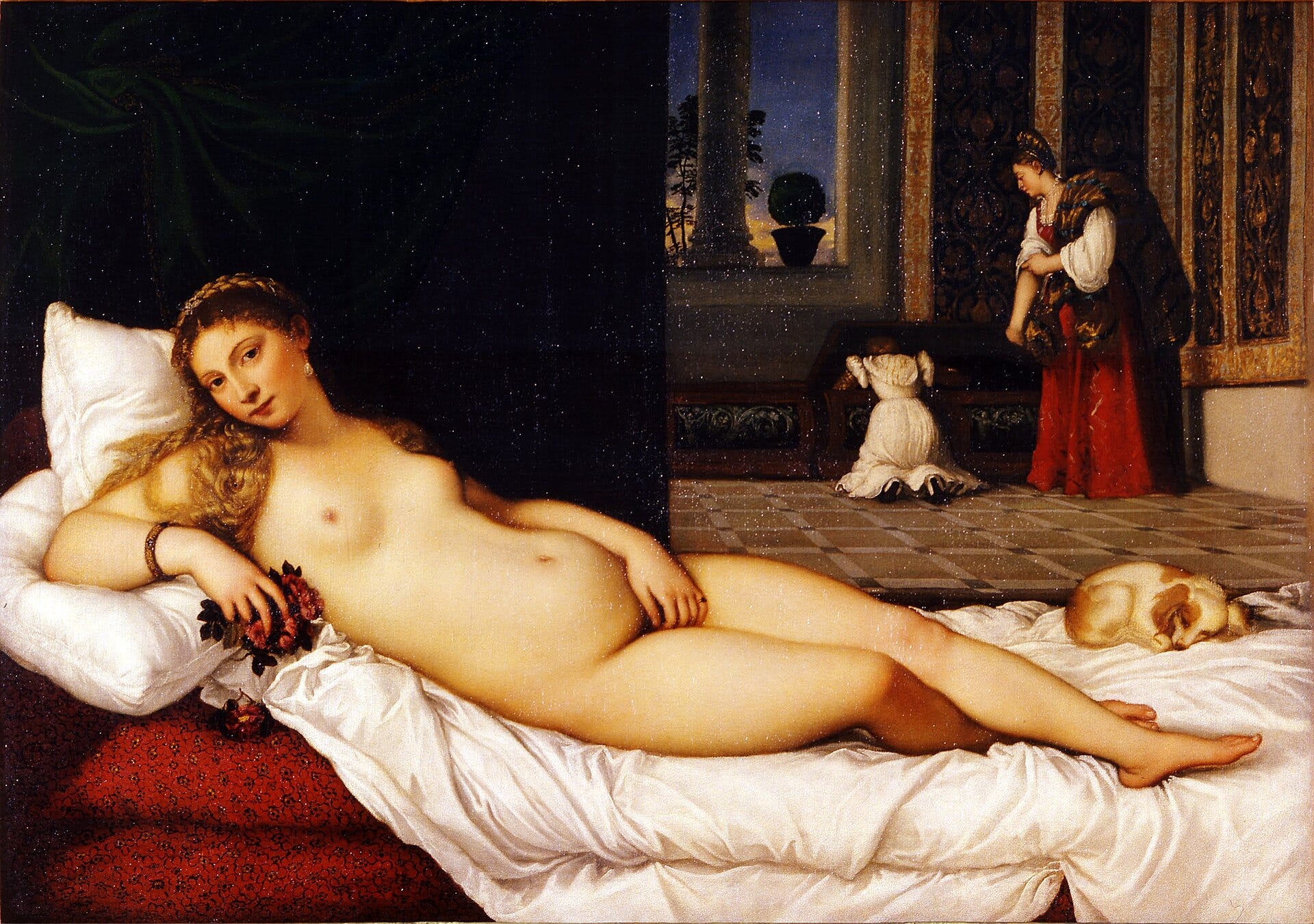
6. Titian, Venus of Urbino (1538)

Reclining nude Venus meeting the viewer's eye, Titian
Titian, Venus of Urbino, 1538, Uffizi, Florence.

A nude woman reclines on rumpled sheets and looks straight at you, unhurried, a small dog asleep at her feet. Titian borrowed Giorgione's pose but woke her up, moved her indoors, and met the viewer's eye.

It was probably a wedding picture. Painted for the Duke of Urbino, it wraps frank sensuality in the respectable clothes of marriage, love and fidelity, with maids fetching clothes in the background.

Not everyone was charmed. Centuries later Mark Twain called it the foulest painting in the world, which only proves how directly it still meets your gaze.


130,000 readers already get these. Add your email, it is free.


7. Bronzino, An Allegory with Venus and Cupid (about 1545)

Venus and Cupid kissing amid strange figures, Bronzino
Agnolo Bronzino, Venus, Cupid, Folly and Time, about 1545, National Gallery, London.

Venus and her son Cupid share a cool, unsettling kiss while strange figures crowd around them, a screaming old woman, a laughing child with rose petals, a girl with a hidden sting.

Bronzino packed the picture with riddles that scholars are still decoding.

The extra figures are usually read as Folly, Time, Jealousy and Deceit, a warning that love brings pain and disease along with pleasure. Nothing here is quite what it seems.

It was a diplomatic gift. The Duke of Florence sent this glossy, brainy puzzle to the King of France, a piece of Renaissance showing off wrapped around a moral.

8. Peter Paul Rubens, Venus at a Mirror (about 1615)

Venus seen from behind, her face in a mirror, Rubens
Peter Paul Rubens, Venus at a Mirror, about 1615, Liechtenstein collection.

A full, soft Venus sits with her back to us while a servant holds up a mirror, and in the glass her face turns to meet our eyes. Rubens loved this kind of body, generous and warm, and gave the word Rubenesque to the language.

The mirror does clever work. It lets us stare at her back and her face at once, and it quietly makes us the ones caught looking, since she can see us watching.

She is a goddess of abundance. Where the Greeks idealized and the northerners moralized, Rubens simply celebrated flesh, light and pleasure without apology.

9. Diego Velazquez, The Rokeby Venus (about 1650)

Venus reclining, looking into a mirror held by Cupid
Diego Velazquez, The Rokeby Venus, about 1650, National Gallery, London.

Venus stretches out with her back to us, gazing into a mirror held by Cupid, her face a soft blur in the glass. It is the only surviving nude by Velazquez, painted in a Spain where the Church could punish such things.

That rarity makes it precious, and it nearly did not survive intact. In 1914 the suffragette Mary Richardson walked into the National Gallery and slashed it seven times with a meat cleaver, in protest at the arrest of a fellow campaigner.

It was carefully repaired. Look closely today and the mended cuts are still faintly there, a scar from a very different fight over how women are looked at.


Two new stories a week, 130+ secrets unlocked. Start free.


10. Jean Auguste Dominique Ingres, Venus Anadyomene (1848)

Venus rising from the sea wringing her hair, Ingres
Jean Auguste Dominique Ingres, Venus Anadyomene, 1848, Musee Conde, Chantilly.

Venus rises newborn from the sea, wringing the water from her hair, smooth and cool as porcelain, ringed by little cupids. Ingres chased perfect line and flawless skin, and here he polished the goddess to a high shine.

He took his time. Ingres started the idea as a young man in Rome and only finished it decades later, near the age of seventy, which tells you how long he chewed on an ideal.

This is Venus as pure refinement, no plague, no moral, no scandal. Ingres liked the rising pose so much that he reused it eight years later for another famous nude, The Source.

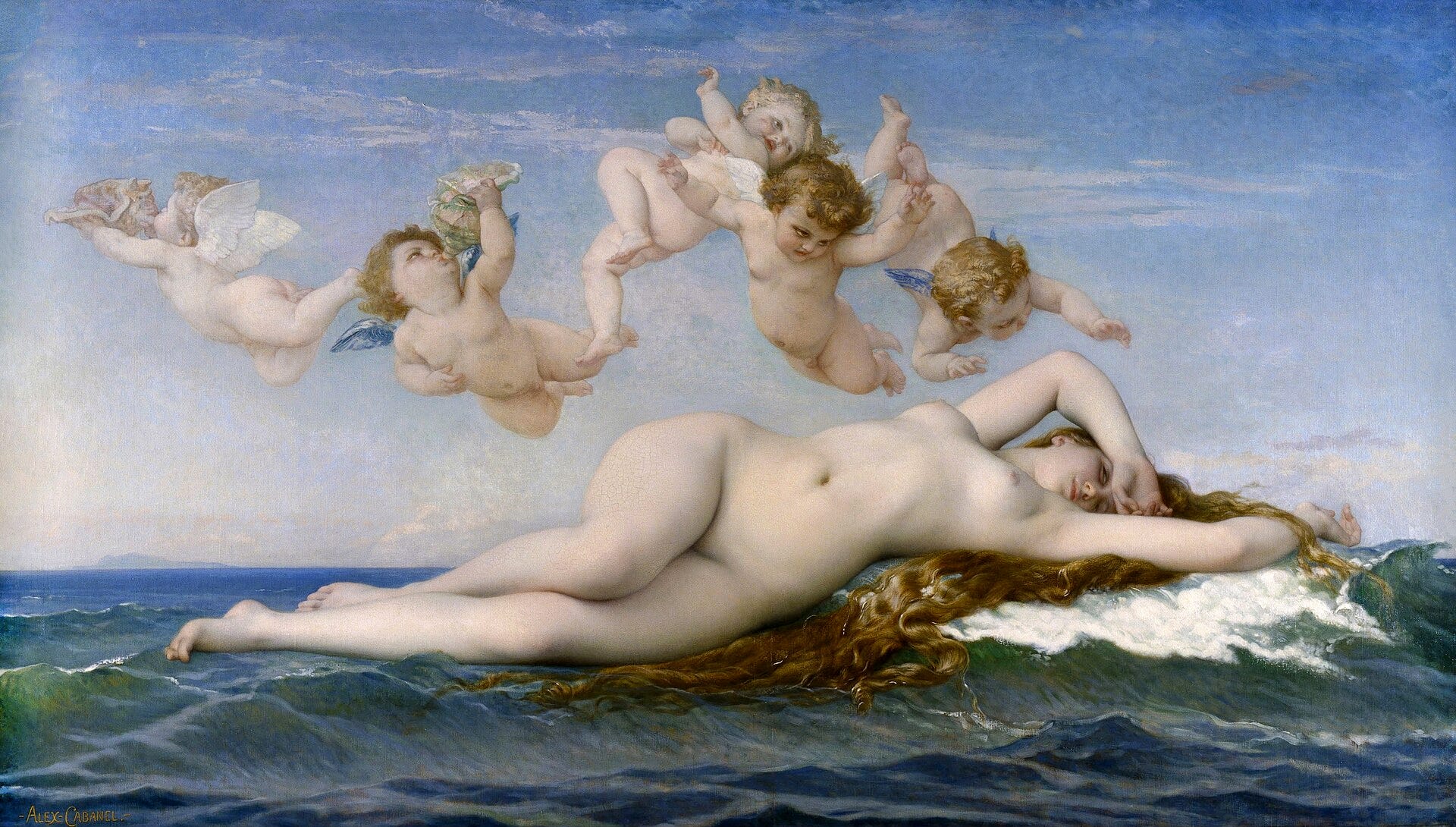
11. Alexandre Cabanel, The Birth of Venus (1863)

Languid Venus on the waves with cupids, Cabanel
Alexandre Cabanel, The Birth of Venus, 1863, Musee d'Orsay, Paris.

A languid Venus drapes across the waves, one arm over her eyes, more asleep than born, while cupids blow horns overhead. Cabanel served up a nude the official art world could love, and it was the hit of the Paris Salon of 1863.

The state agreed. Emperor Napoleon the Third bought it for his own collection, and Cabanel became rich and honored on the strength of it.

The timing is the joke. That same year the Salon jury threw out newer, blunter nudes by younger painters, proving Venus was allowed to be naked only if she looked safely like a myth.

12. Dante Gabriel Rossetti, Venus Verticordia (1864 to 1868)
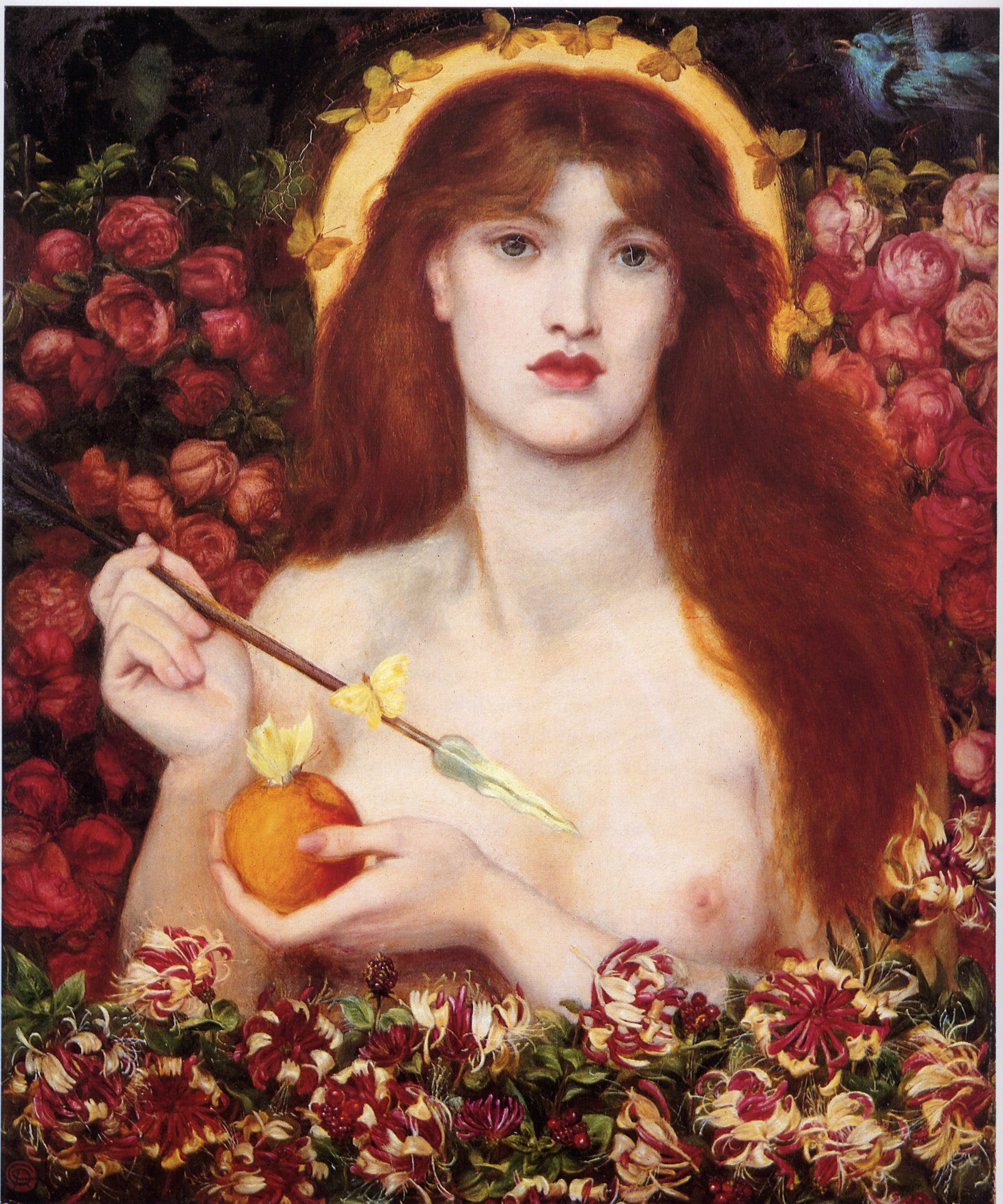
Red haired Venus with apple and arrow among roses
Dante Gabriel Rossetti, Venus Verticordia, 1864 to 1868.

A red haired woman fills the frame among roses and honeysuckle, holding an apple and a golden arrow, her gaze steady and knowing. Rossetti called her Venus Verticordia, the turner of hearts, and made her more temptress than goddess.

The flowers unsettled his fans. The critic John Ruskin, who admired Rossetti, complained about the huge blooms, sensing something overripe and dangerous in the whole thing.

She points where Venus was heading. By the late 1800s the goddess of love was turning into the femme fatale, a beauty who lures rather than blesses, and Rossetti led the way.

Where to look her in the eye

  • Botticelli and Titian: the Uffizi, Florence.

  • Giorgione, Sleeping Venus: the Gemaldegalerie, Dresden.

  • Velazquez, The Rokeby Venus: the National Gallery, London.

  • Cabanel, The Birth of Venus: the Musee d'Orsay, Paris.

  • The Venus of Willendorf: the Natural History Museum, Vienna.

Follow the goddess further

Venus is really the story of the nude and the story of desire in art. These go deeper:


Questions people ask about Venus in art

  • Who painted the most famous Venus? Botticelli, whose Birth of Venus of about 1485 in the Uffizi is the best known image of the goddess in all of art.

  • Why are there so many paintings of Venus? The name gave artists a respectable reason to paint the nude female body, so Venus became the go to subject for beauty and desire.

  • Is Venus the same as Aphrodite? Yes. Venus is the Roman name for the Greek goddess Aphrodite, the goddess of love, beauty and desire.

  • Which Venus painting was attacked? The Rokeby Venus by Velazquez, slashed by the suffragette Mary Richardson at the National Gallery in 1914 and later repaired.

  • What is the oldest image of Venus? The Venus of Willendorf, a small limestone figure carved around 25,000 BC, though the Venus name was added by modern archaeologists.

The oldest face in the room

Set them side by side and the goddess keeps changing jobs. She starts as a faceless fertility charm you could hold in one hand, becomes a Greek ideal, a Renaissance ghost, a duke's wedding gift, a warning wrapped in roses, and finally a woman who could ruin you.

Praxiteles carved the first naked goddess and scandalized Greece. Twenty five thousand years earlier, someone in an Ice Age camp had already decided the body was worth carving.

Venus is the name we keep giving that impulse, and no other figure in art has carried so much of what we want and fear about desire.