

200 000+ readers learn art the fun way.
This is a preview. Paid subscribers get the full story.
You’ll also get:
10 new stories / month
The full archive (140+ Art stories)
Your personal art guide. Comment, ask questions, DM me anytime
Apple user? Subscribe at coolstoriesabout.art, not via the app. Apple adds 30% to the price.
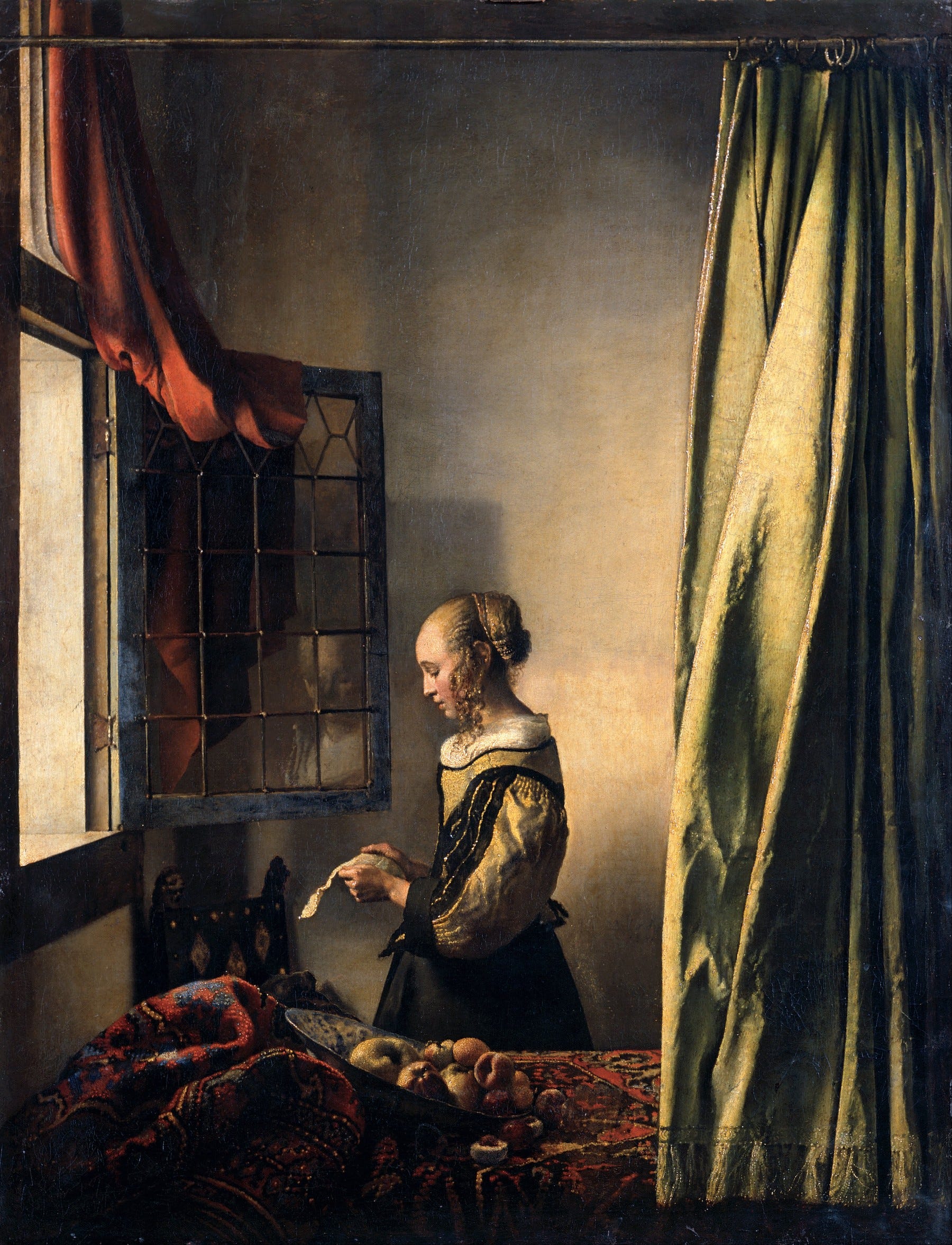
A young woman stands reading, in profile, turned toward a wide-open window. She holds the letter in both hands, the paper tilted up toward the light, and her eyes never leave the lines. In front of her, a table draped with a red rug, and a bowl of fruit. On the right, a tall green curtain hangs the full height of the canvas. Behind her, a white wall. Nothing else.
Johannes Vermeer is 25 years old when he paints this scene, around 1657, in his hometown of Delft, in Holland. The painter of "Girl with a Pearl Earring" has never painted a woman reading a letter before. This is the first, and he will return to the subject for the rest of his life. The painting is called "Girl Reading a Letter at an Open Window." It hangs in Dresden, Germany.
Not a single word on the page can be made out. Vermeer never wrote one.
What is this young woman reading?
The Window
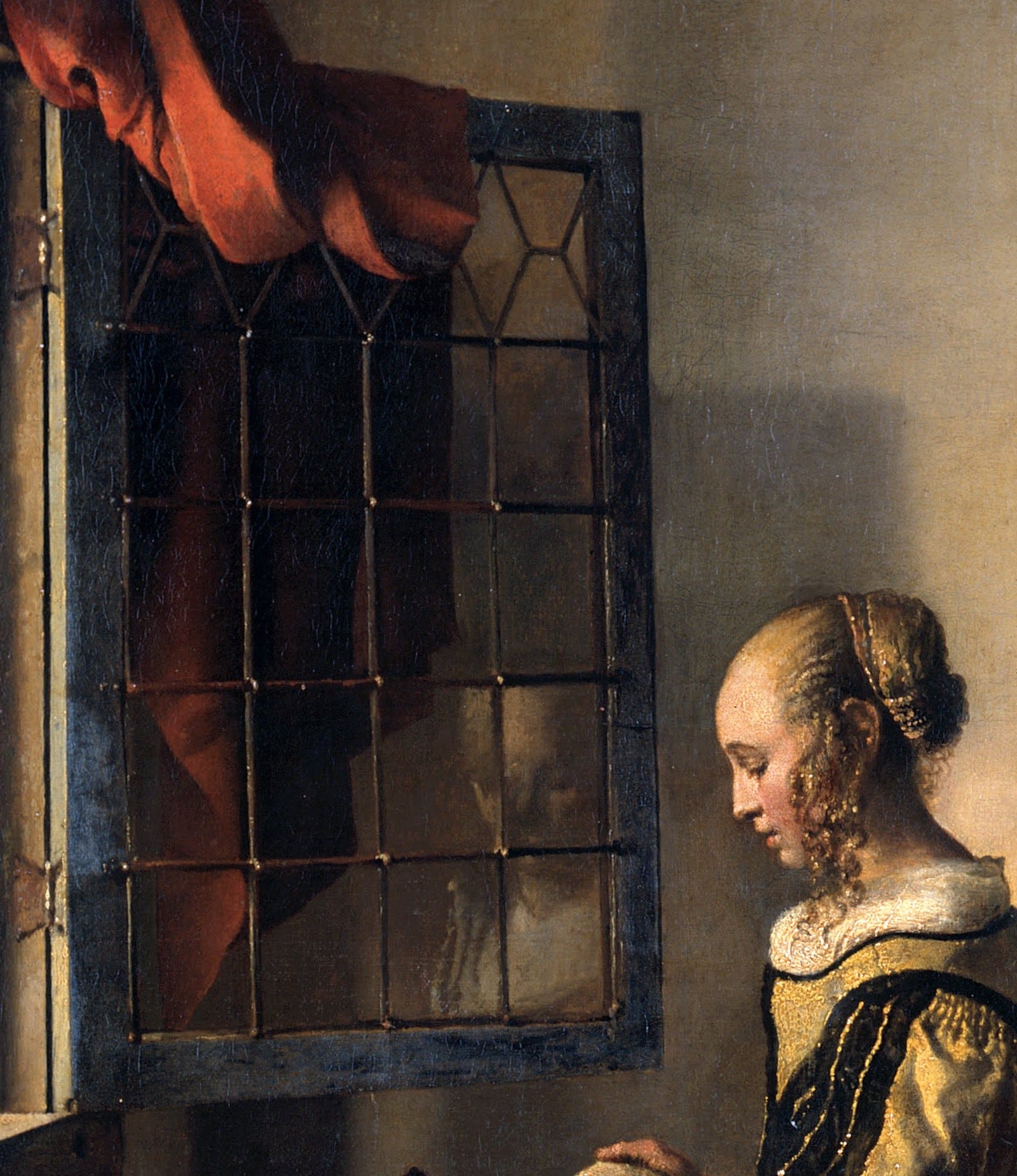
If the page says nothing, the rest of the canvas may say more, and the eye starts with the window. Its frame is blue, its panes are set in a lattice of lead, and the casement swings open into the room. In the glass, a face floats: her own, thrown back by the pane, eyes lowered over the same letter.
The reflection is impossible. From where she stands, no pane could reflect her face, and the head in the glass tilts at a slightly different angle than hers. Vermeer painted it anyway. He wanted a second face in the scene, and this second face wears the same look as the first: lips closed, giving nothing away.
Below the window, the table, and on the table, a red rug with a dense pattern, pushed into thick folds at the front. It is a Turkish rug. In a Dutch household of the time, an imported Turkish carpet cost far too much to walk on: you draped it over a table and set your finest things on it.
Near the front edge, a Chinese porcelain bowl, blue and white, tipped over on the rug. Peaches, plums, and apples tumble from it, and one of the peaches is split open, its pit showing. This is a wealthy house. The rug and the porcelain say so plainly, but they say nothing about the letter.
That leaves the tall green curtain on the right, and it does not hang in the room with her. Its rod runs across the very top of the canvas, ten rings strung on it, and the fabric falls in front of the entire scene, between the young woman and whoever is looking at her.
In those days, a valuable painting was protected by a real curtain, drawn across it against sunlight and dust and pulled aside only for viewing. Vermeer painted his as an illusion meant to fool the eye, half open, as if a hand had just drawn it back to show the scene. And that curtain changes everything: the young woman is not posing, she has been caught. She is reading alone, in a closed room, and someone has just lifted the veil to watch her read. Whoever stands before the canvas is not a visitor but a witness, and what they see was never meant for them. In all of Vermeer's work, it is the only curtain of its kind.
Discover my new newsletter !


The Wall
In Dutch painting of that era, a scene almost never gives up its secret head-on. It gives it up through the back wall. Behind the figures, the painter hangs a picture, a map, a sign, and anyone who knows the code reads what hangs on the wall the way you read a caption under a photograph.
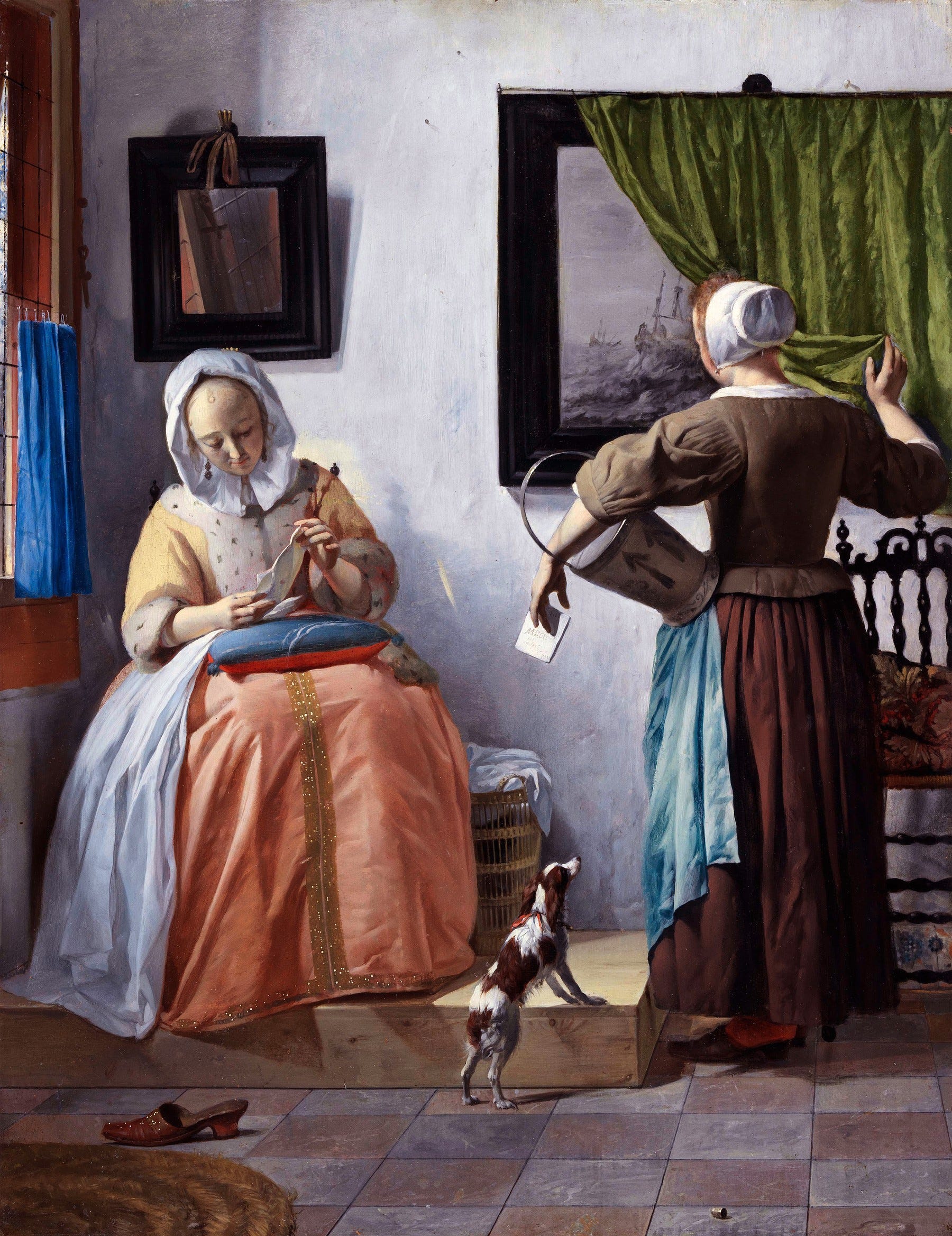
Gabriel Metsu, a contemporary of Vermeer, uses the same device in a scene very similar to this one. A seated young woman reads a letter. Standing beside her, a maid lifts, with her fingertips, the little curtain that protects the picture on the wall. Under the curtain, a stormy sea, a ship tilting in the wind. The young woman has not finished reading, and the wall has already answered: this letter brings news of danger.
Jan Steen, in the same years, paints a family saying grace, hands folded, over the plainest of meals. Nailed to the wall behind them, a sign carries a prayer from the Bible: do not desire riches, ask for nothing but an honest life. Everything in the room, from the table to the clothes to the bread, shows that this family lives as the sign asks.
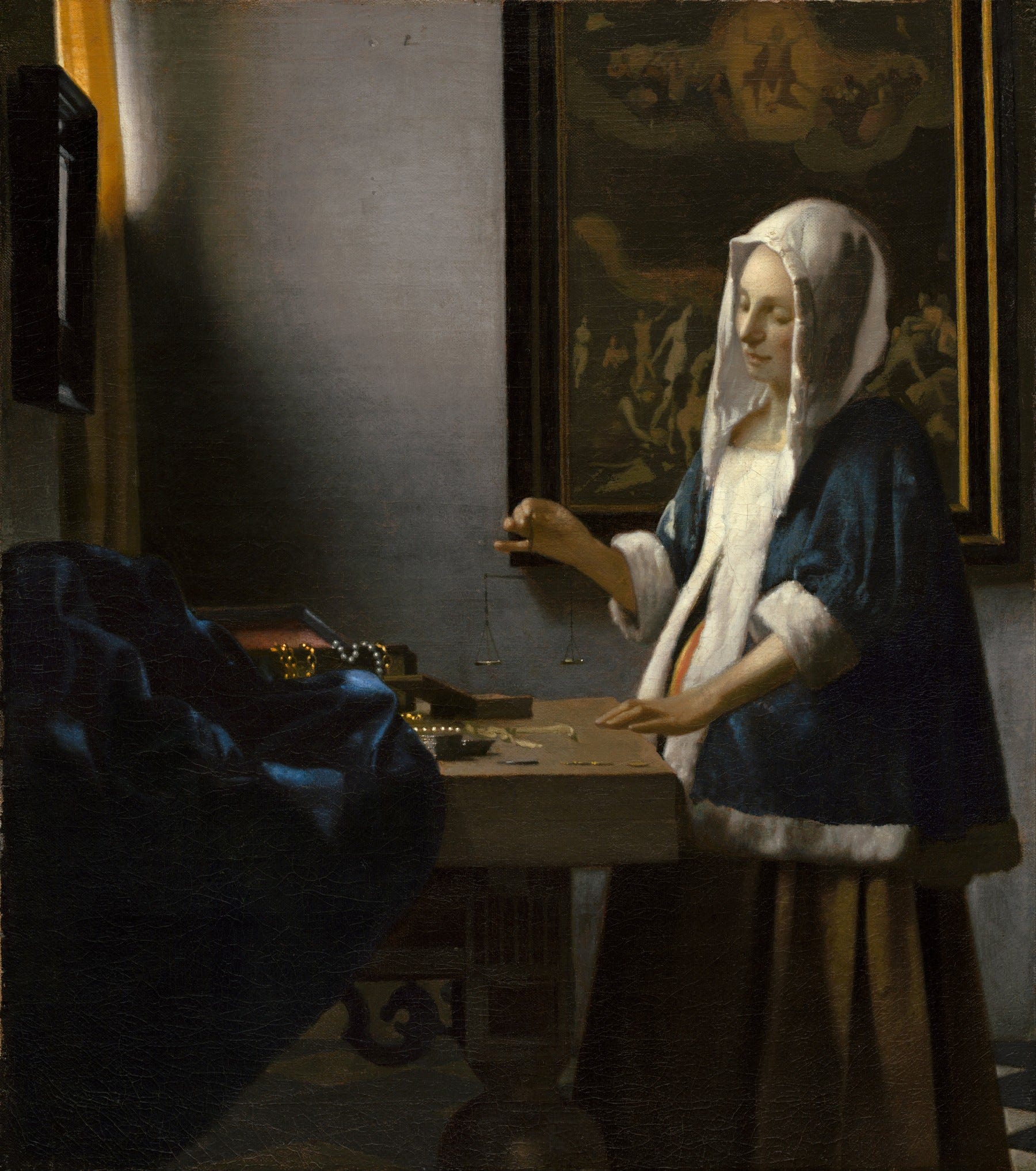
Vermeer plays by the same rules. In "Woman Holding a Balance," a woman holds a small balance scale between two fingers, and behind her, on the wall, he has hung a Last Judgment, the scene in which the dead are judged before God. Beneath that picture, her scale is not weighing gold. It is weighing souls.
So we come back to the wall behind the young woman with the letter. It is white, from the window to the curtain. No picture, no map, no placard. Where every other painter hangs the key, Vermeer hangs nothing. He leaves the wall bare, and what the young woman is reading, he keeps to himself.
The Light Table
The painting leaves Dresden in 1979 for an exhibition in the United States, and before a journey like that, the museum has it X-rayed. The rays pass through the paint and register on film whatever the painter laid down underneath, even what he covered over.
The film is developed. The museum's specialist in Dutch painting spreads it on a light table, next to the canvas. On the canvas, the white wall. On the film, a large pale shape, painted, then covered. She compares them for a long while, then gives her verdict: Vermeer covered it himself. He had painted something on that wall, changed his mind, and painted over it with his own white. The painting leaves for America.
The Cotton Swab
Nearly 40 years later, in the spring of 2017, the painting lies flat in the restoration studio of the Dresden museum, under an old, yellowed varnish. Christoph Schölzel, the museum's conservator, rolls a cotton swab soaked in solvent across the surface, and Vermeer's colors come back, cool and sharp.
Swab after swab, he works his way toward the wall. And in the middle of the wall, the swab meets resistance. This patch of white reacts differently, and it is a shade darker than Vermeer's white along the window. Schölzel stops.
He takes a few flecks of that white and puts them under the microscope. Between Vermeer's paint and the white of the wall runs a thin, dark line. Grime. A layer like that takes decades to form. By the time this white went on, Vermeer's paint was already old, and already dirty.
In early 2018, Schölzel sits down at the canvas, eye to the microscope, scalpel in hand, and begins scraping the white away, starting at the top of the wall. A patch the size of a fingernail a day, at best.
Under the white, a black line appears. Then a second, running down at a right angle. It is the corner of a frame. A picture, in the middle of the wall.
Vermeer never painted this white wall. Behind the young woman, he had hung a painting, and someone painted it out after his death…
What You’ll Discover
What is inside that frame.
Where this hidden painting turns up again.
When this Vermeer passed for a Rembrandt.
What the letter really says.