

170 000+ readers. Learn art the fun way.
This is a preview. Paid subscribers get the full story.
You’ll also get:
10 new stories every month
The full archive (130+ Art stories)
Your personal art guide. Comment, ask questions, DM me anytime
iPhone user? Subscribe at coolstoriesabout.art, not via the app. Apple adds 30% to the price.
In the Dutch Republic, around 1620.
Balthasar Gerrits is arrested by the city authorities. The charge is one of the most serious of the time: counterfeiting. Geerts would melt down low-grade metal, give it the appearance of a gold or silver coin, and put it back into circulation. He barely escapes beheading.
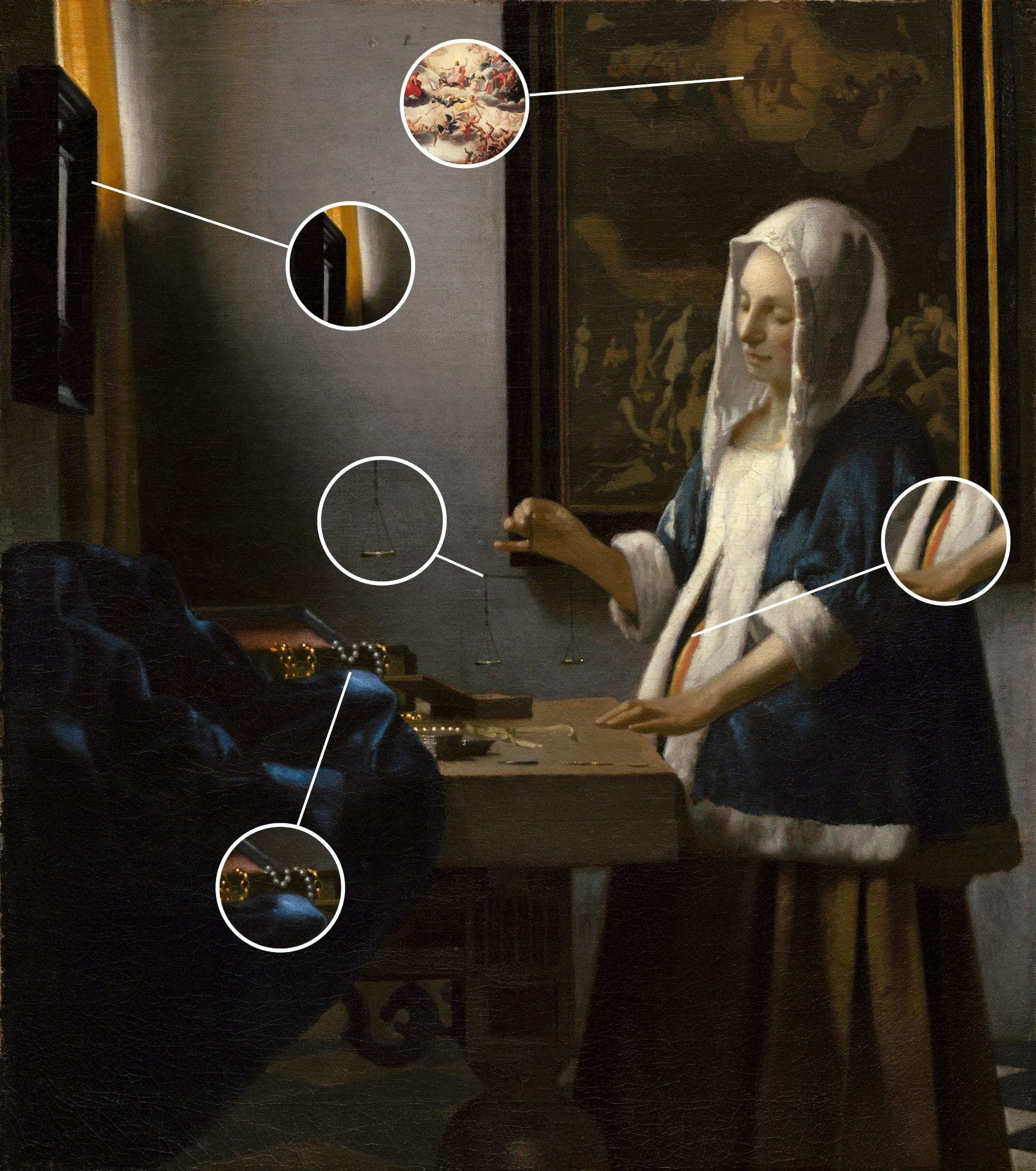
Forty years later, in Delft, his grandson paints a young woman holding a balance between her fingers, in front of a casket overflowing with gold and pearls.
The grandson is Johannes Vermeer. The painting is known, for three centuries, as A Woman Weighing Gold.
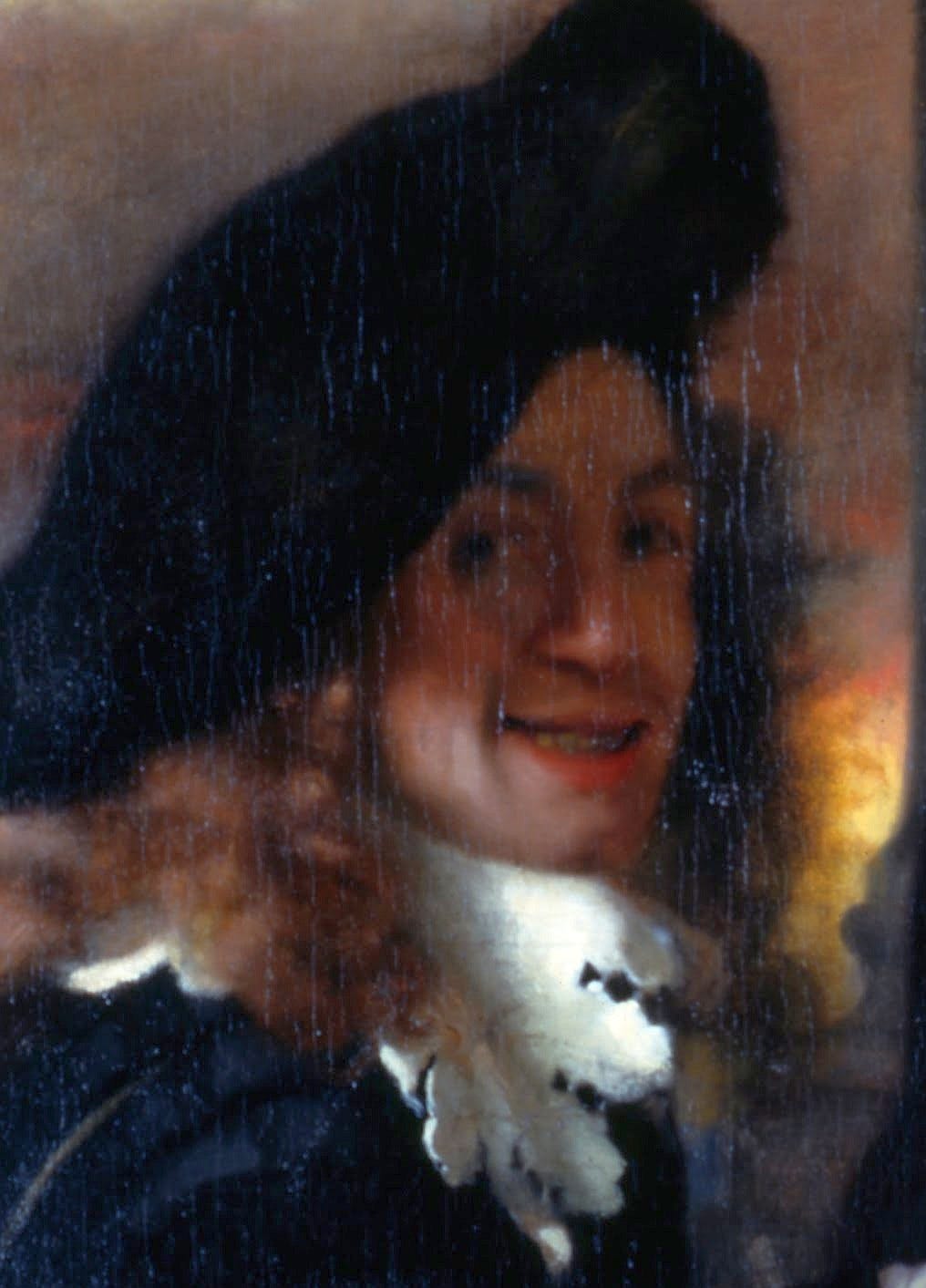
Vermeer paints it at age 32, around 1664, in his mother in law’s house in Delft, where he lives with his wife Catharina. The painting is now at the National Gallery of Art in Washington. It is barely 40 by 35 centimeters.
It is probably the densest painting in Vermeer’s entire body of work.
We are going to look at it detail by detail.
The yellow curtain
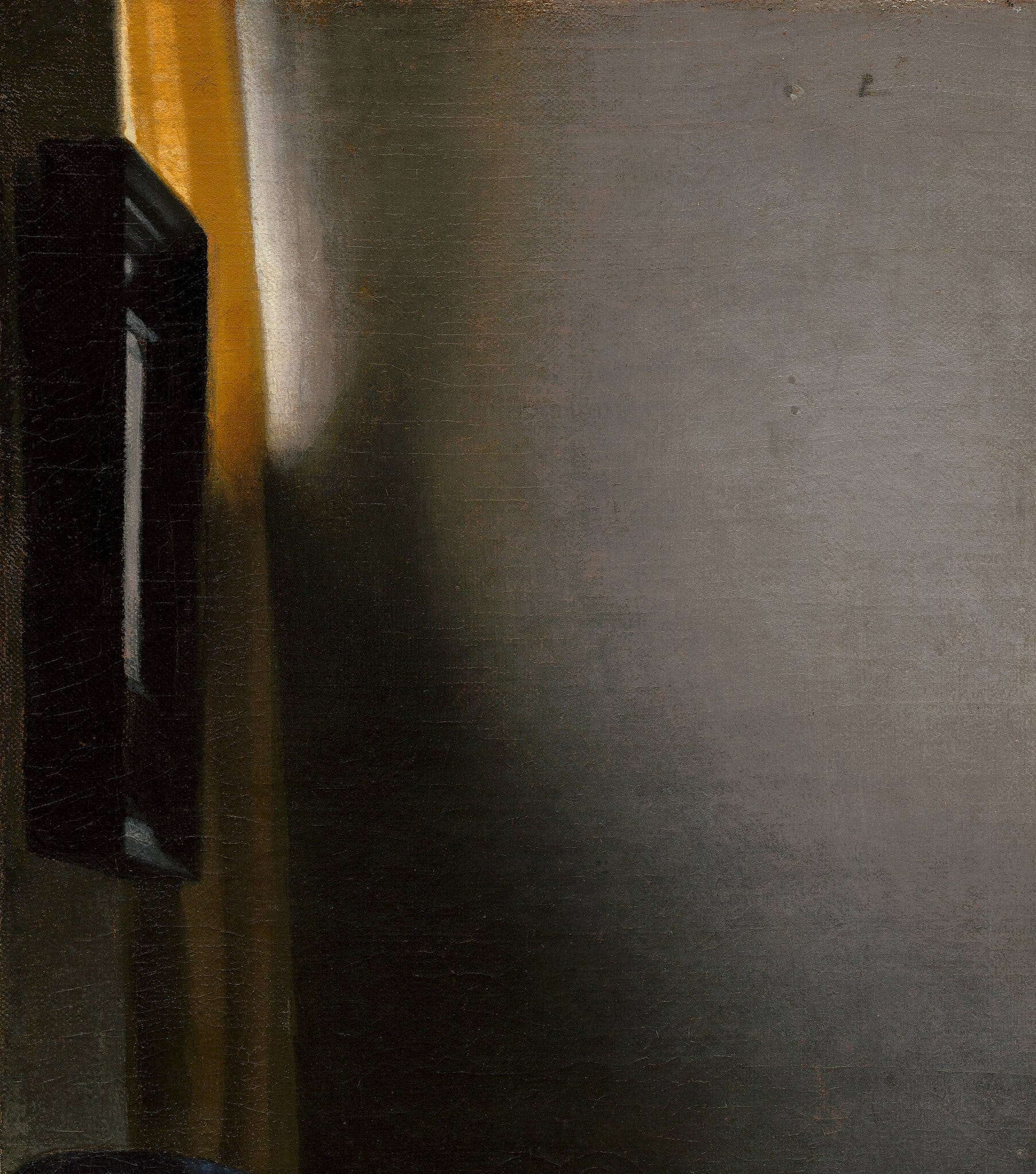
The whole room is lit by a single window, in the upper left of the painting. Vermeer has drawn a heavy yellow curtain across it, blocking almost the entire opening.
The daylight no longer enters directly: it turns into a golden glow, filtered through the fabric, that brushes the back wall and catches the edge of the woman’s face.
No other known work by Vermeer has its window so completely covered. In almost all of his other paintings from the same decade, you can see the sky through the panes, or at least make out the leaded glass.
Here, no. Here, Vermeer closes off the outside world.
Something, in Delft that summer, is worth keeping at a distance.
The plague.
It has been killing family after family for two years. Burials happen after dark, without bells, to avoid panic. The city’s official physician writes that bodies rot before they even die.
The yellow curtain is not there to filter the light.
It is there to close the door to the world dying outside.
Discover my new newsletter !

The blue cloth
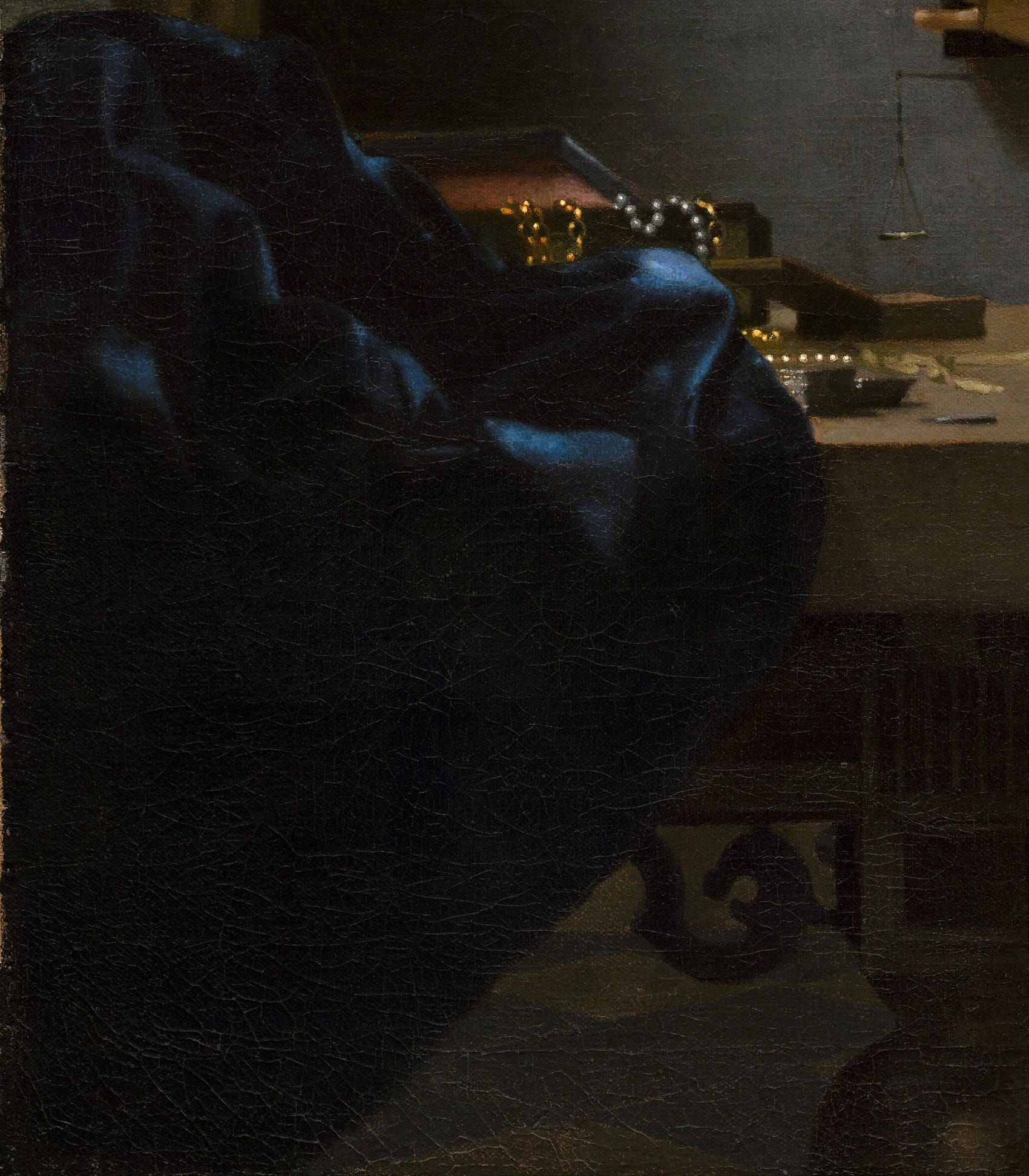
Slide your gaze toward the left corner of the table. A heavy cloth of deep blue is thrown there in thick folds, spilling almost toward the viewer.
That blue is natural ultramarine, extracted from lapis lazuli, a semi precious stone imported drop by drop from Afghanistan by Italian merchants. By the gram, it is the most expensive pigment in the world. More expensive than gold.
When a painter signs a contract with a wealthy client, a clause sometimes specifies how many grams of ultramarine will go on the canvas and exactly where, because clients know that painters tend to dilute it and keep some for themselves.
And in all of European painting since the Middle Ages, ultramarine is reserved for one thing only: the Virgin’s cloak.
Vermeer uses it everywhere on his canvas. Not on a saint. Not on a cloak.
On a tablecloth, thrown casually across the corner of a middle class table.
Keep that in mind. We come back to it.
The casket and the jewels
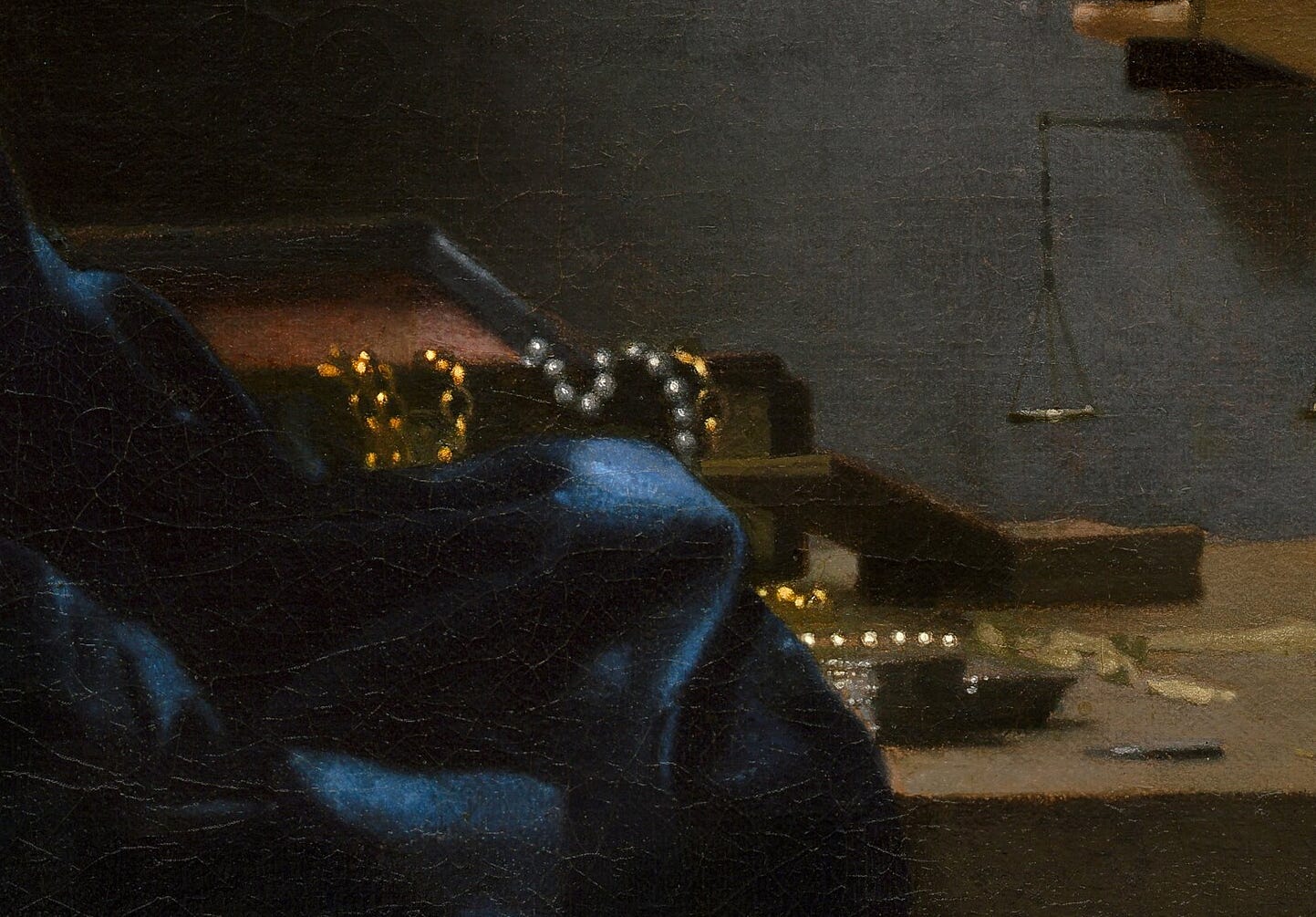
Right next to the cloth sits a small dark wooden casket, its lid open. Inside, you can see a red velvet lining. From the casket spill two long pearl necklaces, a heavy gold chain, and a few coins scattered on the wood.
Vermeer almost certainly did not own these objects. He was too poor.
The jewels you see here were most likely borrowed from Maria de Knuijt, the wife of Vermeer’s main patron, a wealthy Delft burgher and a shareholder in the Dutch East India Company. She would lend Vermeer her caskets and her precious fabrics to give his paintings the look of a rich household.
A single well formed pearl, in the seventeenth century, is worth more than the yearly wage of a working man. On this table, there are dozens, carelessly tipped onto the wood.
Keep them in mind too. We come back to them.
The jacket and the fur
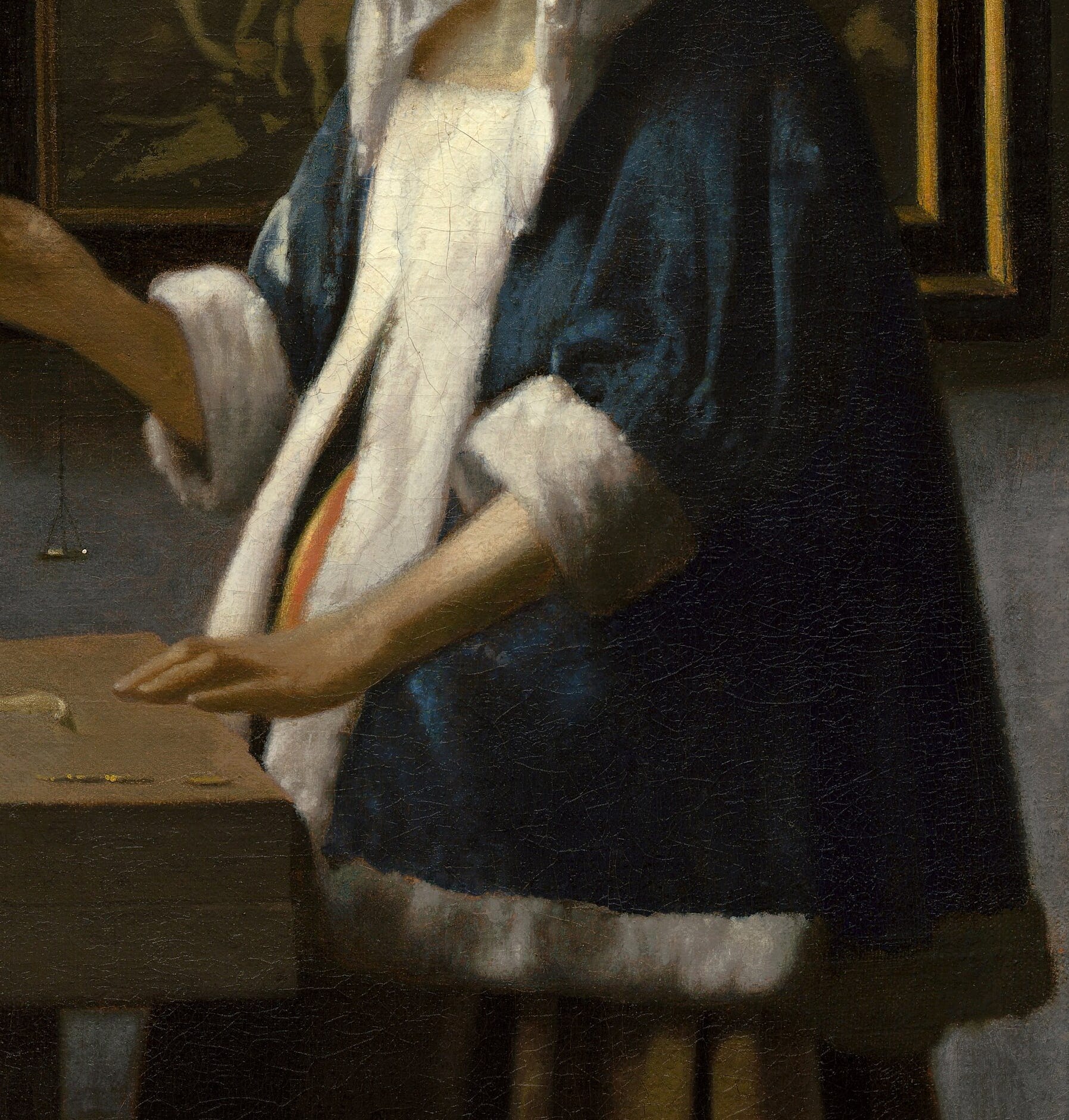
Move back up to the woman’s torso. The jacket is deep blue velvet, short sleeves, trimmed with a thick band of white fur.
That fur, for three centuries, has been taken by every visitor for ermine. Nobody in the Dutch middle class of the seventeenth century wore ermine to sit around the house.
The notarial inventories of the time are clear: the fur that lined those indoor jackets was white squirrel, sometimes cat, sometimes even mouse. It was a domestic garment you slipped on to keep from freezing in those large Dutch houses, badly heated.
The jacket belonged to Catharina, Vermeer’s wife. We find it in the inventory drawn up after Vermeer's death in 1676.
Vermeer puts it on other models in other paintings: you can see it in The Concert in Boston, in The Guitar Player at Kenwood House, in The Love Letter in Amsterdam. It is a studio prop that runs through his whole career, like a signature.
The belly
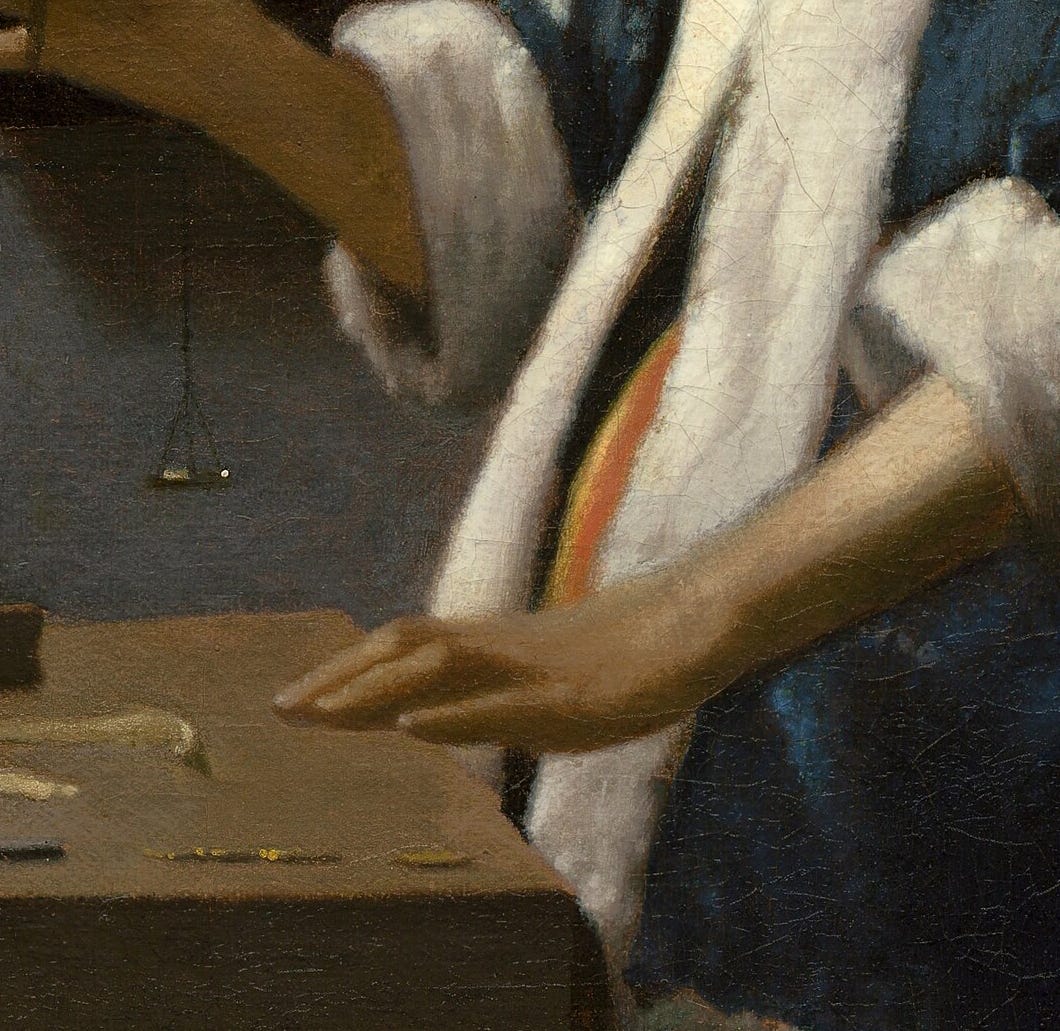
Look down. The jacket opens onto an ochre skirt fastened with bright red ribbons.
The belly is rounded. Heavily.
Van Gogh, in a letter to Émile Bernard in June 1888, describes a pregnant Dutch woman by Vermeer, most likely another canvas.
Some historians, for a long time, refused the idea. Their argument was that pregnancy was never depicted in genre painting at the time. Even the pregnant Virgins of the Renaissance Visitations were hidden under thick, shapeless drapes.
The prominent belly, they said, was simply the fashion of the day: those heavily padded skirts worn under short jackets.
But those who have spent their lives in front of this painting have ended up admitting that Van Gogh was probably right.
There is a detail visible to the naked eye that convinced them. On the ochre skirt, a bright yellow line begins high on the waist and curves down exactly along the shape of the belly. If it were just fashion artificially inflating the skirts, Vermeer would never have outlined that curve with a brush.
But he did. He painted a pregnancy, not a fold of fabric.
In 1998, two doctors in The Lancet published a clinical diagnosis just from looking at the painting: pallor, slight facial edema, prominent abdomen. Pregnancy of five or six months.
And Catharina’s biography leaves little room for doubt. Fifteen children in twenty years of marriage. In 1664, she is probably expecting her seventh or eighth.
Keep learning art the fun way


The mirror
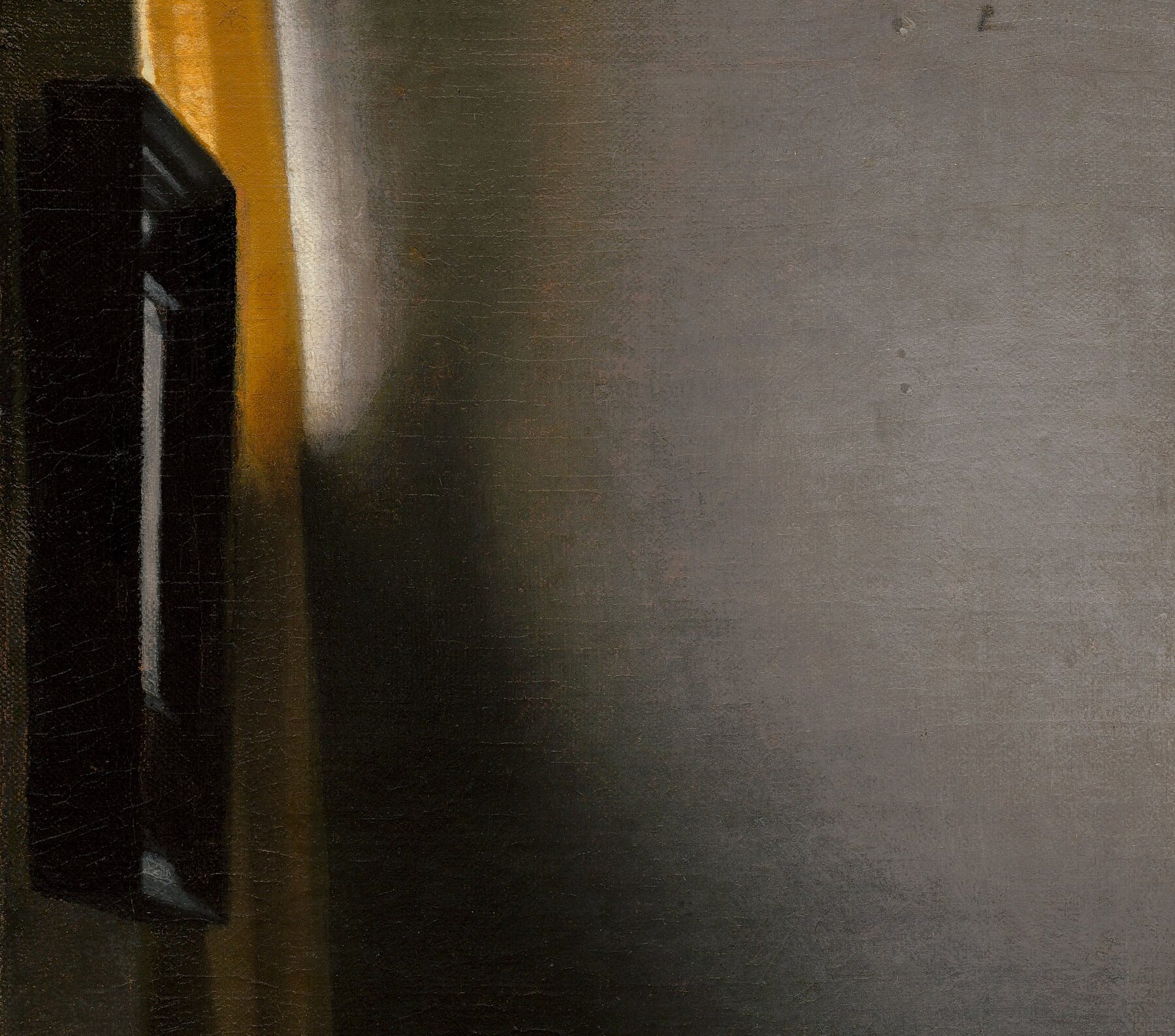
Turn your head to the left. Not toward the back wall. Toward the side wall, perpendicular to the window, where a small mirror hangs.
Thin black wood frame, flat, square, no ornament. It is placed exactly opposite the woman’s face. She could see herself with a single flick of her eyes.
She does not look at it.
Her eyelids are lowered toward her own hands. The mirror catches a little of the light from the yellow curtain. It reflects nothing of her.
In seventeenth century Dutch painting, a mirror placed next to a woman surrounded by jewels is almost always a warning slipped into the decor: beauty fades, possessions fade, death comes.
This woman does not see the warning. She does not see the mirror. She does not see the pearls. Her attention is elsewhere, lower down, toward the balance she holds at hip height.
A curtain that shuts the plague out. The Virgin’s blue on a table. A pregnancy. Ignored jewels.
This woman is not weighing her gold. She is weighing something else.
The answer is not in her hand. It is in the painting that hangs above her head…