Victorian Erotic Art: 12 Works and the Age That Hid Them

The Victorians hung more naked bodies on their walls than any generation before them. The trick was the alibi: give the nude a Greek myth, a Bible verse or a marble bath, and a picture that would be obscene in a modern dress became respectable art.

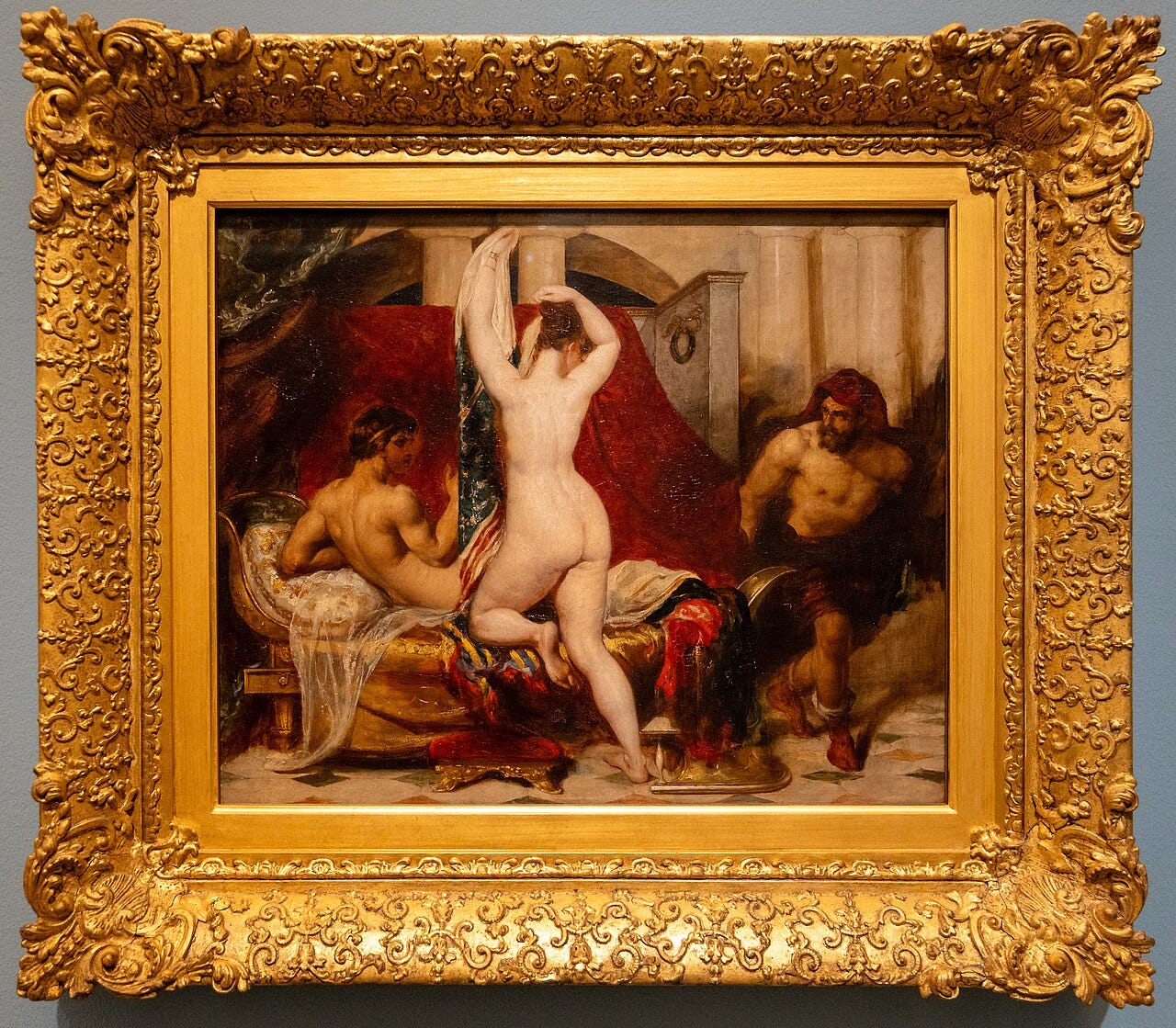
A king showing his wife to a hidden servant
William Etty, Candaules Shows His Wife to Gyges, 1830

The same decades produced the first British obscenity law, a locked cabinet of forbidden objects at the British Museum, and the ruin of a painter arrested for a sexual offence.

Here are twelve works from that double life, and what happened to each of them. All are in the public domain.


Learn art the fun way. Free stories every week, no boring lectures.


1. William Etty, Candaules Shows His Wife to Gyges (1830)

Critics called Etty indecent for thirty years, and he answered that he painted the nude because God's most glorious work deserved it.

Here he takes a story from Herodotus: a king hides a servant behind the bedroom door so the man can watch the queen undress. Etty drew from the life model at the Royal Academy into his sixties, longer than any student in the room.

When he died in 1849 his studio sale ran for nine days.

2. William Holman Hunt, The Awakening Conscience (1853)

Woman rising from a man's knee in a furnished room
William Holman Hunt, The Awakening Conscience, 1853

Ruskin had to write to the papers to explain this picture, because viewers were missing what the woman was. She rises from her lover's knee in a rented room, seeing something through the window.

Every object convicts them: a cat toying with a bird, a discarded glove, a clock under a glass dome. The furniture is new and showy, and only an unmarried couple would furnish a room like this.

Pre Raphaelite moralising was itself a licence, letting a painter show the sin at length.

3. Oscar Rejlander, The Two Ways of Life (1857)

Composite photograph of virtue and vice
Oscar Rejlander, The Two Ways of Life, 1857

Rejlander combined more than thirty negatives into one enormous photograph, a sermon on virtue and vice with a crowd of nudes on the sinful side.

Queen Victoria bought a print for Prince Albert. Exhibited in Scotland, half of it was covered up: a naked body drawn was art, and a naked body photographed was something else.

Rejlander later photographed human expressions for Charles Darwin.

4. Simeon Solomon, Sappho and Erinna in a Garden at Mytilene (1864)

Two women embracing in a garden
Simeon Solomon, Sappho and Erinna in a Garden at Mytilene, 1864

Two women embrace in a garden, one leaning back to be kissed. Solomon painted Jewish ritual, Greek myth and, plainly, desire between women and between men.

In 1873 he was arrested in a public lavatory off Oxford Street and charged with attempted sodomy. His friends dropped him, his prices collapsed, and he died in a workhouse in 1905.

Tate bought this watercolour in 1980, and it now hangs among the pictures that once made him unmentionable.

5. Dante Gabriel Rossetti, Lady Lilith (1866)

Woman combing her hair before a mirror
Dante Gabriel Rossetti, Lady Lilith, 1866

Rossetti painted Adam's first wife with the face of Fanny Cornforth, and years later, at his patron's request, repainted the head as another woman.

The patron wanted a different face on the same body. Lilith combs her hair before a mirror, and the man is nowhere. Rossetti's poem for the picture calls the hair a net for young men's hearts.

Critics have long read the Victorian femme fatale as a way of locating desire in the woman rather than the viewer.

6. Edwin Long, The Babylonian Marriage Market (1875)

Row of seated women waiting to be auctioned
Edwin Long, The Babylonian Marriage Market, 1875

It set the highest auction price yet paid for a work by a living artist when it sold for over six thousand pounds in 1882. Girls sit in a row waiting to be auctioned, most beautiful first, in an Orientalist fantasy taken from Herodotus.

The setting is Babylon, safely ancient and safely far away, and the buyers in the painting are doing openly what the London marriage market did in drawing rooms.

Everyone understood this. Nobody said so.


Join 130,000 readers who get the secrets behind the paintings. Free.


7. Lawrence Alma Tadema, A Sculptor's Model (1877)

Life size Roman nude beside a statue
Lawrence Alma Tadema, A Sculptor's Model, 1877

A life size Roman nude, painted with the archaeological exactness that made Alma Tadema rich. The Bishop of Carlisle wrote afterwards that he found it hard to look at such a picture without a certain sense of shame, which is the most honest sentence any Victorian wrote about this genre.

The alibi was the marble, the sandals, the Latin title. Alma Tadema sold more paintings to more industrialists than almost anyone.

Nobody in his pictures ever undresses in a modern room.

8. Frederic Leighton, The Bath of Psyche (1890)

Psyche loosening her robe beside a pool
Frederic Leighton, The Bath of Psyche, 1890

Leighton was President of the Royal Academy and the only British painter made a lord, though he held the title for a single day before he died.

He never married and lived alone in a house with one bedroom. His Psyche loosens her robe beside a pool between two marble columns, seen from below, reflected in the water.

She is undressing for a god, which is what makes it acceptable. Change the columns to a bathroom and the Academy would not have hung it.

9. John William Waterhouse, Hylas and the Nymphs (1896)

Water nymphs reaching for a young man at a pond
John William Waterhouse, Hylas and the Nymphs, 1896

In 2018 the Manchester Art Gallery took this canvas off the wall for a week, as an act of art in itself, to provoke a conversation about how women's bodies are displayed.

Seven water nymphs rise out of a pond and take hold of a young man's arm. The public reaction was hostile and it went back up. Nobody involved in that week said anything the Victorians had not already said about the same picture, in the same city.

10. John Collier, Lady Godiva (1897)

Godiva riding through an empty street
John Collier, Lady Godiva, about 1897

The legend says the townspeople of Coventry stayed indoors, so Collier paints an empty street in which we are the only ones looking, and Peeping Tom is the viewer.

She rides with her eyes lowered. Collier was Thomas Huxley's son in law, married two of his daughters in turn, and had to wed the second in Norway because the law in England forbade it.

The picture reached Coventry through the bequest of the social reformer Thomas Hancock Nunn.

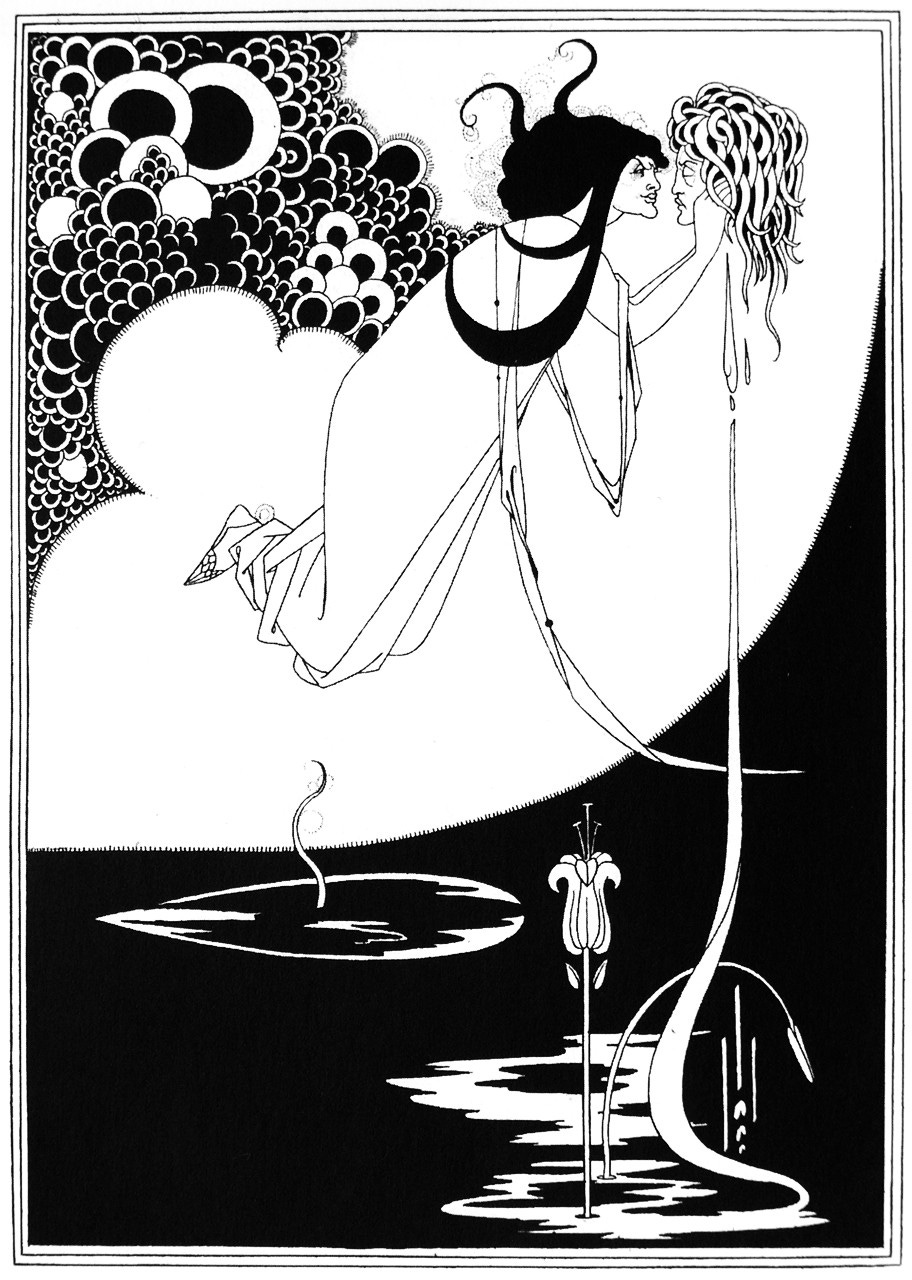
11. Aubrey Beardsley, The Climax (1893)

Salome rising to kiss a severed head, in black and white
Aubrey Beardsley, The Climax, from Salome, 1893

Beardsley illustrated Oscar Wilde's Salome at twenty one and slipped indecent details into the borders, several of which the publisher removed.

Salome floats up to kiss the severed head of John the Baptist, drawn in black and white with almost nothing else on the page. Beardsley was not involved in Wilde's trial, but after the conviction a newspaper described Wilde carrying a yellow book, and Beardsley lost his job at The Yellow Book.

He died of tuberculosis at twenty five, having asked in a letter that his obscene drawings be destroyed.

12. Edward Burne Jones, Pygmalion and the Image: The Soul Attains (1878)
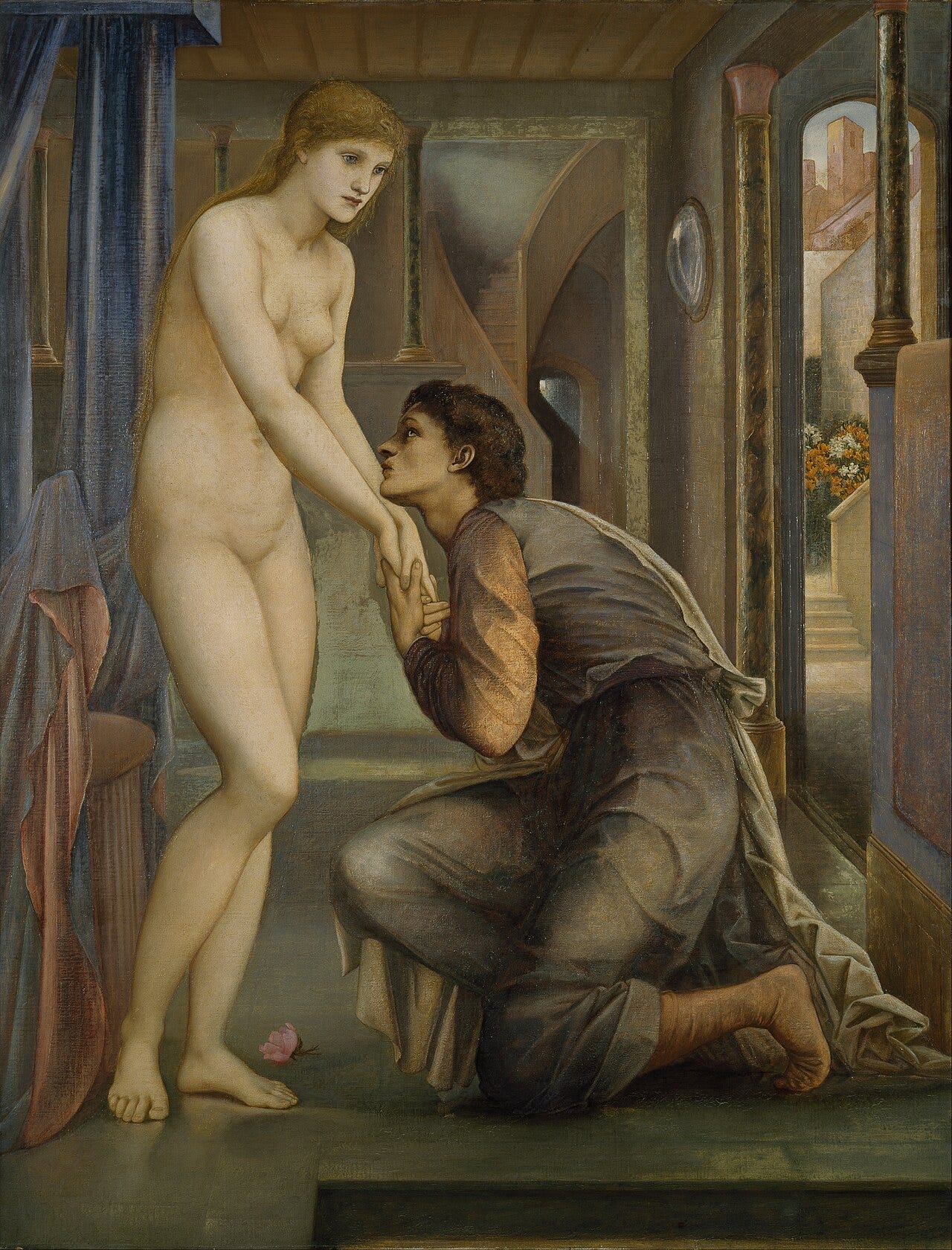
Sculptor kneeling before his statue come to life
Edward Burne Jones, Pygmalion and the Image: The Soul Attains, 1878

Burne Jones painted the Pygmalion story twice, and the model for the statue coming to life was Maria Zambaco, with whom he had an affair that ended when she tried to drown herself in Regent's Canal.

His wife stayed. The sculptor kneels before the woman he carved and Venus has quickened, and she looks down at him without expression.

The picture's symbolism makes a living woman and a work of art the same object, which is the joke and also the complaint that has been made about the whole century.


The Victorian nude, straight answers

  • Was Victorian art really erotic? Openly. The nude was everywhere, provided it was set in Greece, Rome, the Bible or the East.

  • What was the Obscene Publications Act? An 1857 law that let magistrates order the destruction of obscene material. Its sponsors promised it was not aimed at serious art, though the Act granted no exemption and non pornographic works were destroyed under it.

  • What is the Secretum? A locked room at the British Museum, created in 1865, holding objects judged obscene. Some stayed shut away until the 1960s.

  • Why did Victorians paint so many myths? A classical subject was the alibi. The same body in modern clothes would have been indecent.

  • Was any Victorian artist prosecuted? Simeon Solomon was arrested in 1873 for a sexual offence, not for his art, and was ruined by it.


If this double life pulled you in, you will love these too:


The alibi and the lock

A century that jailed Solomon and Wilde also bought Alma Tadema by the yard. The rule was never about bodies, it was about which story a body was allowed to be in.

The British Museum's Secretum was assembled in 1865 to hold everything that failed the test, and much of it was only returned to the public galleries in the second half of the twentieth century.


Two new stories a week, 130+ secrets unlocked. Start free.