
Between 1837 and 1901, the years of Queen Victoria's reign, painting in Britain drew crowds. Some canvases needed a guard at the Royal Academy, and engravings of the favorites hung in homes across the country. A few of those images are still at work today, on shortbread tins and in the title of a future president's book.
Cool Stories About Art is a newsletter to learn art the fun way.
Join 200,000+ readers and get:
10 new art stories / month
The entire archive of content (140+ articles)
Comment, ask questions, and chat with other readers
What Made a Painting Victorian
Victorian painting is the painting of Queen Victoria's Britain, from 1837 to 1901. The word names a period rather than a style, and many styles fit inside it. In those years the Royal Academy's summer show in London drew huge paying crowds, and a single picture could make a painter's name in a week.
That public shaped the subjects. Many painters went after scenes their visitors could read at a glance, a battle seen from the ranks, a sick child, a day at the races. Others worked for a single patron, and some of their pictures found a wide audience only later.
All twelve works are by painters who lived and worked in Britain, and all date from the reign. Some appear on every list of the period, others almost never. The young painters who called themselves the Pre Raphaelites keep three places.
12. Elizabeth Thompson, The Roll Call (1874)
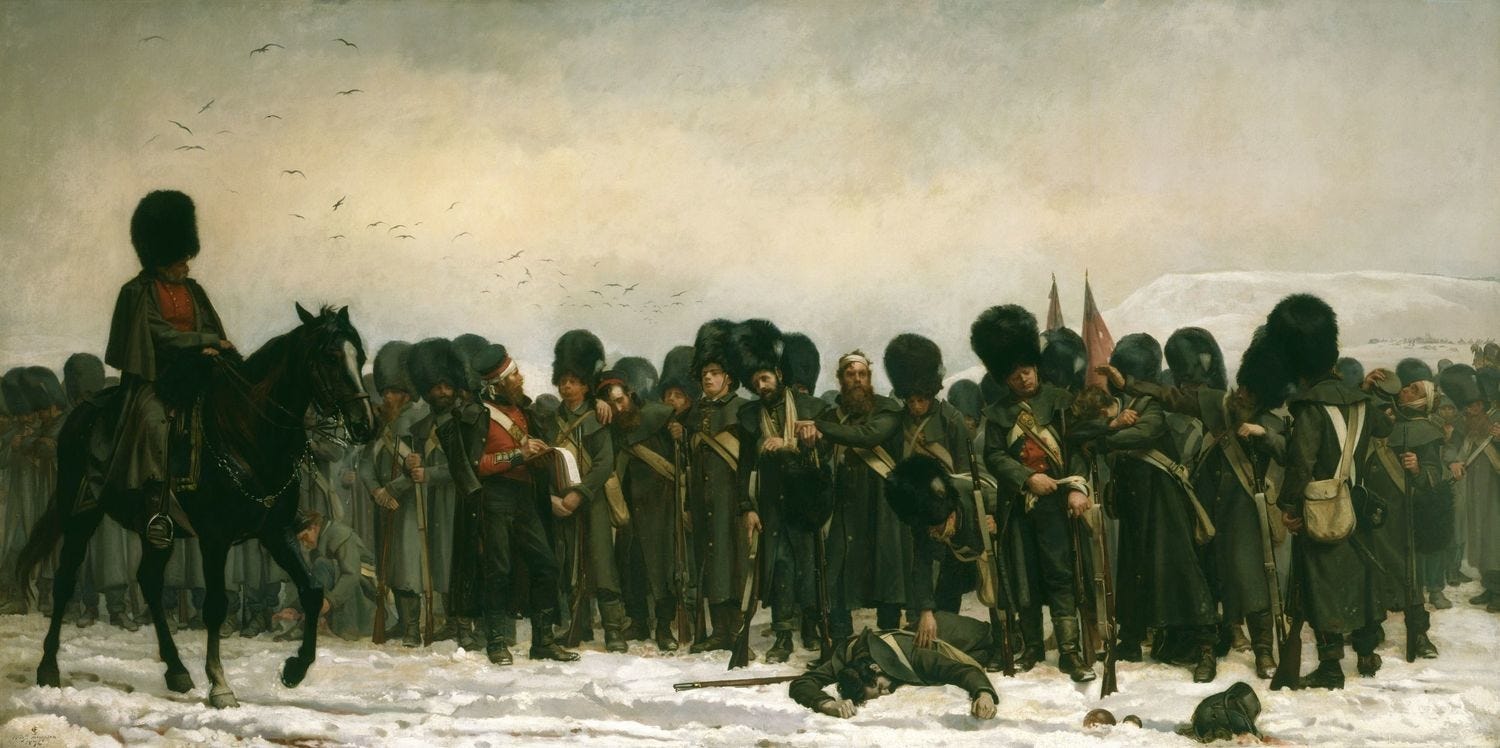
Some of the Guardsmen in The Roll Call have bandaged heads. One has sunk into the snow. The rest stand in a long ragged line in their gray greatcoats, after a battle of the Crimean War, while a sergeant reads out their names. A man who does not answer is dead or missing.
That line of tired privates went against a habit. In 1874, a British battle picture was expected to show a charge, a flag and a commander. Elizabeth Thompson, a painter aged 27 who was almost unknown in London, left all three out. Nothing in her picture says who won the battle. She painted the hour after the fighting, when a regiment finds out how many men it has left.
What she put in instead had to be exact. She read the historian Alexander Kinglake's account of the war, questioned veterans, had several of them pose for her, and tracked down the exact uniforms and kit.
The canvas already had a buyer, a Manchester industrialist named Charles Galloway. When it went up at the Royal Academy that spring, the crowd pressed so hard against it that a policeman was posted beside it. Queen Victoria sent for the canvas so she could see it alone at Buckingham Palace, then asked Galloway to give it up to her, and the picture went on to tour the country.
Success did not open every door. The Times called it "one of the pictures of the year least likely to be forgotten." Five years later, John Everett Millais proposed her as an associate member of the Academy, the first step toward full membership. The painter John Gilbert had said he wouldn't have "any damned woman" in. She lost by two votes.
At a Glance
Artist: Elizabeth Thompson, Lady Butler (1846 to 1933)
Painted: 1874
Medium: Oil on canvas
Size: 93.3 × 183.5 cm (36.7 × 72.2 in)
Where to see it: Royal Collection (shown in the royal palaces in rotation)
11. Richard Dadd, The Fairy Feller's Master Stroke (1855 to 1864)
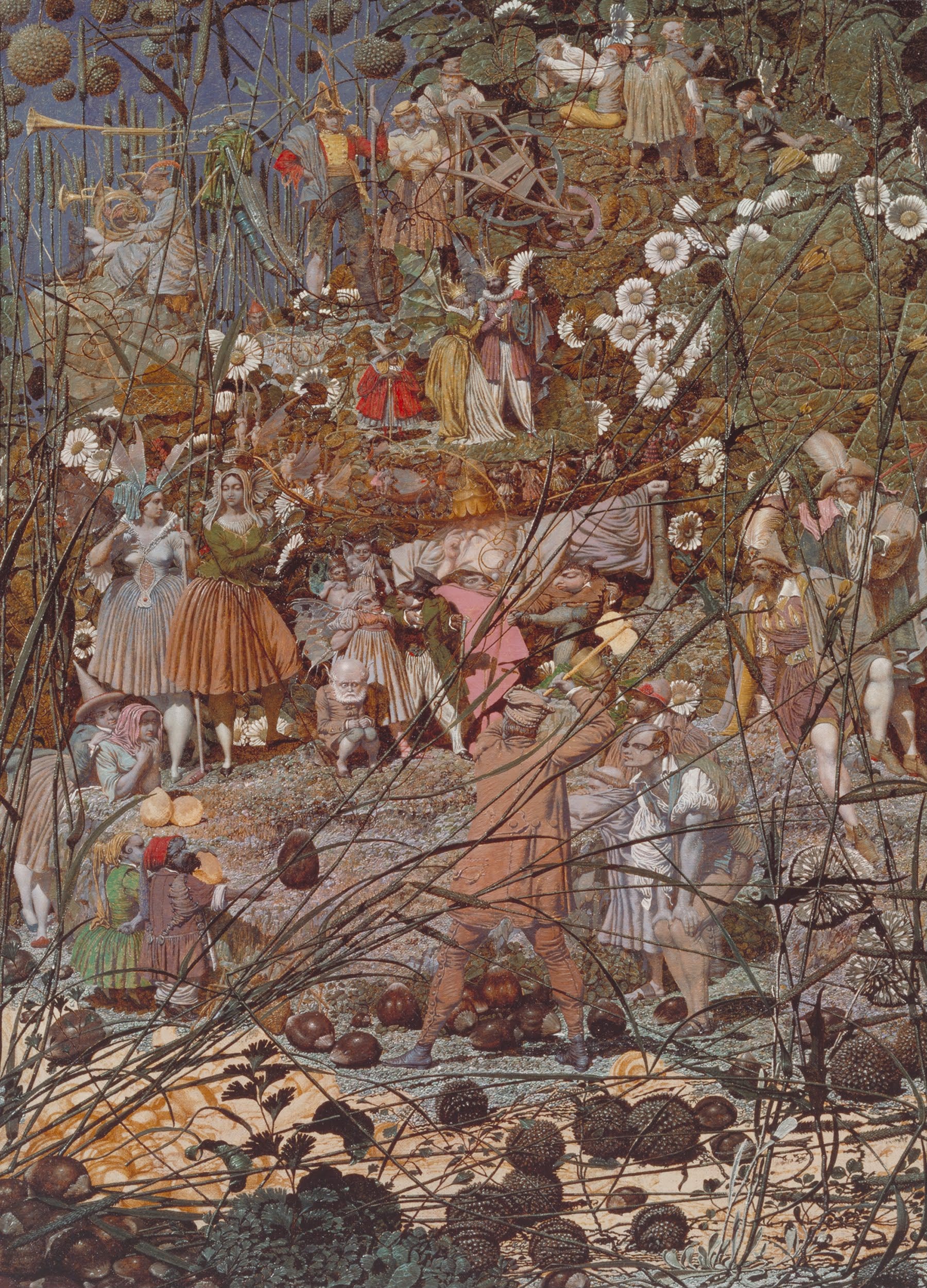
A crowd of tiny figures, many no taller than the daisies around them, has gathered among tall stalks of grass. At its center, his back to us, a woodsman lifts an axe over his head to split a hazelnut set upright on the ground. Above him an old man in a wide hat raises one hand to give the signal. Nobody moves. The man who painted this clearing spent nine years on it, inside a locked hospital wing.