
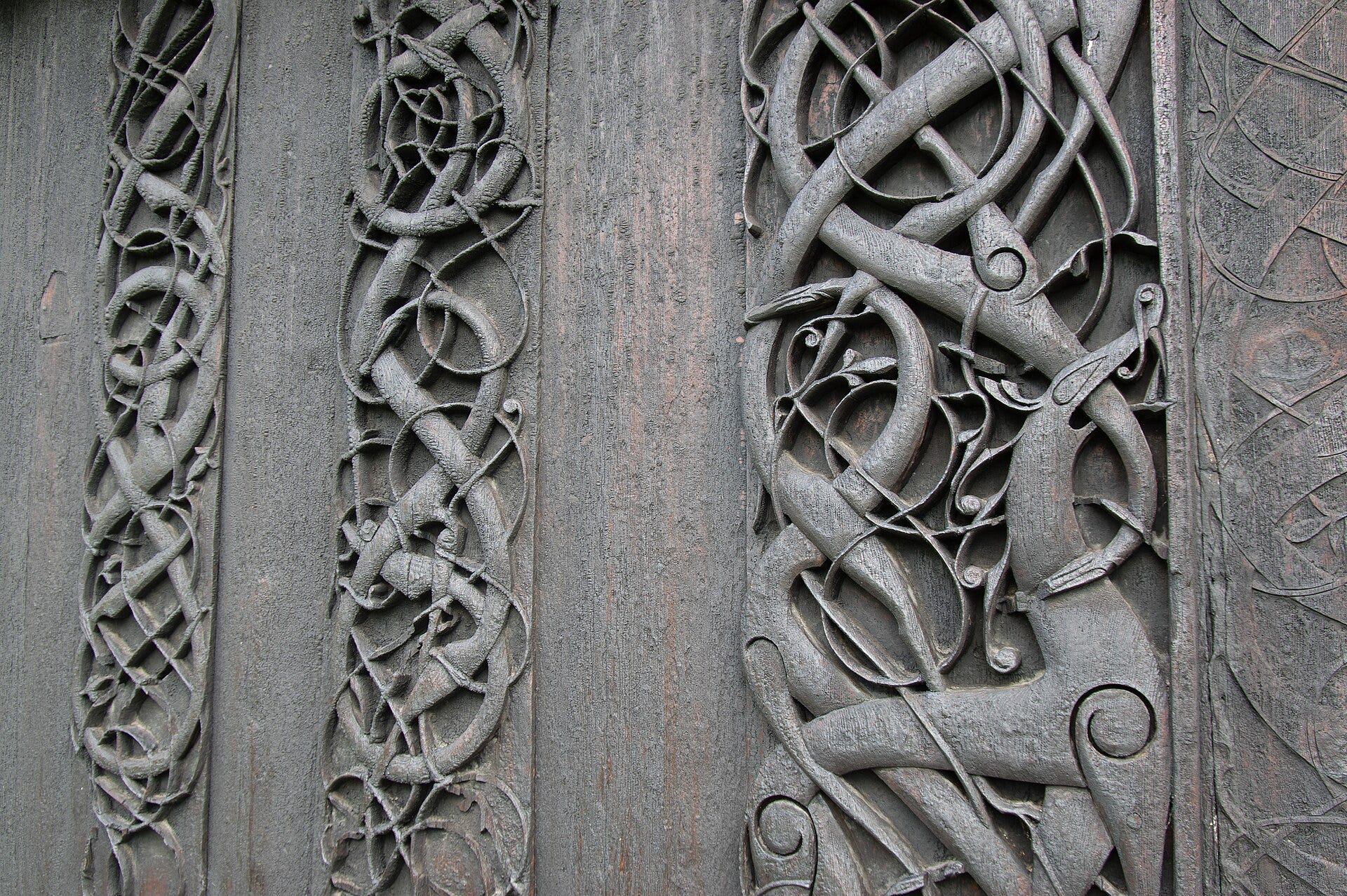
Viking art is almost never a painting. It is the decoration Scandinavian craftsmen cut, cast and inlaid on things people used: weapons, boats, gaming pieces, memorials to the dead. Nearly all of it is crowded with beasts that coil around one another and bite. A few pieces set the old gods beside Christ, and one face with sewn lips sat in front of a smith's bellows.
Cool Stories About Art is a newsletter to learn art the fun way.
Join 200,000+ readers and get:
10 new art stories / month
The entire archive of content (140+ articles)
Comment, ask questions, and chat with other readers
What the Makers Left Behind
The Viking Age is usually dated from 793, when raiders attacked the monastery of Lindisfarne, off the coast of England. Its decoration was still being made in Scandinavia around 1125.
Over those three centuries the Scandinavians became Christian, but the stories of the old gods did not vanish from their work all at once.
The makers left no names. They worked in wood and iron, in several kinds of rock, in gilded metal and in ivory. They worked in Norway, Denmark and Sweden, and in the parts of England where Scandinavians had settled.
Each of the twelve works was chosen for something it still shows about the people who made it: a myth they told, the way they buried their dead, or a change of faith. Eleven were made during the Viking Age, and one in the Norwegian kingdom that followed it. None is a modern painting of Vikings.
12. The Snaptun Stone (about 1000)
Short lines cross the lips of the face carved on this flat stone, and they are stitches. Someone has sewn the man's mouth shut. The stone is a piece of soapstone from Norway or Sweden, and it turned up on a beach at Snaptun, on Horsens Fjord in Denmark, in 1950.
It was made for a forge. On the back, a hole with a raised rim took the nozzle of a bellows, and a Viking smith set the stone in front of his fire to blow air through it.
The face is probably Loki's, one of the Norse gods. His mouth is sewn shut in a story told by Snorri Sturluson, a 13th century writer who set down several of the old Norse myths.
In it, Loki bets his head with a dwarf named Brokk that Brokk's brother, Sindri, cannot make three treasures as fine as the ones other dwarves have just forged.
Brokk works the bellows while his brother forges, and a fly stings his hand, then his neck, then the spot between his eyes. With blood running into his eyes, he lets go for a moment, and the god Thor's hammer comes out of the fire with a handle that is too short. The gods give the victory to the dwarf all the same.
The story never says that the fly is Loki, though it is easy to take it for him. When Brokk comes to collect, Loki argues that his head belongs to the dwarf but his neck does not. So Brokk gives up on the head, pierces Loki's lips with his brother's awl and sews his mouth shut.
On the Snaptun stone, the air from the bellows came out through a small hole just below that sewn mouth.
At a Glance
Artist: Unknown Viking Age smith or carver
Made: About 1000, found in Denmark
Medium: Soapstone (steatite) from Norway or Sweden
Size: 20 × 24.5 × 7.5 cm (7 7/8 × 9 5/8 × 3 in)
Where to see it: Moesgaard Museum, near Aarhus, Denmark
11. The Ramsund Carving (11th century)
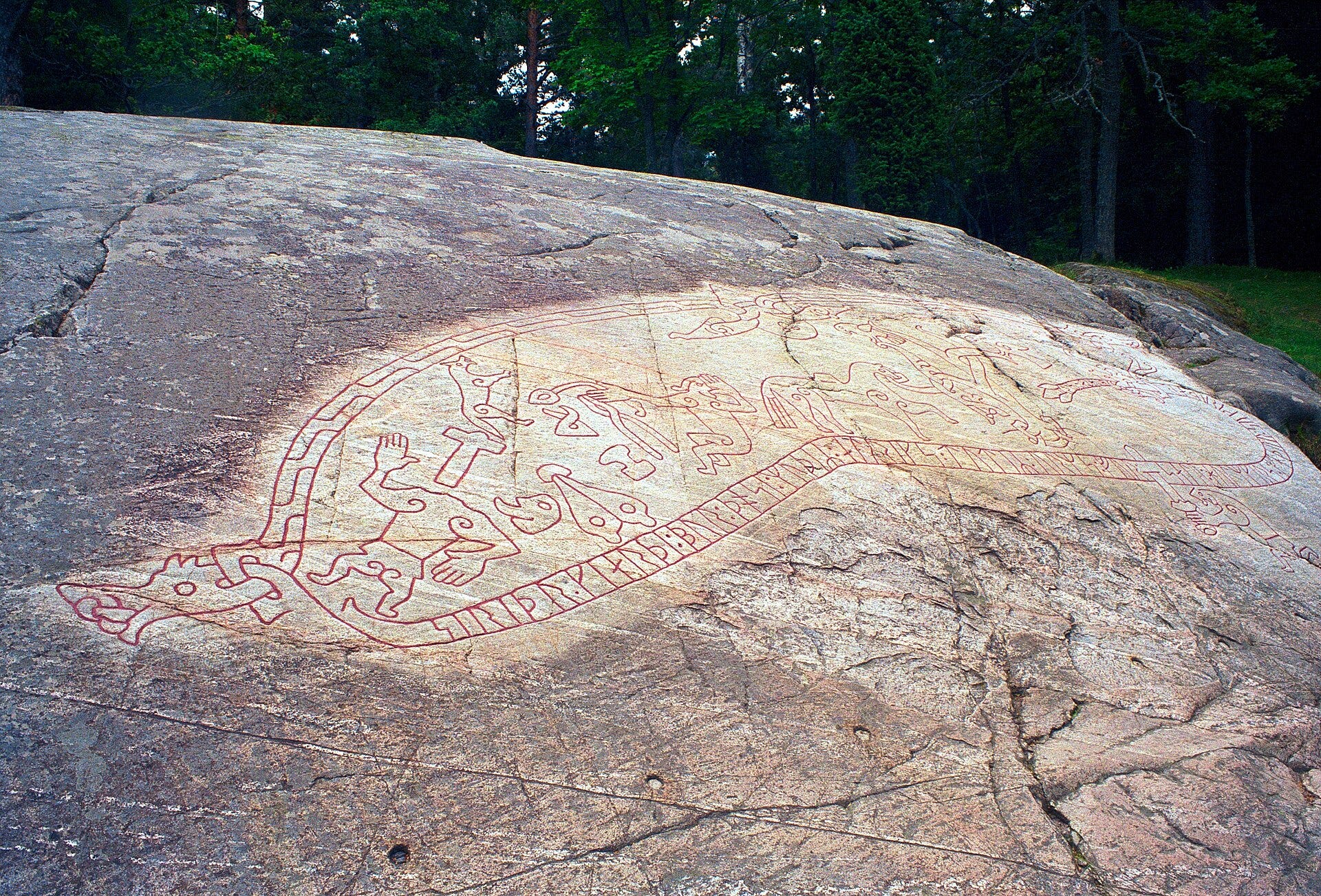
On a flat stretch of rock in Sweden, a small figure sits beside a fire with his thumb in his mouth. Over the flames, on a spit, roasts the heart of a dragon he has just killed.