
Viktor Vasnetsov (1848 to 1926) was a Russian painter who put the heroes of old songs and fairy tales on canvas. His favorite heroes were the bogatyrs, the warrior knights of Russia's old epic songs.
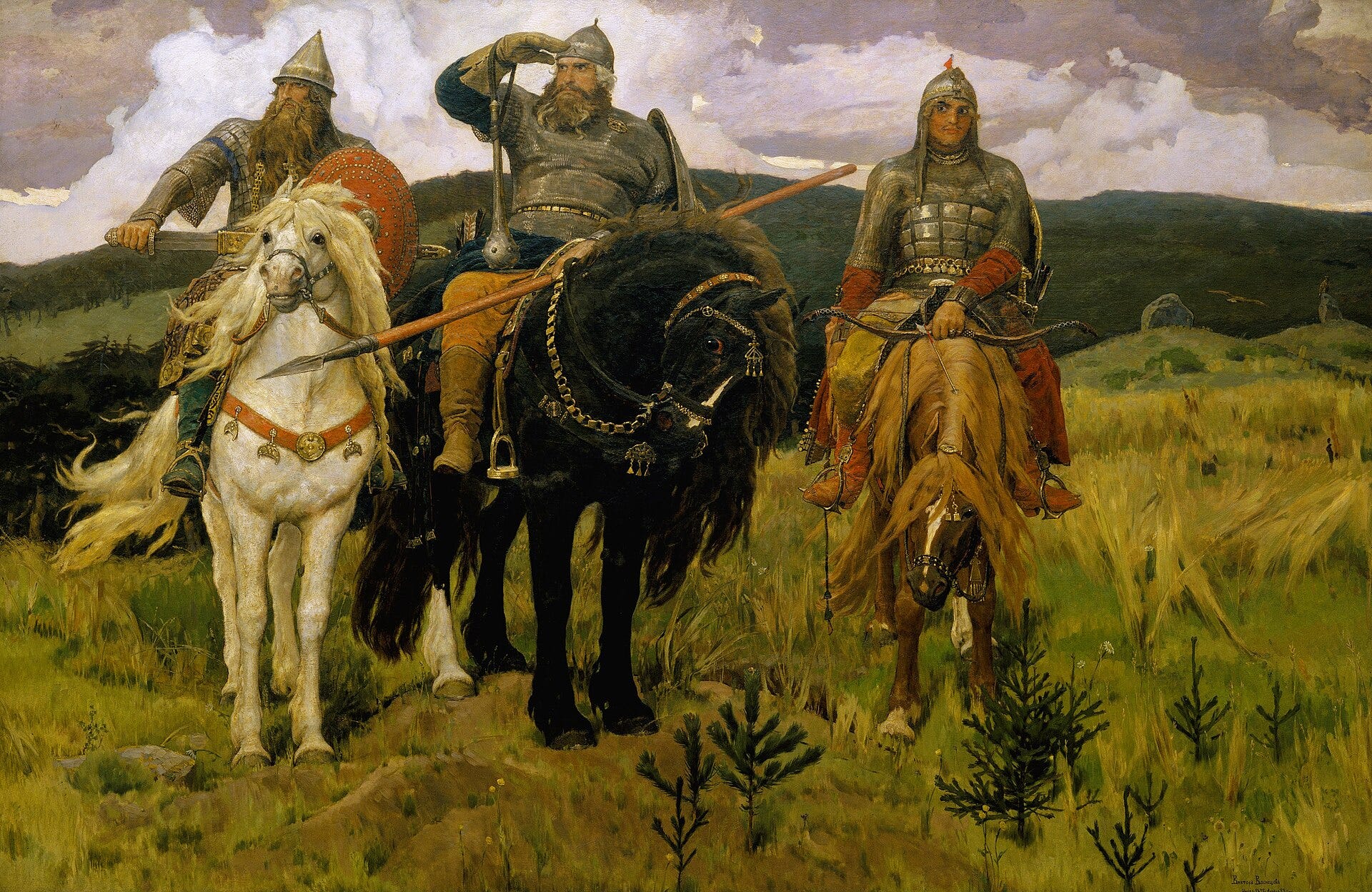
Vasnetsov's most famous painting, The Bogatyrs, shows three of those knights on horseback, keeping watch over an open plain. In 1898, the Moscow collector Pavel Tretyakov bought it for the Tretyakov Gallery, the museum of Russian art he had founded.
Twenty years earlier, Vasnetsov had shown his first bogatyr in public, a lone rider stopped in front of a stone. A Moscow critic, and even Vasnetsov's own teacher, judged the picture a failure.
Cool Stories About Art is a newsletter to learn art the fun way.
Join 200,000+ readers and get:
10 new art stories / month
The entire archive of content (140+ articles)
Comment, ask questions, and chat with other readers
Viktor Vasnetsov grew up in Lopyal, a village of northeastern Russia where his father was the priest. At nineteen, he left the seminary, the school that trained priests, for St. Petersburg, then the capital of the Russian Empire, to become a painter.
In St. Petersburg, Vasnetsov took drawing lessons from Ivan Kramskoi, a portrait painter who would soon lead the Wanderers. The Wanderers were a group of painters who wanted art to show Russia as it really was. Like them, Vasnetsov painted peasants and poor city families, and he showed his pictures at their exhibitions.
In March 1878, at the Wanderers' exhibition, Vasnetsov showed something new, The Knight at the Crossroads. A rider in armor has stopped his horse on an empty plain scattered with bones. In front of him stands a stone carved with a warning: whoever rides straight ahead will not live.
The rider is Ilya Muromets, the most famous bogatyr of the old songs. Vasnetsov painted him under an ordinary gray sky, as if the song told of a real event.
Kramskoi, his teacher in St. Petersburg, wrote to the painter Ilya Repin about the picture. "No, not good!" he began, and later: "And what a motif he spoilt!" A motif is the subject of a picture.
In June, a Moscow newspaper put a name on the fault. The rider was "too real," its critic wrote, and the setting "too coarse," that is, rough and crude.
Why was a knight who looked too real a failure in 1878, and why did the same kind of knight succeed twenty years later?
In the rest of the story, you'll find out:
why a founder of the Wanderers tried to keep a Vasnetsov picture out of their show
how a railroad tycoon turned a shed into a studio for a single painting
who gave their faces to the three bogatyrs
how the painter of the failed knight came to design the front of the Tretyakov Gallery