
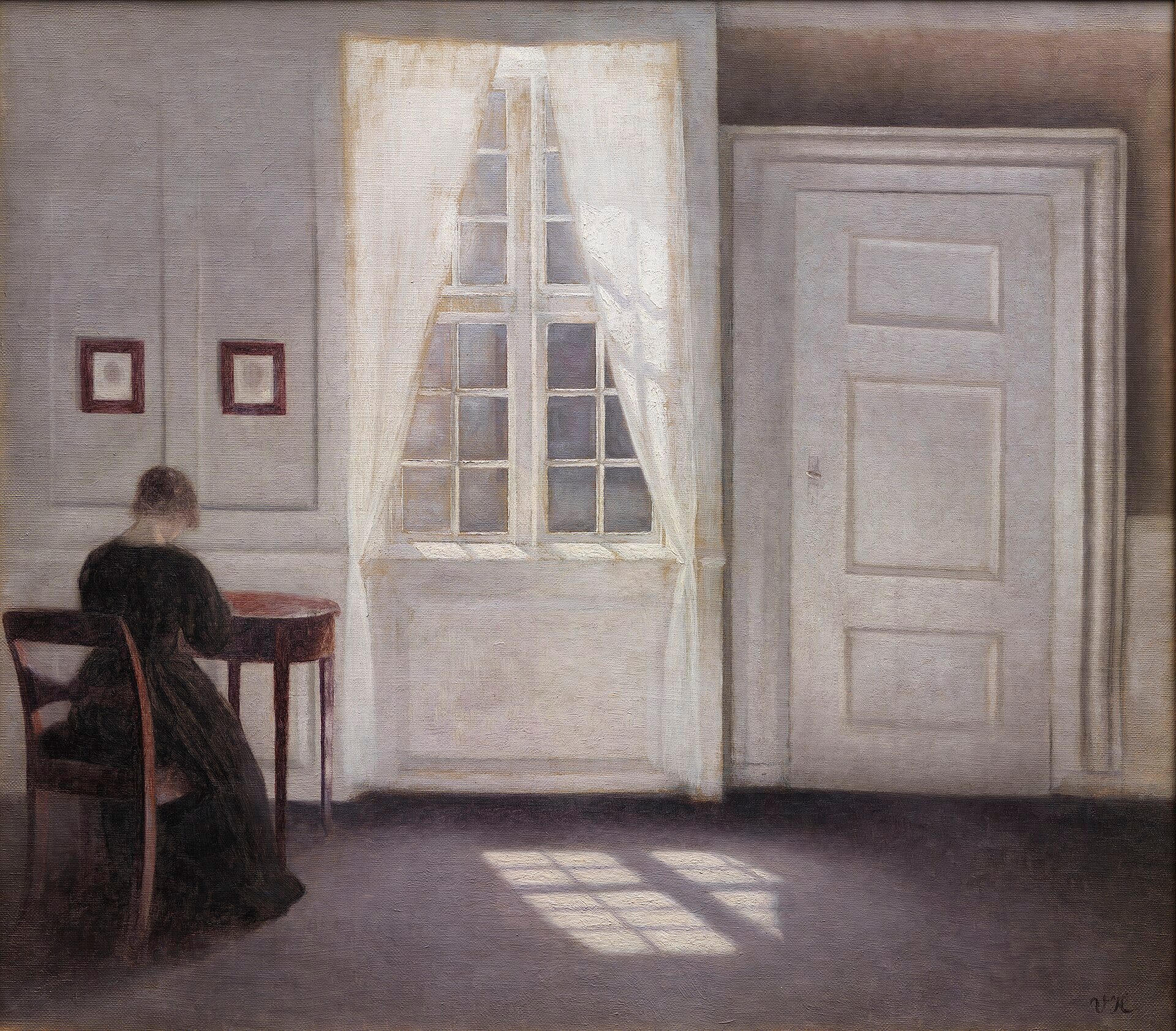
Vilhelm Hammershøi (1864 to 1916) was a Danish painter famous for quiet gray rooms, like Interior in Strandgade, Sunlight on the Floor, at the National Gallery of Denmark in Copenhagen. Many of his pictures show no one at all.
Cool Stories About Art is a newsletter to learn art the fun way.
Join 200,000+ readers and get:
10 new art stories / month
The entire archive of content (140+ articles)
Comment, ask questions, and chat with other readers
The gray rooms Vilhelm Hammershøi painted were his own. He lived for months in Paris and in London, yet his best-known pictures show the apartment in Copenhagen that he shared with his wife, Ida. He painted its few rooms about sixty times in ten years.
Hammershøi was born in Copenhagen, the capital of Denmark, on May 15, 1864, the son of a wholesale merchant. He took drawing lessons as a boy, and in 1879, at fourteen, he entered the Royal Danish Academy of Fine Arts, the country's official art school.
From 1883, he also took classes with Peder Severin Krøyer, the most famous Danish painter of the day, known for his beaches full of sunshine. Krøyer taught at an independent school that artists had opened outside the Academy.
The new pupil painted with almost no color, mostly in grays. Krøyer later told another teacher at the school: "I have a pupil who paints most oddly. I do not understand him, but believe he is going to be important and do not try to influence him."
In April 1885, Hammershøi showed a painting in public for the first time, at the Charlottenborg Spring Exhibition, the great yearly art show of Copenhagen, where a jury from the Academy chose the works. The painting was a portrait of his sister Anna, seated, in blacks, grays and browns.
Some visitors found the portrait new and exciting, others strange and empty. It had also been entered for the Neuhausen Prize, an award the Academy gave to young painters. Rather than reward the gray portrait, the Academy gave no prize at all that year.
In May 1887, Hammershøi traveled abroad for the first time, to Holland and Belgium, above all to see the paintings of Johannes Vermeer, a Dutch painter of the 1600s. Vermeer painted calm rooms where daylight from a window falls on a wall, often with a woman alone at some quiet task.
Why would a painter who went abroad to study Vermeer's rooms end up painting the same few rooms of his own home?
In the rest of the story
How the young painter answered when the Academy's jury refused his next picture.
What Hammershøi chose to paint in London, one of the world's biggest cities.
What Hammershøi said in 1907 about the rooms he painted without people.
Which great museum in Italy asked the once-refused painter for a self-portrait.