
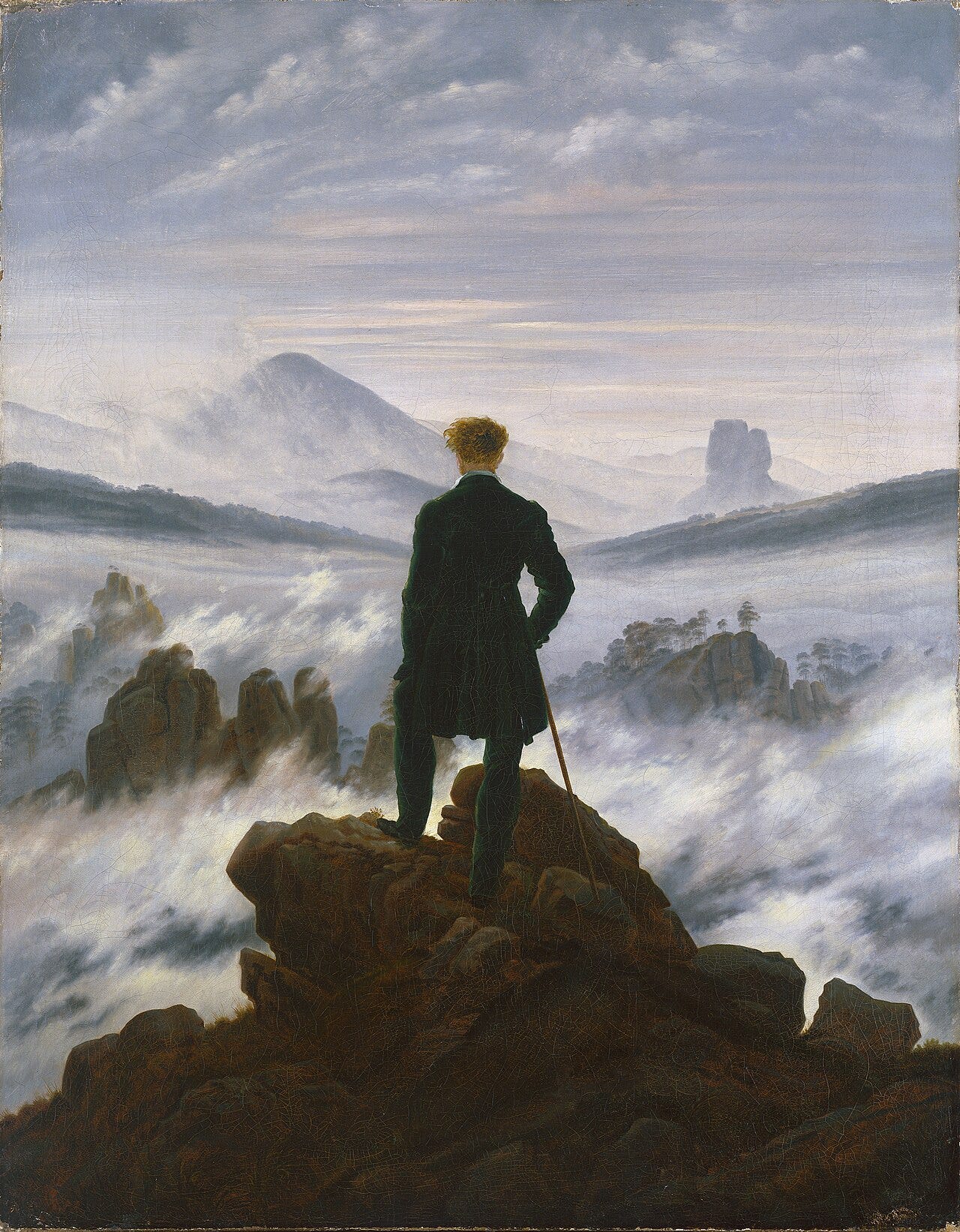
Wanderer above the Sea of Fog shows a man with his back to us, standing on a rock above a valley full of fog. It is read as a picture of one person facing a landscape he can neither master nor fully see. Caspar David Friedrich painted it around 1818, and the fog stands for everything a person cannot know.
His face is never shown, so anyone looking at the canvas ends up standing in his place on the rock. A commentary from the German Historical Institute goes further and calls him "a stranger in the world, the very icon of modern alienation," a man cut off from everything he is looking at.
Cool Stories About Art is a newsletter to learn art the fun way.
Join 200,000+ readers and get:
10 new art stories / month
The entire archive of content (1,000+ articles)
Comment, ask questions, and chat with other readers
That reading rests on words that came long after the painter. Friedrich never called the picture Wanderer above the Sea of Fog. It was published for the first time in August 1950, in a description by the art historian Ludwig Grote, and the title dates from that moment, more than a century after Friedrich died in Dresden in 1840.
Before that, the trail of the canvas goes cold. It shows up in 1939 in a Berlin gallery, and the dealer had been told who the man on the rock was: a Herr von Brincken, a high Saxon forestry official. No such official has ever been traced.
So the lonely stranger of the commentary has a title from 1950 and a name from 1939, and Friedrich supplied neither. What he called the picture in his own studio, the records do not say, and I would like to know.
Where did the title Wanderer above the Sea of Fog come from?
It came from the twentieth century, not from Friedrich. The first person to publish the painting was Ludwig Grote, in August 1950, and the German title, Der Wanderer über dem Nebelmeer, dates from his description. By then Friedrich had been dead for more than a century, and the canvas had surfaced only a decade earlier.
The name did not settle at once. When the painting went to the Tate Gallery in London in 1959, the catalogue called it Mountaineer in a Misty Landscape, and the two titles describe two different men. A mountaineer is someone with a summit in mind.
A wanderer has no goal, and in German the word carries a Romantic weight, the lonely walker of Franz Schubert's songs. That is the comparison the German Historical Institute's commentary reached for.
The words may also echo a painting that no longer exists. In 1806 the writer Gotthilf Heinrich von Schubert saw a canvas by Caspar David Friedrich in the painter's studio, an eagle above a sea of fog. He remembered it in his memoirs, published in 1855, as a picture of the fatherland's history in those years.
The canvas has not survived, and the art historians Nemitz and Sumowski suggested that it planted the phrase.
Either way, the label came after the painter. The only name ever attached to the man at the center of the picture came the same way, by word of mouth.
What You'll Discover
Who the man on the rock is.
What his green coat gives away.
Which mountains are real.
Where the canvas spent those years.