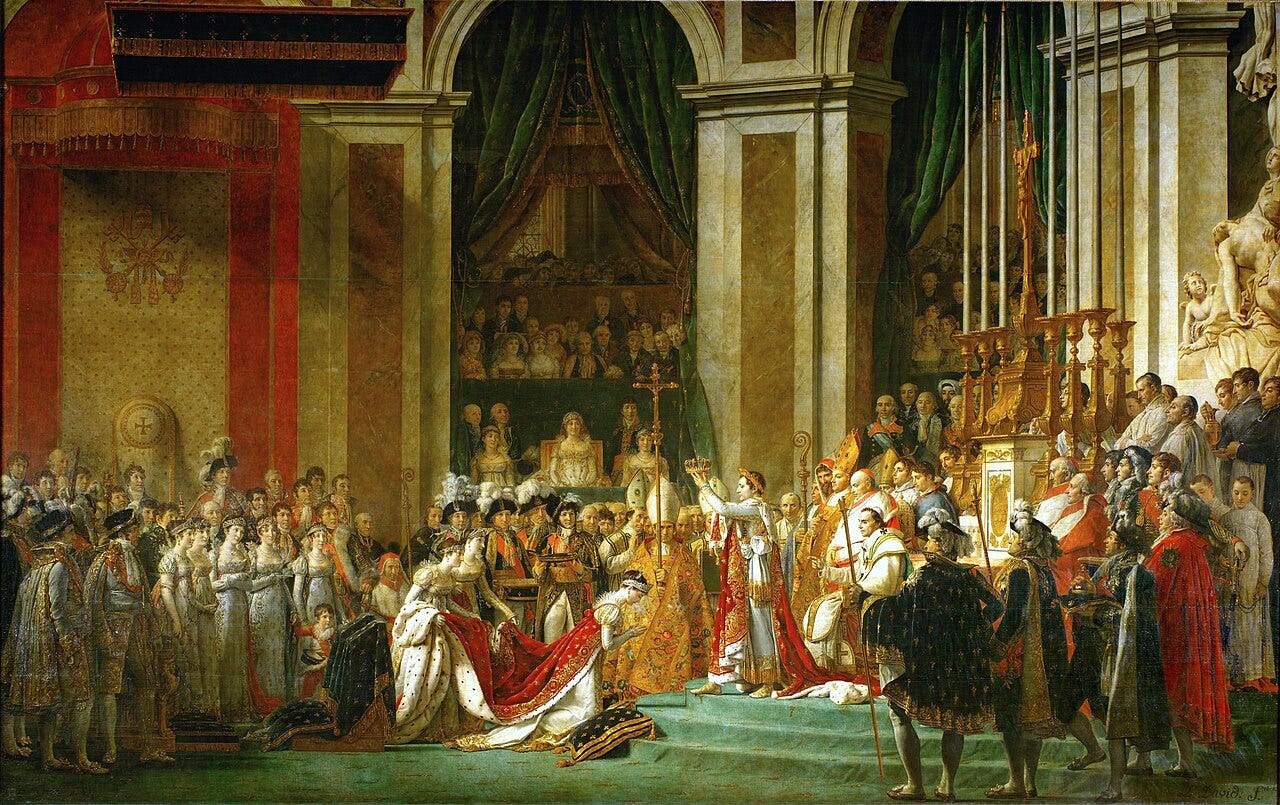
Painting built power and recorded its cost. Jacques Louis David staged Napoleon's coronation on a canvas ten meters wide, Goya painted a firing squad in The Third of May 1808, and rulers paid for centuries to control which image survived.
To paint the coronation of Napoleon, Jacques Louis David had a scale model of the cathedral built in his studio. The finished canvas stretches ten meters wide and holds roughly 200 identifiable figures.
It also lies. Napoleon crowned himself that day, and David painted him crowning Josephine instead, a gentler scene that the new emperor preferred the world to remember.
That is the whole history of war and power in art in one picture. Painters gave rulers the version of events they wanted, and rulers paid, promoted, censored, and sometimes jailed them in return.
The eight collections below cover both directions of that exchange, from battlefields to throne rooms to prison cells.
Battles as arguments
A battle painting is rarely a report. It is a claim about who deserved to win.
Paolo Uccello made three panels of the Battle of San Romano around 1440, and today they hang in three different countries, split between London, Florence and Paris. Centuries later, David's Napoleon Crossing the Alps put the general on a rearing horse, when in reality Napoleon crossed on a mule, in good weather, led by a guide. He had asked to be painted calm on a fiery horse, and got exactly that.
Then Goya broke the contract. The Third of May 1808 shows an anonymous firing squad shooting an unnamed victim, with no hero anywhere on the canvas.
From glory to horror
There is a wider arc that runs past any single battle. It starts with Uccello's Battle of San Romano and ends with a pyramid of human skulls.
That pyramid is Vasily Vereshchagin's The Apotheosis of War, painted in 1871 and now in the Tretyakov Gallery in Moscow. It sits in a scorched desert, and the painter dedicated it to all conquerors, past, present and future.
Goya's Disasters of War etchings belong to the same arc, with a telling delay. Made around 1815, they were only published in 1863, thirty five years after his death.
The collection of famous war paintings tracks twelve works across that whole trajectory.
America argues with itself
The American Civil War was refought in paint for decades after the shooting stopped. Winslow Homer had covered the Union army for Harper's Weekly before he painted Prisoners from the Front in 1866.
The losing side painted too, and painted well enough to reshape memory. William D. Washington's The Burial of Latane, from 1864, became a cornerstone of the Lost Cause myth, which recast a war fought over slavery as noble sacrifice.
Scale itself became an argument. Peter F. Rothermel's Battle of Gettysburg, finished in 1870, stands sixteen feet tall and thirty two feet wide at the State Museum of Pennsylvania, one of the largest framed paintings in the United States.
All twelve are in the guide to Civil War paintings.
Revolution as a propaganda machine
When Marat was murdered in his bathtub in 1793, David turned the scene into a secular martyrdom. The Death of Marat, now in the Royal Museums of Fine Arts in Brussels, smooths away the skin disease that actually forced Marat to work in his bath.
Objects traveled as propaganda too. After the Bastille fell in 1789, its key was shipped to George Washington, and it still hangs at Mount Vernon.
Even the most famous image of French revolt is commonly misread. Delacroix's Liberty Leading the People, in the Louvre, depicts the July Revolution of 1830, though it has come to stand for revolution in general.
The page on French Revolution paintings gathers twelve of these images and the edits behind them.
The coronation, as edited
Napoleon placed the crown on his own head in front of the assembled clergy. David painted the softer moment instead, Napoleon crowning Josephine, and went further by adding Napoleon's mother to the tribune even though she had boycotted the ceremony entirely.
Coronation paintings carry another oddity most viewers miss. England's medieval regalia was melted down in 1649 after the execution of Charles I, and new regalia was made for the restoration in 1661, so English coronation scenes before and after that date show physically different objects.
The survey of coronations in painting covers twelve of these ceremonies and what each one chose to fix.
The royal portrait, under control
How do you paint a king without flattering him? Velazquez found one answer in Las Meninas, where the king and queen appear only as a reflection in a small mirror at the back of the room, while the painter himself faces forward in the foreground.
Goya found a riskier one. The Family of Charles IV, from 1800, shows the Spanish royals with no flattery at all, which prompted a later critic to say they looked like a corner grocer's family that had just won the lottery.
Remarkably, both painters kept their court positions. The gallery of famous paintings of kings and queens shows how far each artist could push before the image stopped serving the crown.
Prison, the underside of power
Every throne room has a cell somewhere beneath it, and painters went there too. Giovanni Battista Piranesi's Imaginary Prisons, sixteen etchings from 1750, show staircases and vaults that do not actually connect if you trace them with your eye.
For some artists the subject was personal. Honore Daumier spent six months in jail in 1832 for a caricature that showed the king as Gargantua swallowing bags of gold taken from the poor.
Even the paintings themselves could disappear. Paul Delaroche's The Execution of Lady Jane Grey, from 1833, was believed destroyed in a 1928 flood and turned up in a Rijksmuseum storeroom in 1973.
Twelve of these images are collected in the page on prisons in art.
When the institutions strike back

In 1815 the Spanish Inquisition summoned Francisco Goya to answer for The Nude Maja. Whatever he said in his defense has not survived.
The courtroom could ruin a painter just as surely. James McNeill Whistler sued the critic John Ruskin for libel over Nocturne in Black and Gold, won the case, and was awarded a farthing, one quarter of a penny. The legal costs bankrupted him.
The pattern continued into living memory. Chris Ofili's The Holy Virgin Mary, from 1996, prompted New York's mayor to try to cut a museum's funding in 1999. The painting later sold for 4.6 million dollars.
Frequently asked questions
Why did painters work for kings and generals for so long? Rulers were the clients who could pay for canvases at this scale, and they bought a version of events. Napoleon asked David to show him calm on a fiery horse when he had actually crossed the Alps on a mule.
What is the difference between a battle painting and a war painting here? The battle paintings page focuses on single engagements, from Uccello's San Romano panels to Goya's Third of May. The war paintings page follows the longer arc, ending with Vereshchagin's pyramid of skulls dedicated to all conquerors.
Which of these paintings actually got their maker in trouble? Goya faced the Inquisition in 1815 over The Nude Maja, Daumier spent six months in jail in 1832 for a caricature of the king, and Whistler won his libel suit against Ruskin only to be bankrupted by the costs.
Did any painter show war as something other than glorious? Goya did, twice over. The Third of May 1808 shows an execution with no hero in it, and his Disasters of War etchings were so raw they stayed unpublished until 1863, thirty five years after his death.
What happened when the ceremony did not match the painting? The painting usually won. David showed Napoleon crowning Josephine rather than crowning himself, and placed Napoleon's mother in the tribune even though she had boycotted the ceremony, and his canvas remains the image most people carry of that day.
One more thing
Every page above shows power shaping paintings. Sometimes a painting outlasts every power that touched it.
Emanuel Leutze painted Washington Crossing the Delaware in 1851, in Germany, as an American hoping to inspire the European revolutions of his own time. The first version was destroyed in a wartime bombing. The second has hung at the Metropolitan Museum in New York since 1897.