

200 000+ readers learn art the fun way.
This is a preview. Paid subscribers get the full story.
You’ll also get:
10 new stories / month
The full archive (140+ Art stories)
Your personal art guide. Comment, ask questions, DM me anytime
Apple user? Subscribe at coolstoriesabout.art, not via the app. Apple adds 30% to the price.
My first book is out (in French only)

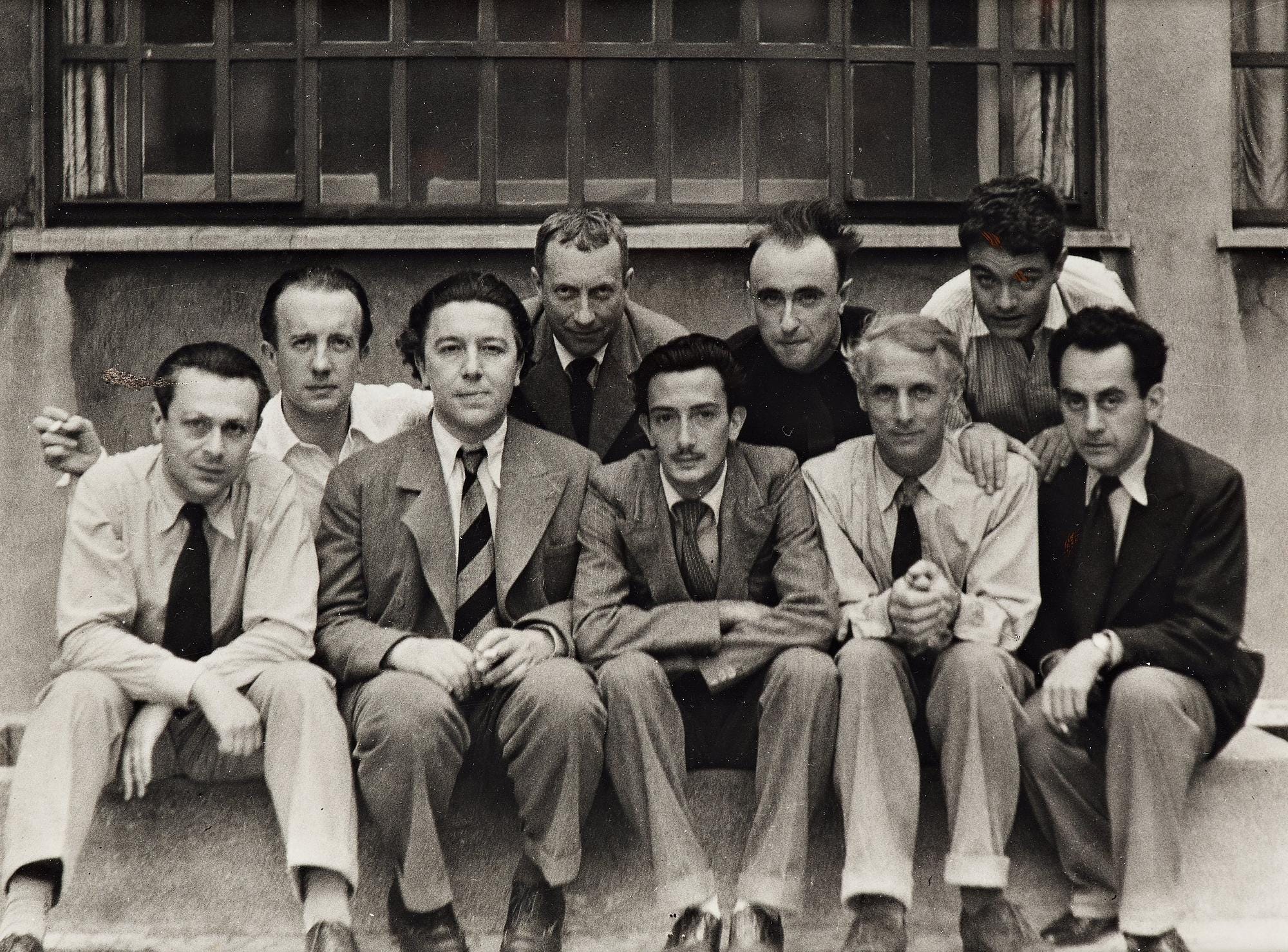
At Léon Pierre-Quint's, in Paris, on a Thursday evening in January 1934, dinner is coming to an end.
Pierre-Quint is a writer and publisher, a friend of Proust and Gide. He has had the Surrealists to dinner since the group's earliest days, the circle of young poets and painters who follow André Breton.
Dinner is over. The glasses are still full.
A young man pushes back his chair and stands up to speak. He talks with his hands, rolling his r's in a thick Catalan accent, and the subject is Germany.
“You have to look at Hitler very closely. He is the most irrational phenomenon we have seen in centuries. In one year, he has turned an entire country upside down.”
The young man is 29 and has been in Paris for five years. No painter in Paris is talked about more: in November, a Manhattan gallery gave him his first New York show. Gala, his companion, a Russian ten years older than he is, sits beside him and never takes her eyes off him.
Across the table, André Breton sets down his glass. He is 37, he runs the group, and he is the one who brought the Catalan into it and defended him against all comers.
Breton talks about Berlin. On May 10 last year, three months after Hitler came to power, Nazi students burned thousands of books on the Opernplatz. Jewish authors, communists, anything they judged contrary to the German spirit, with a formula shouted out for each name.
Freud's books went into the fire. Everyone at this table claims the Viennese doctor of dreams as their own.
“Do you know what they shouted when they threw Freud into the flames? I consign to the flames the writings of Sigmund Freud.”
The young man won't back down. He praises the Berlin government, violence and all, and explains what attracts him to Hitler.
“He destroys all your certainties. That's what frightens you.”
Pierre-Quint changes the subject. The papers are still full of the Christmas train wreck.
Two days before Christmas, 20 kilometers from Paris, a train bound for Nancy had stopped on the tracks, and the Strasbourg express plowed into it at 110 kilometers an hour. The last five cars, old wooden ones added for the holidays, were crushed. The death toll was 204, families on their way home.
The young man answers him, looking around the table.
“A train wreck delights me all the more when it hits third class passengers.”
Silence. He goes on.
“I wish misfortune on my friends. On my friends especially.”
Breton says nothing. He relights his pipe and does not say another word all evening.
The young man sits back down beside Gala. His name is Salvador Dalí.
Discover my new newsletter !


Blue Ink, Yellow Paper
Breton's silence lasts four days. On Monday, January 22, he sits down at his desk and reaches for his blue ink. Four pages addressed to Dalí. Breton writes down everything he heard at Pierre-Quint's: the praise of Hitler, the train wreck, the friends. He demands a written reply on each point.
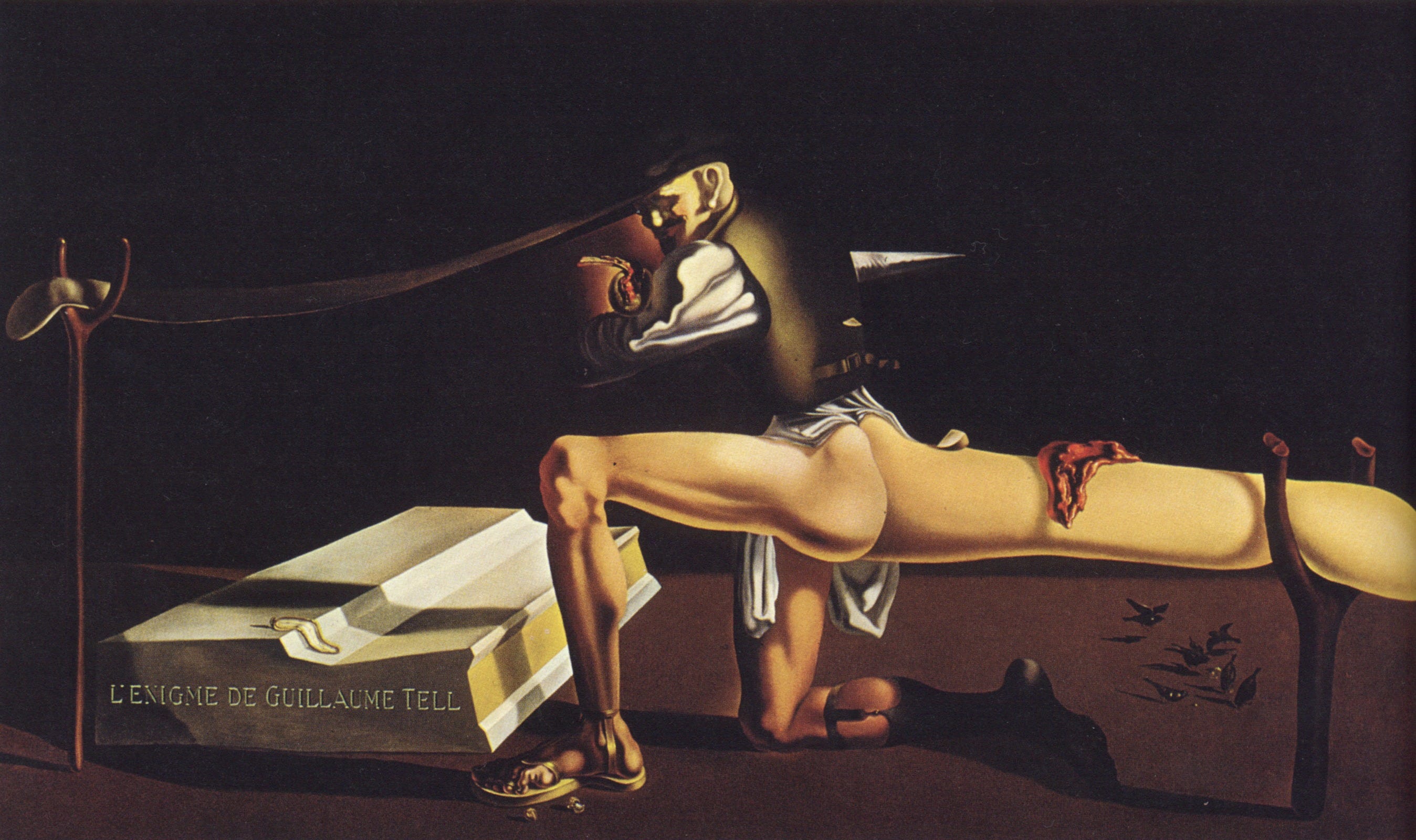
He also goes after Dalí's most recent painting. The canvas is two meters high and three and a half meters wide. On it, a giant Lenin squats in the pose of William Tell, in a cap with a long visor. One buttock stretches so far that a crutch props it up.
For Breton, it is a mockery aimed at the hero of the Russian Revolution, the revolution he and his friends champion. At that very moment, Hitler is locking German communists up in his first camps.
Three days after the letter, Dalí climbs the rue Fontaine to Breton's. Number 42 sits at the foot of Montmartre, and Breton waits for him there among the Oceanic masks that crowd his walls. Benjamin Péret is with him. Péret is a poet, Breton's right-hand man, and the Surrealist most committed to the communist revolution.
No discussion. Breton takes a half sheet of yellow paper and drafts, in the first person, a statement for Dalí to sign: that he is no enemy of the workers, that he will no longer defend Hitler, that he will denounce fascism unequivocally, that he never meant to insult Lenin.
I pledge to put a stop to the Hitlerite propaganda I am said to be carrying on in various circles.
Last line: Down with Hitler! Long live Lenin!
Breton hands him the sheet. Dalí signs.
That same evening, at home, Dalí writes to Breton at length. He is, he insists, a Surrealist without reservation.
“I am not a Hitlerite, in fact or in intention.”
Further down the page, he still stands by what he said at Pierre-Quint's table.
“If we fight Hitler without trying to understand him, no progress is possible.”
And if the Nazis entered France, he adds, his paintings would burn, and most likely he would burn with them.
Letters from Nice
The signature is not enough for Breton. He wants every member of the group, in Paris or away from it, to say in writing where he stands.
At the end of the month, Péret mails them all a questionnaire. Four questions on the group's political line, one of them on the roots of Hitler's movement.
An answer arrives from Nice on January 29. It comes from Paul Éluard, a poet and one of the group's founders, who was Gala's husband until she left him for Dalí. To Breton, he writes that the thought of a break with Dalí dismays him. To Gala, he writes more bluntly: praising Hitler is unacceptable and will wreck Surrealism.
“Dalí absolutely must find another object for his delirium.”
From Nice again, the same day, a letter from Tristan Tzara, the founder of Dada. Dalí's provocations, he writes to Breton, have been “of fruitful use to all of us,” and he sides with Éluard against a break.
René Crevel, a poet and Dalí's most loyal defender, is in Davos, in Switzerland, being treated for a lung ailment. He replies that Dalí's only problem is that he is too isolated.
On February 2, in Paris, Péret takes a sheet of pink paper and writes: Dalí is a “fascist element,” to be fought “by every possible means.” Eight members sign, including the painter Max Ernst.
Two days later, the Lenin with the crutch is on view at the Grand Palais, in a major painting exhibition. Breton and a few of his group walk through the galleries to reach it. They have come to destroy it.
The canvas is hung too high. They leave.
A Thermometer Under the Tongue
The next day, Monday, February 5, in the early afternoon, the group waits for Dalí at Breton's on the rue Fontaine. Éluard, Tzara and Crevel are away from Paris. Breton paces, pipe clamped in his teeth.
In the doorway, an oversized camel-hair coat, shoes untied, a thermometer under the tongue. Dalí has a fever, he says. Some in the room suspect he is putting on an act.
He pulls out a statement written that very afternoon and reads out his defense. As he reads, he sheds the coat, then the jacket, then the sweaters, one by one, dropping each at Breton's feet.
Breton stops pacing.
“How much longer are you going to keep pissing us off with this Hitler of yours?”
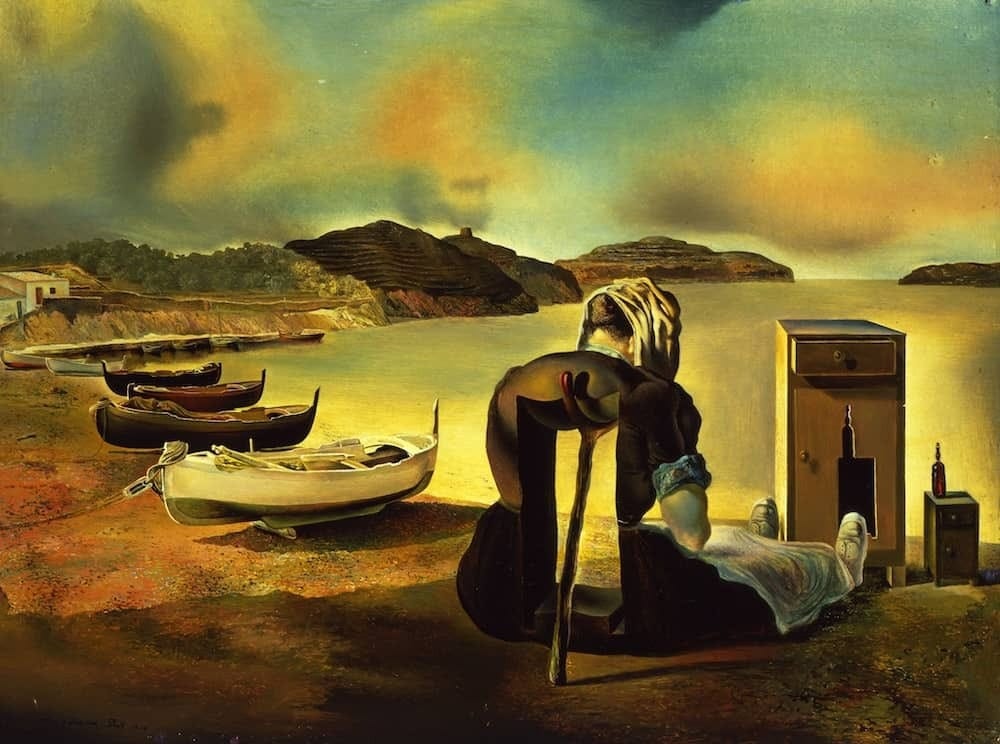
Breton brings up another canvas, a nurse wearing a swastika armband. Dalí falls back on the group's own rule: whatever comes from the dream gets painted, all of it, without censorship. He is only following the rule.
“I paint what I dream. If tonight I dream that I am making love to you, tomorrow morning I will paint our most beautiful positions.”
Bare-chested, he drops to his knees and holds out his hand to Breton.
The doorbell rings. A telegram from Switzerland, signed Crevel. Breton unfolds it and reads it aloud: Attempt the impossible to avoid a break.
Dalí is still on his knees, hand outstretched.
Breton turns to the others. A decision has to be made.
What You’ll Discover
Was Dalí expelled from the Surrealists?
Why was Dalí obsessed with Hitler?
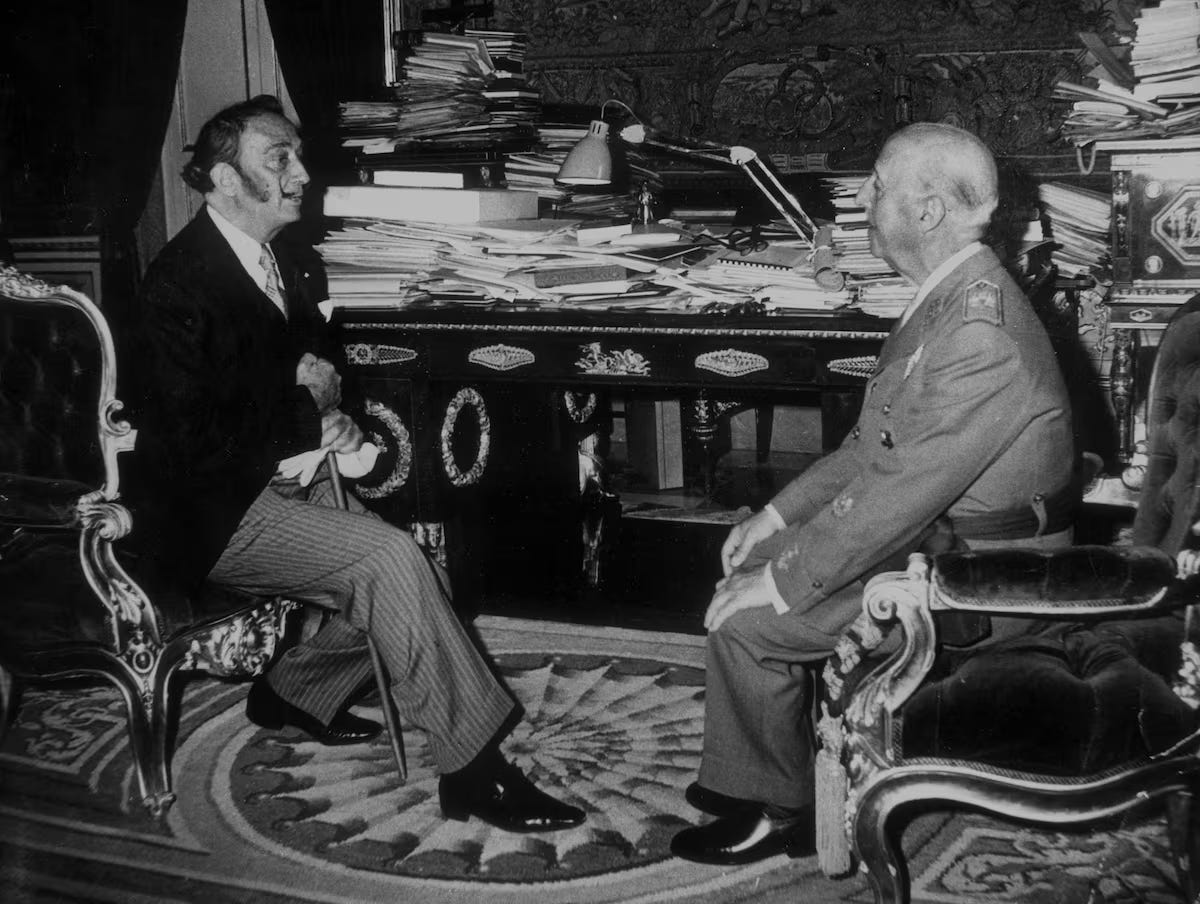
Did Dalí support Franco?
Was Dalí really a fascist?