Weird Paintings: 12 of the Strangest Pictures in Art
The weirdest paintings in art go beyond scary into the truly strange: a face built from fruit, a boat of fools going nowhere, a giant eye floating like a balloon. Long before Surrealism, painters were already dreaming up the impossible.
These are not horror pictures but head scratchers, riddles and dreams that have puzzled viewers for centuries. I have picked twelve of the strangest, and most of them were painted long before anyone had a word for this kind of imagination.
Why painters got weird:
The puzzle. Some pictures are riddles, packed with proverbs, symbols and jokes to decode.
The dream. Others come straight from sleep and imagination, centuries before Surrealism named it.
The satire. Turning people into fruit or fools was a sly way to mock power and folly.
The wonder. Sometimes an artist just wanted to make something no one had ever seen.
The ones I would send a friend
If you want the detail rather than the summary:
Inside Monet house at Giverny, room by room, including his own bedroom
The Ambassadors, detail by detail, the object at the bottom that only works from one side
Luncheon of the Boating Party, detail by detail, who everybody at that table actually was
1. Hieronymus Bosch, The Garden of Earthly Delights (about 1500)
Naked people ride giant birds, climb inside berries and dance around a pool in an impossible pink paradise. This is the central panel of Hieronymus Bosch's The Garden of Earthly Delights, painted around 1500, and no one has ever fully explained it.
Five hundred years later scholars still argue whether it is a warning against sin or a lost dream of innocence. Bosch invented a private zoo of monsters and marvels that looks, uncannily, like Surrealism made three centuries too early.
2. Hieronymus Bosch, The Ship of Fools (about 1500)
A crew of drunken monks and peasants sings and squabbles aboard a little boat that is going absolutely nowhere. Bosch meant his Ship of Fools, painted in the 1490s, as a joke with a sting, a whole society too foolish to notice it has no rudder.
A tree grows from the mast, someone lunges at a dangling cake, and a nun strums a lute. The panel we see is only the top of a larger lost work, its bottom half now in another museum, yet even this fragment is pure, sharp weird.
3. Quentin Massys, The Ugly Duchess (about 1513)
Who was the astonishingly ugly old woman in this portrait, and why would anyone paint her? The Ugly Duchess, made by Quentin Massys around 1513, shows a grotesque noblewoman in an outdated headdress, squeezed into a young girl's low cut dress.
The face may caricature a real bone disease that swells the jaw and brow. What is certain is its afterlife, since three centuries later it became the model for the Duchess in Alice in Wonderland.
4. Pieter Bruegel the Elder, Netherlandish Proverbs (1559)
In 1559 Pieter Bruegel the Elder crammed more than a hundred old sayings into one chaotic village, from people banging their heads on brick walls to casting roses before swine and belling the cat.
It is a giant visual puzzle, and half the fun is spotting each proverb in the mess. Bruegel loved the folly of ordinary people, and here he turned a whole way of talking into one busy, brilliant scene.
5. Giuseppe Arcimboldo, The Librarian (about 1566)
Look closely and this dignified scholar is made entirely of books, his face a stack of open covers, his hair a feather duster. Giuseppe Arcimboldo dreamed up The Librarian around 1566, one of the first artists ever to build a portrait out of objects.
The joke has a bite, since the figure is often read as a dig at a courtier who collected books for show rather than reading them. Arcimboldo pulled these tricks for the Habsburg court, and modern eyes see him as a grandfather of the strange.
6. Pieter Bruegel the Elder, The Land of Cockaigne (1567)
Bruegel returned to pure fantasy in 1567 with The Land of Cockaigne, where three stuffed men lie sprawled on their backs under a tree hung with pies, too bloated to move.
Roast pigs trot about with knives already stuck in them, and the fences are woven from sausage.
It is a dream of endless food from an age that knew real hunger. Yet Bruegel makes the gluttony grotesque, a paradise that has turned its guests into snoring lumps.
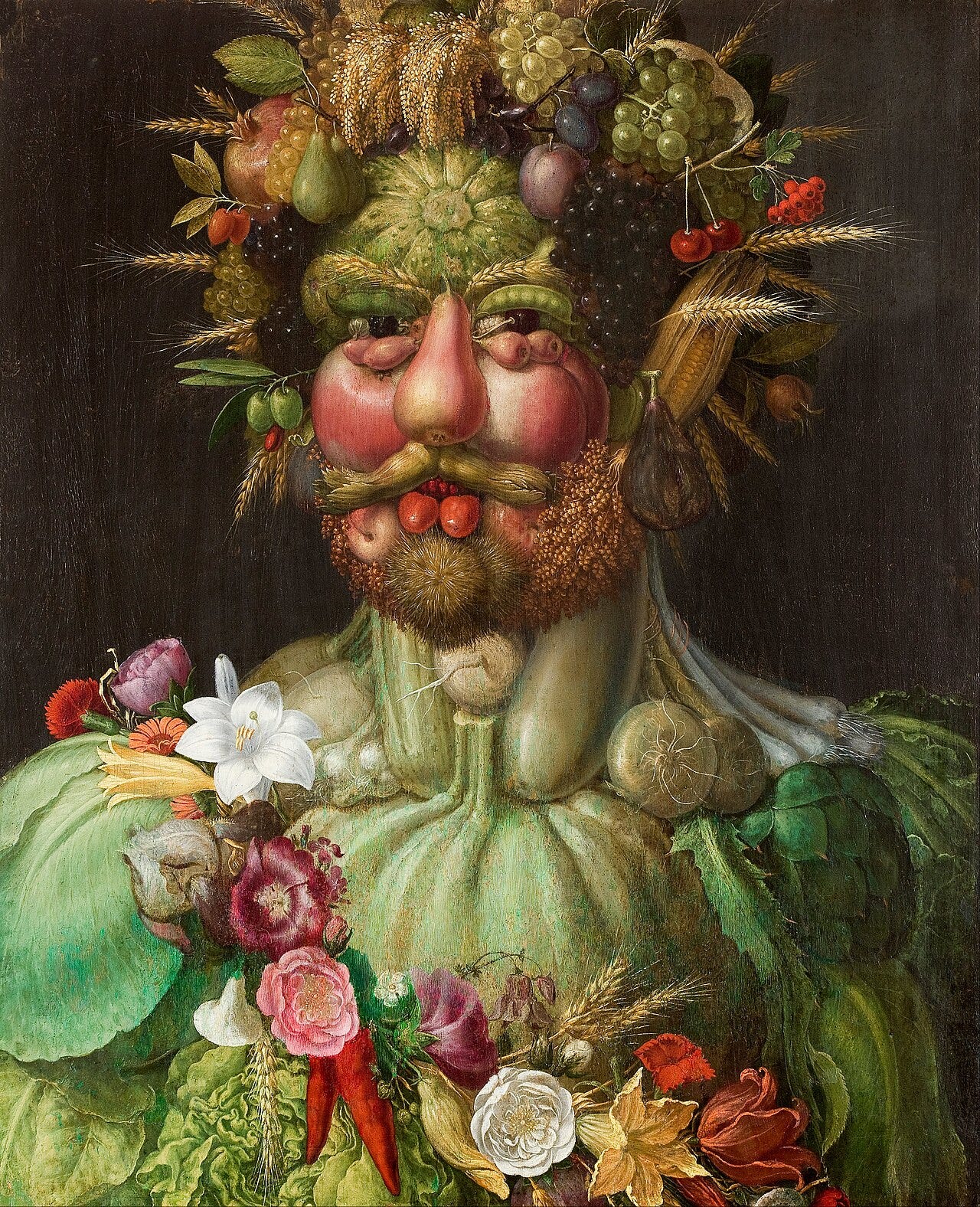
7. Giuseppe Arcimboldo, Vertumnus (about 1590)
Arcimboldo once turned an emperor into a pile of fruit and vegetables, and the emperor adored it. In Vertumnus, from around 1590, the ruler Rudolf the Second appears as the Roman god of the seasons, cheeks made of apples, beard of chestnuts, brow of a marrow.
Far from an insult, it was the highest compliment, casting the emperor as the source of all nature's plenty. It is the most charming strange picture of its age, a face you could almost eat.
8. After Hieronymus Bosch, The Concert in the Egg (about 1560)
A crowd of people crams inside a giant cracked eggshell to sing from a songbook, while a thief quietly picks a pocket and an owl peers out from a funnel hat.
The Concert in the Egg, painted by a follower of Hieronymus Bosch, probably after a lost Bosch design, is as strange as anything the master himself made.
It mocks a foolish, off key world too busy singing to notice the thief in its midst. A whole choir stuffed inside an egg is the kind of image only the truly weird tradition could produce.
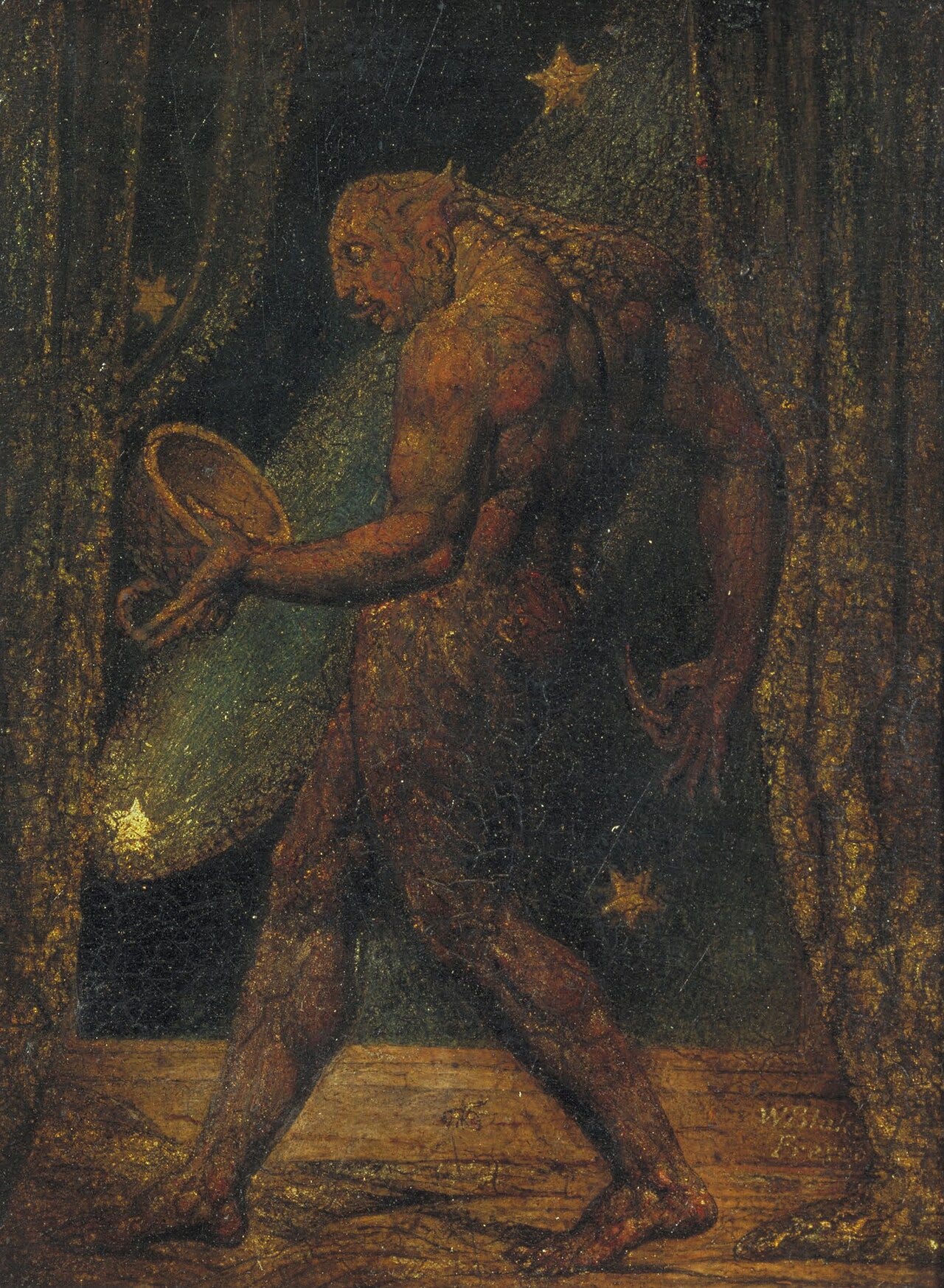
9. William Blake, The Ghost of a Flea (about 1819)
William Blake swore he had actually seen this creature, a muscular monster with a lizard's tongue, cupping a bowl to drink blood.
He painted The Ghost of a Flea around 1819, after telling a friend that the spirit of a flea had appeared to him in a vision.
Blake believed fleas were home to the souls of bloodthirsty men. Tiny and gleaming with gold, the picture is one of the strangest things in British art, half nightmare and half comedy.
10. Grandville, Un Autre Monde (1844)
A juggler flings planets across the sky on a tightrope of stars, and no one blinks. The French artist known as Grandville filled his 1844 book Un Autre Monde, meaning Another World, with images like this, where objects come alive and the laws of nature quietly bend.
He drew dancing playing cards, marrying vegetables and a bridge stretched between planets, decades before anyone said the word Surrealism. The Surrealists later claimed him as one of their own.
11. Odilon Redon, The Eye Like a Strange Balloon (1882)
A single enormous eyeball drifts up into the sky like a hot air balloon, carrying a little dish below it. Odilon Redon made The Eye Like a Strange Balloon as a lithograph in 1882, part of a whole world of floating eyes, spiders with human faces and smiling monsters.
Redon called these his blacks, dark dreamlike visions that seemed to bubble up from the unconscious. They fed straight into Surrealism, the art of dreams that would take over the next century.
12. Henri Rousseau, The Sleeping Gypsy (1897)
A lion sniffs at a sleeping woman in a moonlit desert, and neither of them seems remotely worried. Henri Rousseau painted The Sleeping Gypsy in 1897, a scene so still and dreamlike it feels stopped outside of time.
Rousseau was a self taught customs officer who painted from pure imagination, and critics laughed at his flat, simple style. Then Picasso found this picture, understood exactly what it was, and the weird, dreaming outsider became a hero of modern art.
Where to see the strange ones
Bosch, The Garden of Earthly Delights: the Prado, Madrid.
Massys, The Ugly Duchess: the National Gallery, London.
Bruegel, Netherlandish Proverbs: the Gemaldegalerie, Berlin.
Arcimboldo, Vertumnus: Skokloster Castle, Sweden.
Blake, The Ghost of a Flea: the Tate, London.
Rousseau, The Sleeping Gypsy: the Museum of Modern Art, New York.
If the strange side of art pulled you in, keep going:
Ten women artists you need to know, the names the textbooks skipped
Was Monet really the first Impressionist, the painting that may have got there first
The secret behind Monet Magpie, one bird in the snow, and why it matters
Weird art, a few quick questions
What is the weirdest painting? Bosch's The Garden of Earthly Delights and Arcimboldo's fruit portraits are the usual answers, with Blake's Ghost of a Flea close behind.
Who painted people made of fruit? Giuseppe Arcimboldo, an Italian working for the Habsburg emperors, built portraits from fruit, vegetables, books and animals.
Were these painters Surrealists? No. Surrealism began in the 1920s, but Bosch, Arcimboldo and Redon dreamed up impossible images centuries earlier and helped inspire it.
What does The Garden of Earthly Delights mean? No one is certain. It may warn against sin, or picture a lost paradise, and the argument is part of its strange power.
Why did old painters make such strange pictures? To teach, to mock, to amuse, and sometimes just to show off an imagination no one else could match.
The dream was always there
Line them up and you realize weird art is not modern at all. Long before anyone wrote a Surrealist manifesto, a Dutchman was painting men who lived inside berries, an Italian was carving faces out of fruit, and an Englishman was drawing a monster he swore had visited him at night.
The strangeness was never a mistake or a joke gone wrong. It was imagination refusing to stay inside the lines. When Picasso stood in front of Rousseau's dreaming lion, he did not laugh, he understood, and modern art was already halfway to the dream.