What Do Dali's Melting Clocks Mean?

Three watches melt, one stays hard and covered in ants. Here is what Dali actually painted in 1931, and the cheese that supposedly started it all.

Salvador Dali painted three pocket watches melting over a barren coastal landscape in 1931. He later said the idea came from watching a wheel of Camembert cheese soften in the sun. One watch, covered in ants, stays hard and closed.

Dali melting clocks painting
Salvador Dali, The Persistence of Memory, 1931.

The painting is tiny, smaller than a sheet of paper, yet it became one of the most recognized images to come out of Surrealism, reproduced far more than its actual size would suggest.

  • Date: 1931.

  • Medium and size: Oil on canvas, 24 by 33 centimeters.

  • Location: Museum of Modern Art, New York.


No boring lectures, ever. Join 170,000 readers learning art the fun way, free.


More Artists Who Broke the Rules

Dali built a whole career on refusing to paint the expected thing. These artists share that instinct.


A Landscape Pulled from Real Life

The cliffs in the background are not invented. They match the real coastline near Port Lligat and Cadaqués in Catalonia, the part of Spain where Dali grew up and later kept a home.

Setting a scene this strange against a real, recognizable place is part of what makes the painting unsettling rather than purely decorative.

Cap de Creus rocky coastline
Victor Perea Ros, Cap de Creus coastline, Catalonia.

Three Watches Melting, One Staying Solid

Four watches share the same rocky ledge, and each behaves differently. Three go soft, draped over a branch, a ledge, and a sleeping shape, while a fourth stays rigid and closed, crawling with ants. That contrast, hard against soft, closed against melting, is the actual engine of the painting, not the watches alone.

One melting watch drapes over a bare tree branch. Another sags over the edge of a rectangular ledge. A third slumps across a strange, fleshy shape lying in the foreground.

A fourth watch sits closed and untouched on the ledge, its case covered in ants, hard where the others have gone soft.

What strikes me is that detail more than the melting ones. Everyone remembers the soft watches. The one that resists decay is the one doing the real symbolic work.

Dali cabinet with drawers painting
Salvador Dali, The Anthropomorphic Cabinet, 1936.

See art differently. 170,000 people read these free stories. Come find out why.


Where the Idea Came From

Some critics have linked the melting watches to Einstein's theory of relativity, published only decades earlier. Dali never confirmed that reading in his own writing. Across interviews for decades he gave one consistent answer: he watched a wheel of ripe Camembert cheese soften and spread on a table on a hot day, and the image stuck.

Dali claimed the melting watches came to him after watching a wheel of Camembert cheese soften and spread in the heat of the sun, and he simply transferred that same soft, spreading quality onto something rigid instead.

It is a strange origin for such a widely discussed symbol of time, but Dali repeated the story himself. He liked to describe the cheese story with a straight face in interviews for decades, never once softening how ordinary and domestic the actual trigger had been.

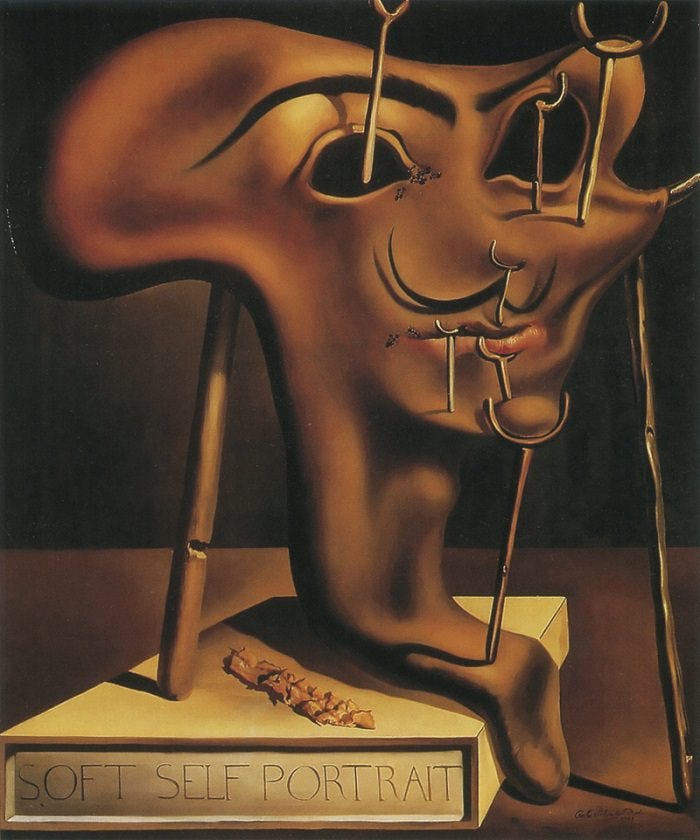
Dali soft self portrait painting
Salvador Dali, Soft Self Portrait with Fried Bacon, 1941.

The Strange Shape in the Middle

The pale, fleshy form draped across the center of the painting is not a rock or a piece of driftwood. Its closed eye and long lashes echo Dali's own sleeping profile, and its soft, boneless texture is exactly why a watch can melt across it without resistance.

The fleshy, eyelash draped form lying at the center of the painting has been read by many as a distorted, sleeping self portrait, its outline echoing Dali's own profile.

Whatever it represents exactly, it anchors the whole scene, the one shape soft enough for a watch to melt across without resistance.

To me, that self portrait buried in the landscape changes the whole reading. He is not just showing time dissolving, he is lying at the center of it.

Dali Atomicus photograph
Salvador Dali, photographed by Philippe Halsman, 1948.

Dali Revisited It Twenty Years Later

In 1954, Dali painted The Disintegration of the Persistence of Memory, breaking the same composition apart into floating blocks, a response to his growing fascination with atomic physics after the bombing of Hiroshima.

A Symbolist Got There First

Dali did not invent dream logic in painting. French Symbolist Odilon Redon spent the 1880s drawing floating eyes, disembodied heads, and impossible hybrid creatures decades before Surrealism existed as a movement. Andre Breton, the Surrealists' own leader, later named Redon as a direct ancestor of everything the movement claimed to discover.

Redon died in 1916, fifteen years before Dali painted his melting watches, and never called himself a Surrealist. The label was applied to his work only after the fact, once Breton's circle recognized their own project already sitting in his lithographs.

Redon eye balloon lithograph
Odilon Redon, The Eye Like a Strange Balloon, 1882.

One painting. One story. Every week. Free, with 170,000 readers who never sat through an art history lecture.


More Stories Behind Famous Paintings

A small canvas can still rewrite how people think about a subject. These did too.


Smaller Than It Looks in Reproductions

The Persistence of Memory measures just 24 by 33 centimeters, smaller than a standard sheet of writing paper and small enough to hold flat in two hands. Posters, book covers, and screensavers have reproduced it at mural scale for decades, which is exactly why most people expect a much larger canvas at MoMA.

The Persistence of Memory measures only 24 by 33 centimeters, oil on canvas, barely bigger than a sheet of writing paper. Visitors expecting a large canvas at the museum are often surprised by how small it actually is in person.

Dali worked at that scale deliberately, closer to the size of a Dutch seventeenth century still life than a grand Surrealist statement, forcing viewers to lean in rather than step back. That small scale is part of why photographs of the painting are so misleading, since reproductions in books and on posters give no sense of how close a visitor has to stand to see the brushwork at all.

First Shown in Paris, Sold Almost Immediately

The painting debuted in June 1931 at the Galerie Pierre Colle in Paris, part of Dali's first major Surrealist exhibition there. It sold quickly, a sign of how fast his reputation was building even before he had settled permanently in the public imagination.

Word of the melting watches spread through the small Surrealist circle around Andre Breton well before most of the wider public had ever seen a reproduction.

In New York Since 1934

The Museum of Modern Art acquired the painting in 1934, only three years after it was painted, at a moment when Dali was still far better known in Paris than in the United States.

It has stayed at MoMA ever since, one of the most reproduced images in the museum's entire collection and usually one of the first paintings visitors ask to see. Its actual wall label is easy to miss among larger, brighter canvases nearby, which surprises many first time visitors who expect a painting this famous to dominate the room rather than sit quietly in a corner of it.

I think that is the real afterlife of this painting. A tiny canvas Dali could hold in two hands became the one thing a museum full of masterpieces is best known for.

Ants and a Fly Hidden in Plain Sight

Dali covered the closed orange watch at lower left with a swarm of ants, an image he returned to again and again across his career as a private symbol of decay and the body slowly consumed after death.

A single fly perches on one of the melting watches nearby, small enough that many visitors miss it on a first look. Dali wrote about flies as tiny, almost angelic presences hovering over the kind of decay he kept painting for decades.

Frequently Asked Questions

  • When did Salvador Dali paint The Persistence of Memory?

    In 1931.

  • How big is the actual painting?

    Quite small, only 24 by 33 centimeters, smaller than a standard sheet of paper.

  • Where did the idea for melting clocks come from?

    Dali said it came to him after watching a wheel of Camembert cheese soften in the sun.

  • Where is the painting kept today?

    At the Museum of Modern Art in New York.

  • Did Dali ever revisit this composition?

    Yes. In 1954 he painted The Disintegration of the Persistence of Memory, breaking the same scene into floating fragments.


Learn art the fun way. Join 170,000 readers getting one painting and its story every week.