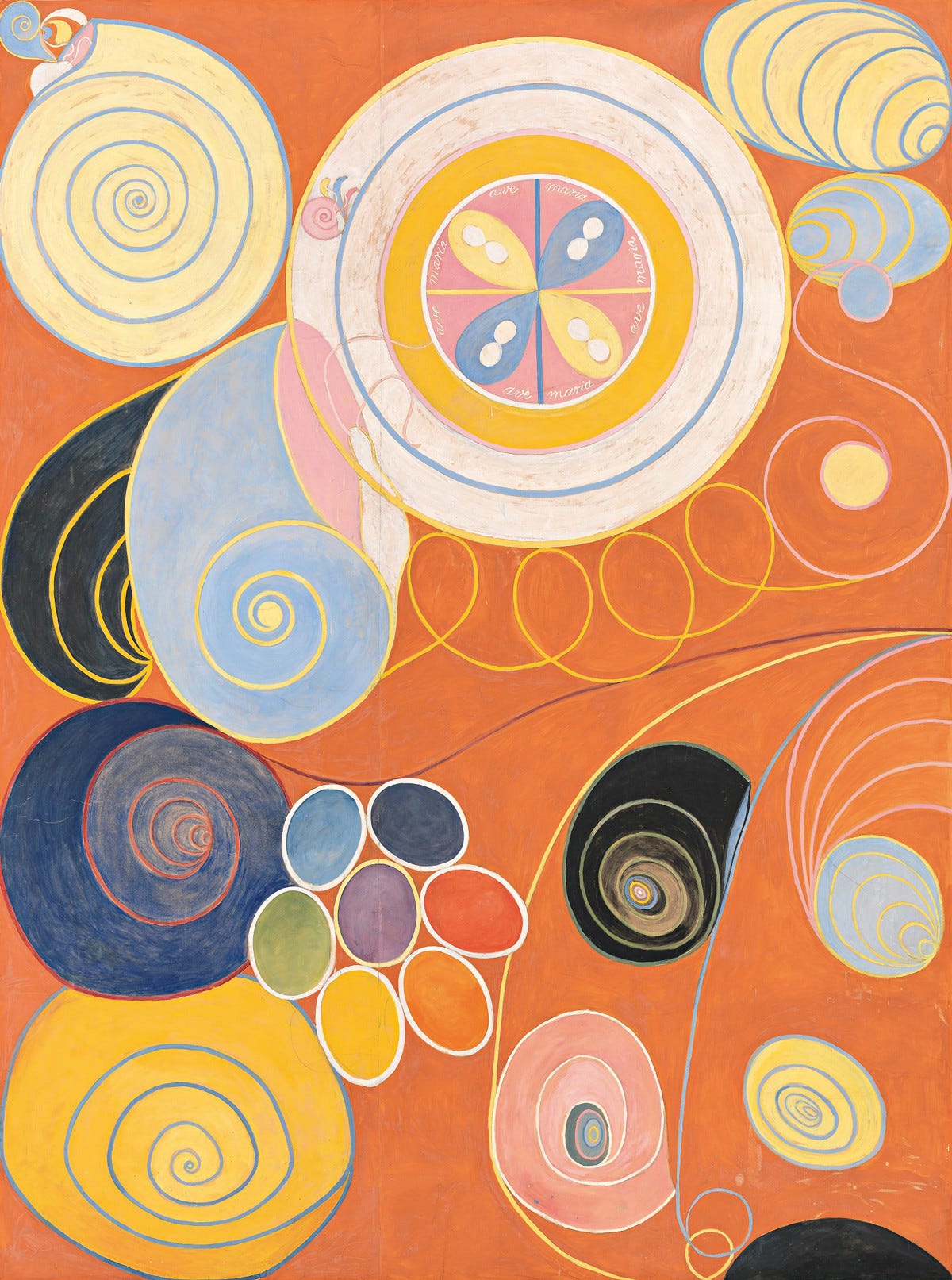
The Ten Largest are ten paintings Hilma af Klint made in 1907, each one over three meters tall, using spirals, shells and flowers instead of human bodies to show childhood, youth, adulthood and old age.
She said the shapes were not her own idea. A spirit she called Amaliel dictated them during a séance, and she finished all ten canvases in about six weeks.
Artist: Hilma af Klint, Swedish, 1862 to 1944
Painted: 1907, all ten canvases in about six weeks
Now at: the Moderna Museet, Stockholm
Three More Artists Ahead of Their Own Time
Hilma af Klint is not the only artist whose real story took decades to catch up with the work. These three are just as worth your time.
I first saw a photo of one of these paintings on a random blog years ago, and my honest reaction was disbelief that anyone painted spirals like that in 1907, decades before art historians casually started using the phrase abstract art.
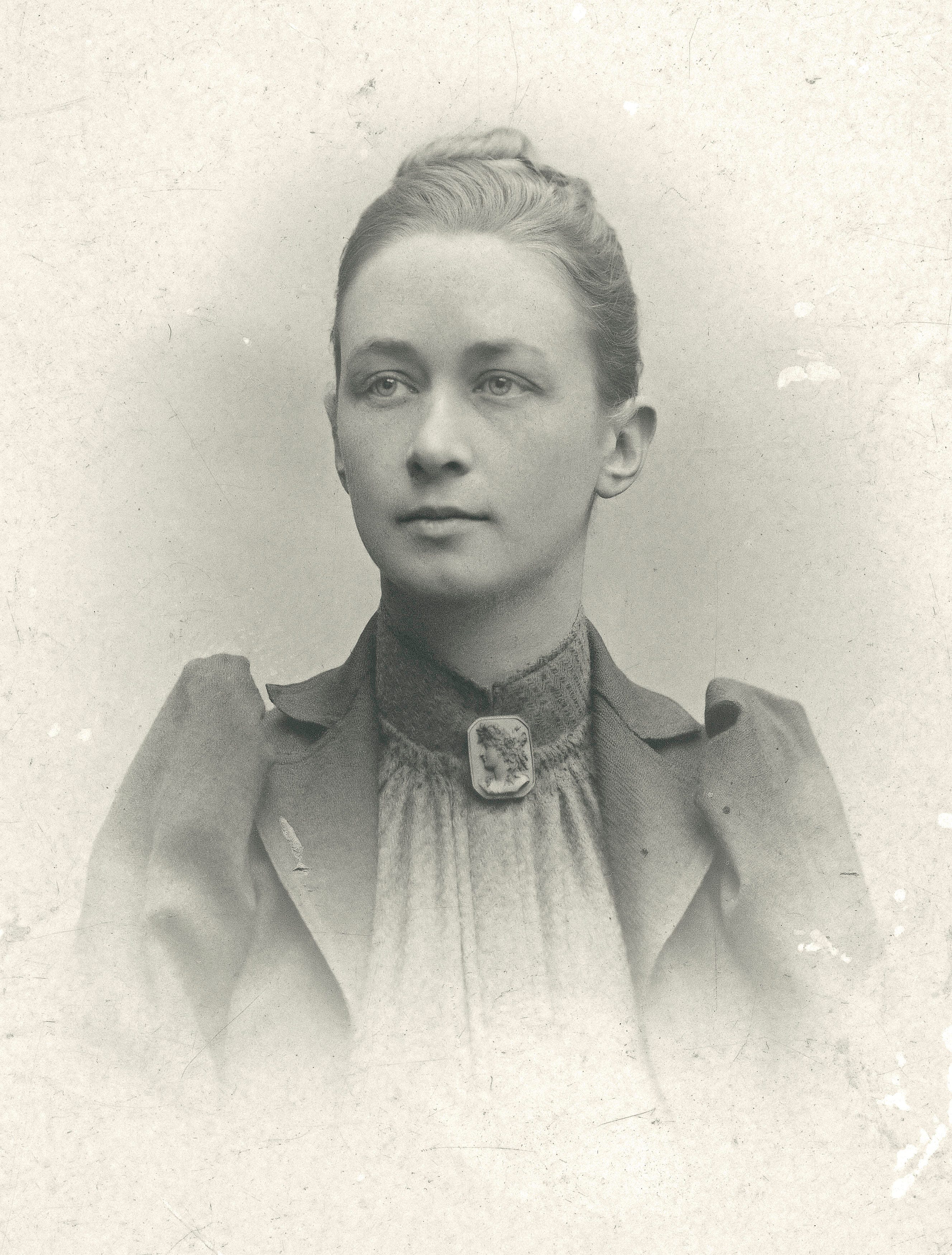
Who Was Hilma af Klint Before the Temple
She trained at Sweden's Royal Academy of Fine Arts in Stockholm, one of the first women to get a full academic education there.
For most of her working life, the public Hilma af Klint painted landscapes, botanical studies and portraits. Competent, sellable work that paid her bills.
None of that prepared anyone, including her own family, for what she was doing in private.
A Group of Five Women Who Talked to Spirits
In 1896 she started meeting with four other women in Stockholm: Anna Cassel, Cornelia Cederberg, Sigrid Hedman and Mathilda Nilsson.
They called the group The Five.
Every week they gathered, prayed, and tried to reach beings they called the High Masters. One of them served as medium for the session and produced automatic drawings, images that came through her hand rather than her own conscious choices.
Af Klint kept these session notebooks for over a decade. Symbols, geometric fragments, letters from an alphabet nobody in the group had drawn before it appeared through their hands.
In 1904, two of these spirits, Georg and Ananda, asked The Five to build a temple. Two years later, a spirit named Amaliel gave af Klint the real assignment. Paint the walls of that temple herself.
That commission grew into 193 works known as The Paintings for the Temple, made between 1906 and 1915. The Ten Largest is the second group inside that much bigger project.
Ten Canvases in About Six Weeks
Af Klint began the first canvas in the autumn of 1907 and finished the tenth roughly forty days later.
Each painting measures about 328 by 240 centimeters. Stand next to one and it is taller than two grown men stacked on each other's shoulders.
She worked on the studio floor, mixing huge batches of paint by hand, moving between multiple canvases as the shapes told her, in her own account, what they needed to become next.
The series follows four life stages. Paintings one and two cover childhood, on a blue background. Three and four cover youth. Five through eight cover adulthood, the largest cluster and the most crowded with color.
Nine and ten cover old age, on a pale pink ground that reads almost drained next to the earlier canvases.
What the Shapes Actually Mean
There are no people anywhere in these ten paintings. No faces, no bodies, nothing you would call a figure.
Instead you get spirals that resemble shells, looping vine forms, letters from a private alphabet, and round soft shapes that read as flowers or cells depending on how close you are standing.
Af Klint left some of her own keys to this language. Blue and the lily stood for what she called the feminine principle. Yellow and the rose stood for the masculine principle.
In her system, childhood was a stage where those two principles had not separated yet. That is part of why the earliest canvases feel the most tangled and fused.
By adulthood the shapes spread out and get more confident, more spacious. By old age they thin out again, the color goes pale, and the composition opens into more empty ground.
She was not illustrating four people getting older. She was mapping what she believed happens to a soul moving through a life, according to the spirits she said she was in contact with.
Painted Years Before Kandinsky
Wassily Kandinsky usually gets credit as the first abstract painter in the West, based on a watercolor from around 1911.
Af Klint was doing this in 1906 and 1907. Four or five years earlier, drawing from many of the same sources later abstract painters would cite as inspiration too. Theosophy, séances, the belief in a hidden order behind the visible world.
The real difference is not the work. It is that Kandinsky showed his. Af Klint did not.
That gap between made first and credited first is most of the reason her name took a century to catch up with her paintings.
Why She Hid Them for Twenty Years
Af Klint left clear instructions in her will. Her paintings for the temple were not to be shown for twenty years after her death.
She died in 1944. Her nephew inherited more than a thousand works and mostly kept them in storage, out of public view.
It actually took much longer than twenty years for the world to see them properly. They stayed largely unknown until a landmark exhibition, The Spiritual in Art, opened at the Los Angeles County Museum of Art in 1986.
It took until 2018, with a retrospective at the Guggenheim in New York called Hilma af Klint: Paintings for the Future, for her to become one of the most visited artists in that museum's history.
She thought people were not ready for these paintings during her own lifetime. Given how long it took even after her death, she was probably right.
Where to See The Ten Largest Today
The Ten Largest usually live at the Moderna Museet in Stockholm, home to the largest af Klint collection anywhere.
They travel for major exhibitions occasionally, including a dedicated show at the Guggenheim Bilbao. Because of their size and fragility, they do not travel often, so check a museum's current schedule before planning a trip around them.
If you cannot get there in person, high resolution scans exist online. They are not a substitute for standing in front of a three meter canvas, but they do let you study the color shifts between the four life stages up close.
A Trained Painter With a Private Practice
What makes af Klint's story different from most outsider art narratives is that she was not untrained or isolated from the art world.
She had a full academic education, professional standing, and exhibited work under her own name for decades.
The Ten Largest came out of a separate part of her life, one she never expected the public to see. A technically skilled painter using a disciplined, almost procedural method to paint what she believed a spirit had instructed her to paint.
That combination, discipline plus conviction, is why the series still holds up as something more than a historical curiosity.
More Overlooked Women Artists
Af Klint's name took a century to catch up with her work. These three artists had a similar fight for recognition.
Frequently Asked Questions
What does The Ten Largest by Hilma af Klint mean? The ten canvases represent childhood, youth, adulthood and old age through abstract shapes rather than human figures, based on ideas af Klint said came from a spirit guide during séances.
When did Hilma af Klint paint The Ten Largest? She painted all ten canvases in 1907, finishing the series in about six weeks.
Why are the paintings so large? Af Klint said the scale was part of what the spirits asked for. Standing close to a canvas that size makes you feel surrounded by color rather than simply viewing it from a distance.
Did Hilma af Klint really believe in spirits? Yes. She was part of a group called The Five who held regular séances for over a decade before she began this abstract work.
Was Hilma af Klint the first abstract painter? Her spiritual abstract work predates Wassily Kandinsky's first widely recognized abstract watercolor by four to five years, though she was not shown publicly at the time.
Why did Hilma af Klint hide her paintings? She believed the world was not ready to understand them and left instructions that they stay unseen for twenty years after her death.
Where can I see The Ten Largest today? The series belongs to the Moderna Museet collection in Stockholm and occasionally travels to major exhibitions elsewhere.
What do the colors in The Ten Largest represent? Af Klint used blue and the lily for what she called the feminine principle, and yellow and the rose for the masculine principle.