What Does A Sunday on La Grande Jatte Mean?

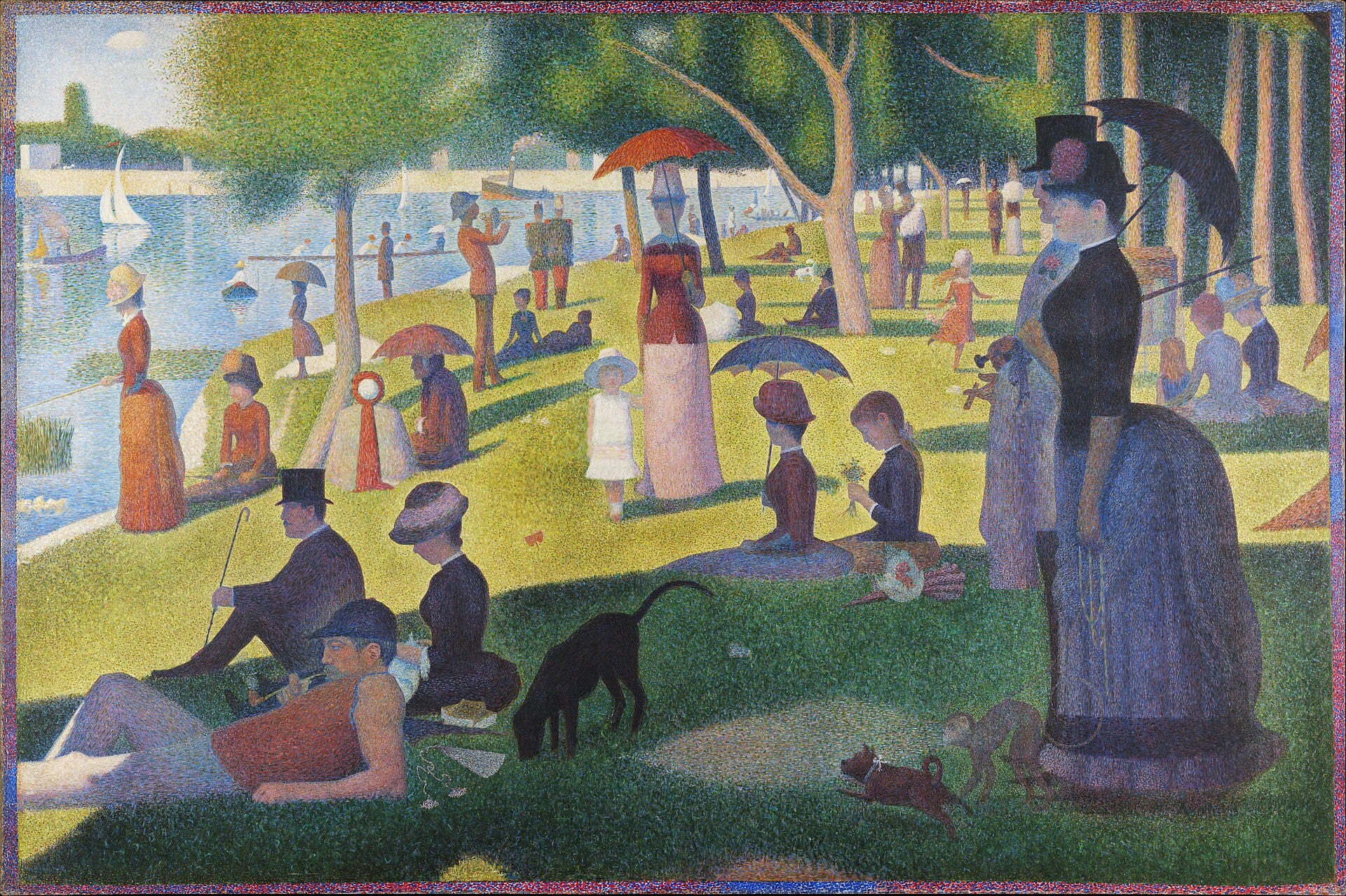
A Sunday on La Grande Jatte shows Parisians from several classes sharing an afternoon on an island in the Seine.

Georges Seurat spent two years building the scene from thousands of small dots of pure color, a method later called pointillism, turning an ordinary park outing into a deliberately still, almost frozen study of modern leisure.

What strikes me about this painting is how often people call it relaxing, when Seurat built something closer to a held breath. Nobody in that park is actually enjoying themselves in a loose way, everyone is posed, facing away from each other, holding still for a moment that never happened all at once. I do not think that is an accident of technique. Two years is a long time to spend on a Sunday, and I think Seurat used that time to turn a casual outing into a kind of class chart, dressed up as a picnic. The monkey joke tells me he knew exactly what he was doing and was not above hiding it in the crowd.

Georges Seurat's large pointillist canvas showing Parisians of mixed classes relaxing on the banks of the Seine
A Sunday on La Grande Jatte, oil on canvas, 1884 to 1886, Art Institute of Chicago.

Learn art the fun way. Free stories every week, no boring lectures.


A Painting That Took Two Years To Say One Thing

A Sunday on La Grande Jatte 1884 shows an ordinary afternoon on an island in the Seine, just outside Paris, and it sits at the center of the complete story of Georges Seurat's short career.

It is enormous, close to seven feet wide, built for a room where visitors need to step back to let the dots resolve into a park scene.

The painting has lived at the Art Institute of Chicago since 1924, not in Paris.

Pointillism, Explained Without The Jargon

Seurat called his method chromo luminarism. Painters and critics later renamed it pointillism, then Neo Impressionism.

Instead of mixing paint on the palette, Seurat placed small dots of pure, separate color side by side. Standing close, the canvas looks like static. Standing back, the eye blends the dots into shape and light.

The method borrowed directly from contemporary color theory, particularly the idea that colors placed next to each other mix optically, more vividly than pigments mixed by hand.

Who Is Actually In The Park

Around forty figures fill the canvas, spanning several classes at once: nurses, soldiers, a factory worker's family, a well dressed couple, children, a dog, a monkey on a leash.

Several are read as Parisian stereotypes rather than individuals: the bustle and parasol of high fashion beside a bare chested rower, an office clerk beside a woman fishing at the water's edge.

The mixed cast is part of the point. A Sunday on the Grande Jatte was one of the few places where Paris's classes shared the same patch of grass.


More Impressionist And Post Impressionist Stories


The Frozen Quality People Notice First

Almost nobody in the painting moves. Figures stand at odd angles, facing away from each other, caught mid gesture and then locked there.

Seurat was not aiming for a snapshot. He wanted, in his own words, to make modern people file past the viewer in essential form, closer to a Greek frieze than a candid photograph.

That stillness reads to some viewers as calm, and to others as a quiet critique, a rigid version of leisure matching a society that kept its classes politely apart even while sharing a park.

Close detail of a fashionably dressed woman walking a monkey on a leash in the foreground of the painting
The pet monkey beside a fashionable woman has long been read as a period joke about respectability.

The Woman Fishing And The Monkey On A Leash

Two details carry more weight than they first appear to. A woman fishing at the water's edge was contemporary slang for solicitation.

Nearby, a fashionable woman holds a monkey on a leash. In French, singesse, a female monkey, was period slang for a woman of loose morals, and art historians read the pairing as a quiet joke about respectability on display.

Seurat never explained these choices directly, so the reading stays an interpretation, not a confirmed key. It fits the painting's habit of hiding its sharpest observations in plain sight.


Cool Stories About Art is a free newsletter. The stories behind the paintings, straight to your inbox.


Why The Technique Mattered As Much As The Scene

The painting arrived in 1886 at the eighth and final Impressionist exhibition, where it effectively announced a new movement rather than closing out the old one.

Seurat's science based approach to color put him at odds with the Impressionists' looser, faster brushwork, even though both groups worked from real modern life.

How Long It Actually Took

Seurat made dozens of preparatory drawings and oil sketches, studying the island and its visitors in different seasons before starting the final canvas.

The full work took roughly two years, an unusually long process for a single canvas in the 1880s, matching Seurat's method: nothing in the final composition is improvised.

Portrait of the painter Georges Seurat
Georges Seurat spent about two years building the canvas from small dots of pure color.

Where To See It And Why It Still Draws Crowds

The Art Institute of Chicago has held the painting since 1924, and it remains one of the most visited works in the museum's collection.

Its scale and precision reward the walk that most museum labels ask for, close enough to see the dots, far enough to see the park.


More stories to fall into


The Art Institute of Chicago, home to A Sunday on La Grande Jatte
The Art Institute of Chicago has held the painting since 1924.

Frequently Asked Questions About A Sunday on La Grande Jatte

  • What does A Sunday on La Grande Jatte mean?
    It shows Parisians of different social classes sharing a Sunday afternoon on an island in the Seine, painted with a scientific dot technique that turned an ordinary scene into a carefully built study of modern leisure and class.

  • What is pointillism?
    Pointillism is a painting method built from small dots of pure, unmixed color placed side by side, so the viewer's eye blends them into shape and light from a distance, rather than the paint being mixed on a palette.

  • How long did Georges Seurat spend on this painting?
    Close to two years, including dozens of preparatory drawings and oil studies of the island and its visitors, before he began the final large canvas.

  • Why does everyone in the painting look so still?
    Seurat wanted a timeless, frieze like effect rather than a candid snapshot. The stiffness has also been read as commentary on a rigid, class divided society enjoying the same park without truly mixing.

  • What does the monkey in the painting symbolize?
    A fashionable woman walks a monkey on a leash in the foreground. In period French slang, singesse, meaning female monkey, referred to a woman of loose morals, which art historians read as a quiet joke about respectability.

  • Where is A Sunday on La Grande Jatte located today?
    It hangs at the Art Institute of Chicago, where it has been part of the collection since 1924.

  • Is A Sunday on La Grande Jatte an Impressionist painting?
    No. It debuted at the final Impressionist group exhibition in 1886, but its scientific color technique launched a separate movement, later called Neo Impressionism or pointillism.

  • How big is the painting?
    It measures close to seven feet wide, large enough that the museum room is built to let visitors step back and watch the dots resolve into figures.


Join 170,000 readers learning art the fun way. Free stories every week, no boring lectures.