What Do Almond Blossoms by Van Gogh Mean?

He painted it for his newborn nephew's bedroom wall, and his family never let it go.

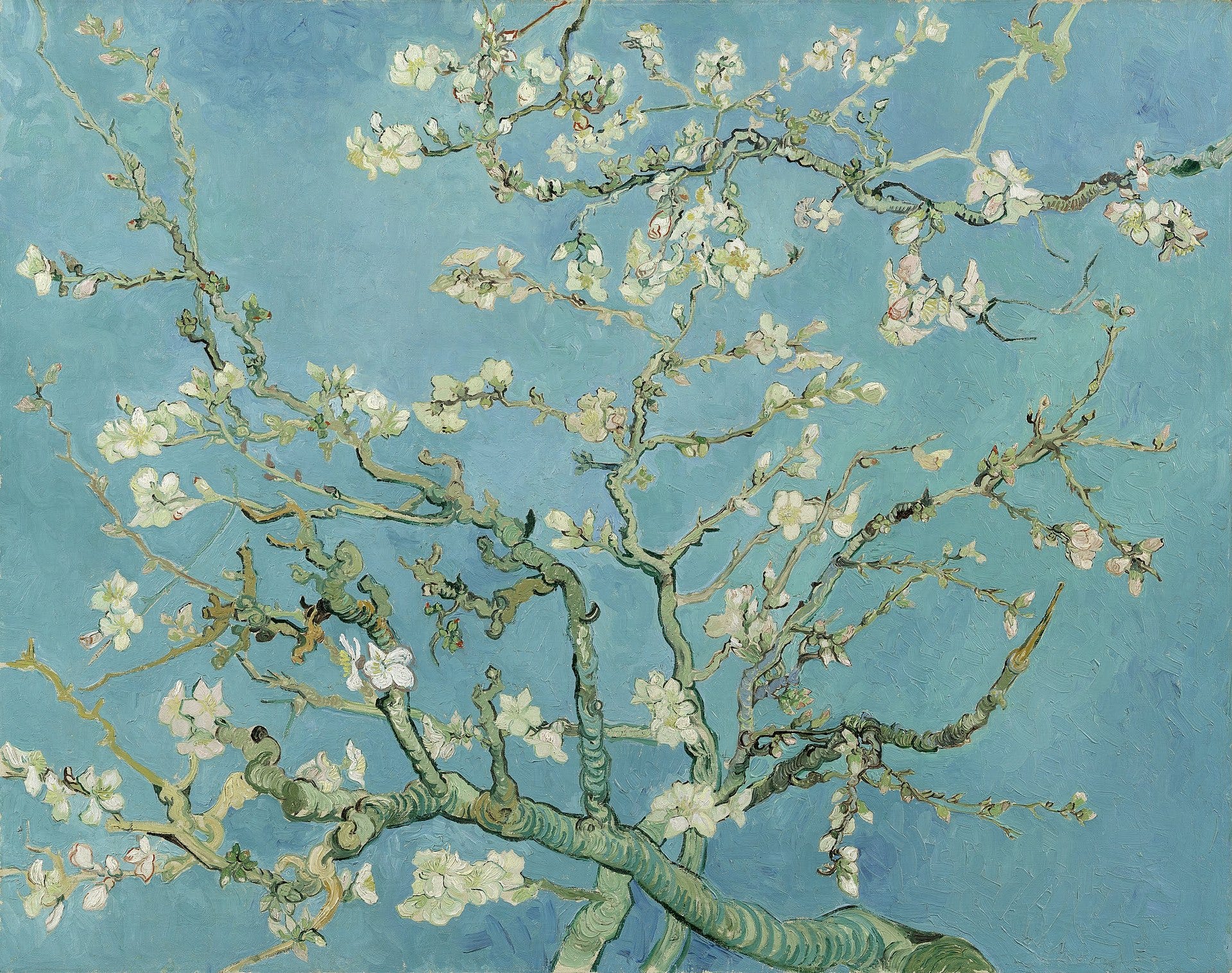
Van Gogh painted Almond Blossoms in February 1890 as a birth gift for his newborn nephew. He filled it with white blossoms against blue sky, borrowing Japanese print style, and made something rare for him: a painting with no sadness in it.

Van Gogh almond blossoms against blue sky
Vincent van Gogh, Almond Blossoms, 1890.

He was living at the Saint Paul de Mausole asylum in Provence when the news reached him. Within days he had already chosen the subject and the colors.

  • Painted: February 1890, at Saint Remy de Provence

  • Made for: The birth of his nephew, Vincent Willem van Gogh

  • Now in: The Van Gogh Museum, Amsterdam


Ten minutes, one masterpiece. That is the deal. 170,000 readers already took it, free.


More Van Gogh Stories Worth Your Time

If Almond Blossoms pulled you in, these dig even deeper into the same five years:


A picture made for one crib, not for sale

On 31 January 1890, Theo van Gogh wrote to his brother Vincent with the best news he had in years. His wife Jo had given birth to a son, and they had named the boy Vincent, after his uncle.

Vincent was living at the Saint Paul de Mausole asylum in Saint Rémy de Provence at the time, working through one of the hardest stretches of his life. He wrote back to their mother about how the news had landed on him.

He admitted he would have preferred the boy carry their late father's name instead of his own. But since it was done, he told her, he started right away on a picture for the child's bedroom: big branches of white almond blossom against a blue sky.

That is the whole brief he set for himself. Not a grand statement, not a message to the art world. A picture for a wall a baby would see first thing every morning.

Van Gogh bedroom in Arles interior
Vincent van Gogh, The Bedroom, 1888.

What he wanted to give the boy that nobody gave him

Van Gogh's own childhood and adult life were nothing like carefree. By 1890 he had already spent time in and out of psychiatric care, survived on Theo's money for years, and sold almost nothing of his own work.

Several of his biographers read Almond Blossom as an attempt to hand his godson the one thing life had withheld from Vincent himself: an open, hopeful start. Whether or not that was his conscious intention, the picture reads that way.

There is no darkness worked into it, none of the thick anxious brushwork you find in his skies from the very same year.

It is, by his own late standard, an unusually calm painting. Almost guarded, in how little it lets show.

Why an almond tree, and not a rose or an iris

Almond trees are the first thing to flower in Provence, often while snow still sits on the ground and every other tree in the orchard looks dead. Van Gogh had already painted a whole run of blossoming orchards two years earlier, right after he arrived in Arles in the spring of 1888.

Apricot, peach, and plum trees all came into flower within weeks of each other that year, and he tried to catch nearly all of them.

Fourteen paintings of blossoming fruit trees in about a month, sometimes finishing a canvas a day, among them the Pink Orchard, Peach Tree in Blossom, and Orchard in Blossom Bordered by Cypresses.

The 1890 almond picture is different from those Arles orchards. There is no ground, no horizon, no rows of trees receding into the distance. Just branches, filling the frame, reaching past its own edges as if the tree kept growing beyond what the canvas could hold.

That framing was not an accident. The branches sit so close to the viewer that they recall a line from Delacroix that Van Gogh admired, the idea that even a part of a thing can be a complete entity in itself.

Van Gogh had used that same trick two years earlier, in March 1888, when unexpected snow in Arles kept him indoors and he painted small studies of a single almond branch in a glass instead of a whole orchard.

Vincent van Gogh, a sprig of blossoming almond branch in a glass, oil study, 1888
Vincent van Gogh, Blossoming Almond Branch in a Glass, 1888.
Van Gogh cafe terrace at night in Arles
Vincent van Gogh, Cafe Terrace at Night, 1888.

He wrote to his sister around that time about wanting as much serenity as possible, even while knowing almost nothing for certain, calling it a better remedy for every kind of trouble than anything sold at a chemist's shop.

Almond Blossom, painted two years later for a newborn rather than for himself, is that same idea taken as far as he ever took it.

Van Gogh had been collecting Japanese woodblock prints since his years in Paris, and he called their influence on his own work Japonaiserie. He admired printmakers like Hiroshige the way he admired Rembrandt or Vermeer, which for him was about as high a compliment as art could get.

You can see that admiration directly in Almond Blossom. Flat color instead of shading. Dark outlines holding each branch in place. No cast shadows anywhere on the canvas.

His biographer Steven Naifeh has even traced a possible chain of influence behind the composition, running from a Hokusai woodblock of a bullfinch and a weeping cherry tree, through a painting by his friend John Russell, and into this canvas. Van Gogh rarely built a picture from nothing.

He built it from everything he had looked at for years. That borrowing ran in a direct line, from Delacroix's writing on color, through Hiroshige's woodblock prints, to the branches filling this canvas.

The myth that this was his last painting

People repeat this one constantly, and it simply is not true. Almond Blossom was finished in February 1890. Van Gogh did not die until the end of July that year, in Auvers sur Oise, roughly a hundred and thirty miles north of where he painted the almond branches.

In his last ten weeks alone, working at a pace that still amazes historians today, he is thought to have completed around seventy more paintings. Almond Blossom was not a farewell.

It was closer to the opposite: a picture made in a rare stretch of hope, five months before the end most people assume came right after it.

The confusion probably comes from a different canvas, Wheatfield with Crows, which is often mistakenly called his final work simply because its mood fits the story people want to tell about his death.

Almond Blossom sits at the other end of that same year, made when he still had a young family to paint for and, by his own account, real reasons for hope.

The blue that holds the whole thing together

Strip away the backstory and the picture still works purely as color. The sky is a flat, saturated blue with none of the atmospheric fade you would expect from a real Provençal afternoon.

Against it, the white blossoms nearly glow, held in place by dark, almost calligraphic outlines around every branch and bud.

It is a tightly controlled painting from an artist whose late work is usually remembered for the opposite: loose, urgent brushwork and skies that seem to move on their own. Here, everything stays still.

This was a picture meant to hang in a child's room for years, not to unsettle anyone who walked past it.

Van Gogh starry night swirling sky
Vincent van Gogh, The Starry Night, 1889.

Where it lives now, and why it stayed in the family

Theo died just six months after Vincent, and it was Jo who spent the rest of her life building her brother in law's reputation, one letter and one loaned painting at a time.

Almond Blossom stayed with her, then passed down through the family, and is now part of the permanent collection at the Van Gogh Museum in Amsterdam, the very institution most shaped by Jo's decades of quiet work.

It is often singled out as the painting closest to the family's heart, which is a strange thing to say about an artist mostly remembered for suffering. Jo herself is the reason we know most of what we know about Vincent at all.

She edited and published his letters, organized the first major exhibitions of his work, and turned a painter almost nobody bought while he lived into one of the most recognized names in art history within a couple of decades of his death.

If you are new to reading paintings this way, through the person they were made for rather than only the artist who made them, our list of ten artists you need to know is a good next stop.


One painting. One story. Every week. Free, with 170,000 readers who never sat through an art history lecture.


More Secrets to Unlock

A few more paintings worth taking apart the same way:


Still curious? 170,000 readers get one painting explained like this every week, free.


Frequently Asked Questions

  • What does Almond Blossoms by Van Gogh mean? It was painted in February 1890 as a birth gift for his newborn nephew, Vincent Willem, using the flat colors and dark outlines of Japanese prints to make an image of hope rather than the turmoil found in much of his other late work.

  • When did Van Gogh paint Almond Blossoms? He started it in February 1890, at the Saint Paul de Mausole asylum in Saint Rémy de Provence, right after learning that his brother Theo and sister in law Jo had had a son.

  • Who was Almond Blossoms painted for? His nephew, Vincent Willem van Gogh, born in January 1890 and named after his uncle. Van Gogh intended the picture to hang above the baby's bed.

  • Where is Almond Blossoms today? It is part of the permanent collection of the Van Gogh Museum in Amsterdam, an institution largely built out of Jo van Gogh Bonger's decades of work promoting her brother in law's paintings and letters.

  • Was Almond Blossoms Van Gogh's last painting? No. He finished it in February 1890 and kept painting until his death that July, completing dozens more works, including around seventy in his final ten weeks at Auvers sur Oise.

  • Why are there no leaves on the almond tree in the painting? Almond trees bloom before their leaves appear, flowering earliest of all the fruit trees in Provence, often while snow is still on the ground. That is exactly what Van Gogh painted.

  • What art style influenced Almond Blossoms? Japanese woodblock prints, a style Van Gogh called Japonaiserie. The flat color, dark outlines, and absence of shadow all borrow directly from printmakers like Hiroshige, whom he collected and admired.

  • How many almond blossom paintings did Van Gogh make? Almond Blossoms refers to a small group of paintings made in 1888 and 1890. The most famous, the one painted as a gift for his nephew, is the 1890 canvas now in Amsterdam.


That is Almond Blossoms, decoded. Get the next one free, alongside 170,000 readers.