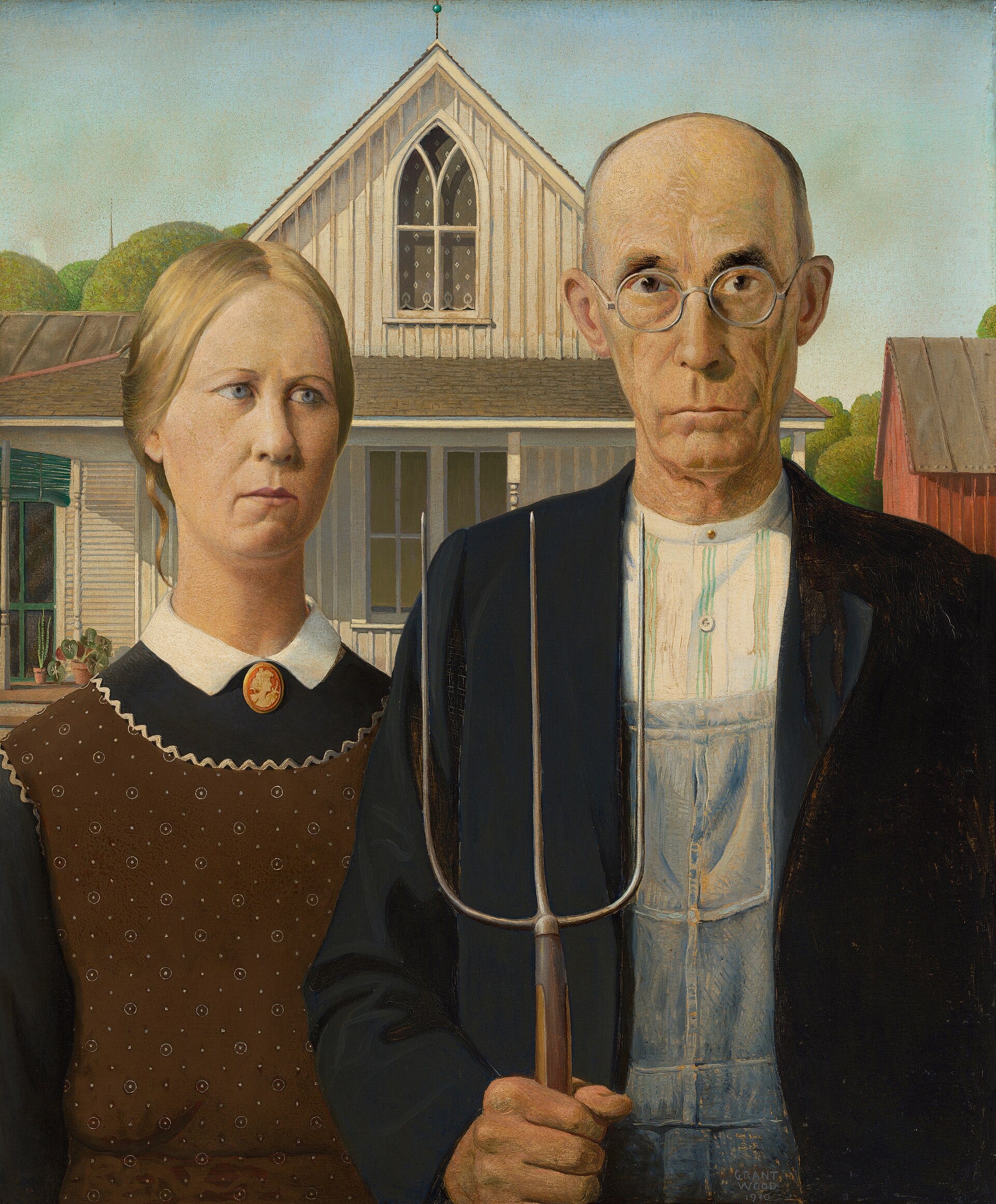
American Gothic shows a farmer holding a pitchfork beside a woman long assumed to be his wife, though Grant Wood said she was his daughter.
Painted in 1930 in front of a real Eldon, Iowa farmhouse, the picture is deliberately ambiguous, read by different viewers as satire of rural life and as a tribute to it.
Everyone calls this a portrait of a farm couple, and almost everyone gets that wrong. Grant Wood was specific about it. The two figures are father and daughter, not husband and wife.

It Is a Father and Daughter, Not a Married Couple
Grant Wood described the two figures in American Gothic as a farmer and his unmarried daughter, not spouses standing together in front of their home.
The models reinforce that reading. The woman was Wood's own sister, Nan Wood Graham, and the man was Byron McKeeby, the Wood family dentist, roughly three decades older than Nan.
The mistaken couple reading has stuck for generations anyway, largely because the pair stand close together in a pose that looks marital at a glance.
Wood reportedly grew frustrated by the couple assumption during his lifetime, since it changed how audiences read the tone of the whole picture, from family portrait to marriage satire.
The House Gave the Painting Its Title
Wood spotted the house first, a small white home in Eldon, Iowa, built in a style called Carpenter Gothic, which borrowed pointed arched windows from European Gothic cathedrals and translated them into wood frame construction.
He sketched the house, then invented the two figures to stand in front of it. The title refers to the architecture, not to the people in front of it.
That order matters. The building came first in Wood's imagination, and the people were added afterward to complete the scene he wanted to paint.
Carpenter Gothic houses like this one were common across small Midwestern towns in the period, built by local carpenters copying grander stone originals from Europe using cheaper wood and simpler tools.
Wood was reportedly precise about proportions when building the composition, stretching the man's face slightly to match the vertical lines of the window above him, a small distortion most viewers never consciously notice.
The Pitchfork Echoes the Window
The three pronged pitchfork the farmer holds repeats the shape of the pointed gothic window directly above the house's front porch.
The same triple pointed pattern shows up again in the stitching on the man's overalls. Wood built the repetition into the picture on purpose, not by accident.
It ties the man to the house visually, suggesting he belongs to this architecture as much as the house belongs to him.
Some critics have also read the pitchfork as a marker of stubborn, defensive posture, a farmer guarding his home and his daughter from an outside world he distrusts.
More Stories on American Art and Realism
Satire or Tribute? Wood Refused to Settle It
When American Gothic won a prize and started circulating nationally, many viewers, including plenty of Iowans, read it as mockery of narrow minded rural life.
Wood pushed back on that reading for the rest of his life. He said he intended a sincere, respectful image of the people who had raised him in Iowa.
He also admitted there was some satire in it, but added that any honest, realistic picture carries a bit of satire simply by showing things as they are.
Letters from angry Iowa residents at the time accused Wood of turning their state into a joke, and he answered several of them personally, defending his intentions.
A Depression Era Symbol of Endurance
American Gothic was completed in 1930, months after the stock market crash that opened the Great Depression across the United States.
For many viewers over the following decade, the stern, upright pair came to stand for a kind of plain, unbroken resolve, people who would keep working no matter what the economy did.
That reading helped the painting outlast the controversy over its tone. It became shorthand for steady rural endurance just as much as for any joke about it.
The timing was not planned. Wood painted it before the crash fully reshaped public mood, yet the picture absorbed that new meaning almost immediately once the Depression set in.

Where the Real House Still Stands
The Dibble House in Eldon, Iowa, the building that inspired the painting, still exists and is open to visitors today.
It sits much as it did when Wood first saw it, a modest frame house with the same distinctive upper window intact.
A small museum nearby displays material related to the painting's making, including photographs and props used for reenactment portraits by visiting tourists.
How the Painting Became a Cultural Shorthand
Almost as soon as it became famous, American Gothic started getting copied, parodied and referenced in advertising, film and album covers.
The pose is instantly recognizable even to people who could not name the artist, which is part of why it keeps getting borrowed for new jokes.
That afterlife in pop culture has arguably done more to spread the image than any museum wall label ever could on its own.
What to stop believing
The two figures are not husband and wife, whatever the composition suggests at a glance to a casual viewer.
The painting was not made as a direct attack on any specific real family or town, despite the backlash from some Iowans who felt caricatured by it.
And it was not painted purely as comedy either. Wood's own statements point to genuine respect sitting alongside the satire, not one canceling out the other.
More paintings, more stories
American Gothic Frequently Asked Questions
Are the two people in American Gothic married?
No. Grant Wood described them as a farmer and his daughter, not husband and wife standing together.Who posed for American Gothic?
Wood's sister Nan Wood Graham posed as the daughter, and the family dentist, Byron McKeeby, posed as the farmer holding the pitchfork.What does American Gothic mean?
Wood left the meaning deliberately open. Many viewers read it as satire of narrow rural life, while Wood himself described it as a sincere tribute to Midwestern endurance.Where is the house from American Gothic?
It is the Dibble House in Eldon, Iowa, and it still stands today, open for visitors to see up close.Why does the man hold a pitchfork?
Its three prongs echo the shape of the gothic window on the house and the stitching on his overalls, tying the man visually to the building.Is American Gothic satire?
Wood said there was some satire in it, the same way any honest realistic picture carries a bit, but he denied that mockery was his main goal.When was American Gothic painted?
In 1930, shortly after the start of the Great Depression, though before its full effects had reshaped American life.Where can I see American Gothic today?
It is held by the Art Institute of Chicago, where it remains one of the most visited paintings in the collection.