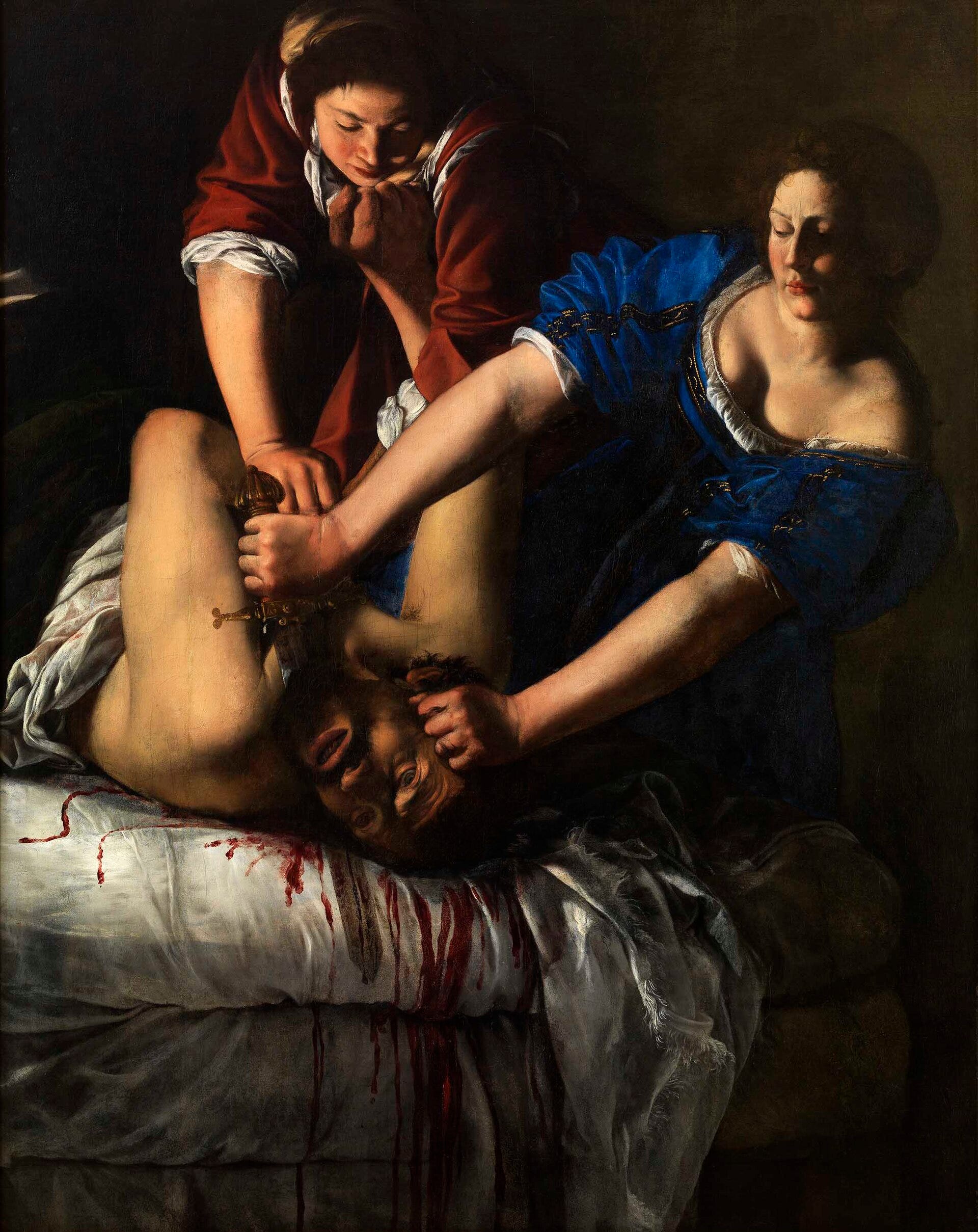
Artemisia Gentileschi painted Judith Beheading Holofernes twice, in the years of her own rape trial. A third disputed Judith, found in Ferrara, was scanned with imaging that found reworking around the face.
Most painters before her kept Judith at a polite distance from the blood. Gentileschi put the viewer close enough to feel the struggle.
Date: First version around 1612 to 1613, second version around 1620
Medium: Oil on canvas
Location: First version in the Museo di Capodimonte, Naples. Second version in the Uffizi Gallery, Florence
More Women Who Painted on Their Own Terms
Gentileschi was not painting in a vacuum. These three stories belong next to hers.
A Trial Before the Second Brushstroke
In 1611, a tutor named Agostino Tassi raped Artemisia Gentileschi, 17 at the time. Her father Orazio pressed charges in 1612. The seven month trial included Gentileschi being tortured with thumbscrews to test her testimony. Tassi was convicted but barely punished. She began her first Judith during this same period.
Tassi was already married when he assaulted her, a fact that came out during testimony and undercut his defense in court.
Orazio filed the complaint only after Tassi refused to marry his daughter, the era's usual fix for such crimes.
Two Different Judiths
Gentileschi painted this subject twice, seven years apart. The Naples version from 1612 shows Judith and her maid Abra leaning their full weight into the kill. The Florence version from 1620 tightens the composition but keeps the same raw violence. She never softened the scene. She sharpened it instead.
What strikes me is that line, she never softened the scene, she sharpened it instead. It reads like a decision, not an accident.
Judith's sleeve is pushed up past the elbow in both versions, and her maid Abra grips Holofernes down by his shoulder in both, changes that keep the physical struggle at the center of the composition rather than in the background.
Blood spatters the sheets in both paintings, arcing away from the body in thin lines rather than pooling quietly, a detail Caravaggio's version leaves out entirely.
How She Compares to Caravaggio
Caravaggio painted his own Judith Beheading Holofernes around 1599, a version Gentileschi likely knew since her father moved in the same Roman circles as Caravaggio. His Judith stands back at arm's length, hesitant. Gentileschi's Judith and her maid instead push down together with their full weight, turning distance into contact.
Caravaggio gives Holofernes an open mouth mid scream, his hands still gripping the sheets. Gentileschi keeps his arm raised instead, caught in the act of pushing back against the women holding him down.
Both paintings use the same tenebrist lighting that Caravaggio helped popularize in Rome, but Gentileschi's canvas puts two women's bodies at the physical center of the action instead of one man's face.
To me the real difference from Caravaggio is not the violence. It is whose body the picture asks you to watch.
A Third Judith Still Being Tested
A painting showing Judith exposing the head of Holofernes surfaced in Ferrara and is attributed to Gentileschi, though a near identical composition exists credited to her father Orazio. Raking light, ultraviolet imaging, and radiography all focused on Judith's face, the one area of the canvas that had been reworked most, and restorers spent the twentieth century repairing exactly that spot.
The Ferrara canvas is not the Naples or Florence version. It shows a different moment, Judith holding up the severed head rather than cutting it off, and its authorship is still debated among specialists.
Technical analysis found that the paint layers around the face carry different material than the rest of the canvas, evidence of reworking done in the same period rather than centuries later.
A Career Built on Her Own Terms
After the trial and an arranged marriage, Gentileschi moved to Florence, where in 1616 she became the first woman admitted to the Accademia delle Arti del Disegno. She went on to work for the Medici court, then in Rome, Venice, London, and Naples, running her own workshop for four decades.
She married Pierantonio Stiattesi shortly after the trial, a match arranged partly to restore her reputation, and the couple moved to Florence within the year.
Her Florence membership gave her legal independence to buy paint and sign contracts without her husband's consent, a right most women painters of the period did not have.
A Self Portrait as a Martyr
Gentileschi painted herself many times, in many roles. Around 1615, she posed as a Christian martyr holding a palm branch, giving the figure the same steady, direct gaze she gave Judith. It is a quieter picture than the beheading scenes, proof that her range went well beyond one violent subject.
The martyr's palm branch is a stock attribute borrowed from centuries of Catholic painting, yet the face wearing it is unmistakably her own, a signature she repeated across several self portraits.
She painted the Allegory of Painting self portrait two decades later, a far more confident image of a working artist rather than a suffering saint, shown earlier on this page.
The Record Sale Nobody Saw Coming
In 2018, the National Gallery in London paid 3.6 million pounds for Gentileschi's Self Portrait as Saint Catherine of Alexandria, a record for the artist at auction. Two years later the same museum gave her a solo show, the first time in its history a woman painter had one to herself.
For most of the three centuries after her death, her paintings were misattributed to her father Orazio or to male contemporaries working in the same style.
The market only caught up to her reputation in the twenty first century, decades after art historians had already restored her name to the paintings.
The Revenge Story Is Too Simple
It is tempting to read both Judiths as pure revenge against Tassi. That is not the full picture. Gentileschi painted dozens of subjects across five decades, heroines, saints, and portraits with nothing to do with the trial, evidence of a long working career rather than one act of anger frozen in paint.
She painted Judiths, Susannas, and Cleopatras, along with portraits of noblewomen for patrons across Italy and England, a body of work far wider than the single trial that made her famous online today.
The torture she endured during questioning speaks to a legal system built to test a woman's testimony under pain, since a man's word rarely needed the same physical proof.
I think the violence in her Judiths gets more attention than the four decades of steady, well paid work that followed the trial, and that imbalance says as much about us as it does about her.
More Stories Worth Reading
A few more paintings that reward a second, closer look.
Frequently Asked Questions
Why did Artemisia Gentileschi paint Judith Beheading Holofernes twice?
She returned to the subject about seven years apart, once around 1612 in the period of her rape trial and again around 1620 in Florence, refining the composition each time without softening the violence of the scene.
Is the painting connected to her own assault?
Many historians read it that way, though Gentileschi never wrote that the painting was a direct response to her trial. What is documented is the timing: she began the first version around the same period as the case against Agostino Tassi.
How is her version different from Caravaggio's Judith?
Caravaggio's Judith stands at arm's length from Holofernes with a look of hesitation. Gentileschi has Judith and her maid physically pinning him down together, sleeves rolled up, both fully committed to the act.
What happened to Agostino Tassi after the trial?
He was convicted in 1612 but served little real punishment, a common outcome for such cases at the time. Artemisia, not her attacker, endured a public trial that included being tortured to test her testimony.
Where can I see the two versions today?
The first version, from around 1612, is in the Museo di Capodimonte in Naples. The second, from around 1620, is in the Uffizi Gallery in Florence.
Is the Ferrara Judith definitely by Artemisia Gentileschi?
Not with full certainty. A closely related composition is credited to her father Orazio, and researchers are still comparing paint layers and technique to settle the attribution.