What Does Bruegel's Netherlandish Proverbs Mean?

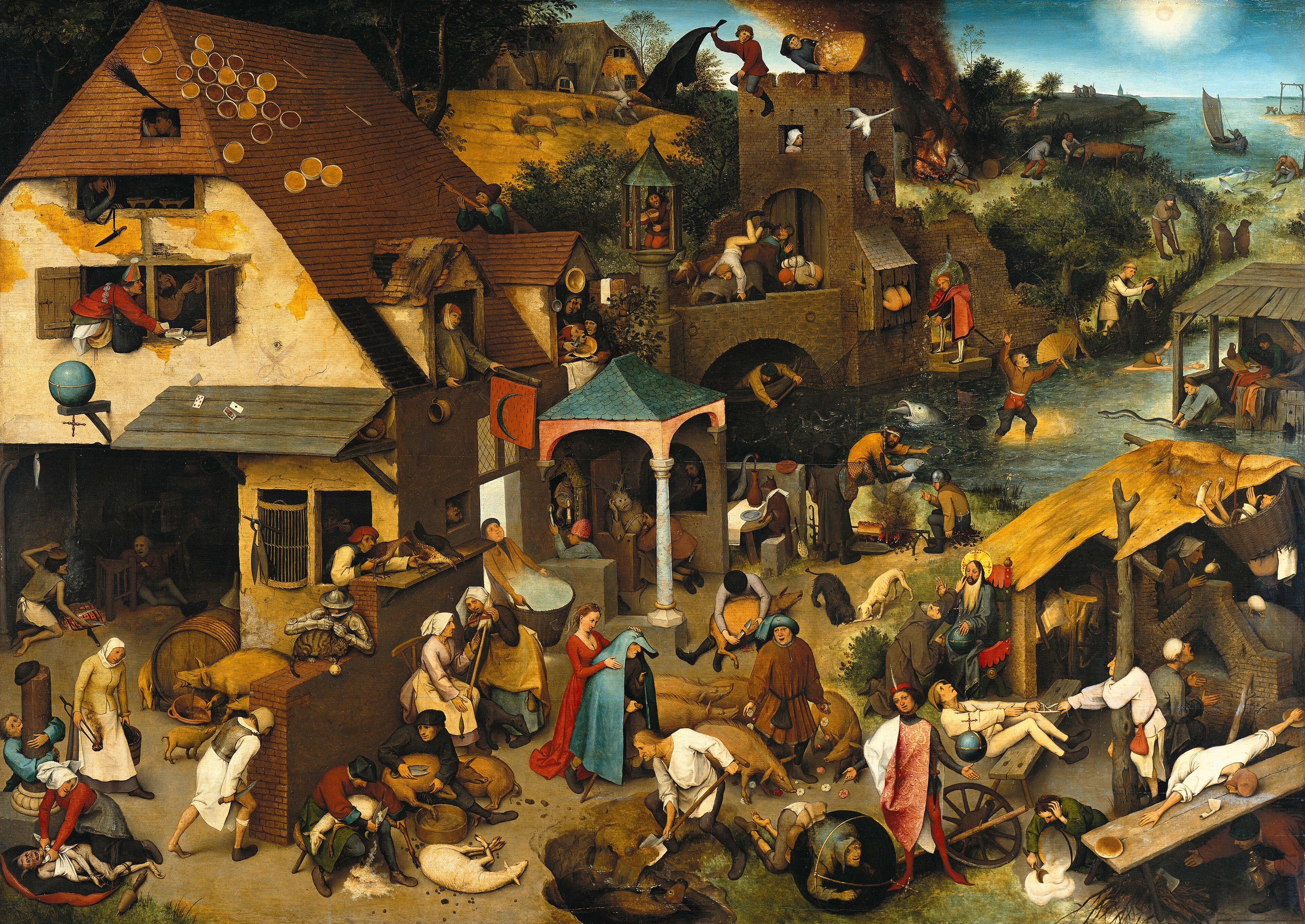
A man headbutting a wall, a globe hanging upside down, a wife covering her husband with a blue cloak. Bruegel packed over one hundred sayings into one busy village.

Pieter Bruegel packed more than one hundred Flemish proverbs into a single 1559 village scene, each one acted out literally. A man headbutts a wall. A globe hangs upside down from a building. A wife drapes a blue cloak over her husband, which meant she was deceiving him.

Netherlandish Proverbs painting
Pieter Bruegel the Elder, Netherlandish Proverbs, 1559.

Nothing in the painting is random. Every figure, animal, and prop in this crowded village is illustrating a saying people actually used in sixteenth century Flanders, some of which are still around today.

  • Date: 1559.

  • Medium and size: Oil on oak panel, 117.5 by 163.6 centimeters.

  • Location: Gemäldegalerie, Berlin.


Ten minutes, one masterpiece. That is the deal. 170,000 readers already took it, free.


More Northern Renaissance Puzzles Worth Solving

Bruegel loved hiding meaning in plain sight. These paintings reward the same close look.


A Village Built Out of Sayings

Bruegel sets his hundred plus proverbs inside a single invented Flemish village, not a real place but a composite of Antwerp style houses, a church, a castle, and a river, built purely so more than one hundred figures could each act out a saying at once. Nothing here illustrates a real town. It illustrates an idea: a whole community acting out its own foolishness in public, in broad daylight.

Bruegel sets the whole thing in one sprawling village, a river running through it, a church and castle in the distance. Over one hundred figures fill the space, and almost every one of them is a proverb given a body.

Seen from a distance it reads as ordinary village chaos. Look closer and each cluster of people is a punch line.

The World Turned Upside Down

The upside down globe hanging from a house front works as Bruegel's thesis for the whole panel. It is not one proverb among many, it is the key that unlocks the rest: a world running backward, values inverted, where foolish behavior has become so ordinary that nobody in the crowd even reacts to it anymore.

Near the center, an orb with a cross on top hangs upside down from a house front. It stands for the whole painting: a world where everything is backward and nobody seems to notice.

That single image gave the painting one of its other names among collectors: The Topsy Turvy World.

To me, that nickname says it best. Every joke in this village points back to the same idea, a world that has quietly gone backward without admitting it.

Netherlandish Proverbs painting detail
Netherlandish Proverbs, detail.

Fish Eating Fish, Walls Taking Headbutts

Two proverbs anchor this corner of the panel. A big fish swallows smaller fish, meaning the powerful devour the weak, and a man rams his head into a brick wall, meaning someone chasing an impossible goal anyway. Both sayings survive in English almost unchanged, nearly five centuries after Bruegel painted them.

In the water, a huge fish has smaller fish spilling out of its mouth, acting out big fish eat small fish. On land, a man rams his skull into a brick wall, showing what it looks like to try the impossible anyway.

Elsewhere someone ties a bell around a cat's neck, an old way of saying that a person has taken on a risky task out in the open, where everyone can see it coming.

Netherlandish Proverbs painting detail
Netherlandish Proverbs, detail.

One painting. One story. Every week. Free, with 170,000 readers who never sat through an art history lecture.


The Blue Cloak

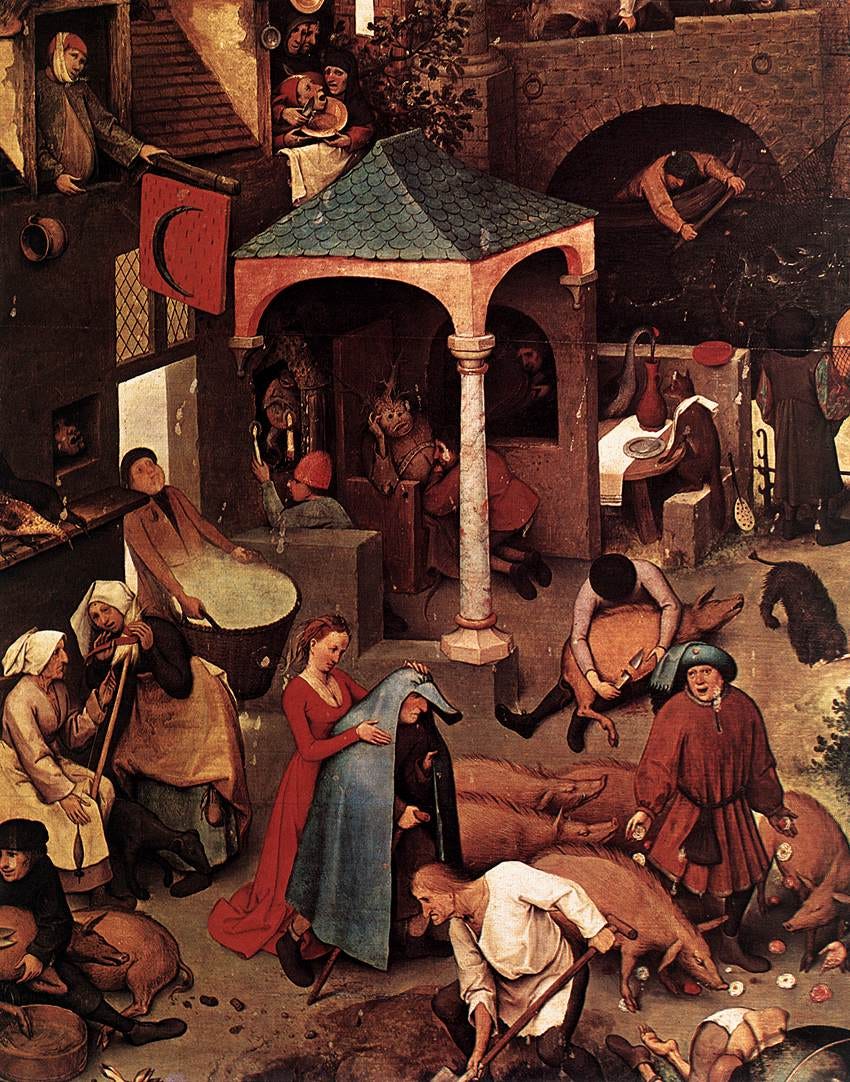
A woman settling a blue cloak over a seated man's shoulders gave the whole painting one of its early names. In sixteenth century Flemish, covering someone with a blue cloak meant covering up a lie, most often a wife's infidelity, and Bruegel placed the scene at the exact center of the village, not off to one side.

It sits at the compositional heart of the panel, one of the few vignettes Bruegel placed dead center rather than scattered without hierarchy across the crowd.

What I find telling is that placement. Bruegel scattered a hundred jokes at random across the crowd, then put the one about deception dead in the middle.

It became such a recognizable detail that early owners sometimes called the whole painting The Blue Cloak instead of by its proverbs.

Netherlandish Proverbs painting detail
Netherlandish Proverbs, detail.

A Painting Copied by His Own Son

Pieter Bruegel's son Pieter Brueghel the Younger ran an Antwerp workshop that treated his dead father's compositions as a standing product line. Netherlandish Proverbs was copied and resold at least sixteen times between roughly 1580 and 1620, proof that the joke about human folly still sold decades after some of the sayings themselves had started fading from daily speech.

Copies went to collectors across the Low Countries who wanted the joke without owning the original, the same business model the workshop used for Bruegel the Elder's other village scenes.

Historians have counted close to one hundred and twenty distinct proverbs across the panel, and new ones still get identified.

I think that ongoing count is part of the fun. Nobody, including Bruegel's own century, ever finished reading this painting.

Netherlandish Proverbs painting detail
Netherlandish Proverbs, detail.

No boring lectures, ever. Join 170,000 readers learning art the fun way, free.


More Stories Behind Famous Paintings

If you liked untangling this one, these are just as layered.


Painted in 1559, Kept in Berlin Since 1914

Bruegel painted Netherlandish Proverbs in 1559, oil on oak, and signed it clearly, unusual for a scene this crowded with figures. The panel changed hands across noble collections for more than three centuries before the Gemäldegalerie in Berlin bought it in 1914, and it has stayed on public view there ever since, aside from wartime storage outside the capital.

Historians have identified more than one hundred distinct proverbs and idioms acted out across the single scene, sometimes several stacked into one figure at once, and new ones still get proposed.

A Copy Sold for 6.3 Million Pounds

Netherlandish Proverbs did not stay a one off panel. Pieter Brueghel the Younger's workshop turned it into a recurring product, and the market never really stopped. In 2023, Christie's in London sold one of those later workshop versions for six point three million pounds, above its presale high estimate, proof that four and a half centuries later collectors still buy the joke, not only the original.

Close to one hundred Brueghel family workshop paintings survive today across museums and private collections, nearly all produced without Bruegel the Elder ever touching a brush again after his death in 1569.

One Proverb That Started as a Print

Two years before the panel, Bruegel had already designed Big Fish Eat Little Fish as an engraving, published in 1557 under another engraver's name, a common practice at the time. He then folded that same image, almost unchanged, into the corner of Netherlandish Proverbs, recycling one joke across two very different price points.

It shows Bruegel recycling his own visual jokes across formats, from cheap prints sold to a wide public to an expensive painted panel made for a single wealthy buyer.

This Was a Book Genre Before It Was a Painting

Bruegel was not inventing a novelty. Proverb collecting was already a serious literary trade: the humanist Erasmus had published Adagia in 1500, eventually gathering more than four thousand ancient and vernacular sayings with commentary, and Sebastian Brant's Ship of Fools had already turned human folly into a bestselling illustrated book in 1494. Bruegel painted into a genre his buyers already knew well.

Most explanations of this painting stop at counting the proverbs on view. The panel actually belongs to a decades old culture of folly literature, the same one that let Erasmus mock scholars, rulers, and lovers under cover of humor, which is why it reads as satire rather than as a simple visual dictionary.

Examined Layer by Layer

Infrared and X ray scans at the Gemäldegalerie show Bruegel repositioning at least two figures mid composition, proof the crowded scene was planned and adjusted rather than dashed off in one pass. The oak panel is built from several vertical boards joined edge to edge, a standard Antwerp method that has kept it stable for more than four and a half centuries.

Conservators have examined the panel with this imaging more than once, work that keeps refining exactly which figures Bruegel moved before settling on the composition his son later copied.

Frequently Asked Questions

  • When did Bruegel paint Netherlandish Proverbs?

    In 1559.

  • How many proverbs are hidden in the painting?

    Historians count somewhere between one hundred and one hundred and twenty distinct sayings.

  • Where is the painting kept today?

    At the Gemäldegalerie in Berlin.

  • Why is it sometimes called The Blue Cloak?

    Because of the vignette showing a wife covering her husband with a blue cloak, an old way of depicting deception.

  • What does the upside down globe mean?

    It represents the painting's overall theme, a world where folly has become the normal order of things.

  • Has a version of this painting ever sold at a modern auction?

    Yes. In 2023 Christie's in London sold a workshop copy by Pieter Brueghel the Younger for six point three million pounds, above its high estimate.


Learn art the fun way. Join 170,000 readers getting one painting and its story every week.