What Does Bruegel's The Tower of Babel Mean?

The tower is still under construction and it is already falling apart. Here is what Bruegel actually painted in 1563, and why it looks like the Colosseum.

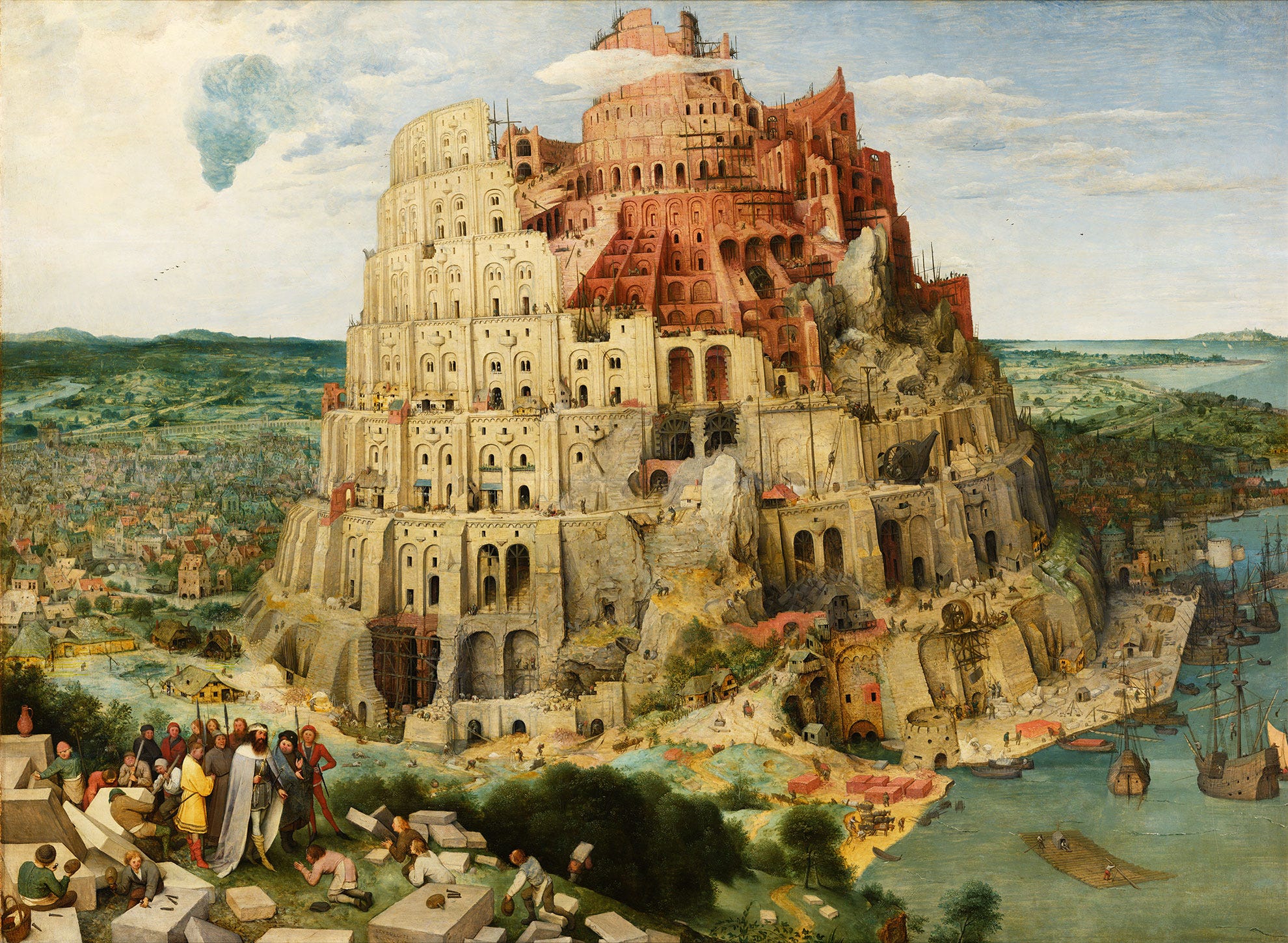
Pieter Bruegel painted the Tower of Babel in 1563 as a warning about pride. The tower already leans and crumbles even as workers keep adding to it. Its shape echoes Rome's Colosseum, ambition modeled on empire, doomed the moment language breaks down.

Tower of Babel painting
Pieter Bruegel the Elder, The Tower of Babel, 1563.

The story comes from Genesis. Humanity, all speaking one language, decides to build a city and a tower reaching into the sky, so as to make a name for itself. God answers by confusing their speech, so the builders can no longer understand each other, and the work stops.

  • Date: 1563.

  • Medium and size: Oil on panel, 114 by 155 centimeters.

  • Location: Kunsthistorisches Museum, Vienna.


See art differently. 170,000 people read these free stories. Come find out why.


More Northern Renaissance Puzzles Worth Solving

Bruegel was not the only painter hiding a warning in plain sight. These three reward a second look.


A Tower Built to Reach Heaven

The Book of Genesis describes Babel as one people, sharing one language, building a tower meant to reach the heavens before God scatters their speech and stops the work. Pieter Bruegel skips that ending. He paints the tower still rising, cranes turning and stone moving, so the viewer watches the failure begin rather than arrive.

In the biblical account, Babel is an act of collective ambition. One people, one language, and a plan to build high enough to rival the heavens themselves.

Bruegel does not paint the moment the tower falls. He paints the moment it is still rising, workers everywhere, cranes turning, stone being hauled up ramps that spiral around the whole structure.

Modeled on the Colosseum

Pieter Bruegel built his tower from tiers of rounded arches stacked one on top of the next, copying the exact profile of the Colosseum in Rome, which he had sketched firsthand during a trip south in the early 1550s. Borrowing the shape of a fallen empire ties Babel to a real historical warning, past a simple Bible story.

Look at the tiers. Rounded arches stacked one on top of another, exactly like the Colosseum in Rome, which Bruegel had seen firsthand on a trip south in the 1550s.

Building Babel out of a Roman ruin is not an accident. He is pointing at an empire that also overreached and did not last.

Smaller Tower of Babel version
Pieter Bruegel the Elder, The Tower of Babel, circa 1568.

The King Who Bows to No One

A king arrives at the building site with his court while stonemasons kneel before him, a figure later tradition calls Nimrod, though Genesis never actually gives the ruler a name. Pieter Bruegel paints him small against the tower's scale, a visual joke about how even the man who ordered the project is dwarfed by it.

In the foreground, a king arrives with his court. Stonemasons drop to their knees in front of him. Later legend names him Nimrod, the ruler behind the tower, though he is not named in Genesis itself.

Bruegel paints him small against the tower's scale, a reminder that even the man in charge is dwarfed by his own project.

What I find telling is that detail. Bruegel could have made the king the largest figure in the scene. Instead he makes him small, just another cog inside a project bigger than any one man.

Bruegel Children's Games painting
Pieter Bruegel the Elder, Children's Games, 1560.

Ten minutes, one masterpiece. That is the deal. 170,000 readers already took it, free.


Already Falling Apart

At the upper levels of the tower, the stonework visibly leans and the arches stop lining up with each other, while the summit disappears into cloud instead of open sky. Pieter Bruegel paints construction and collapse happening at the same time, which is the entire argument of the picture in a single image.

Look closely at the upper levels. The stonework leans, the arches do not quite line up, and the top vanishes into cloud rather than sky.

The tower is not finished and it is already failing. That is the whole argument of the painting: ambition that outgrows what can actually hold together.

To me, that is the real lesson buried in the architecture. Bruegel is not just illustrating a Bible story, he is diagramming how overreach actually looks from the outside.

Hunters in the Snow painting
Pieter Bruegel the Elder, Hunters in the Snow, 1565.

Two Versions, One Warning

Pieter Bruegel painted the Tower of Babel twice. The large Vienna panel came first in 1563, and a smaller version, sometimes called the Little Tower of Babel, followed a few years later and now hangs in the Museum Boijmans Van Beuningen in Rotterdam. Both share the same spiraling ramps and the same unstable summit.

Bruegel painted Babel twice. The large Vienna version came first, in 1563. A smaller version, sometimes called the Little Tower of Babel, followed a few years later and is now in Rotterdam.

Both show the same spiraling structure and the same unstable summit. Bruegel clearly thought the image was worth returning to.

The Harvesters painting
Pieter Bruegel the Elder, The Harvesters, 1565.

One painting. One story. Every week. Free, with 170,000 readers who never sat through an art history lecture.


More Stories Behind Famous Paintings

If a single canvas can carry this much warning, these are worth your next ten minutes.


A Patron Who Collected Sixteen Bruegels

Pieter Bruegel painted this version of the tower around 1563 for Niclaes Jonghelinck, an Antwerp merchant who owned sixteen of his paintings, more than survive by his hand in any single museum today. Jonghelinck lost the collection in 1565 when he used it as collateral on an unpaid debt to the city of Antwerp.

Bruegel painted this version of the tower around 1563 for Niclaes Jonghelinck, an Antwerp merchant and one of the richest private collectors in the Low Countries. Jonghelinck owned sixteen paintings by Bruegel in total, more than survive by his hand today in any single museum.

In 1565, Jonghelinck used his art collection as collateral to guarantee a debt owed to the city of Antwerp. When the debt went unpaid, the city seized the paintings, and in 1594 the tower eventually passed to Archduke Ernest of Austria, entering the Habsburg collection that became today's Kunsthistorisches Museum in Vienna.

I think that fate is almost too fitting. A painting about ambition outrunning its own foundations ended up seized as collateral for debt.

A Building Site Crawling With Workers

Pieter Bruegel filled the tower with cranes, pulleys, and scaffolding copied from real construction manuals circulating in Antwerp during the 1550s and 1560s. Historians have counted more than a thousand individual figures across the panel, most no larger than a fingernail, hauling stone up ramps that spiral around the entire structure.

Bruegel filled the tower with cranes, pulleys, and scaffolding lifted straight from the construction manuals and engineering prints circulating in Antwerp in the 1550s and 1560s. Historians have counted more than a thousand individual figures on the panel, most no larger than a fingernail.

The tiny workers haul stone up ramps that spiral around the tower's exterior, a detail Bruegel could have observed firsthand on his trip to Rome in the early 1550s, where he sketched the Colosseum and other ruins still standing among working quarries.

Cleaned and Rehung More Than Once

The Vienna panel has been cleaned and restored several times since entering the Habsburg collection, work that gradually removed old varnish and revealed brighter blues and oranges in the sky. Infrared scans later showed that Pieter Bruegel adjusted the angle of the tower's ramps after finishing his first underdrawing.

The panel has been cleaned and restored several times since entering the Habsburg collection, work that has gradually removed old varnish layers and revealed brighter blues and oranges in the sky. Infrared examination has also shown that Bruegel adjusted the angle of the tower's ramps after the underdrawing stage.

The painting hangs today in the Kunsthistorisches Museum in Vienna, one of the most reproduced images in the museum's entire collection, printed on everything from jigsaw puzzles to phone cases. In 2018, the Kunsthistorisches Museum built its largest ever Bruegel exhibition around the four hundred and fiftieth anniversary of the painter's death, and the tower was one of its central loans, drawing some of the biggest crowds the museum had recorded in years.

Frequently Asked Questions

  • When did Bruegel paint the Tower of Babel?

    In 1563, for the large Vienna version. A smaller version followed around 1568.

  • Where can I see the Tower of Babel today?

    The large version hangs in the Kunsthistorisches Museum in Vienna. The smaller version is in the Museum Boijmans Van Beuningen in Rotterdam.

  • What story does the painting illustrate?

    The Genesis account of a tower built to reach heaven, stopped when God confuses the builders' shared language.

  • Why does the tower look like the Colosseum?

    Bruegel had traveled to Rome and modeled Babel's tiered arches on the ancient amphitheater, tying the story to a real empire that also overreached.

  • Who is the king shown in the foreground?

    Later tradition calls him Nimrod, credited as the ruler behind the tower, though Genesis itself never names him.


No boring lectures, ever. Join 170,000 readers learning art the fun way, free.