What Does Caravaggio's The Calling of Saint Matthew Mean?

A beam of light, a room full of tax collectors, and a two hundred year old argument over who is actually Matthew.

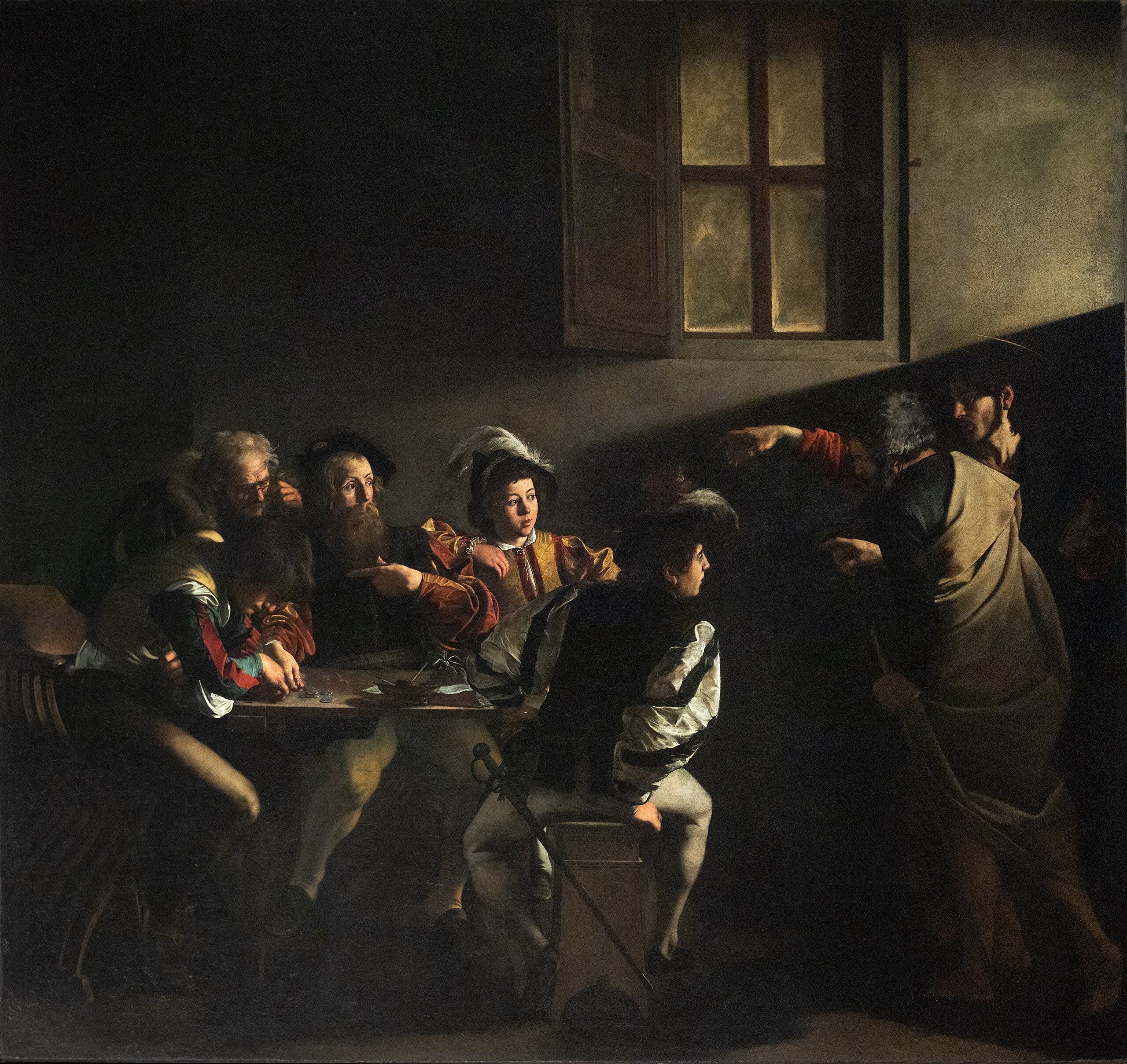
Caravaggio's Calling of Saint Matthew shows Christ pointing into a dim tax office, calling a startled money counter into a new life. Rome's own clergy rejected the chapel's other altarpiece outright, and that first rejected canvas was destroyed by fire in Berlin in 1945.

Calling of Saint Matthew Caravaggio
Caravaggio, The Calling of Saint Matthew, 1599 to 1600.

The painting still hangs where Caravaggio installed it, in a side chapel of a Roman church most tourists walk past without knowing what waits inside. It changed what a religious painting was allowed to look like.

  • Date. Painted between 1599 and 1600, Caravaggio's first major public commission.

  • Medium. Oil on canvas, about 322 by 340 centimeters.

  • Location. The Contarelli Chapel, San Luigi dei Francesi, Rome, its original site.


Learn art the fun way. Join 170,000 readers getting one painting and its story every week.


Stories that go further into the dark

Caravaggio's whole career reads like a series of arguments with the church that paid him. Start here.


A tax office, not a temple

Caravaggio sets a biblical calling inside a room built like a Roman tavern or counting house, not a temple. Everyone but Christ and Peter wears the plumed hats and slashed sleeves of Caravaggio's own Rome. The miracle happens in a room a viewer could actually walk into.

The men around the table wear the fashions of 1600, not biblical robes. Only Christ and Peter, half hidden at the edge of the light, dress in the plain garments expected of a first century scene.

That mismatch was deliberate. Caravaggio wanted a parishioner kneeling in the pew to recognize the room, not just the miracle.

Supper at Emmaus Caravaggio painting
Caravaggio, Supper at Emmaus, 1601.

Which man is Matthew?

Tradition names the bearded man near the center as Matthew, one hand on his chest as if asking, do you mean me? A newer reading argues the real Matthew is the young man at the table's end, still counting coins, too absorbed to notice he has just been called.

For centuries the bearded man's reading went unchallenged in guidebooks and lectures alike. To me, that unchallenged reading says more about habit than evidence. Nobody looked twice once the guidebooks agreed.

In that newer reading, the bearded man is simply pointing at his neighbor, not at himself, and the future apostle is the one who has not even looked up yet.

Inspiration of Saint Matthew Caravaggio
Caravaggio, The Inspiration of Saint Matthew, 1602.

One painting. One story. Every week. Free, with 170,000 readers who never sat through an art history lecture.


Light that does not obey the room

A window is painted above the group, but the light in the scene does not come from it. It follows Christ's outstretched hand instead, as though the gesture itself were the source. That inconsistency is the entire engine of Caravaggio's chiaroscuro.

Physically, the beam makes no sense against the painted architecture. Theologically, it makes complete sense: light in Caravaggio's hands marks grace, not physics. What strikes me is that trade. Caravaggio gives up physical logic to get something he clearly wanted more, a light that behaves like a decision, not a law of nature.

I find this the detail that separates Caravaggio from every imitator who copied his shadows without copying his logic. The light has to break a rule to make a point.

Martyrdom of Saint Matthew Caravaggio
Caravaggio, The Martyrdom of Saint Matthew, 1599 to 1600.

The companion Berlin lost

Caravaggio painted the chapel's altarpiece, Saint Matthew and the Angel, twice. The first version, showing a barefoot, unlettered Matthew with an angel physically steering his hand, was rejected by the parish clergy as disrespectful before it ever reached the altar in 1602.

The rejected canvas did not vanish. The collector Vincenzo Giustiniani bought it privately, and it passed down through his heirs for three centuries.

It eventually entered Berlin's Kaiser Friedrich Museum, where it was destroyed in a wartime fire in 1945. Today it survives only in black and white photographs taken before the war.

Caravaggio repainted the subject in the calmer version that still hangs in the chapel today, facing the Calling across the same small room.

portrait of Caravaggio
Ottavio Leoni, portrait of Caravaggio, circa 1621.

See art differently. 170,000 people read these free stories. Come find out why.


More light and shadow


Painted straight onto the canvas

Caravaggio worked without the careful preparatory drawings most of his contemporaries relied on. He scratched incised lines directly into the wet ground to mark key positions, then painted over them, adjusting figures as he went rather than following a fixed plan.

Technical study of the canvas, roughly 322 by 340 centimeters, has traced these incised guidelines under the paint layer.

It is one reason his figures feel caught mid gesture rather than posed. He composed with the brush itself, not with a cartoon transferred beforehand.

You still need a coin to see it properly

The Contarelli Chapel is dim by design, lit mainly by daylight from the church's high windows. For decades, a coin operated box beside the chapel has sold visitors a couple of minutes of electric light on all three Matthew paintings at once.

It remains there today, now taking euro coins instead of the old lire.

It is one of the few places left where seeing a masterpiece still costs a literal coin in the slot, a small ritual that has outlasted several currencies.

A restoration that changed how it reads

Old varnish and candle soot had dulled the painting for decades into what looked like a nearly monochrome scene of browns and blacks. A twentieth century cleaning campaign by Italian restorers stripped that grime away and uncovered brighter reds and ochres in the men's clothing.

Those colors had been effectively invisible to generations of visitors, hidden under a slow accumulation of soot from candles burned in the chapel over centuries.

Photographs taken before and after that cleaning are still used in art history courses to show how much a layer of old varnish can change a viewer's sense of a painting's mood.

Which window is the real one?

The Contarelli Chapel has a real window near where Caravaggio's altarpiece stands, letting daylight into the same space shown in the Calling of Saint Matthew. Art historians have long debated whether the diagonal beam painted across the scene was meant to echo that actual opening, since the small window built into the painted room itself sits at an angle that could never produce it.

That real window sits close to where Caravaggio's altarpiece now stands, roughly on the same side the painted beam in the Calling seems to come from. The small window built into the painted room could never produce that light on its own, since it sits at the wrong angle entirely. Restorers and art historians have pointed out the parallel for years, though Caravaggio left no notes explaining whether he planned it or arrived at it by instinct while working inside the actual chapel.

San Luigi dei Francesi is the French national church in Rome, and the Contarelli Chapel occupies a side aisle near the altar rather than the main nave, one more reason casual visitors can walk straight past all three paintings without noticing them.

Frequently asked questions

  • Where is the Calling of Saint Matthew located?

    In the Contarelli Chapel of San Luigi dei Francesi, a French church in Rome. It has never left the chapel Caravaggio painted it for.

  • Who is Matthew in the painting?

    Tradition points to the bearded man near the center of the table. Some scholars argue the true Matthew is the young man at the far end, still counting money.

  • Why does the light look strange?

    The light source does not match the painted window in the scene. It appears to follow Christ's pointing hand instead, a hallmark of Caravaggio's dramatic chiaroscuro.

  • When was the Calling of Saint Matthew painted?

    Between 1599 and 1600, as part of Caravaggio's first major public commission.

  • Is the Calling of Saint Matthew part of a series?

    Yes. It hangs alongside The Inspiration of Saint Matthew and The Martyrdom of Saint Matthew, all painted for the same chapel around the same years.

  • What happened to the rejected version of the chapel's altarpiece?

    It was bought by the collector Vincenzo Giustiniani, passed to his heirs, and later entered a Berlin museum, where it was destroyed by fire in 1945. It survives only in old photographs.


No boring lectures, ever. Join 170,000 readers learning art the fun way, free.