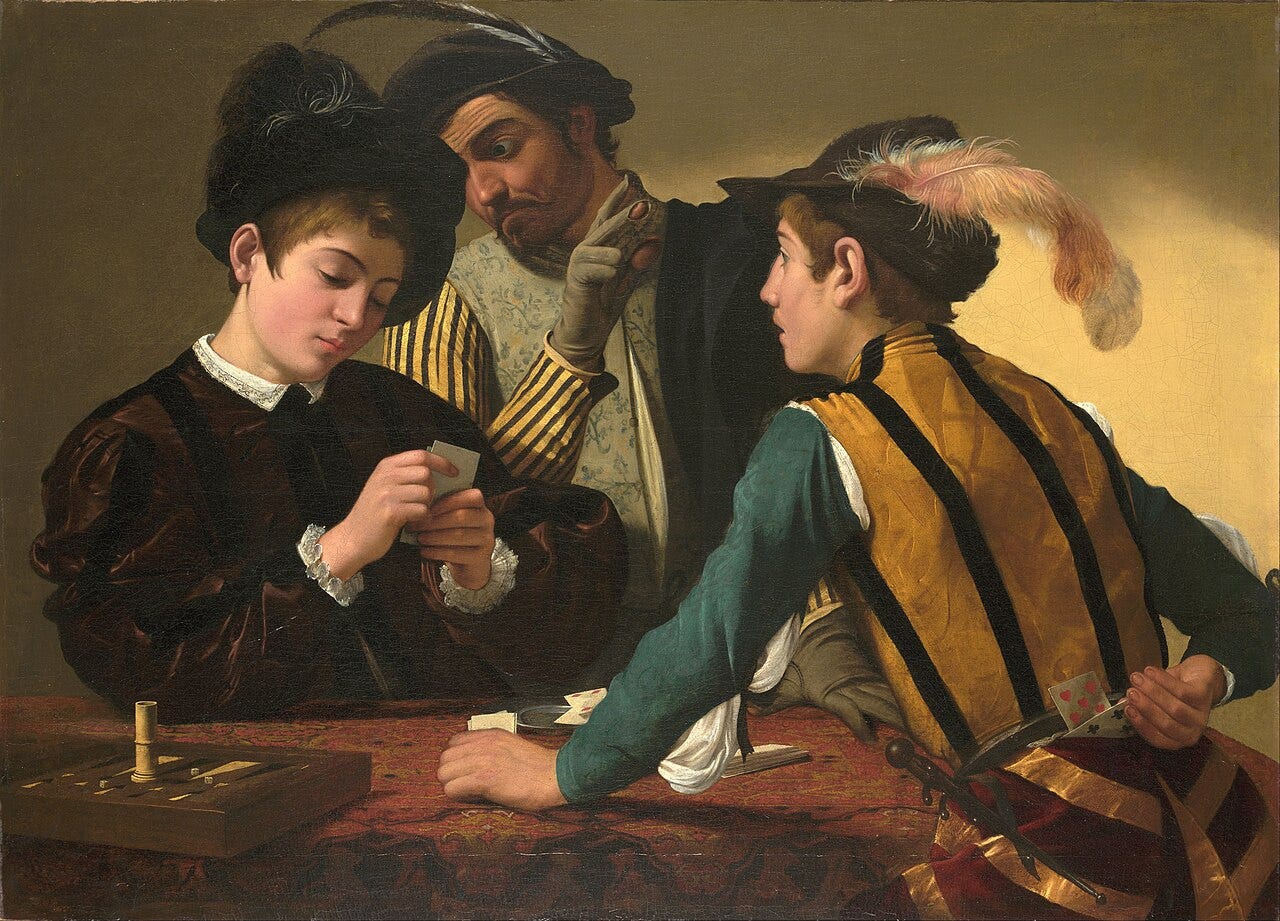
Caravaggio's Cardsharps shows a naive young man being cheated at cards by two con artists, painted around 1594 before he had a single religious commission. A near identical version later sold for just 42,000 pounds, then triggered a London lawsuit over what a real Caravaggio is worth.
Long before he painted saints in violent light, Caravaggio painted street life: gamblers, fortune tellers, boys peeling fruit. This is the best known picture from that early group.
Date. Painted around 1594, when Caravaggio was in his early twenties and unknown in Rome.
Medium. Oil on canvas, about 94 by 131 centimeters.
Location. Kimbell Art Museum, Fort Worth, Texas.
Where Caravaggio's story really starts
Before the chapels and the murder charge, there was a young painter selling scenes like this one on the street. Here is where the rest of it goes.
A young man about to lose everything
A well dressed youth studies his cards, unaware that the older man across the table is reading his hand through a slit cut into his own glove. A second, younger accomplice stands behind him, signaling the cards with his fingers, and nobody in the scene looks at the viewer.
The whole painting works like a silent warning about trusting the wrong company, staged with the timing of a caught moment rather than a posed portrait. What strikes me is that timing. Caravaggio catches the cheat mid gesture, not posed for it, which is exactly what makes the con feel real instead of staged.
A dagger tucked into the older cheat's belt hints at what happens if the trick gets noticed before the hand is played out.
The painting that built a career
The Cardsharps caught the eye of Cardinal Francesco Maria del Monte, a Roman collector with real influence. Del Monte brought Caravaggio into his own household and, through him, into contact with the patrons who commissioned his religious masterpieces only a few years later.
Without this one canvas of a card game gone wrong, there may have been no Contarelli Chapel commission and no Calling of Saint Matthew.
I think that is the part most museum labels skip: Caravaggio's entire religious output rests on a painting of two men fleecing a rich kid.
Lost, then found again
For much of the twentieth century, no signed original was known to survive, and historians worked mainly from later copies. In 1987, the British scholar Denis Mahon identified a canvas catalogued only as in the manner of Caravaggio as the lost original, based on brushwork and pigment.
The canvas had been deposited in Zurich for restoration and analysis before the reattribution. It had circulated for decades priced like an imitation.
The Kimbell Art Museum bought it that same year. It is the only Caravaggio in the museum's collection.
A second Cardsharps and a court case
In 2006, Sotheby's sold a second, near identical version of the scene for just 42,000 pounds, catalogued as a follower's copy. The buyer, Denis Mahon himself, later announced it was an autograph replica painted by Caravaggio's own hand, worth vastly more than the sale price.
The original seller, Lancelot Thwaytes, sued Sotheby's in 2013, arguing the auction house had been negligent in failing to research the painting properly before selling it so cheap. To me, that lawsuit says more about the market than about the painting. A picture this good got sold cheap once, and someone was always going to notice eventually.
In 2015, London's High Court ruled that Sotheby's had not been negligent, and the court was not persuaded the second canvas was an autograph Caravaggio. The dispute over that second version has never fully closed.
More cons, more curiosities
How the cheat signals his partner
Look past the young dupe and his cards, and the trick is laid out in plain sight. The older cardsharp holds extra cards behind his back with one hand, while flashing finger signals to an accomplice standing just behind the mark's shoulder, who reads the hand and passes it on.
Caravaggio built the whole composition as a circuit of seeing and not seeing. The mark sees only his own cards. Everyone else sees him.
It is staged so precisely that a viewer can trace the entire con in a single glance, table to glove to fingers to accomplice.
What the painting is made of
Cardsharps is oil on canvas, measuring about 94 by 131 centimeters, modest next to Caravaggio's later church commissions. It was painted with a lighter, more even daylight than the dramatic single source of shadow he later became known for, closer to a well lit street scene than a chapel.
Conservation study at the Kimbell found pentimenti, changes Caravaggio made as he worked, including a reworked hand position for the cheat signaling behind his back.
More than fifty copies of the composition are known today, made by other painters who studied under or around Caravaggio in the decades after he painted it.
Where it hid before 1987
Before Denis Mahon identified the Kimbell canvas, it had circulated among private collectors for generations, catalogued only as an anonymous follower of Caravaggio rather than an autograph work. That missing attribution kept its sale price low for decades, long after it had left Italy.
Because it carried no name, it changed hands at prices far below what an authenticated original would command.
That gap between an anonymous old master and a documented Caravaggio is exactly what Mahon's 1987 identification closed, and exactly what the 2006 Sotheby's sale reopened for a second canvas.
Inside the museum that holds it
The Kimbell Art Museum in Fort Worth, Texas, where the Cardsharps has hung since 1987, was designed by the American architect Louis Kahn and opened in 1972. Its galleries are built as a row of vaulted concrete rooms, each lit by a narrow skylight running along the top of the vault rather than by conventional windows.
That design means most rooms rely on daylight rather than artificial light for most of the day, a detail that puts the Cardsharps back under something close to natural light for the first time since it left Rome, centuries after Caravaggio painted it using the same plain daylight the scene itself depicts.
The Kimbell is known for a small, tightly chosen collection rather than an encyclopedic one, and owning a single Caravaggio put the Fort Worth museum on a short list of American institutions that can make that claim.
The painting is still catalogued in Italian scholarship under its original title, I Bari, literally the cheats. English language museum labels and books almost always use Cardsharps instead, the name most readers now associate with the composition.
Frequently asked questions
When was the Cardsharps painted?
Around 1594, early in Caravaggio's career, before any of his religious commissions.
Where is the Cardsharps today?
At the Kimbell Art Museum in Fort Worth, Texas.
Why is the Cardsharps important to Caravaggio's career?
It caught the attention of Cardinal Francesco Maria del Monte, who became his patron and introduced him to the Roman elite who later commissioned his major religious works.
Is the Kimbell painting the original?
Yes, though this was only confirmed in 1987. For years the canvas was catalogued as a copy before being reattributed to Caravaggio himself.
How is the Cardsharps different from Caravaggio's later work?
It is lit by plain daylight and shows an everyday street scene, without the dramatic single light source that defines his later religious paintings.
What happened with the second Cardsharps sold at Sotheby's?
Sotheby's sold it in 2006 for 42,000 pounds as a copy. The buyer later claimed it was an autograph Caravaggio, and the seller sued the auction house in 2013. A London court ruled against him in 2015.