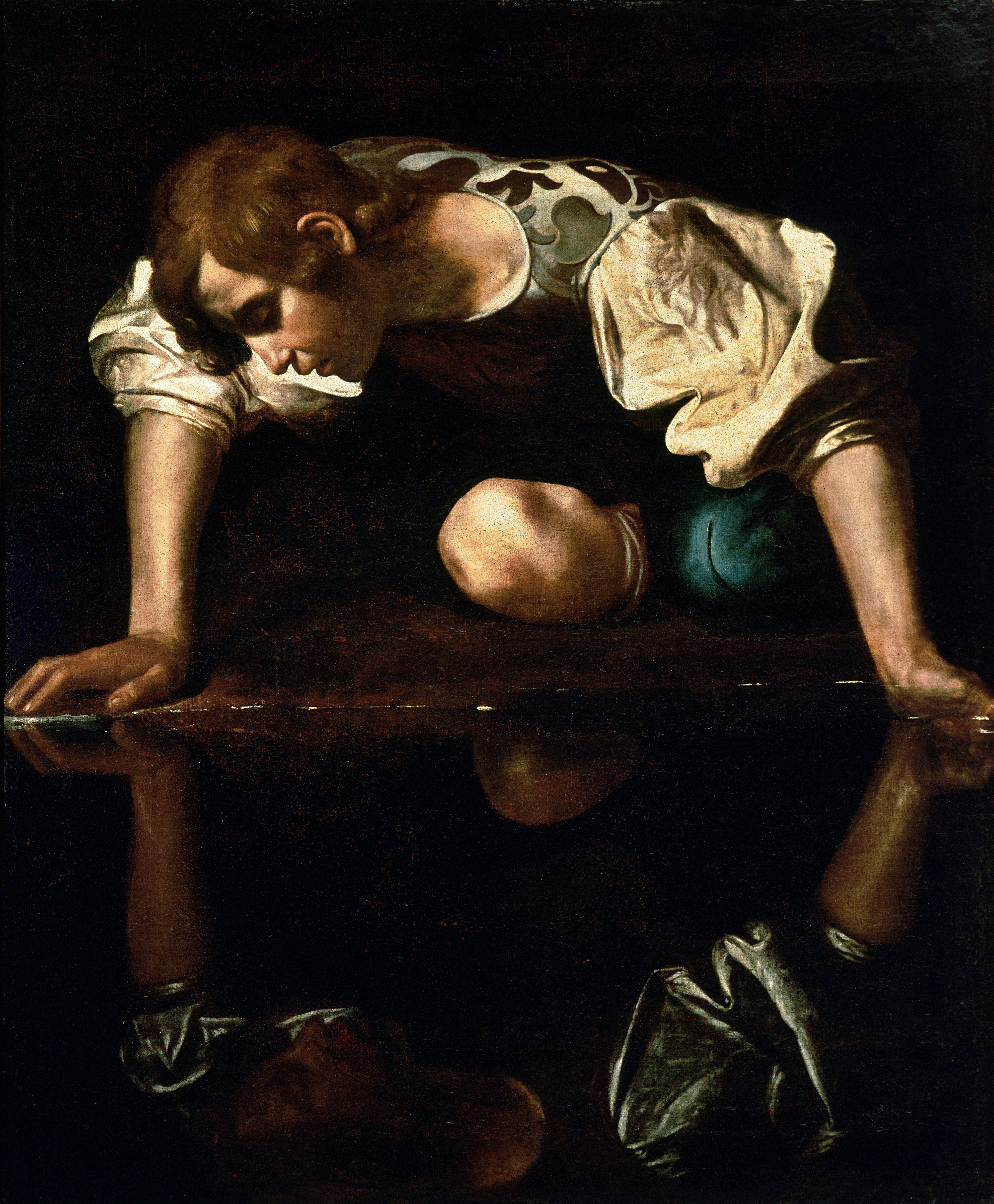
Caravaggio's Narcissus shows a young man kneeling over dark water, so lost in his own reflection he never notices the painter watching him. For over a century, historians could not even agree he painted it.
This is one of only two paintings Caravaggio ever made based on a Greek myth. That alone should make it more famous than it is.
Instead it sits in a Roman museum, quietly at the center of one of the longest running attribution fights in art history.
Painter: Caravaggio, disputed until a 1995 restoration confirmed it.
Painted: around 1597 to 1599.
Where to see it: Galleria Nazionale d'Arte Antica, Palazzo Barberini, Rome.
More Caravaggio Stories Worth Your Time
Three more pieces on the same painter, if the mystery above got you curious.
The Myth Caravaggio Painted
The story comes from Ovid's Metamorphoses. Narcissus is a beautiful young man who rejects every admirer, including the nymph Echo, until the gods punish his coldness.
He bends over a pool of water to drink and sees his own face for the first time. He falls in love with the reflection and cannot look away.
He wastes away beside the water, unable to leave the only love he was ever capable of feeling. It is a story about vanity, but also about isolation.
Narcissus does not get punished for being handsome. He gets punished for being incapable of loving anyone who is not himself.
What Is Actually Happening in the Frame
Caravaggio strips the myth down to almost nothing. There is no forest, no nymph, no landscape. Just a young man in a rich sleeve, bent forward, and his own reflection staring back.
The real body and the reflected body form a closed circle, knee touching knee across the waterline. Everything outside that circle disappears into black.
Caravaggio built the entire composition around a loop that has no exit. You never fully see his face. It is turned down, half lost in shadow.
That breaks from Caravaggio's usual habit of putting raw emotion right on the surface of a face. That absence is part of why the attribution fight even exists.
Look at the light and the trick becomes obvious. A single source hits the sleeve and the kneecap, the two brightest points in the entire canvas.
Caravaggio used the sharp light against near total darkness known as chiaroscuro, and let your eye trace the same circle the water is tracing.
Why Scholars Doubted It Was Caravaggio at All
The painting was not identified as a Caravaggio until 1916, when the art historian Roberto Longhi attributed it to him based on style.
Before that, it had passed through collections without a confirmed author. Even after Longhi's attribution, doubt never fully went away.
Some historians proposed the real painter was Spadarino, a lesser known Roman follower of Caravaggio's style. Others suggested Orazio Gentileschi or Niccolo Tornioli.
Both painters worked in the same dark, theatrical tradition. The core problem is the face. Caravaggio's confirmed paintings usually show intense, legible expressions.
A raised eyebrow, a parted mouth, real drama on the skin. Narcissus keeps his face half hidden, which makes stylistic comparison much harder than it should be.
The Restoration That Changed the Debate
The attribution finally gained real support in 1995, when conservators carried out a full technical restoration of the canvas.
Underneath centuries of varnish and old retouching, they found brushwork and underpainting habits that matched Caravaggio's confirmed technique far more closely than anyone had been able to see before.
Major Caravaggio scholars, including Mina Gregori and Maurizio Marini, backed the attribution after seeing the cleaned surface.
That restoration is the reason the painting now hangs at the Galleria Nazionale d'Arte Antica, inside the Palazzo Barberini in Rome, labeled as a Caravaggio.
The Case Against Caravaggio, Still Alive Today
Even with the 1995 evidence, the argument never fully closed. A major Caravaggio exhibition at the same Palazzo Barberini in 2025 opened by directly acknowledging the doubt.
The hesitation comes back to the same issue every time: Narcissus does not look, feel, or behave like the rest of Caravaggio's catalog.
No violence, no crowd, no direct eye contact with the viewer, none of the theatrical staging that made him famous in Rome.
I find this refreshing, honestly. Most museum labels sound certain even when the underlying research is not. Here the uncertainty is stated in public, on the wall.
Why the Composition Still Unsettles People
I have stood in front of a lot of Caravaggio paintings, and this one bothers me differently than the others.
His famous scenes usually pull you in as a witness, a card game, an arrest, a beheading in progress. Narcissus does not need a witness.
That is the entire point of the composition. The circle he forms with his reflection is complete without you.
Standing in front of the canvas feels like watching someone through a window they will never open. It reads less like vanity today and more like a picture of someone stuck in a loop he cannot break.
Where Narcissus Fits in Caravaggio's Life
Caravaggio painted this around 1597 to 1599, while he was working in Rome under the patronage of Cardinal Francesco Maria del Monte.
That period produced some of his first major public commissions. He was already known for turning street models, gamblers, and musicians into saints and mythological figures.
Narcissus fits that pattern. The clothing looks contemporary rather than ancient, exactly the kind of choice that made religious authorities uneasy about his work later. You can trace that whole arc in Caravaggio, the complete story.
Within a decade, Caravaggio would kill a man in a street fight, flee Rome, and spend his final years running from a death sentence. Narcissus belongs to the calmer half of a life that ended in chaos.
The Other Mythological Caravaggio
Caravaggio painted exactly one other subject drawn from Greek mythology in his surviving work, a severed Medusa head painted onto a ceremonial shield, made around the same period for the same patron.
Put the two together and a pattern emerges. Both figures are caught at the exact moment a myth turns against them, Medusa mid scream, Narcissus mid collapse into his own reflection.
Caravaggio was never interested in mythology as pretty decoration. He wanted the worst second of the story.
Narcissus Before and After Caravaggio
Painters had been depicting Narcissus for centuries before Caravaggio got to him, almost always inside a full landscape, with Echo fading into the rocks nearby.
Caravaggio cut all of that away. No Echo, no gods, no green hillside. Just a boy, dark water, and a black background that could be anywhere.
Later artists went the opposite direction. Nicolas Poussin painted a lush, mournful landscape version decades afterward, and Salvador Dali later reimagined the myth as a surrealist hand cracking open like an egg.
That comparison is also why Caravaggio belongs on any serious list of artists you need to know. He removed everything from the myth except the one moment that actually hurt.
More Ways to Look at a Painting
A few more stories, if you like art that hides more than it shows.
Frequently Asked Questions
When did Caravaggio paint Narcissus?
Around 1597 to 1599, while he was living and working in Rome under the patronage of Cardinal Francesco Maria del Monte.
What myth does the painting depict?
The story of Narcissus from Ovid's Metamorphoses, a young man who falls in love with his own reflection in a pool of water and cannot look away, eventually wasting away beside it.
Is Narcissus definitely painted by Caravaggio?
Most major scholars now accept the attribution, especially after a 1995 restoration revealed technique consistent with Caravaggio's confirmed works. A minority of historians still express doubt, and museum wall text still acknowledges the debate.
Who else has been suggested as the real painter?
Over the decades, scholars have proposed Spadarino, Orazio Gentileschi, and Niccolo Tornioli as possible alternative authors, all painters working in a similar dark, dramatic style.
Where is the painting today?
It hangs at the Galleria Nazionale d'Arte Antica, inside the Palazzo Barberini in Rome, one of the two major locations that hold the museum's collection.
Why is the attribution so uncertain compared to Caravaggio's other paintings?
The subject's face is largely hidden in shadow, which removes the intense, legible expression found in almost every other confirmed Caravaggio painting, making stylistic comparison unusually difficult.
How does this painting compare to other famous depictions of self reflection in art?
It sits closer to a study of isolation than to the tradition of famous self portraits, since Narcissus is not an artist recording his own likeness, but a mythological figure trapped by what he sees.
Is Narcissus considered one of Caravaggio's major works?
It is smaller and quieter than his famous religious commissions, but significant precisely because it is one of only two mythological subjects in his surviving body of work, part of why it still gets discussed alongside the greatest painters of all time.