What Does Cezanne's The Large Bathers Mean?

Nude bathers built from the same color planes Cézanne used for mountains and apples. Here is what he was really after, unfinished at his death.

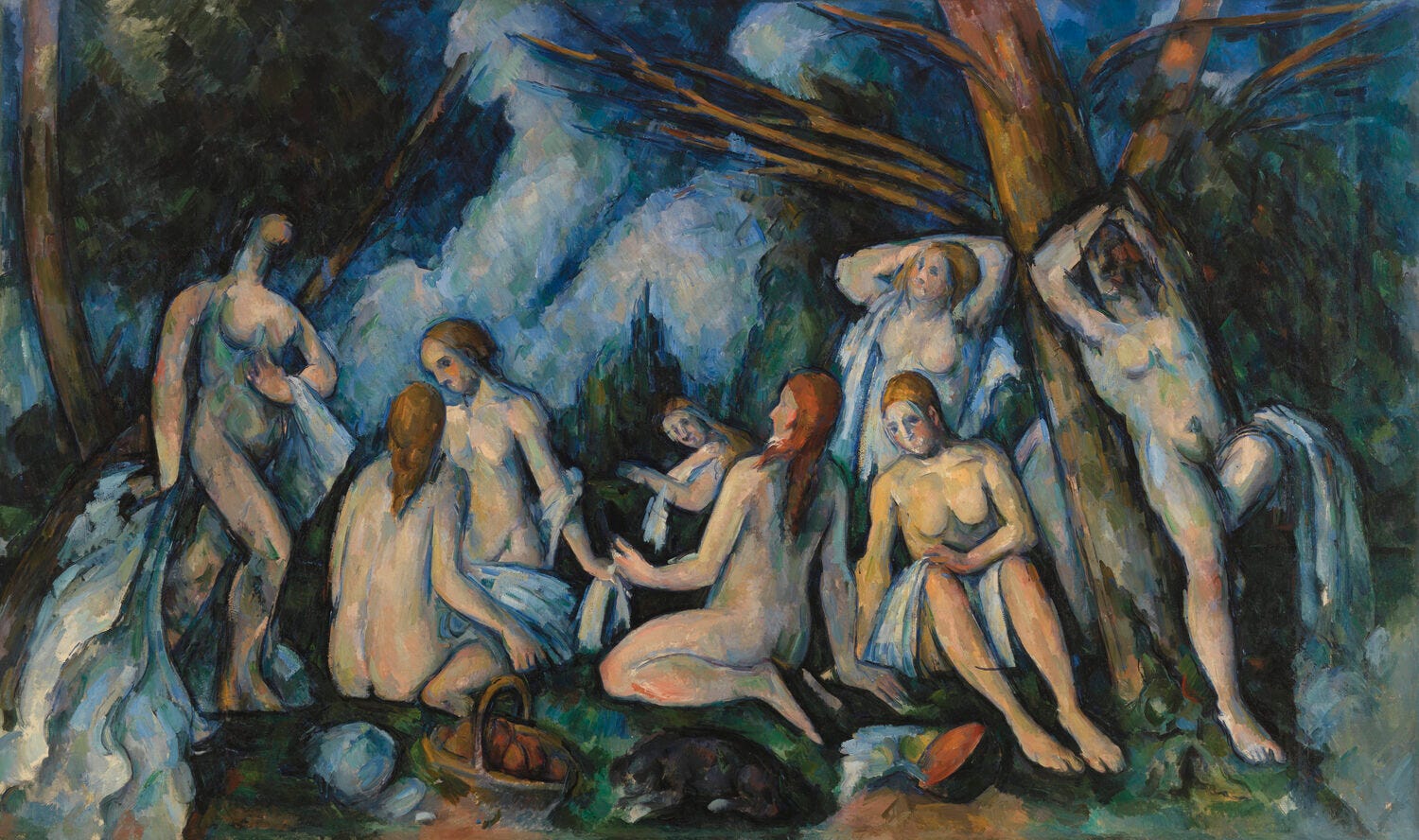
Cezanne spent his final years painting bathers he never watched pose. The Philadelphia version of The Large Bathers rebuilds a classical subject through blocks of color instead of live anatomy, and it stayed unfinished when he died in 1906, one of three large versions he left behind.

Nude bathers grouped under arching trees
Paul Cézanne, The Large Bathers, circa 1900.

Nobody in this painting looks quite real.

That is not a failure. Cezanne was building bodies out of the same geometry he used for rocks and fruit.

  • Date: Painted between 1900 and 1906, left unfinished at Cezanne's death in October of that year.

  • Medium: Oil on canvas, measuring about 210 by 250 centimeters, the largest canvas he ever completed.

  • Location: Held by the Philadelphia Museum of Art. Related versions hang at the National Gallery in London and the Barnes Foundation in Merion, Pennsylvania.


One painting, one real story. Join 170,000 readers who get art explained without the jargon, free.


More Cezanne and His Legacy

If bodies built from geometry got your attention, these stories cover more painters who rebuilt the rules from scratch.


A Canvas He Never Called Finished

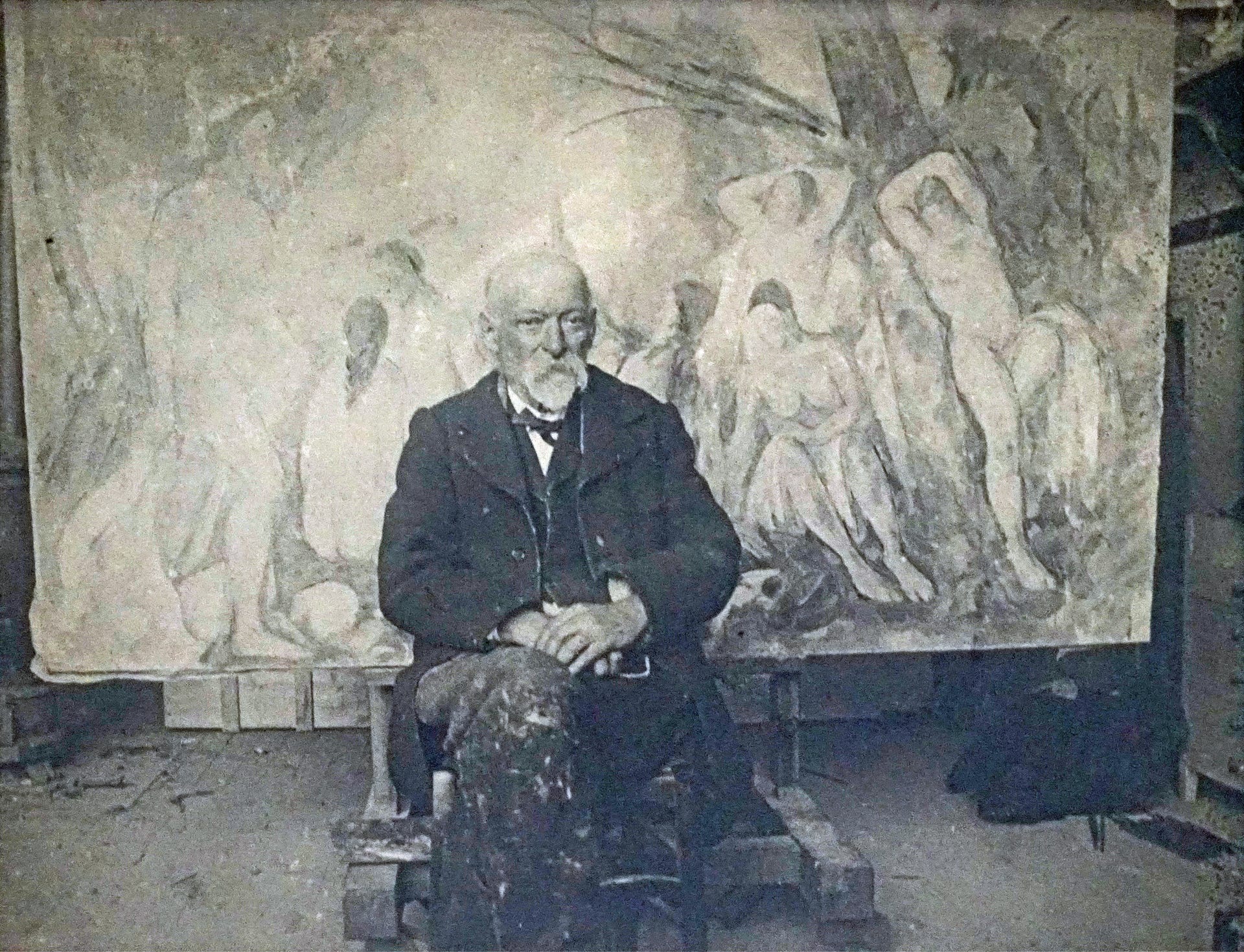
Cezanne worked on the Philadelphia version of The Large Bathers from around 1900 until his death in October of 1906. At roughly 210 by 250 centimeters, it is the largest canvas he ever painted, and he left patches of bare, unpainted canvas visible near its edges when he died.

He had painted smaller bather scenes since the 1870s, returning to the same subject again and again across three decades.

This final canvas was less a picture to complete than a problem Cezanne kept reopening every time he came back to the easel.

Visitors today can still see bare canvas near the top corners, left untouched when Cezanne died in 1906.

Bodies Built From the Same Geometry as His Mountains

Cezanne painted these bathers with the same color planes he used for Mont Sainte Victoire and his still life fruit. Instead of smooth anatomy, arms and torsos become blocks of warm and cool color that hold the composition together, the same method he applied to rock faces and apples.

The pyramid shaped grouping under arching trees echoes bathing scenes Cezanne had studied in the Louvre as a young painter.

He kept that classical pyramid but swapped in blocky, unresolved limbs that read closer to construction work than to traditional anatomy.

Even the trees bend inward like columns, framing the bathers the way architecture frames a doorway.

What I find most telling is that even the trees behave like architecture here. Nothing in the scene is asked to look natural, not the bodies, not the landscape around them.

Mountain seen across a green valley
Paul Cézanne, Mont Sainte Victoire, 1897.

No Model Ever Posed for This Scene

Cezanne did not hire live models for these late bathers. Biographers describe him working instead from memory, decades old life drawings, and prints of earlier bathing scenes, partly because he had grown uneasy working with nude models later in life. That absence of a real body in the room shaped how mechanical the figures look.

That distance from real bodies is part of why the figures read more like blocks of geometry than individual people.

I think that choice is exactly why the picture still feels unfinished in a useful way, rather than a failed one.

Cezanne had grown famously private in his last years, working alone in his studio outside Aix en Provence rather than hiring sitters.

Painter's self portrait with a hat
Paul Cézanne, Self Portrait, 1880.

See how painters actually think. 170,000 readers already do. Join free and get the next one.


From Cezanne's Studio to a Philadelphia Trust

This canvas left Cezanne's studio at his death in 1906 and changed hands several times before reaching Philadelphia three decades later. It passed through a Paris art dealer, then a private collecting family, before an American museum purchase closed the chain in 1937.

The dealer Ambroise Vollard bought the painting from Cezanne's son in 1907, a year after the painter's death.

Auguste Pellerin owned it in Paris through the 1920s, and his son Jean Victor Pellerin held it until the sale that sent it to America.

The Philadelphia Museum of Art acquired the canvas in 1937 for 110,000 dollars, funded through a trust tied to the collector Joseph Widener.

Apples piled in a woven basket
Paul Cézanne, The Basket of Apples, 1895.

Three Canvases, One Obsession

Cezanne painted three large, related versions of this same triangular bathing scene in his final years. The Philadelphia canvas is the largest and most resolved. A second hangs at the National Gallery in London, and a third belongs to the Barnes Foundation in Merion, Pennsylvania, each with its own balance of finish and bare canvas.

The three share the same pyramid of bodies under trees, but differ in scale, in how much canvas stays bare, and in how far the color planes are pushed.

None of the three carries a date Cezanne wrote down himself, so historians rely on style and technique to place them across his final decade.

To me, that uncertainty suits the painting. Even Cezanne never seemed willing to say exactly when any version of it was finished.

The Barnes Foundation version stays close to Philadelphia's palette, while the London canvas reads flatter and more sketch like.

The Painters Who Studied It Before the Public Could

English audiences barely knew Cezanne until critic Roger Fry staged a major London exhibition of his work in 1910. Matisse and Picasso had already seen his late bathers years earlier through dealers and private collections, and each later said the paintings changed how they built a human figure from color instead of outline.

Matisse's Le Bonheur de Vivre from 1905 and 1906 and Picasso's Les Demoiselles d'Avignon from 1907 both carry that debt, even though neither painting looks much like Cezanne's bathers at first glance.

Cezanne had already been carving rock faces into blocky planes at the Bibemus quarry years earlier, the same logic Picasso would push further into Cubism.

Fry's 1910 exhibition arrived four years after Cezanne's death, so British audiences discovered this way of building a figure only after it had already reshaped Paris.

Rocky quarry with orange stone walls
Paul Cézanne, Bibémus Quarry, 1895.

Keep Reading About Art History

A few more stories worth your next ten minutes.


Ten minutes, one masterpiece. That is the deal for 170,000 readers who already signed up, free.


Frequently Asked Questions

  • Is there more than one version of The Large Bathers?

    Yes. Cezanne painted three large versions of this same composition, now split between the Philadelphia Museum of Art, the National Gallery in London, and the Barnes Foundation in Merion, Pennsylvania.

  • Why do the figures look so unrealistic?

    Cezanne built the bodies from simplified color planes, the same approach he used for mountains and still life, rather than aiming for anatomical accuracy.

  • Did Cezanne use live models for this painting?

    No. He worked mostly from memory, older life drawings, and earlier bather compositions instead of a posed model in the studio.

  • Did Cezanne finish The Large Bathers?

    Not entirely. He kept reworking the composition until his death in 1906, and patches of bare canvas remain visible near the edges.

  • How did the painting end up in Philadelphia?

    The dealer Ambroise Vollard bought it from Cezanne's son in 1907, it passed through the Pellerin family collection in Paris, and the Philadelphia Museum of Art purchased it in 1937.

  • Did The Large Bathers influence later painters?

    Yes. Matisse and Picasso both studied Cezanne's late bathers closely before painting Le Bonheur de Vivre and Les Demoiselles d'Avignon.


No boring lectures, ever. Join 170,000 readers learning art the fun way, free.