What Does Courbet's The Stone Breakers Mean?

Two anonymous laborers, painted at the scale of history. The canvas that started Realism was destroyed in 1945, and only the story survives.

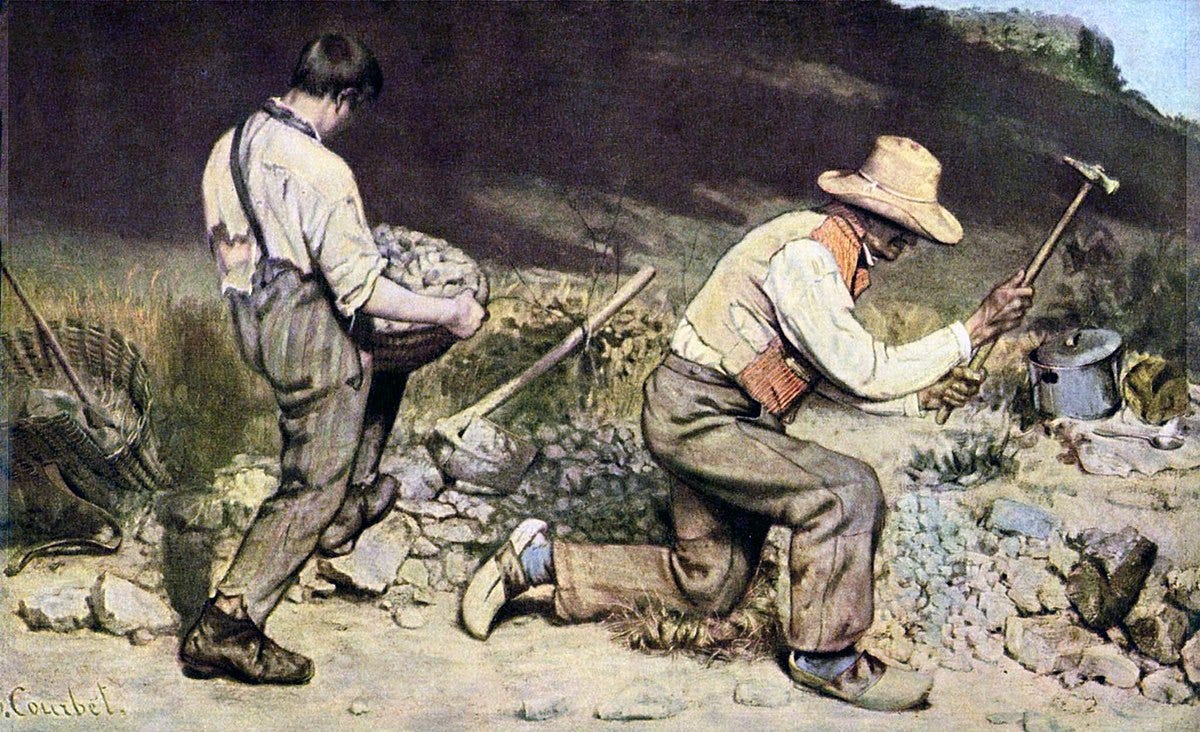
Courbet's The Stone Breakers shows two anonymous laborers, an old man and a boy, breaking rocks on a roadside near Ornans in 1849. By painting manual work at the scale of history painting, Courbet argued that ordinary labor deserved to be seen. The canvas no longer exists. It was destroyed in 1945.

Two laborers breaking stones by a road
Gustave Courbet, The Stone Breakers, 1849.

I keep coming back to this painting for what it refuses to give you. No hero, no drama, no face you can really read. Just two men doing the same job, and doing it again tomorrow.

  • Date: Painted in 1849, shown at the Paris Salon of 1850 to 1851.

  • Medium: Oil on canvas, about 165 by 257 centimeters.

  • Location: Destroyed in the Allied bombing of Dresden in February 1945. Known today only through photographs and reproductions like this one.


Learn art the fun way. Join 170,000 readers getting one painting and its story every week.


More Stories From the World of Painting

If Courbet's honesty about ordinary life caught your attention, these stories go further into painters who broke their own rules.


Two Strangers on a Road Near Ornans

Courbet said he met an old man and a boy breaking stones on a roadside near Ornans in October 1848, then asked them to pose in his studio the next day. He painted their faces turned away or shadowed, so no viewer could recognize an individual laborer, only labor itself.

Their clothes were patched and worn on purpose. Courbet painted torn trousers, cracked boots, and hands thickened by work, refusing any hint of polish.

It is tempting to read the scene as autobiography, as if Courbet had once done this labor himself. He had not. He came from a comfortable landowning family near Ornans and never broke stone for a living.

I think that gap between what he painted and how he lived is what makes the picture harder to dismiss, not easier.

Courbet greeting a patron on a road
Gustave Courbet, Bonjour Monsieur Courbet, 1854.

A Canvas Built for History Painting, Not a Parlor Piece

The Stone Breakers measures about 165 by 257 centimeters, roughly the scale French academies reserved for battles, saints, and monarchs. Courbet used that same monumental format for two anonymous day laborers, and built the surface with a palette knife as much as a brush, leaving paint in rough, uneven patches instead of a smooth academic finish.

History painting sat at the top of the academic hierarchy, a size and seriousness usually kept for kings and generals. Critics understood the insult in giving that same scale to two day laborers.

The rough texture was deliberate. Rock, dust, and worn cloth do not look polished, so Courbet refused to paint them that way.

Painter at his easel surrounded by figures
Gustave Courbet, The Painter's Studio, 1855.

Realism Arrives at the Salon of 1850

Courbet painted The Stone Breakers in 1849, one year after Karl Marx and Friedrich Engels published the Communist Manifesto, and exhibited it at the Paris Salon of 1850 to 1851. Critics split hard. Some called it deliberately ugly, while the philosopher Pierre Joseph Proudhon praised it as visual proof of his own ideas about labor and class.

Painting rural poverty at monumental scale, without sentimentality, read as a political statement in the tense years after the 1848 revolutions. Courbet never called the painting political in his own words. The Salon jury and the press did that for him.

Courbet also hung A Burial at Ornans at the same Salon, another life sized scene built around ordinary townspeople rather than nobility. Together the two canvases made his case twice.

Jean Francois Millet showed The Sower at that same Salon, another canvas that gave a laborer's body real weight instead of picturesque charm. Critics who disliked Courbet's rough handling often reached for Millet as the safer comparison, even though both men were accused of the same thing: refusing to flatter anyone.

Funeral crowd gathered at a graveside
Gustave Courbet, A Burial at Ornans, 1849.

See art differently. 170,000 people read these free stories. Come find out why.


From a Private Parlor to a Dresden Museum Wall

The Stone Breakers did not go straight into a museum. It passed through private French collections for decades after the 1850 Salon before the Dresden Gemaldegalerie acquired it in the early twentieth century, joining the museum's growing group of French realist paintings well before the Second World War.

The museum housed it in the Gemaldegalerie Neue Meister, a collection built around nineteenth century French and German painting, shown alongside major names from the same realist generation.

That ownership history matters, because it means the painting spent its final decades on public view, studied and photographed, rather than hidden away in a private house.

The Night Ornans Lost Its Most Famous Painting

The image everyone reproduces today is not the canvas Courbet painted for the 1850 Salon. That original was destroyed during the Allied bombing of Dresden in February 1945, along with dozens of other works from the same museum. What survives is a smaller autograph version, painted in reverse, now in the Oskar Reinhart Collection in Winterthur, Switzerland, plus prewar photographs like the one at the top of this page.

Accounts differ on whether the canvas was still hanging in the Gemaldegalerie Neue Meister or already being moved toward Konigstein castle for safekeeping when the bombs fell. Either way, it did not survive the night.

Most paintings from Dresden's state museums had already reached safer storage by early 1945. That is why so many other works from the same collection made it through the war.

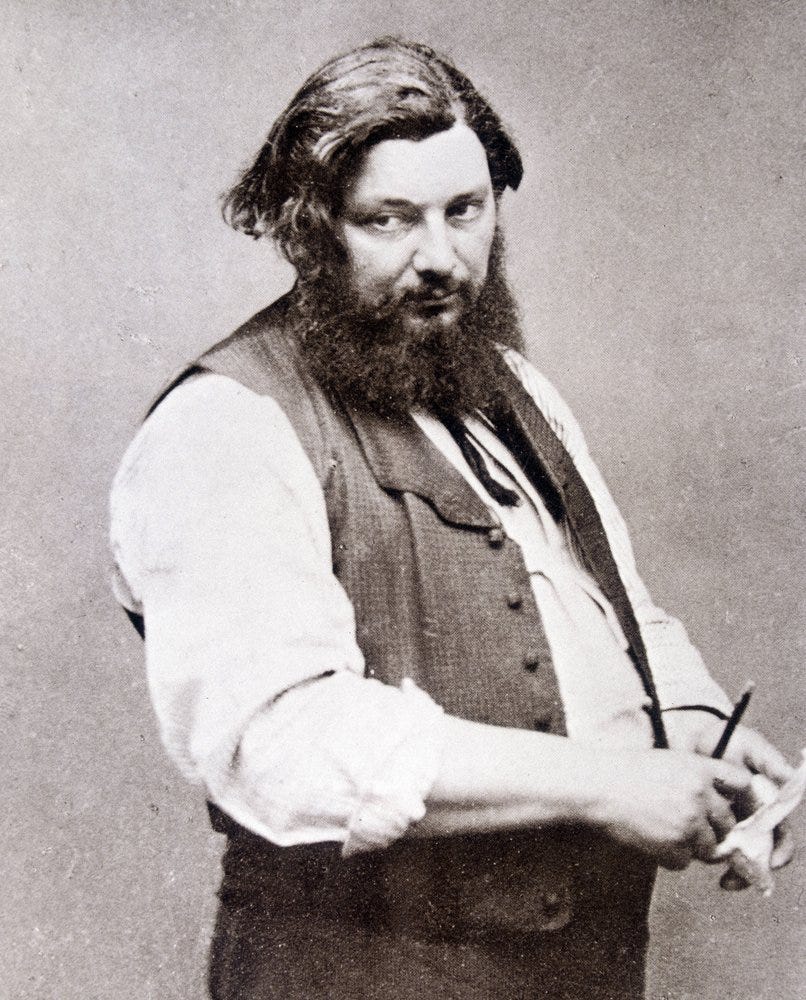
Bearded man in a dark coat
Étienne Carjat, Portrait of Gustave Courbet, 1861.

Keep Reading About Art History

A few more stories worth your next ten minutes.


No boring lectures, ever. Join 170,000 readers learning art the fun way, free.


What the Loss Still Tells Us

The Stone Breakers is one of relatively few major nineteenth century French paintings destroyed outright, rather than looted, damaged, or misattributed. That total loss means every study of the work today relies on secondhand evidence: photographs taken before 1945, written descriptions from the 1850 Salon, and the smaller Winterthur version Courbet painted himself.

That is also why reproductions vary slightly in tone and detail from one book to another. Each one traces back to a different prewar photograph or to the Winterthur canvas, not to one surviving original.

The Dresden museum still lists the painting in its records as destroyed in 1945, one of the clearest documented losses from that single night of bombing.

Frequently Asked Questions

  • Where is The Stone Breakers today?

    Nowhere. The original was destroyed in the Allied bombing of Dresden in February 1945. Only photographs and painted copies made before the war survive.

  • Who are the two men in the painting?

    Their identities were never recorded. Courbet described meeting two laborers on a road near Ornans and asking them to pose for him.

  • Why is The Stone Breakers considered the start of Realism?

    It gave anonymous manual labor the scale and seriousness usually reserved for history painting, without idealizing the men or their work.

  • How big was The Stone Breakers?

    About 165 by 257 centimeters, close to life size for the two figures.

  • Was Courbet alive when the painting was destroyed?

    No. Courbet died in 1877. The canvas was destroyed in the Allied bombing of Dresden in February 1945, more than sixty years after he painted it.

  • Does any version of the painting survive?

    Yes. A smaller autograph version, painted in reverse, survived the war and is held today in the Oskar Reinhart Collection in Winterthur, Switzerland.


Ten minutes, one masterpiece. That is the deal. 170,000 readers already took it, free.