Damien Hirst pickled a fourteen foot tiger shark in formaldehyde and called it art. It sold for millions as a meditation on death, then started rotting so badly Hirst had to catch and preserve a second shark just to keep the piece alive.

I remember the first time someone told me a pickled shark sold for eight million dollars. My honest reaction was that art had officially lost its mind.
Artist: Damien Hirst, born 1965
Made: 1991, a tiger shark preserved in formaldehyde
Movement: Young British Artists
More Artists Worth The Detour
If a rotting shark can be worth millions, the rest of art history has a few surprises of its own.
Hirst Before the Shark
Then I read what actually happened behind the tank, and the story turned out to be smarter, and stranger, than the punchline everyone repeats.
Hirst was born in Bristol in 1965 and grew up in Leeds, in a house without much money and without much interest in art. He got into Goldsmiths, an art school in London, on his second attempt.
While still a student in 1988, he organized an exhibition called Freeze in a disused warehouse, showing his own work alongside classmates who would later become famous themselves. Charles Saatchi walked through that show and started paying attention.
By the time Saatchi offered to fund whatever Hirst wanted to build next, the two already had a working relationship. The shark was not a lucky first meeting. It was the payoff of years of positioning.
What You Are Actually Looking At
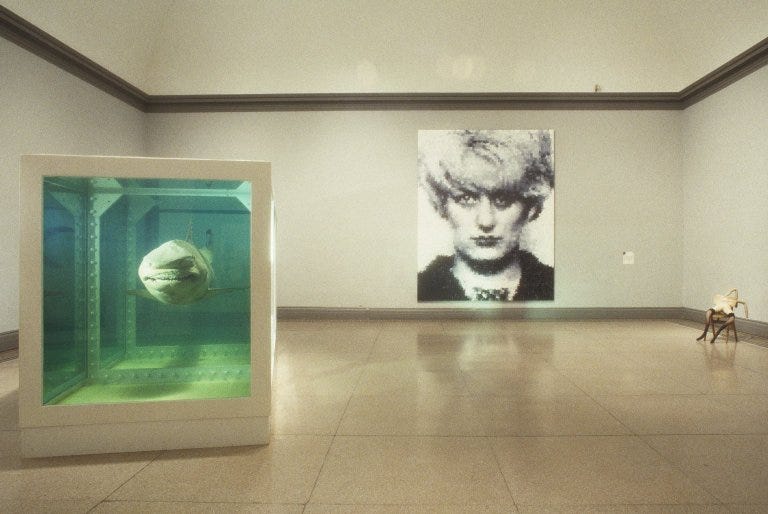
The full title is The Physical Impossibility of Death in the Mind of Someone Living. Most people just call it the shark, which tells you everything about how the image beats the words.
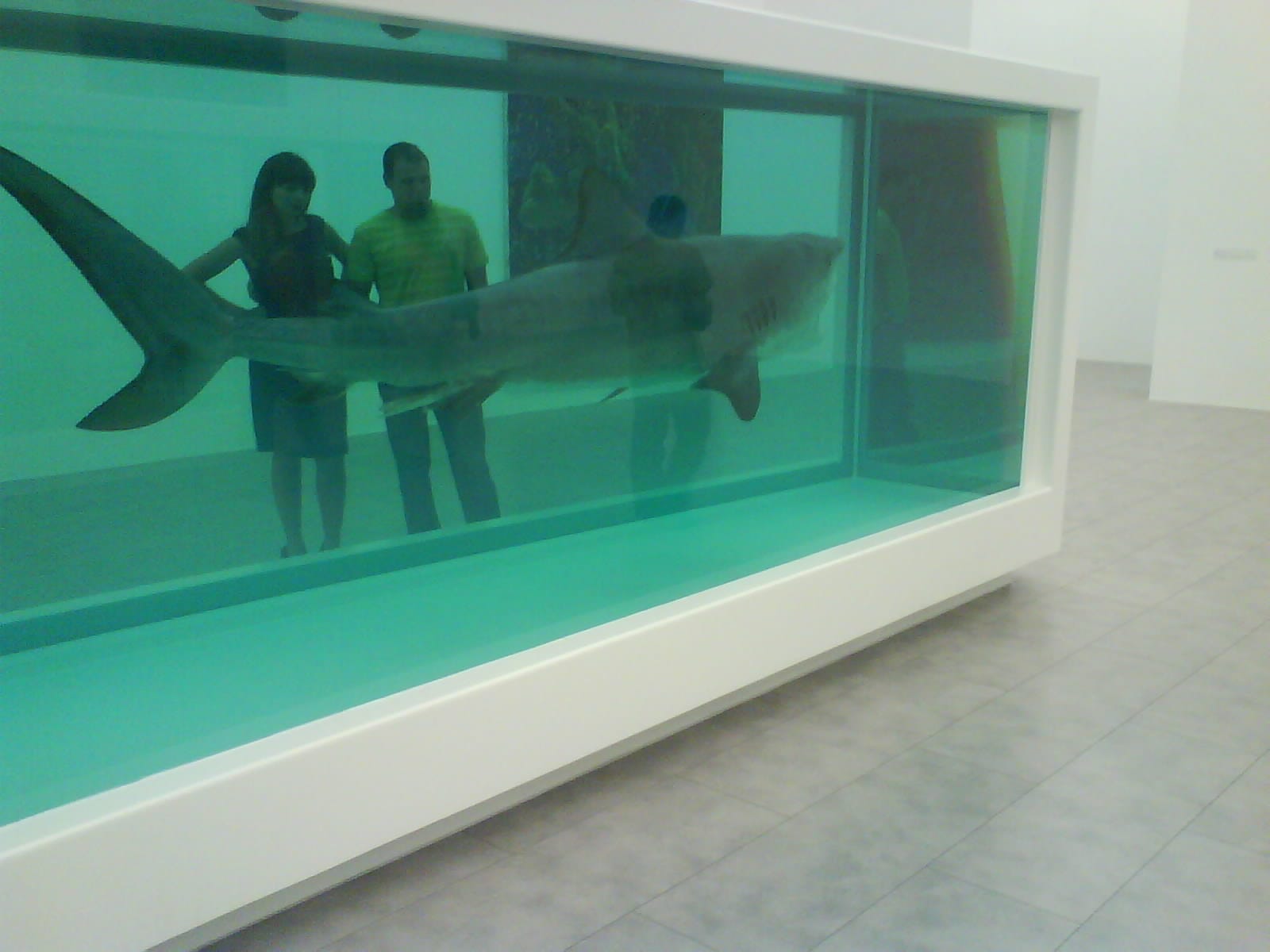
It is a tiger shark, caught off the coast of Queensland, Australia, floating inside a steel and glass tank filled with formaldehyde. Hirst made it in 1991, when he was twenty six years old and had barely sold a piece of art in his life.
There is no plinth trick here, no metaphor hiding behind paint. It is an actual dead predator, frozen mid glide, close enough to touch the glass with your nose if a gallery guard would let you.
Charles Saatchi's Blank Check
Hirst did not have the money to make this on his own. In 1991, the advertising mogul and collector Charles Saatchi offered to fund whatever piece Hirst wanted to build, with no real limit on the budget.
The shark itself cost around six thousand pounds, caught to order by an Australian fisherman. The full production, tank, steel, formaldehyde, engineering, came to roughly fifty thousand pounds, a serious sum for an artist nobody outside London's small gallery scene had heard of yet.
Saatchi unveiled it in 1992 as part of a show called Young British Artists. The shark walked out of that exhibition as the single image that defined an entire generation of British art.
Why Hirst Chose a Shark
Hirst has said plainly that he wanted something big enough to scare people, something with enough presence in a room that a viewer could not simply glance and move on.
A shark does that instinctively. It is one of the few animals humans are hard wired to fear even in a museum, safely dead, floating behind thick glass under gallery lighting.
The title explains the intention better than the object does. You cannot picture your own death. Your mind refuses the assignment every single time. Hirst wanted an object that forced the attempt anyway, using an animal built by evolution to be the last thing you ever see.
Hirst has also said the title came to him before the object did, and he worked backward from the phrase until the shark felt like the only image that could carry it. That order of operations, sentence first, object second, sums up his whole approach to making art.
The Rot Nobody Talks About
Here is the part most people never hear. Hirst's original preservation method was not built to last. The shark was injected with formaldehyde rather than properly submerged and cured from the start, and the results showed within a few years.
The skin wrinkled. The fluid inside the tank turned murky and green. By the early 2000s, the once sleek predator looked closer to a deflated prop than a frozen moment of nature, and critics openly mocked the decline.
A piece built entirely around the idea of defeating death was, quite literally, decomposing in front of paying visitors. Even Hirst admitted the irony was not lost on him.
A New Shark for Steve Cohen
In 2004, Saatchi sold the work to American hedge fund billionaire Steve Cohen. Reports at the time put the price between eight and twelve million dollars, a number that made headlines well outside the art press.
When Hirst learned about the sale, he offered Cohen something unusual: a full replacement. The original shark would come out, and a freshly caught one would go in, preserved properly this time.
Cohen agreed to fund the operation and reportedly called the extra cost inconsequential. A new female tiger shark was caught off Queensland, shipped to England in a twenty foot freezer with a backup generator, and installed by Hirst's studio in 2006.
Is It Still the Same Artwork
This is the question that actually interests me, more than the price tag ever did. The shark swimming in that tank today is not the shark Charles Saatchi unveiled in 1992.
It is basically the ship of Theseus with teeth. Swap every plank of a ship one at a time and at some point people start arguing about whether it is still the same ship. Hirst just did it once, all at once, with an entire animal.
Hirst's answer is straightforward. The work was always conceptual. The idea, the title, the tank, the intention, that is the art. The shark itself was always going to be a material that needed maintenance, the same way a bronze statue needs occasional cleaning.
Plenty of critics disagree, and I understand why. A painting does not need a new canvas every fifteen years to keep existing. This piece does, and that changes what you are actually paying for when you buy it.
The Diamond Skull That Followed
Hirst returned to the same subject, mortality, sixteen years later, with an entirely different material. In 2007 he unveiled For the Love of God, a platinum cast of a real human skull covered in over eight thousand diamonds.
He priced it at fifty million pounds, and reports at the time said a buyer group including Hirst himself acquired it, which raised its own round of questions about whether the sale was fully independent.
Put the shark and the skull side by side and Hirst's whole career comes into focus. He keeps circling the same fear, death, and keeps finding new expensive materials to stare it down with.
Why This Piece Still Divides People
I will say this plainly. I do not think the shark belongs anywhere near lists of the greatest painters of all time, because it is not a painting, and Hirst has never claimed to be a painter in the traditional sense. That comparison misses the point of what he was doing entirely.
What he did do was force an entire industry to argue, seriously, about what counts as art, what an artist actually makes with their own hands, and whether an idea can be worth more than the craft behind it. Few living artists have managed that on this scale.
Hirst's prices, and the shark's resale, now sit in the same conversation as the most expensive paintings ever sold, even though the object itself started life as a fishing trip and a favor from a wealthy collector.
He also belongs on any serious list of artists you need to know from the last fifty years, whether you find the shark brilliant or ridiculous. Both reactions prove the piece did its job.
More Secrets to Unlock
Frequently Asked Questions
What is the full title of Damien Hirst's shark artwork?
The Physical Impossibility of Death in the Mind of Someone Living. Hirst made it in 1991, and it is now usually just called the shark, since the full title rarely fits on a museum label.
Who paid for the original shark?
Collector Charles Saatchi funded the production in 1991. The shark cost about six thousand pounds, and the full piece, tank included, came to roughly fifty thousand pounds.
Is it a real shark?
Yes. It is a genuine tiger shark, caught to order off the coast of Queensland, Australia, and preserved in a tank of formaldehyde solution.
Why did the original shark need to be replaced?
The first preservation method was flawed. The shark's skin wrinkled and the tank fluid turned murky within a decade, so Hirst caught and preserved a second shark using a better technique in 2006, funded by the new owner.
Who owns the shark now?
American hedge fund manager Steve Cohen bought it from Saatchi in 2004, in a deal widely reported between eight and twelve million dollars. He funded the shark's replacement two years later.
What art movement does this work belong to?
It belongs to the Young British Artists, a loose group that came up together in London in the late 1980s and early 1990s, known for using shock, everyday materials, and conceptual ideas over traditional technique.
Is the shark considered a painting or a sculpture?
Neither, technically. It sits in a category usually called an installation, built from a preserved animal, steel, glass, and chemical solution rather than paint or carved material.
Why do people call this shocking or overrated?
Because the raw materials, a dead animal and a tank, cost a fraction of the sale price, and the idea alone accounts for nearly all the value. That gap is exactly what critics argue about, decades later.