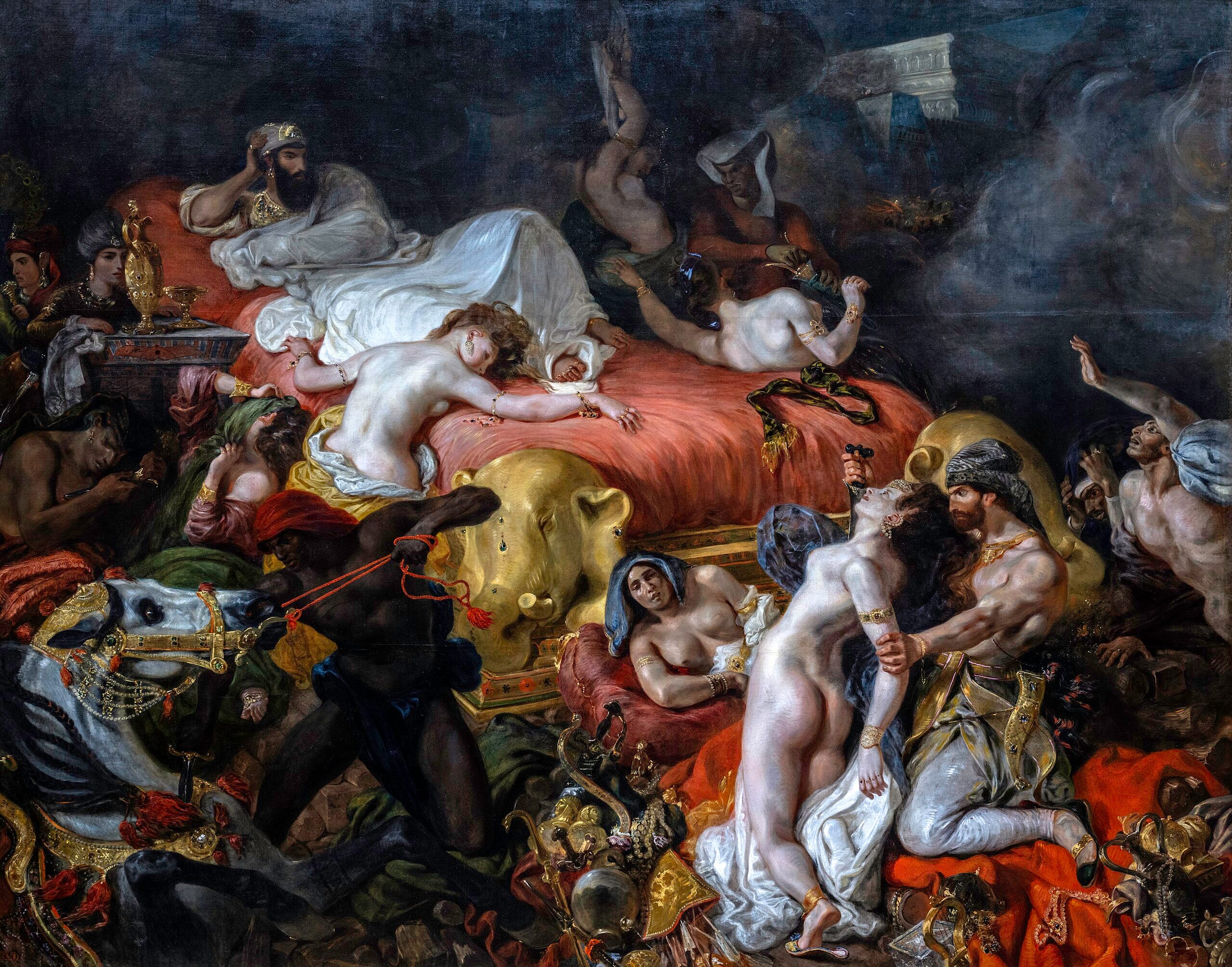
Eugène Delacroix's The Death of Sardanapalus shows an Assyrian king watching from his bed as soldiers kill his horses, concubines, and slaves around him, choosing destruction over surrender. Delacroix painted it in 1827, basing it on a poem by Lord Byron rather than any real historical event.
Nothing in the scene is calm. The one still figure in the entire painting is the king ordering all of it.
Date: Exhibited in 1827 at the Paris Salon
Medium: Oil on canvas, about 392 by 496 centimeters
Location: Louvre Museum, Paris
More Paintings Built on Chaos
Delacroix was not the only Romantic painter chasing this kind of controlled chaos. These three go just as far.
A Poem, Not a History Book
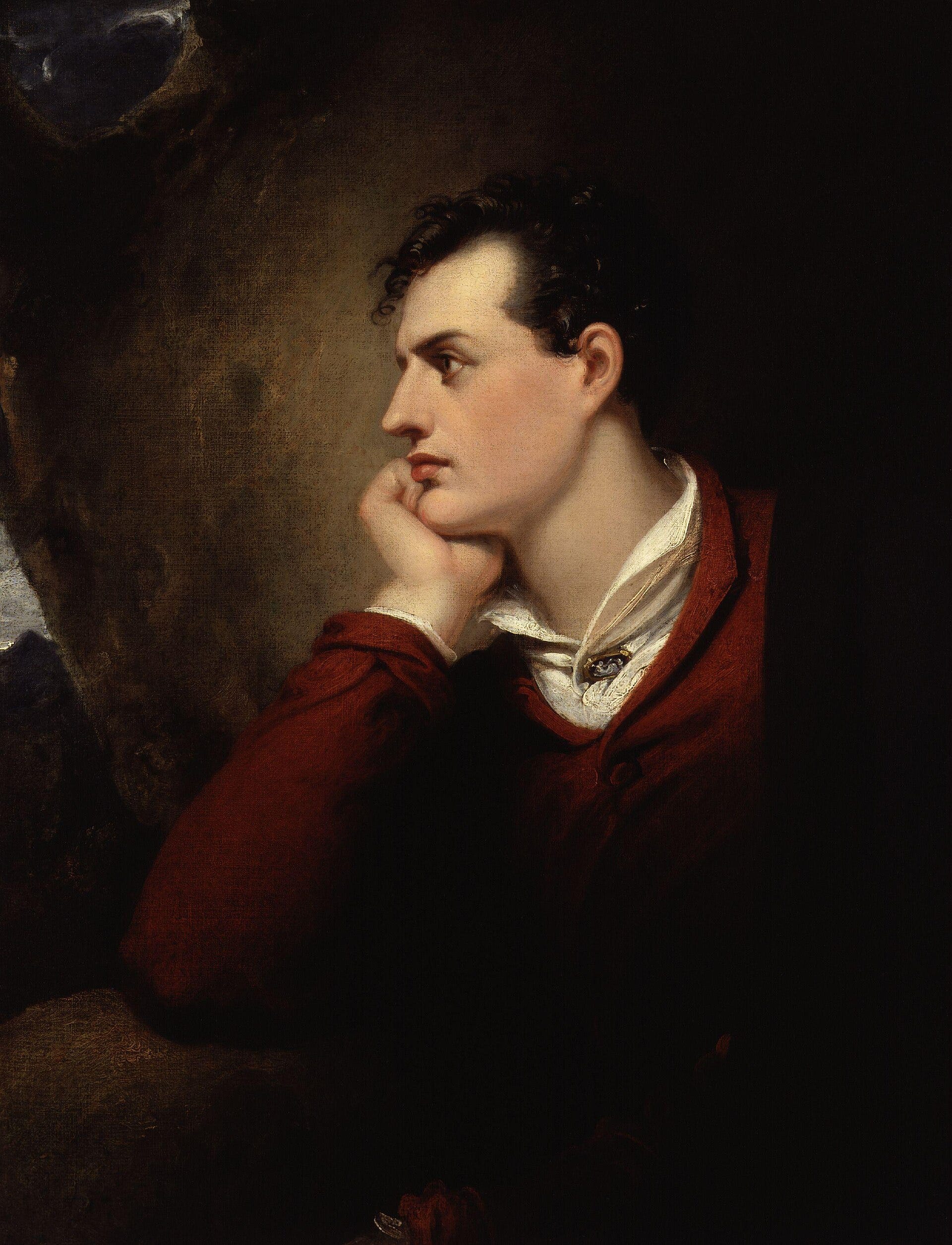
Delacroix's massacre never took place. He based the scene on Lord Byron's 1821 play Sardanapalus, itself drawn from ancient Greek accounts of Assyria's last king. Most historians think that legend blends together stories about several real Assyrian rulers rather than recording one actual siege or one real king's death.
Delacroix based the scene on Lord Byron's 1821 play Sardanapalus, itself loosely built from ancient Greek accounts of the last king of Assyria.
Those accounts describe a king who built a huge pyre and destroyed his own treasures, wives, and himself rather than surrender to a siege. Most historians think the legend is a garbled mix of stories about several real Assyrian kings, not a record of one actual event.
What strikes me is the king's own passivity. He orders the destruction of everything he owns, then just watches from the bed.
A Scandal at the Salon
Critics tore into the painting at its 1827 debut, calling the composition chaotic and the violence gratuitous. The backlash was harsh enough that Delacroix, then only twenty nine, received no new state commission for several years, even though the work is now read as a landmark of French Romanticism.
The painting was harshly criticized when it was first shown in 1827. Critics called the composition chaotic and the violence gratuitous, especially the mix of nude bodies and killing.
The reception was severe enough that Delacroix did not receive another state commission for several years afterward, even though the painting is now considered one of the defining statements of French Romanticism.
I read the years without a state commission as the real cost of the scandal. Delacroix paid for that painting long after it left the wall.
Why He Painted It Twice
The nearly four meter original proved impossible to sell. Years later Delacroix revisited the same scene at a fraction of that size, closer to what a private collector could actually hang, letting him return to Sardanapalus on his own terms long after the 1827 scandal had faded from memory.
Years later, Delacroix returned to the composition at a smaller scale, keeping the same scene but working at a size closer to what a private collector could actually hang.
The huge original had been essentially impossible to sell. The smaller version let him revisit the subject on his own terms, long after the original scandal had faded.
To me the smaller version reads less like a retreat and more like Delacroix finishing an argument nobody wanted to hear the first time.
The Chaos Is the Point
The composition swirls on a diagonal in deep red and gold, the king reclining passively above the frenzy he ordered below him. That broke sharply from the ordered, geometric scenes favored by Neoclassical painters like Ingres and David, and helped establish Romanticism as a real rival in French painting.
The composition swirls on a diagonal, built from deep reds and gold, with the king reclining passively at the top while frenzied violence unfolds below him.
It broke sharply from the ordered, geometric compositions favored by Neoclassical painters like Ingres and David, and helped establish Romanticism as a real rival to that tradition in French painting.
More Stories Worth Reading
A few more paintings that reward a second, closer look.
The Poem Behind the Painting
Byron wrote his verse drama Sardanapalus in 1821, six years before Delacroix picked up a brush. Delacroix read a French translation and focused on the final act, the king's decision to burn everything rather than surrender. The mass killing of concubines and horses on the canvas is Delacroix's own invention.
Byron wrote his verse drama Sardanapalus in 1821, six years before Delacroix picked up a brush. Delacroix read a French translation and moved straight to the final act, the king's decision to burn everything rather than hand it over.
Byron never wrote the mass killing of concubines and horses that dominates the canvas. Delacroix invented that part, going well past his own source material.
It Inspired an Opera Nobody Finished
Byron's play sent the Sardanapalus story into music almost at once. Hector Berlioz wrote a cantata called Sardanapale in 1830, and Franz Liszt began an opera on the same subject in 1845, completing only the first act by 1852 before abandoning the project. That act finally premiered in 2018.
Byron's play sent the story into music almost immediately. Hector Berlioz wrote a cantata called Sardanapale in 1830, and Franz Liszt started an opera on the same subject, Sardanapalo, in 1845. He abandoned it after finishing only the first act.
That single act didn't premiere until 2018, more than a century and a half after Liszt shelved it.
Berlioz fared better with his own Sardanapalus piece. He won the Prix de Rome with his cantata, and it premiered the same evening as his Symphonie fantastique, on 5 December 1830 at the Paris Conservatoire.
The Fanaticism of Ugliness
One critic at the 1827 Salon summed up the reaction in four words, the fanaticism of ugliness. Delacroix's foreshortened bodies and tilted perspective pushed the violence directly into the viewer's space, breaking the ordered, restrained compositions the Salon expected from a history painting of this scale.
One critic at the 1827 Salon summed up the reaction in four words: the fanaticism of ugliness. Delacroix's foreshortened bodies and tilted perspective were built to push the violence directly into the viewer's space, breaking the ordered, restrained compositions the Salon expected.
Historians have since read the scandal as more than a complaint about bad taste, tied to how the picture mixed a foreign king's cruelty with a distinctly French kind of spectacle.
The Louvre Didn't Want It Right Away
The Death of Sardanapalus stayed out of the Louvre for nearly a century after its 1827 scandal. The museum only bought the canvas in 1921, from the collector Baron Raphaël Vitta, using proceeds from an unrelated bequest, almost sixty years after Delacroix himself had died in 1863.
The painting stayed out of the Louvre for almost a century after the 1827 scandal. The museum only purchased it in 1921, buying the canvas from the collector Baron Raphaël Vitta for 700,000 francs, funded through the income of an unrelated bequest, decades after Delacroix's own death in 1863.
A smaller preparatory sketch, less than a twentieth the size of the final canvas, entered the Louvre separately in 1925, bequeathed by the Countess Paul de Salvandy.
Painted at Twenty Nine
Delacroix was only twenty nine years old when The Death of Sardanapalus went on public view, already established enough to attempt a Salon canvas nearly four meters wide. The scandal briefly cost him state commissions, though it never came close to ending his career.
Delacroix was only twenty nine years old when the painting was exhibited, already established enough to attempt a Salon canvas nearly four meters wide.
The scandal briefly cost him state commissions, but it did not end his career.
Frequently Asked Questions
Is the story of Sardanapalus a real historical event?
Not really. It comes from a legend recorded by ancient Greek writers about the last king of Assyria, filtered through a poem by Lord Byron. Most historians think the legend mixes together stories about several real Assyrian kings rather than describing one actual event.
Why did the painting cause a scandal in 1827?
Critics called the composition chaotic and the violence gratuitous, especially the mix of nude bodies and killing. The reception was harsh enough that Delacroix did not receive another state commission for several years afterward.
Did Delacroix paint more than one version?
Yes. He returned to the composition on a smaller scale years later, keeping the same scene but working at a size closer to what a private collector could actually hang.
What makes the composition so unusual for its time?
A swirling, diagonal arrangement of bodies in deep red and gold, with the king reclining passively above the violence. It broke sharply from the ordered, geometric compositions favored by Neoclassical painters like Ingres and David.
Where can I see it today?
In the Louvre Museum in Paris.