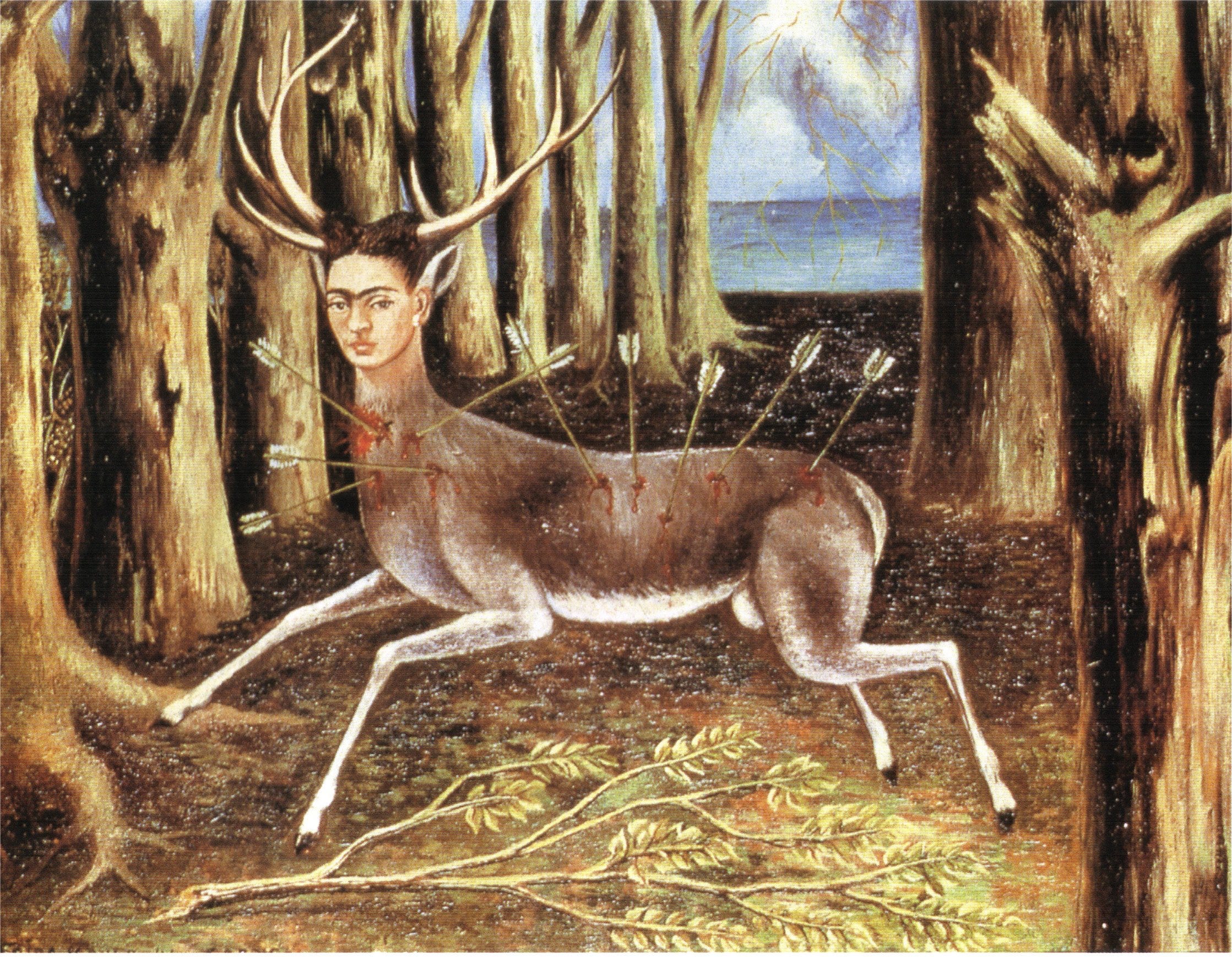
What Does Frida Kahlo's The Wounded Deer Mean?

A deer with Frida's own face, pierced by nine arrows, still walking through the trees. Painted after a failed surgery in 1946, here is the full story.

Frida Kahlo's The Wounded Deer shows her own face on a young stag pierced by nine arrows, painted in 1946 after a failed spinal surgery. Less known: she gave the small panel away as a wedding gift, with a handwritten note about a hurt deer finding a home.

Deer with a human face pierced by arrows
Frida Kahlo, The Wounded Deer, 1946.

The animal keeps walking through a forest of broken branches, one of them carved with a single word that changes how the whole scene reads.

  • Date: Painted in 1946, months after Kahlo's spinal surgery in New York.

  • Medium: Oil on masonite panel, roughly 22 by 30 centimeters.

  • Location: Private collection.


Ten minutes, one painting. Join 170,000 readers who get the story behind a masterpiece every week, free.


More From Frida Kahlo's World

If a small painting can carry this much, her house and her other self portraits carry even more. Start here.


A Small Panel Given Away, Not Sold

Kahlo did not paint The Wounded Deer for a gallery wall. On May 3, 1946, she gave the small panel to her friends Arcady and Lina Boytler as a wedding gift, along with a handwritten note comparing the deer's wound to her own loneliness before finding warmth in their friendship.

The note read, in her own words, that a deer had walked alone, sad and hurt, until it found in Arcady and Lina a warmth and a nest.

That detail rarely makes it into descriptions of the painting, which tend to stop at the arrows and the symbolism of martyrdom. It is the part I found hardest to leave out here.

A gift like this changes the register of the whole piece, from a public statement about suffering to something closer to a private letter.

Arcady Boytler was a Russian born film director and actor who had settled in Mexico, where he made a name directing sound era Mexican cinema. His wife Lina worked alongside him in the same film world. The couple's connection to that industry places The Wounded Deer inside Kahlo's circle of artists and filmmakers, not only her circle of painters.

Nine Arrows and a Surgery That Failed

In 1946, Kahlo traveled to New York for spinal surgery meant to end years of chronic back pain. The operation did not work. She returned to Mexico in more pain than before, and painted The Wounded Deer soon after, its nine arrows echoing the suffering the surgery had failed to fix.

The number nine is not incidental. Several historians connect it to Kahlo's Aztec calendar birth date, which they associate with the number nine, tying the wound to a personal fate rather than pure medical bad luck.

The pose also recalls Saint Sebastian, the Christian martyr traditionally painted pierced by arrows and surviving them, an image Kahlo had already borrowed for earlier self portraits.

Two symbolic systems sit on top of one medical fact, an Aztec calendar reading and a Catholic martyr, both layered onto the same failed operation.

A Body Marked Since Childhood, Not Just Since 1946

The most common misreading of The Wounded Deer treats it as a reaction to one operation. Kahlo's chronic pain actually began in 1925, when a bus she was riding collided with a streetcar and left her with a broken spine and pelvis, and more than thirty operations by the time she painted this deer.

The 1946 surgery was one chapter in a much longer story that began two decades earlier.

Reading the painting only through that single failed operation misses two decades of prior injury that shaped how Kahlo saw her own body long before this canvas existed.

What I find most telling is how much that longer timeline changes the reading. This was not one crisis. It was one more chapter in a body that had been breaking for twenty years.

Young woman in a long dress
Guillermo Kahlo, Portrait of Frida Kahlo, 1932.

See a painting differently. 170,000 readers already do, one story at a time, free.


A Stag, Not a Doe

Kahlo gave the wounded animal her own face, but its body belongs to a male stag, complete with antlers. Historians read the choice as deliberate: Kahlo often blurred gender in her self portraits, and a pet deer named Granizo lived at Casa Azul during this same period of her life.

Granizo appears in photographs from the household taken around 1946, alongside Kahlo's monkeys and dogs, part of the menagerie she kept at home.

Putting her face on a male animal, rather than a doe, adds another layer to a painting that already mixes her own likeness with something not entirely her.

Blue courtyard house with plants
Casa Azul, Frida Kahlo’s house, Coyoacán, Mexico.

The Word Cut Into a Broken Branch

At the bottom of the canvas, Kahlo painted the word Carma into a fallen tree branch, using her own spelling for fate. Paired with the note she gave the Boytlers about a wounded deer finding a home, the inscription turns private symbolism into a message about accepting what cannot be changed.

The branch lies broken among others just like it, in a forest with no clear way out.

Read next to the wedding note, the word stops being a general statement about suffering and becomes something closer to a farewell gift, wrapped in a painting instead of paper.

I read that word the same way. Next to the wedding note, it reads less like martyrdom and more like a goodbye.

Kahlo had already put raw, exposed pain directly on canvas seven years earlier, in The Two Fridas, where two versions of herself sit joined at an exposed artery.

Two seated women holding hands, hearts exposed
Frida Kahlo, The Two Fridas, 1939.

What Most Readings Get Wrong

The Wounded Deer is often filed simply as a wounded animal self portrait, but it draws on at least three traditions at once: Christian martyrdom through Saint Sebastian, a personal reading of the Aztec calendar, and a private note of gratitude to two friends who took her in during a low point.

None of those readings cancel each other out. Kahlo layered them the way she layered fabric, jewelry, and flowers onto her own image throughout her work.

Treating The Wounded Deer as only a record of physical pain, without the gift and the note behind it, leaves out the warmest part of the story, at least to me.

Woman with flowers in her hair
Frida Kahlo, photographed in 1939.

Keep Reading About Frida Kahlo

Three more stories about the woman behind the paintbrush.


Never run out of stories. 170,000 readers get one new painting explained every week, free.


Frequently Asked Questions

  • Why does the deer have Frida Kahlo's face?

    Kahlo frequently painted herself through symbolic stand ins. Giving a wounded stag her own face turned an animal in pain into a direct self portrait.

  • What do the nine arrows in The Wounded Deer mean?

    They are widely read as a reference to her ongoing physical suffering after a spinal surgery that failed, with the number nine tied by several historians to her Aztec calendar birth date.

  • What does the word Carma mean in the painting?

    It is Kahlo's own spelling of fate, carved into a fallen branch in the foreground, echoing a note she wrote about accepting a painful destiny.

  • Who did Frida Kahlo give The Wounded Deer to?

    She gave it to her friends Arcady and Lina Boytler as a wedding gift on May 3, 1946, along with a handwritten note comparing the deer to her own search for warmth.

  • How big is The Wounded Deer?

    It is small, painted in oil on a masonite panel roughly 22 by 30 centimeters, closer to the size of a notebook page than a wall painting.

  • Where is The Wounded Deer now?

    The painting remains in a private collection and is rarely lent for public exhibition, unlike many of Kahlo's more famous self portraits.


One painting, one true story, every week. Join 170,000 readers, free.