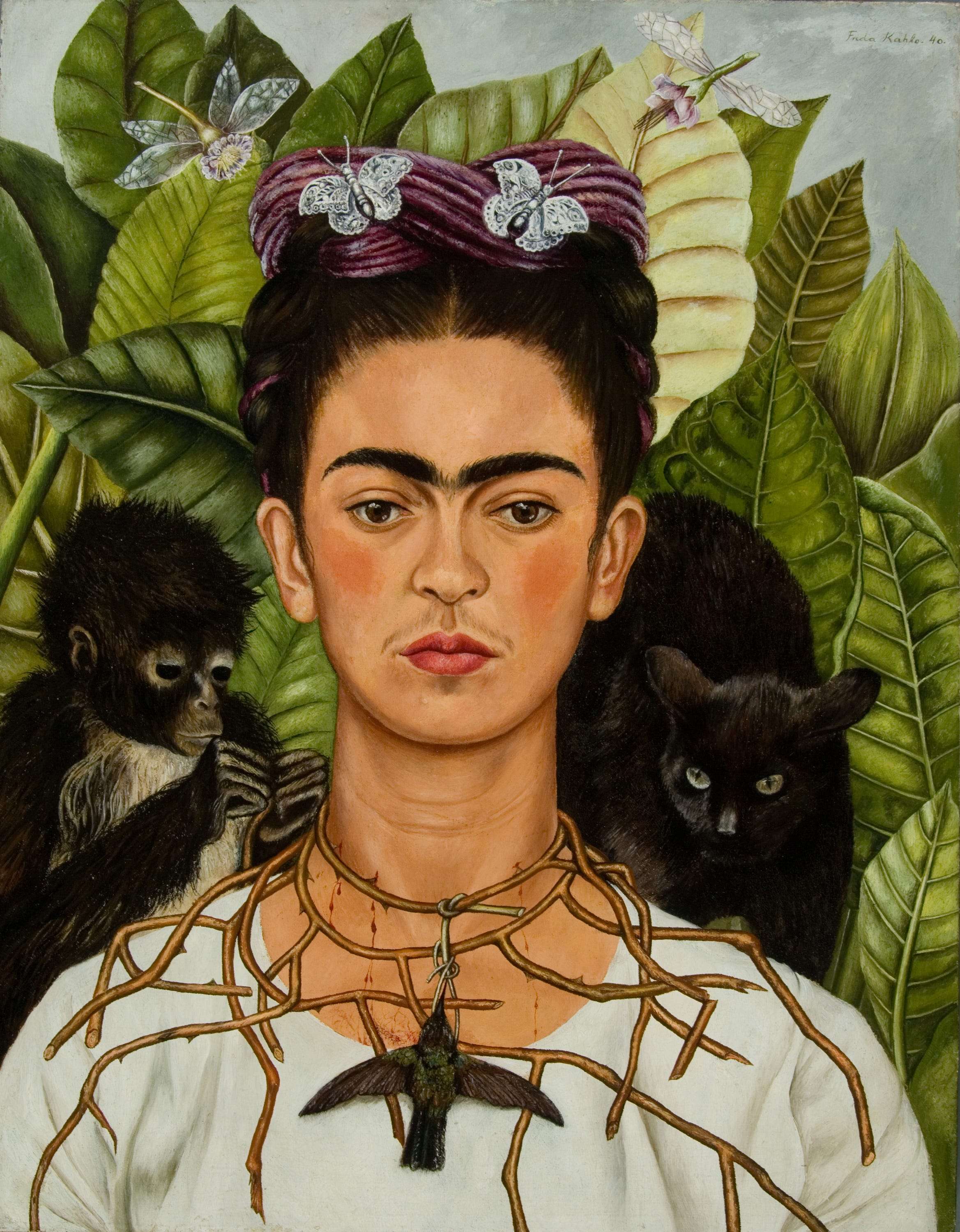
Frida Kahlo painted herself bleeding from a thorn necklace in 1940, the year she divorced and remarried Diego Rivera. A dead hummingbird hangs at her throat. In Mexican folklore hummingbirds bring luck in love. Hers is dead, and the luck ran out.
She painted it for Nickolas Muray, the photographer who was her lover for close to a decade. He asked her for a self portrait. She sent him this one, and it stayed in his collection until his death.
Date: 1940.
Medium and size: Oil on canvas mounted on masonite, 61.25 by 47 centimeters.
Location: Harry Ransom Center, University of Texas at Austin.
Frida Kahlo Self Portraits Worth Reading Next
If this one got under your skin, these three go even deeper.
A Necklace That Draws Blood
Frida Kahlo painted a wreath of thorns cutting into her own neck in this 1940 self portrait, with small drops of blood rendered in the same careful detail as her jewelry and hair. She keeps her face still while the thorns draw blood, turning an injury into a calm, staged image of endurance.
The thorn necklace wraps her throat tight enough to pierce the skin. Small drops of blood fall onto her chest, painted with the same care as everything else in the picture.
She does not flinch. Her face stays calm even though she is bleeding. That calm is what makes the picture hard to look away from.
I read that stillness as the real subject of the picture. She is not hiding the pain, she is refusing to perform it.
The Hummingbird That Should Bring Luck
In Mexican folk tradition, a dried hummingbird worn as a charm was believed to bring luck in love, and women once sewed the birds into small pouches or ribbons. Frida Kahlo inverts that tradition here: her hummingbird hangs dead from the same thorns cutting her neck, wings spread instead of tucked away.
In Mexican folklore, a dead hummingbird worn as a charm was supposed to attract love. Women carried them sewn into little pouches or tied to a ribbon.
Frida flips the symbol. Her hummingbird is not tucked safely in a pouch. It hangs from the same thorns that cut her, wings spread, dead and black.
The Cat and the Monkey
A black cat crouches behind Frida Kahlo's left shoulder in this self portrait, an image tied in Mexican folklore to a coming death, while a spider monkey pulls at the thorn necklace on her right side instead of loosening it. Diego Rivera had given her pet monkeys as gifts over the years.
A black cat crouches behind her left shoulder, ready to pounce. In Mexican imagery, a black cat close to someone marks a death omen.
On her right, a spider monkey pulls at the necklace, tightening the thorns instead of loosening them. Diego Rivera had given her pet monkeys as gifts over the years. Here the animal works against her, not for her.
What strikes me is that detail. Even a gift once given kindly gets turned into part of the wound in the way she paints it.
Why She Painted It the Year of the Divorce
Frida Kahlo divorced Diego Rivera in November 1939 after years of his affairs, then remarried him in December 1940, the same year she painted this self portrait. She never wrote down what the thorns and the dead hummingbird meant to her personally, so every reading of the picture stays an inference from historians, never a quote from Kahlo herself.
Frida and Diego Rivera divorced in November 1939 and remarried in December 1940, the same year this portrait was made.
She never explained the painting in her own words. Historians read the thorns, the blood, and the dead bird as marks of that year, without needing her to spell it out.
One Self Portrait Among Fifty Five
Frida Kahlo painted roughly 55 self portraits over her career, close to a third of her entire output as an artist. She started at 18, recovering in a body cast after a bus accident, when her mother fixed a mirror above her bed so she had something to paint besides the ceiling.
Frida painted around 55 self portraits over her career, close to a third of everything she made.
She started at 18, recovering in bed after a bus accident left her in a body cast for months. Her mother had a mirror installed above the bed so she had something to paint.
More Women Who Changed What Painting Could Say
Frida was not working alone. These stories cover the artists who share her nerve.
A Gift for Nickolas Muray
Frida Kahlo painted this self portrait in 1940 for Nickolas Muray, a Hungarian born photographer who had been her lover for close to a decade. Muray kept the small canvas in his private collection until his death in 1965, when it entered the Nickolas Muray Collection at the Harry Ransom Center in Austin, Texas.
Frida painted this self portrait in 1940 for Nickolas Muray, a Hungarian born photographer who was her lover for nearly a decade. The canvas is barely bigger than a magazine page, just over sixty centimeters across.
Muray kept the painting until his death in 1965. It later entered the Nickolas Muray Collection at the Harry Ransom Center, University of Texas at Austin, where it still hangs today.
Painted Between Two Weddings
Frida Kahlo divorced Diego Rivera in November 1939, then painted this self portrait the following year while living mostly alone at her family home in Coyoacan. By December 1940 the couple remarried in San Francisco, which places the picture squarely inside the one stretch of her adult life she spent without him.
Frida divorced Diego Rivera in November 1939, worn down by his affairs and her own worsening health. She painted the thorn necklace portrait the following year, in 1940, while living mostly alone at her family home in Coyoacan.
By December 1940, she and Rivera remarried in San Francisco. The portrait sits exactly between the two weddings, a record of the months she spent deciding what she wanted without him.
To me, that timing is the whole story. This is not a painting about the divorce or the remarriage. It is a painting about the gap in between.
How a Small Canvas Became a Poster
For decades this self portrait stayed inside Nickolas Muray's private collection and was rarely reproduced in print. That changed after Frida Kahlo's rediscovery in the 1970s and 1980s, and by 2018 the Victoria and Albert Museum in London built an entire exhibition around her clothes and self image, breaking its own advance ticket sales record before the show opened.
For decades the painting stayed inside Muray's private collection, rarely reproduced anywhere. That changed after Kahlo's rediscovery in the 1970s and 1980s, when feminist scholars and curators pulled her work out from under Rivera's reputation.
In 2018, the Victoria and Albert Museum in London built an entire exhibition, Frida Kahlo: Making Her Self Up, around her clothes and her self image. Advance ticket sales broke the museum's own records before the show even opened.
A Practice Built on a Mirror
Frida Kahlo learned to paint herself using a mirror her mother fixed above her bed after a 1925 bus accident left her bedridden for months. She kept working from that same reflection for the rest of her career, which is why almost every one of her self portraits meets the viewer at the same straight on angle.
Kahlo learned to paint herself using a mirror her mother had fixed above her bed after a 1925 bus accident left her bedridden for months. She kept working that way for the rest of her life, even once she was healthy enough to sit up at an easel.
The thorn necklace portrait, like most of her self portraits, was painted from that same mirror reflection rather than from photographs. It explains why almost every Kahlo self portrait meets the viewer at the same straight on angle. Diego Rivera bought her that first easel adapted to the bed, and her mother commissioned a special frame so Frida could paint lying flat during the worst months of her recovery.
Frequently Asked Questions
When did Frida Kahlo paint this self portrait?
In 1940, the same year she divorced and remarried Diego Rivera.
Who was the hummingbird painted for?
It references a Mexican folk charm believed to bring luck in love. Kahlo paints it dead instead of working.
Where is the painting kept today?
At the Harry Ransom Center, University of Texas at Austin, part of the Nickolas Muray collection.
What other animals appear in the portrait?
A black cat over her left shoulder and a spider monkey pulling her necklace on the right, with two dragonflies and butterflies caught in her hair.
How many self portraits did Frida Kahlo paint in total?
Around 55 over her lifetime, roughly a third of her entire output.