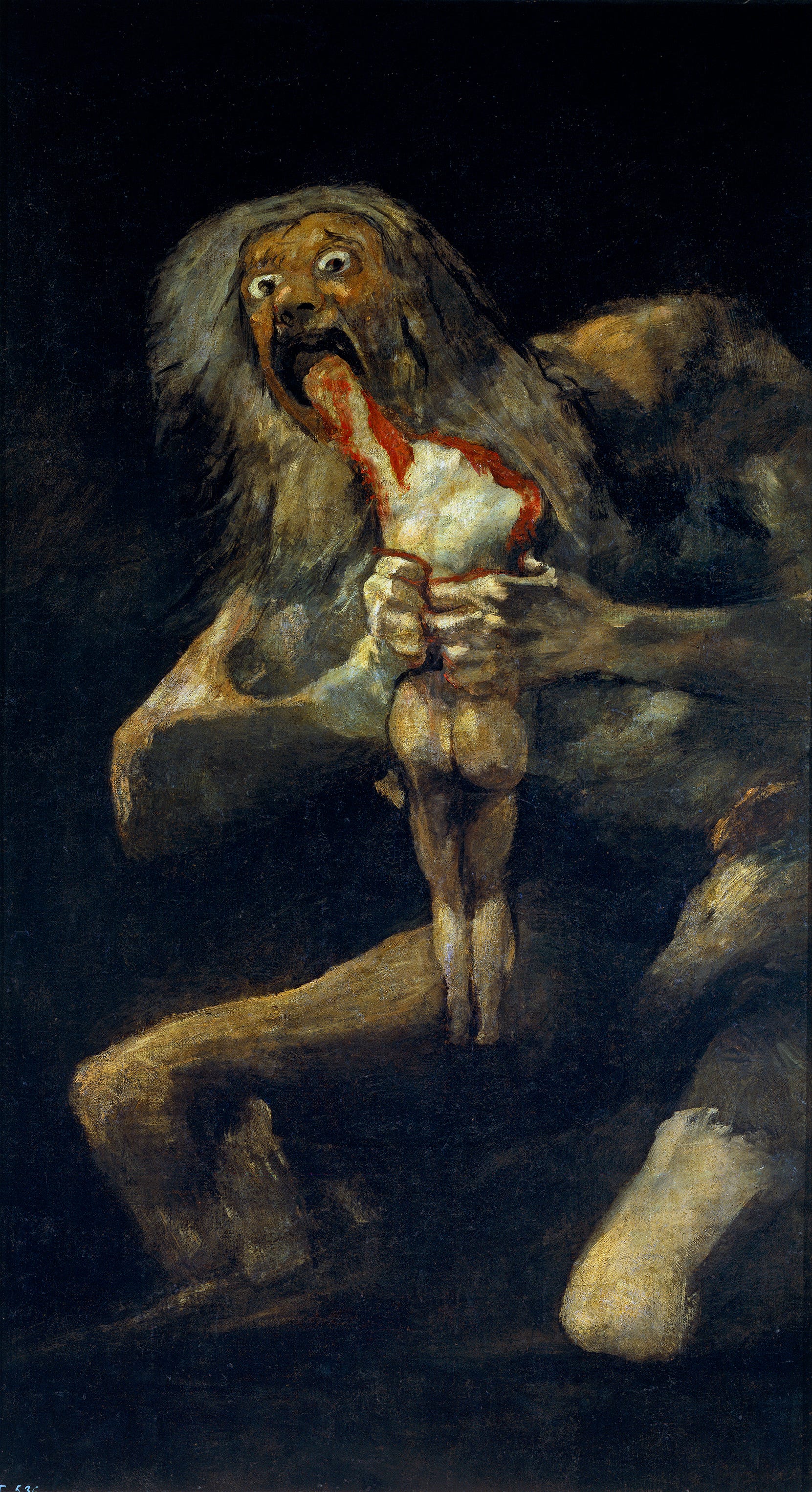
Saturn Devouring His Son shows Goya's most private, most extreme wall painting: Cronos eating a child mid struggle, a detail no ancient myth describes. Photographs taken in 1874, before restorers touched the plaster, show a slightly different Saturn than the one now hanging in the Prado.
Goya painted this scene directly onto the wall of his own house. He never meant for anyone else to see it.
Date: Painted between 1819 and 1823.
Medium: Oil mural, later transferred to canvas.
Location: Museo del Prado, Madrid.
Cross the paywall with six stories worth your time
Cool Stories About Art tells the history behind paintings without the lecture hall tone. Here are six stories in the same register as Goya's darkest work.
The myth Goya turned into blood
In Hesiod's telling from around the seventh century BC, Cronos swallows his children whole and they survive undigested until Zeus frees them later. Nothing in that ancient text describes blood or a missing limb. Goya invented the violence himself, painting Saturn biting into a body that has already lost an arm and part of its head.
Saturn was a Titan who ruled before the gods most people know today. A prophecy warned that one of his own children would overthrow him, so he swallowed each newborn as a precaution.
Goya's version breaks from every earlier account. One son in the painting still struggles against Saturn's grip, a detail with no source in Hesiod, Ovid or any Roman retelling.
People often assume Goya illustrated an old horror story exactly as written. He did not. I think that gap between the calm ancient myth and Goya's savage image is the real subject of the painting, more than the myth itself.
A house he never meant to open
Goya bought a property outside Madrid in February 1819. Locals already called it the Quinta del Sordo, house of the deaf man, after an earlier owner who had lost his hearing decades before. Goya had been deaf himself since 1793, but he inherited the nickname along with the walls. He did not create it.
Between 1819 and 1823 he covered the walls with fourteen paintings now known as the Black Paintings. Saturn Devouring His Son is one of them.
Nobody commissioned these works. Goya painted them for himself, straight onto plaster, in a house he rarely opened to visitors. There is no record of him showing the murals to guests.
I find that privacy telling. A painting made with zero audience in mind reads differently than one made to be judged, sold or hung in a salon.
A Roman god Goya had already seen on a wall
Peter Paul Rubens painted his own Saturn Devouring His Son around 1636, for a hunting lodge near Madrid called the Torre de la Parada. The canvas stayed in Spain's royal collection for generations. Goya worked in Madrid for decades and almost certainly studied it before painting his own version two centuries later.
Rubens shows a controlled scene. Saturn mid bite, his face closer to grim duty than madness, his body proportioned like a classical sculpture.
I read Goya's version as an answer to that restraint, not a copy of it. Where Rubens keeps the god composed, Goya gives him bulging eyes and a mouth stretched too wide, closer to a nightmare than a myth.
From plaster wall to museum canvas
Goya died in 1828 and his house changed owners several times. In 1874, before movers cut the murals from the plaster, Baron Emile d'Erlanger hired photographer Jean Laurent to record them first. Those glass plate photographs are the only images of the paintings as Goya actually left them, before any restorer touched the canvas.
Workers transferred all fourteen murals from wall to canvas in 1874. Erlanger donated them to the Museo del Prado in 1881, where Saturn Devouring His Son still hangs today.
Several historians who compared Laurent's 1874 photographs to the canvas now in Madrid have pointed to small differences on Saturn's body and around the wound. Nobody disputes that restoration happened. What is debated is how much of what visitors see today is Goya's hand alone.
The common assumption is that a museum visit shows exactly what Goya painted on his own wall. The 1874 photographs are a reminder that it does not, not entirely.
Three readings, and nothing written by Goya himself
Goya left no letter, no title and no explanation for this painting. Every interpretation of Saturn Devouring His Son, from a comment on Spain's civil wars to a portrait of Goya's own crumbling mind, comes from historians looking at the work decades after his death, not from anything Goya wrote.
Some read it as Spain devouring itself after the Napoleonic wars and the return of an absolutist king. Others see an old man confronting mortality, or Goya's own fractured state of mind near the end of his life.
None of these readings can be confirmed by anything Goya wrote. They remain interpretations, not facts, however often they get repeated as settled history.
A medical theory that keeps resurfacing
Goya fell seriously ill in 1792 and lost his hearing within months. He also reported tremors, balance problems and periods of confusion for years afterward. A 2004 medical paper proposed chronic lead poisoning from the lead based pigments painters ground by hand, a theory that remains debated and unconfirmed.
The theory would explain the tremors and the sudden deafness. It does not explain why, of every subject available to him, Goya chose a god eating his own child for a wall in the house where he lived essentially alone.
I find the lead poisoning theory useful but incomplete. Medicine can explain a symptom. It cannot explain a subject choice.
More stories from the same shelf
FAQ
Why did Goya paint Saturn Devouring His Son?
He never explained it. The painting is one of fourteen Black Paintings he made directly on the walls of his house between 1819 and 1823, without a commission or an audience in mind.
What myth does the painting show?
The myth of Saturn, known as Cronos in Greek mythology, a Titan who devoured his children to stop a prophecy that one of them would overthrow him.
Where can I see Saturn Devouring His Son today?
At the Museo del Prado in Madrid. The mural was transferred from Goya's house to canvas in 1874 and entered the Prado's collection in 1881.
Is Saturn Devouring His Son part of a series?
Yes. It belongs to the Black Paintings, fourteen works Goya painted on the walls of the Quinta del Sordo, his house near Madrid, during the final years of his life.
Did Goya title the painting himself?
No. Like the other Black Paintings, the title was assigned later by people cataloguing his house after his death.
Does the Prado's Saturn look exactly like Goya painted it?
Not with certainty. Photographs taken in 1874, before the mural moved from plaster to canvas, show details on Saturn's body that some historians read differently from the version on display today.