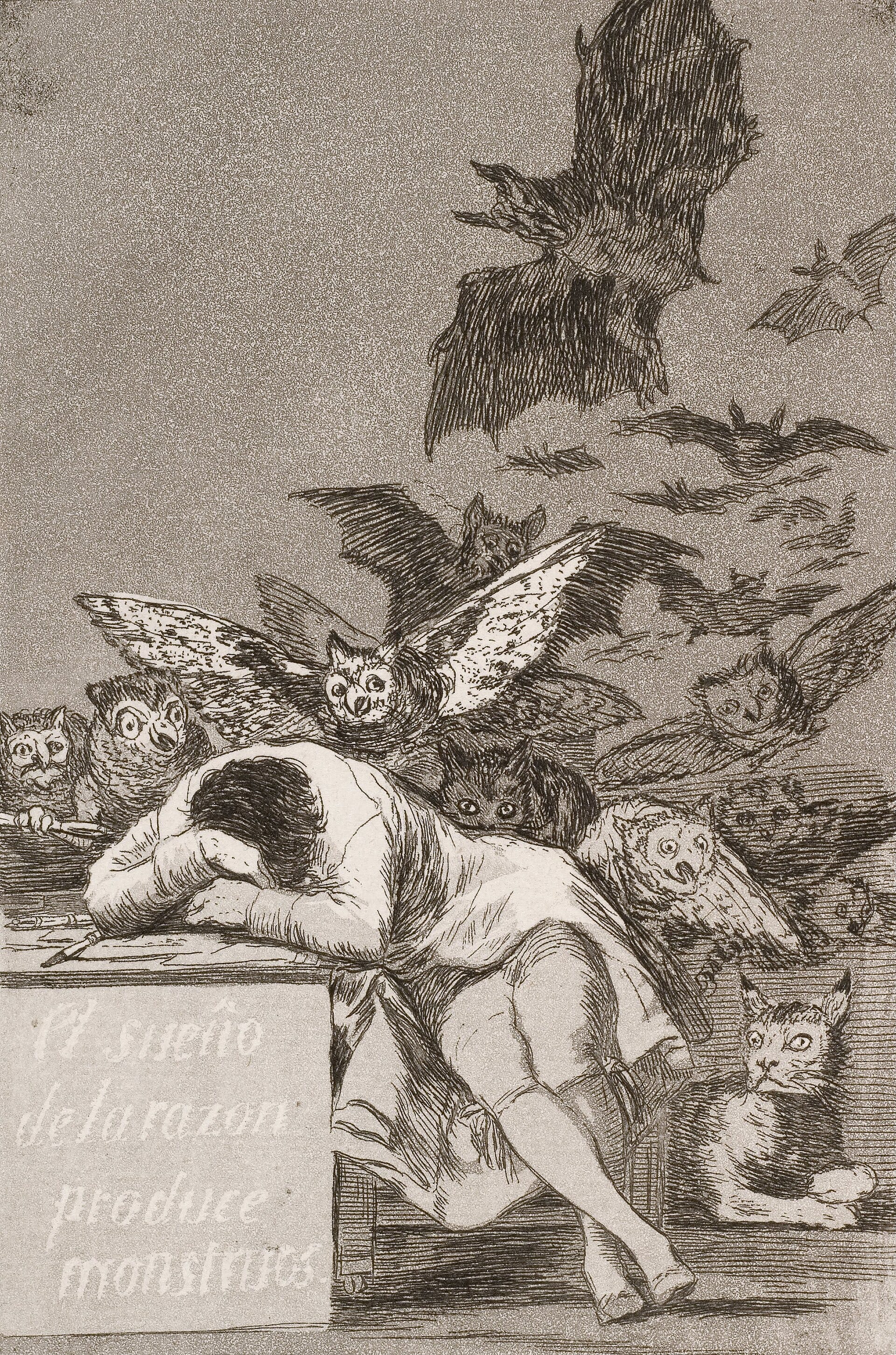
Goya's The Sleep of Reason Produces Monsters shows the artist asleep at his desk, surrounded by owls and bats. The Spanish word sueno means both sleep and dream, so the etching argues that reason left unguarded breeds monsters, or that reason and imagination depend on each other.
I keep coming back to this print because Goya gave it two different captions, and they do not agree with each other. Both were written close to the time of the plate.
Date: 1799, plate 43 of the 80 etchings in Los Caprichos.
Medium: etching, aquatint, drypoint and burin.
Location: no single original painting exists. Prints from the first edition are held in print rooms around the world, including the Nelson Atkins Museum of Art.
If Goya's Darkness Pulls You In
A few more stories from the archive, for readers who want to go further into painters who worked in the dark.
Why Goya Drew Himself Asleep
Goya went completely deaf in 1792, and historians still argue over the cause: lead poisoning, a fever the era's doctors called colic of Madrid, or a form of palsy. The isolation that followed pushed him away from royal tapestry commissions and into Los Caprichos, eighty etchings published in 1799 that attacked the vanity, greed and superstition he saw around him.
Goya held the position of First Court Painter to King Charles IV at the time, a job that called for flattering portraits, not etchings about human folly. He made both at once.
Two Captions, One Print
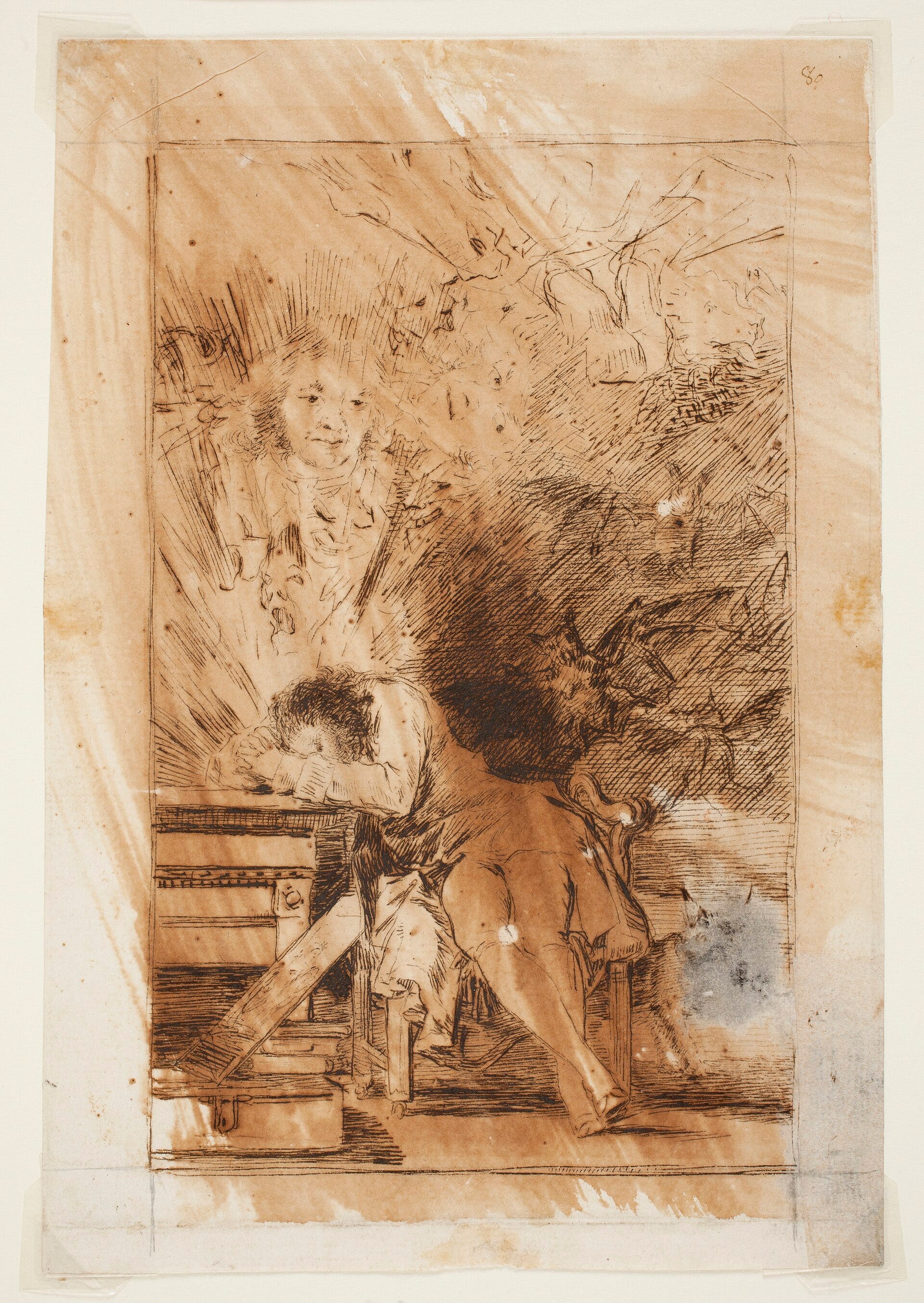
Goya wrote two different captions for this image. One, tied to the preparatory drawing, blames sleeping reason alone for creating monsters. The published caption softens that stance: fantasy abandoned by reason produces impossible monsters, but fantasy united with reason becomes the mother of the arts. Goya never picked a single meaning and kept both in circulation.
Art historian Philip Hofer found evidence that Goya first planned this etching as the frontispiece for the whole series. He changed his mind and placed it 43rd instead, closer to the middle of the 80 plates. What strikes me is that move. Burying it in the middle instead of leading with it changes what the print does, it becomes a hinge, not a headline.
I read the shift between the two captions as Goya covering himself as much as clarifying his intent. An artist openly mocking the clergy in 1799 had good reason to leave room for more than one interpretation.
Owls, Bats and a Watching Lynx
Spanish folk tradition assigned meaning to every creature in the print. Owls stood for foolishness, bats for ignorance, both closing in on the sleeping man from behind. A lynx crouches in the shadows with its eyes open, usually read as the clear sight reason should provide if it stayed awake instead of dozing off.
Plate 24 from the same series shows a different kind of monster: a woman paraded through the streets under sentence from the Inquisition. Los Caprichos found plenty of horror without any owls at all. To me, that plate is the real reminder. The monsters in this series were rarely supernatural, most of them wore ordinary clothes.
The Hinge of Los Caprichos
Placing this print 43rd of 80 was not incidental, historians argue. The first half of Los Caprichos mocks ordinary vice, vanity, marriage, greed. After plate 43 the etchings turn openly fantastical, filled with witches and goblins, the same territory Goya kept returning to for the rest of his life.

Goya was already painting witchcraft scenes like this one for a private client while he etched Los Caprichos. The two projects fed the same obsession with superstition.

Goya returned to this same territory near the end of his life, in the Black Paintings he covered the walls of his own house with. The monsters got worse, not better.
No single event marks the exact hinge. The shift is visible only in hindsight, across the run of eighty plates viewed together in order.
Pulled from sale after two weeks
Goya advertised Los Caprichos for sale in a Madrid newspaper in February 1799, priced at 320 reales for all eighty prints. Only about twenty seven sets sold before he pulled the series after roughly two weeks, most historians agree out of fear the Inquisition would read the etchings as blasphemous, though no formal charge survives in any archive.
I find twenty seven sets a unusually small number for a project that took years to etch. Fear, not public indifference, ended the sale.
Plates traded for a pension
In 1803, four years after pulling Los Caprichos from sale, Goya offered the original copper plates and remaining unsold prints to King Charles IV, in exchange for a pension for his son Javier. The king accepted. The plates entered Madrid's royal print works, the Calcografia, where new impressions are still pulled from the same copper today.
A plate small enough to hold, worn a little more each time
Each Los Caprichos plate measures close to 21 by 15 centimeters, small enough to hold in one hand. Goya combined etching with aquatint, a tone building technique using acid bitten grain, to make the room around the sleeping man read as genuinely dark. Every later print run wears the copper slightly, so a first edition impression and a modern reprint are not identical objects.
Original copperplate size limited how much detail Goya could pack into one scene, which is part of why the sleeping man, his desk and the animals behind him fill nearly the entire plate with almost no empty background.
The Calcografia Nacional has reissued Los Caprichos multiple times since acquiring the plates, with print runs documented across the nineteenth and twentieth centuries.
A museum labeling a print needs to specify which edition it comes from. A first edition impression pulled in 1799 shows finer detail in the aquatint shading than a later reprint taken from the same plate decades afterward.
More Stories Worth Your Time
Frequently Asked Questions
What does The Sleep of Reason Produces Monsters mean?
Goya gave it two readings. Read one way, it argues that reason must stay alert or superstition and cruelty take over. Read the other way, it argues that imagination needs reason as a partner, not an enemy.
Why are there owls and bats in the etching?
In Spanish folk tradition, owls stood for foolishness and bats stood for ignorance. Goya placed both around the sleeping figure to show what fills the space reason leaves empty.
Is the sleeping man Goya himself?
Most historians read the sleeping figure as a self portrait. Goya is shown collapsed over his own drawing tools, which supports that reading.
Where can you see The Sleep of Reason Produces Monsters today?
There is no single original painting. Goya printed the etching from a plate, so multiple prints from the first edition survive in print rooms around the world, including the Nelson Atkins Museum of Art.
What is Los Caprichos?
Los Caprichos is a series of 80 etchings Goya published in 1799. It satirizes vanity, greed, superstition and the corruption Goya saw in Spanish society and the clergy of his time.
Was this etching almost the opening image of the series?
Yes. Historian Philip Hofer found evidence Goya first intended it as the frontispiece for all of Los Caprichos before moving it to plate 43 instead.