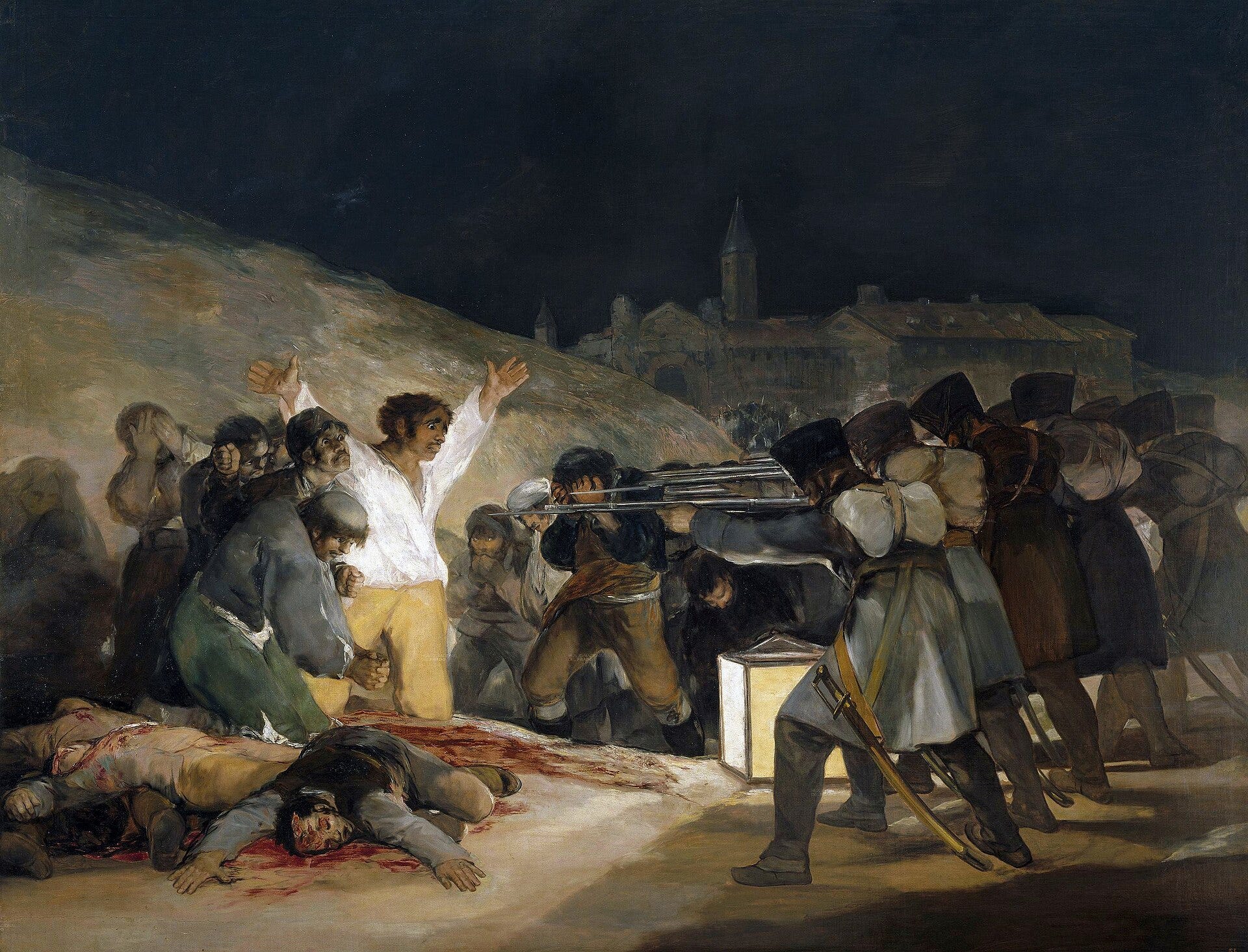
The Third of May 1808 shows French soldiers executing Spanish civilians after Madrid's uprising against Napoleon's occupation. Goya painted it in 1814. Recognition took decades, and in 1936 the canvas fled Civil War Madrid for Geneva before returning to the Prado in 1939.
Spain's provisional government commissioned the painting once the war ended. Goya chose to show brutality, not glory.
Date: Painted in 1814.
Medium: Oil on canvas.
Location: Museo del Prado, Madrid.
Six more stories worth crossing the paywall for
Cool Stories About Art tells the history behind paintings without the lecture hall tone. Here are six stories that sit close to the same register of war, power and consequence.
A night that started with an uprising
On the second of May 1808, citizens of Madrid attacked French troops occupying their city after Napoleon placed his own brother on Spain's throne. Troops crushed the revolt within a day. What followed overnight and into the third of May was a wave of summary executions across the city, the scene Goya later painted.
Napoleon had installed his brother Joseph Bonaparte on the Spanish throne months earlier, a move much of Madrid refused to accept.
Estimates of how many were executed run into the hundreds, though no single official count from 1808 has ever been agreed upon by historians.
The scene Goya chose to paint
A firing squad faces a line of condemned men. One, in a white shirt, throws his arms open as soldiers take aim, a pose that echoes a crucifixion. Some historians read a mark on his raised right hand as a deliberate stigmata reference, in the same spot a nail would pierce Christ's hand.
A single lantern sits on the ground, the only real light source in the scene, throwing long shadows across the condemned. What strikes me is that lantern. It reads like stage light, not daylight, as if Goya wanted the scene to feel staged rather than natural.
Goya never confirmed the stigmata reading himself. He left no letter explaining the detail, the same silence he kept around most of his late work. I read the mark as intentional. Goya rarely left anything to chance in his figures.
A commission written in a formal letter
Goya did not simply decide to paint the executions. On February 24, 1814, he petitioned Spain's Council of Regency, asking in his own words to perpetuate through the brush the most notable and heroic actions of the uprising against the tyrant. The Regency approved and paid him for two canvases, not one.
Instead of a heroic battle, Goya painted fear on the faces of men about to die, and nothing at all on the faces of the soldiers killing them.
Choosing brutality over triumph was itself a risk. A government fresh off restoring order might have preferred a flattering battle scene. Goya gave them corpses and a lantern instead.
Historians consider it one of the first paintings to show war as it happens, without turning it into a celebration.
The companion painting history forgot
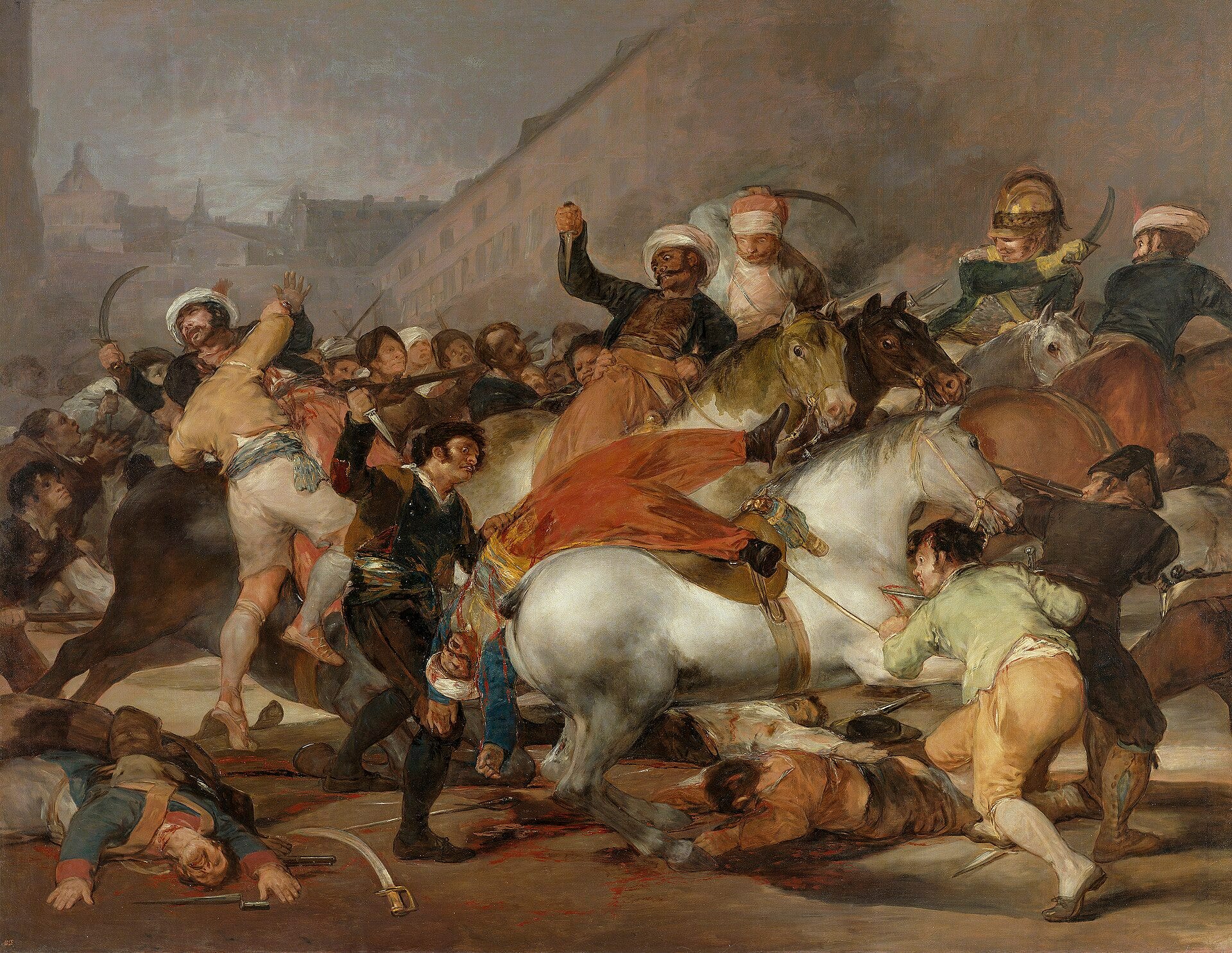
Goya painted a second canvas alongside the executions, The Second of May 1808, showing the street fighting in Madrid the day before, at a similar scale, close to 266 by 345 centimeters. Both hang in the Prado today, but The Third of May absorbed nearly all the attention within a generation.
The Third of May 1808 was not an instant sensation either. Ferdinand VII returned to an absolute monarchy soon after the war ended, and a painting celebrating a popular uprising did not fit his politics.
The Second of May 1808 is also known as The Charge of the Mamelukes, after the Egyptian cavalry Napoleon used to break up the Madrid crowds that morning.
Prado records place its entry into the museum's collection in 1834, two decades after Goya painted it. Its wider reputation built slowly, helped by painters who studied it directly, Manet among them.
Faces on one side, none on the other
The firing squad shows a row of identical backs and raised rifles, no expressions at all. The condemned men each read differently, terror, disbelief, resignation. Goya painted the scene at nearly nine by eleven feet, an unusually large canvas for a subject that was neither religious nor royal.
The man in the white shirt has never been identified by any document from the period. Historians have proposed names over the years. None has been confirmed. To me, that anonymity is the point. Goya does not need a name for him. He needs a stand in for anyone who could have stood in that line.
The brushwork is loose and visibly unfinished in places, closer to a sketch than a polished history painting. I find that roughness deliberate. It puts the viewer closer to the chaos of the night than a smoother technique ever could.
A wartime journey away from Madrid
In 1936, the Spanish Civil War forced the Prado to evacuate its most important paintings out of Madrid to protect them from bombing raids. The Third of May 1808 travelled through Valencia and Barcelona before crossing into Switzerland, where it hung in Geneva at the League of Nations building until the war ended.
The painting returned to Madrid in 1939, once the fighting had stopped, and has remained at the Prado since.
Few visitors admiring the canvas today know it once left Spain entirely, travelling through three cities to escape a second war a century after the one it depicts.
A painting that changed how war gets painted
Decades later, Edouard Manet painted The Execution of Emperor Maximilian using a nearly identical firing squad composition. In the twentieth century, Pablo Picasso looked to Goya again while painting Guernica, his response to the bombing of a Basque town during the Spanish Civil War.
Guernica borrows less of Goya's composition than Manet did. What it keeps is the refusal to make war look organized, a lesson Picasso credited to Spanish painting generally, Goya foremost among it.
Historians trace a direct line from Goya's firing squad to Manet's Mexican emperor and, further still, to Picasso's screaming horses and shattered bodies. Three wars, three painters, one composition passed down.

More stories from the same shelf
FAQ
What event does The Third of May 1808 depict?
The execution of Spanish civilians by French soldiers, in retaliation for the uprising against Napoleon's occupation of Madrid on the second of May 1808.
Why does the man in white have his arms raised?
Goya positioned him in a pose that recalls a crucifixion, arms open, to give one anonymous victim among many the presence of a martyr.
When did Goya paint The Third of May 1808?
In 1814, after Spain's provisional government commissioned the work to commemorate resistance against the French occupation.
Where is The Third of May 1808 today?
At the Museo del Prado in Madrid, alongside its companion painting, The Second of May 1808.
Did The Third of May 1808 influence other artists?
Yes. Edouard Manet referenced its composition in The Execution of Emperor Maximilian, and Pablo Picasso drew on Goya's example while painting Guernica.
Did The Third of May 1808 ever leave Spain?
Yes. In 1936, the Prado evacuated it from Madrid during the Spanish Civil War. It travelled through Valencia and Barcelona to Geneva, where it hung at the League of Nations until it returned to Madrid in 1939.