On April 26, 1937, waves of German and Italian planes bombed Guernica, a Basque town in northern Spain. It was a Monday afternoon, market day, and the streets were full of civilians.
The raid was carried out by the German Condor Legion and Italian air forces fighting for Francisco Franco's Nationalist side in the Spanish Civil War. The town burned. Civilians died in the streets and under the rubble.
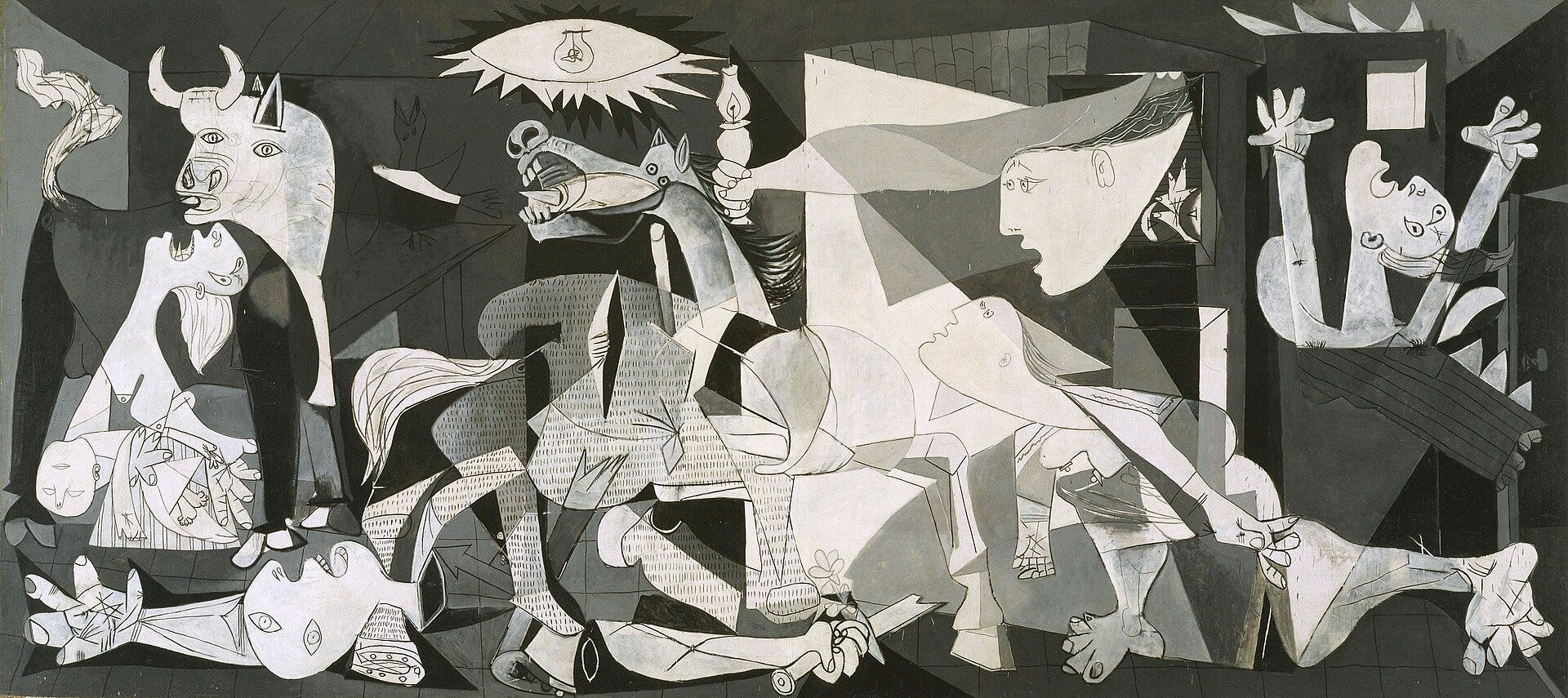
Pablo Picasso read the reports in Paris. Within weeks he began painting his answer, a canvas 3.49 meters tall and 7.76 meters wide, entirely in black, white, and grey.
Guernica means the destruction of innocent civilians by modern warfare. Picasso painted the April 26, 1937 bombing of the Basque town of Guernica as a scene of screaming figures, a dying horse, and a watching bull, turning one air raid into a universal image of war.
Why there is no color
The monochrome palette was a deliberate choice. Black, white, and grey evoke the newsprint and newsreel footage through which most people, including Picasso, learned about the bombing.
The painting reads like a news photograph blown up to the size of a wall. That was the point.
What the bull means
The bull stands on the left side of the canvas, calm amid the chaos. It is the most debated symbol in the painting.
Scholars have read it as Franco's forces, as brute political power, or as Spain itself. Picasso left the ambiguity in place on purpose.
He refused to explain the specific symbols publicly and resisted any fixed, single reading of the imagery. Whatever the bull is, it watches and does not suffer.
What the horse means
The horse screams at the center of the composition, its body twisted, a wound in its side. It is the emotional core of the painting.
The horse is widely read as the ordinary people of Guernica, caught in the bombing with no defense and no warning.
The light bulb and the eye
At the top of the canvas, a bare light bulb burns inside a jagged halo of rays. It works on two levels at once.
It is the flash of the bombs falling. Fused with the shape of an eye, it is also a witness, read by some as the eye of God, by others as the eye of Franco, watching the consequences.
Why Picasso never explained it
Picasso was asked many times what the symbols meant. He refused to pin them down.
He resisted single readings his entire life. The painting stays open, which is part of why it still works. A viewer in 1937 saw Guernica. A viewer today can see any city under bombardment.
Where Guernica is now
The painting was commissioned by the Spanish Republican government for the Spanish Pavilion at the 1937 Paris International Exposition. It never went home with the government that ordered it, because that government lost the war.
In 1939, as World War II began, the canvas was sent to the Museum of Modern Art in New York for safekeeping. It stayed there for decades.
Picasso refused to allow the painting to be displayed in Spain while Franco was alive. Picasso died in 1973, Franco in 1975, and in 1981 MoMA returned Guernica to Spain.
It was first shown at the Cason del Buen Retiro, an annex of the Prado in Madrid. Since 1992 it has hung at the Museo Nacional Centro de Arte Reina Sofia in Madrid, on permanent display, protected behind glass.
FAQ
What does Guernica mean in one sentence? Guernica is Picasso's protest against the April 26, 1937 bombing of the Basque town of Guernica, painted as a universal image of civilians destroyed by modern warfare.
What does the bull in Guernica represent? Its meaning is debated. Scholars have read it as Franco's forces, as brute political power, or as Spain itself. Picasso deliberately kept it ambiguous and never confirmed a single reading.
Why is Guernica in black and white? Picasso chose black, white, and grey on purpose. The palette evokes the newsprint and newsreel footage through which the world learned about the bombing in 1937.
Where is Guernica today? At the Museo Nacional Centro de Arte Reina Sofia in Madrid, where it has been on permanent display behind glass since 1992.
How big is Guernica? The canvas measures 3.49 by 7.76 meters, roughly 11 by 25 feet, painted in oil in 1937.
Picasso never saw the painting hang in Spain. He refused to let it enter the country while Franco was alive, and it finally arrived in Madrid in 1981, six years after Franco's death and eight years after Picasso's own.