What Does Hayez's The Kiss Mean?

Hayez finished this embrace in 1859, the same year Italy and France went to war with Austria. Here is why so many read a goodbye kiss as a political message.

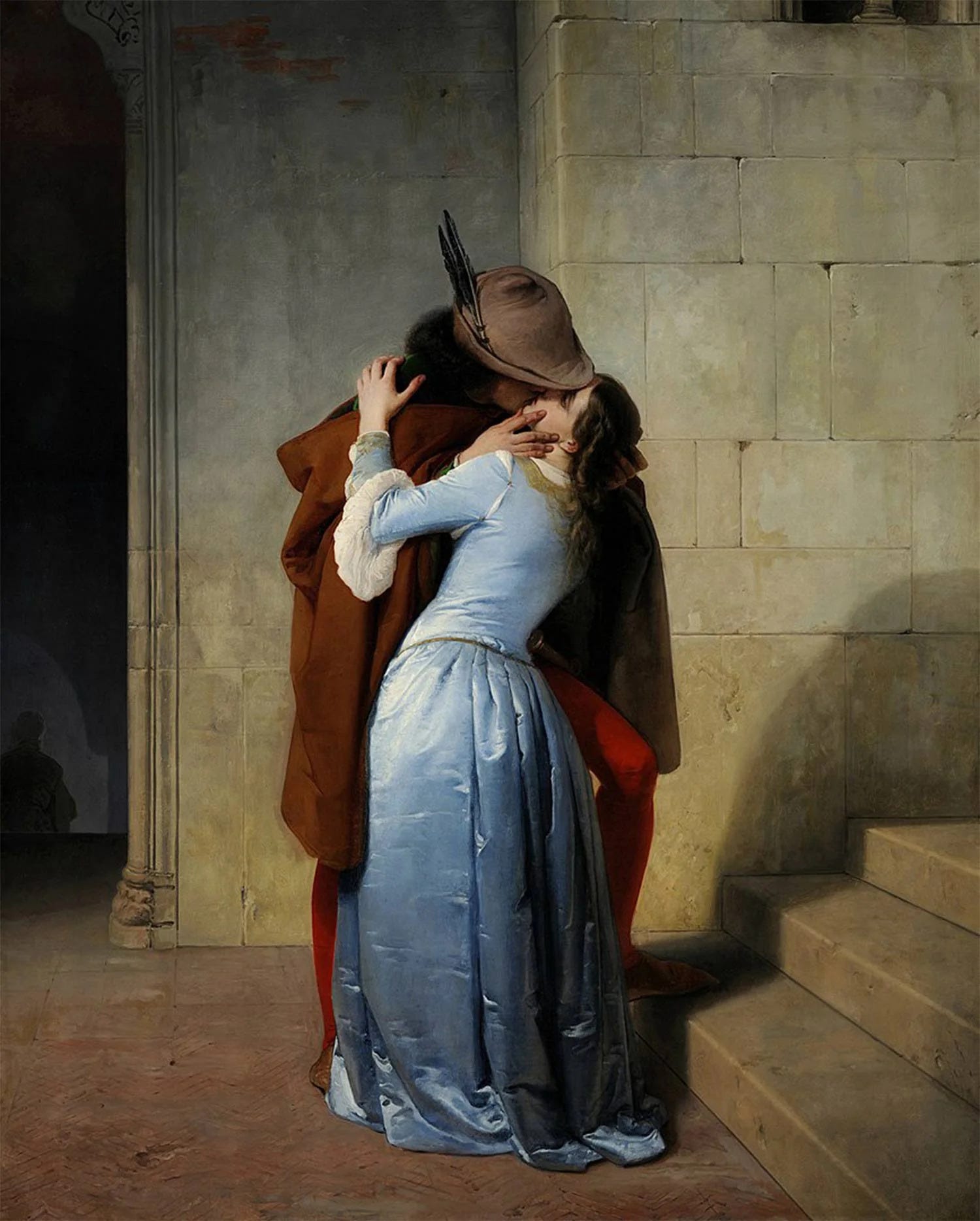
Francesco Hayez's The Kiss shows a young man and woman locked in an embrace on a stone staircase, his foot braced against the step, a shadowed figure watching from the dark. Hayez painted it in 1859, the same year Italian and French troops fought Austria for control of northern Italy.

The Kiss by Hayez
Francesco Hayez, The Kiss, 1859.

The costumes are medieval, not contemporary. That distance is part of what let the painting carry a political meaning without stating one directly.

  • Date: First version completed in 1859

  • Medium: Oil on canvas, about 112 by 88 centimeters

  • Location: Pinacoteca di Brera, Milan


Learn art the fun way. Join 170,000 readers getting one painting and its story every week.


More Paintings Timed to Real Events

Hayez was not the only painter whose picture arrived at exactly the right moment. These three did too.


A Kiss With a Hidden Deadline

Hayez's couple embrace like they are already saying goodbye. The man's foot is braced on the step, his cloak hides a dagger, and both wear medieval dress rather than 1859 clothing. That costume let Hayez paint a farewell between a soldier and his lover without naming the war around him.

The man's foot is braced on the step as if he is already leaving. His cloak, hat, and the dagger at his belt all point to a historical costume rather than 1859 street clothes.

Read one way, it is simply a farewell between two lovers, one of them about to travel or fight. Read another way, it is exactly that, staged just far enough back in time to be safe to paint.

What strikes me is the dagger tucked in his cloak. It turns a kiss into a scene with a clock running on it.

Timed to a War

Hayez finished The Kiss in 1859, the same year French and Piedmontese troops defeated Austria in the Second Italian War of Independence. Contemporaries read the parting kiss as an allegory for that alliance, a soldier's farewell standing in for the sacrifice behind Italian unification.

Hayez finished and exhibited the painting in 1859, the exact year of the Second Italian War of Independence, when French and Piedmontese forces fought Austria in the push toward Italian unification.

Many of his contemporaries read the embrace as an allegory for the alliance between Italy and France, the parting kiss standing in for a soldier's farewell before joining the fight for the nation.

I read the costume choice as the real trick. Medieval dress let Hayez say something about 1859 without ever naming it.

Meditation on the History of Italy
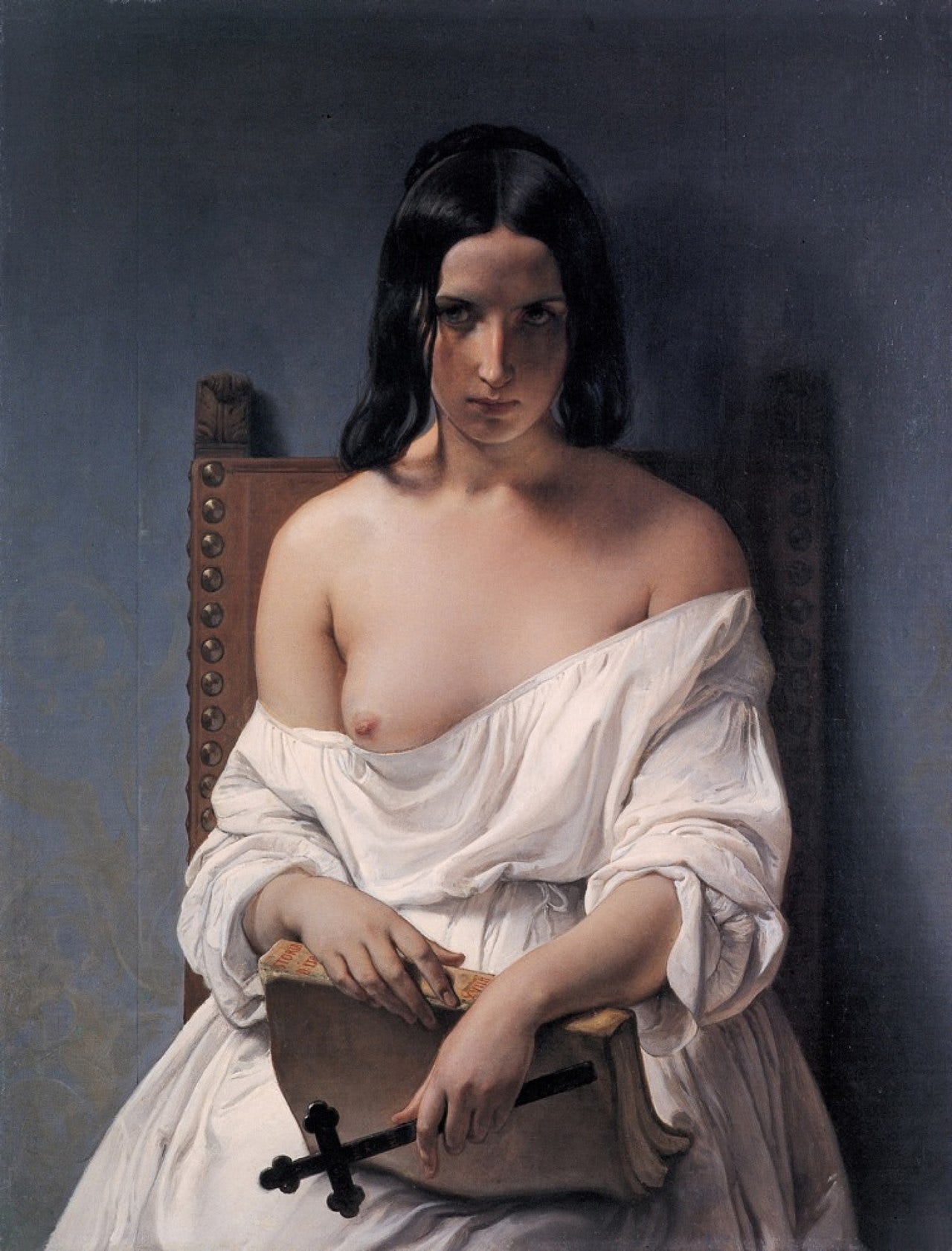
Francesco Hayez, Meditation on the History of Italy, 1850.

Ten minutes, one masterpiece. That is the deal. 170,000 readers already took it, free.


Four Versions, Different Colors

Hayez painted The Kiss four times between 1859 and 1867, in oil and in watercolor. Each version changes small details, especially the color of the woman's dress and the man's cloak, as the political alliances behind the original allegory shifted.

Hayez returned to the composition at least four times between 1859 and 1867, adjusting details like the color of the woman's dress in later versions.

By the time he painted the later versions, the political alliances behind the original story had shifted, and the changed colors are generally read as Hayez updating the allegory to match the new political reality.

To me the shifting colors across four versions are the tell. Hayez kept adjusting the allegory as the politics around him kept moving.

The Kiss 1867 version
Francesco Hayez, The Kiss, later version, 1867.

Why It Still Works as a Symbol

The Kiss works as both patriotic allegory and pure romance, which is why it never stopped circulating. Reproduced on postcards and chocolate boxes for more than a century, it reads equally as a soldier's farewell and as one of Italian painting's most straightforwardly passionate images.

The Kiss became one of the most reproduced images of Italian Romanticism, printed on postcards and chocolate boxes for well over a century.

It works equally as a patriotic symbol and as one of the most straightforwardly romantic images in Italian painting, which is part of why it never stopped circulating.

Francesco Hayez self portrait
Francesco Hayez, Self Portrait at the Age of 78.

More Stories Worth Reading

A few more paintings that reward a second, closer look.


See art differently. 170,000 people read these free stories. Come find out why.


A Painter Already Fluent in Politics

Hayez had already hidden political meaning inside historical costume before The Kiss. His 1847 to 1848 painting The Secret Accusation shows a woman dropping an anonymous denunciation into a stone lion's mouth, a real device once built into Venice's palace walls to report neighbors to the state.

Hayez had used coded political imagery before The Kiss. His 1847 to 1848 picture The Secret Accusation shows a Venetian woman slipping an anonymous denunciation into a lion's mouth carved into a wall, a real device once used in Venice to report neighbors to the state.

By the time he painted The Kiss over a decade later, he had already built a career out of dressing contemporary anxieties in historical costume.

The lion's mouth device, called a bocca di leone, really existed in Venice for centuries, built directly into palace walls so anyone could drop an anonymous note.

Hayez The Secret Accusation painting
Francesco Hayez, The Secret Accusation, 1847 to 1848.

Commissioned to Depict an Alliance

Count Alfonso Maria Visconti di Saliceto commissioned The Kiss and told Hayez exactly what he wanted, an image standing for the hopes tied to the new alliance between France and the Kingdom of Sardinia against Austria. Hayez never painted a flag or a soldier, yet the commission shaped every choice.

Count Alfonso Maria Visconti di Saliceto paid for the first version and told Hayez exactly what he wanted: an image standing for the hopes tied to the new alliance between France and the Kingdom of Sardinia against Austria.

Hayez delivered a painting that never mentions armies, flags, or politics directly. The commission still shaped every choice in it.

It Sat in a Private Home for Decades

The Kiss debuted at Brera in September 1859, then hung as a private decoration inside the Visconti family home for more than twenty five years. Count Visconti only donated it to the Pinacoteca di Brera in 1886, a year before his own death, which is when the public adopted it as a national symbol.

After its debut in 1859, the painting hung as a private decoration inside the Visconti family residence for more than twenty five years, not in a museum. The count only donated it to the Pinacoteca di Brera in 1886, a year before his own death.

The public really only adopted the picture as a national symbol after it left that private house.

Four Kisses, Not Two

Hayez painted The Kiss four times, not two. Beyond the 1859 original, he made an 1861 oil for the Mylius family, an 1859 watercolor gift to Carolina Zucchi, and a later oil with the man's cloak turned green, an allegory of the Italian flag.

The second oil version, painted in 1861 for the Mylius family, traveled to the 1867 Exposition Universelle in Paris and resurfaced at a Sotheby's auction in 2008, selling for 780,450 pounds.

The third version is the only one in watercolor, oval in shape, painted the same year as the original and given by Hayez as a personal gift to Carolina Zucchi. It now hangs in the Pinacoteca Ambrosiana in Milan.

None of the four versions depicts one specific historical event. Each simply repeats the same private embrace, updated in color each time to track the political alliances of the moment.

Frequently Asked Questions

  • What does The Kiss actually show?

    A young man and woman embracing on a stone staircase, his foot braced on a step as if about to leave, with a shadowed figure barely visible in the background.

  • Is the painting about more than romance?

    Many historians think so. Hayez finished it in 1859, the exact year Italian and French forces fought Austria in the Second Italian War of Independence, and read the embrace as a farewell between a soldier and his lover, an allegory for the alliance behind Italian unification.

  • Why did Hayez paint the figures in historical costume?

    The medieval style clothing distances the scene from contemporary 1859 politics on the surface, while still letting viewers connect the parting kiss to the war and the fight for Italian independence happening around them.

  • Are there other versions of the painting?

    Yes. Hayez painted four versions of the composition between 1859 and 1867, adjusting details like the woman's dress color and the man's cloak as the political alliances behind the story shifted.

  • Where can I see the original today?

    In the Pinacoteca di Brera in Milan, where the first version has hung since Hayez completed it in 1859.


No boring lectures, ever. Join 170,000 readers learning art the fun way, free.