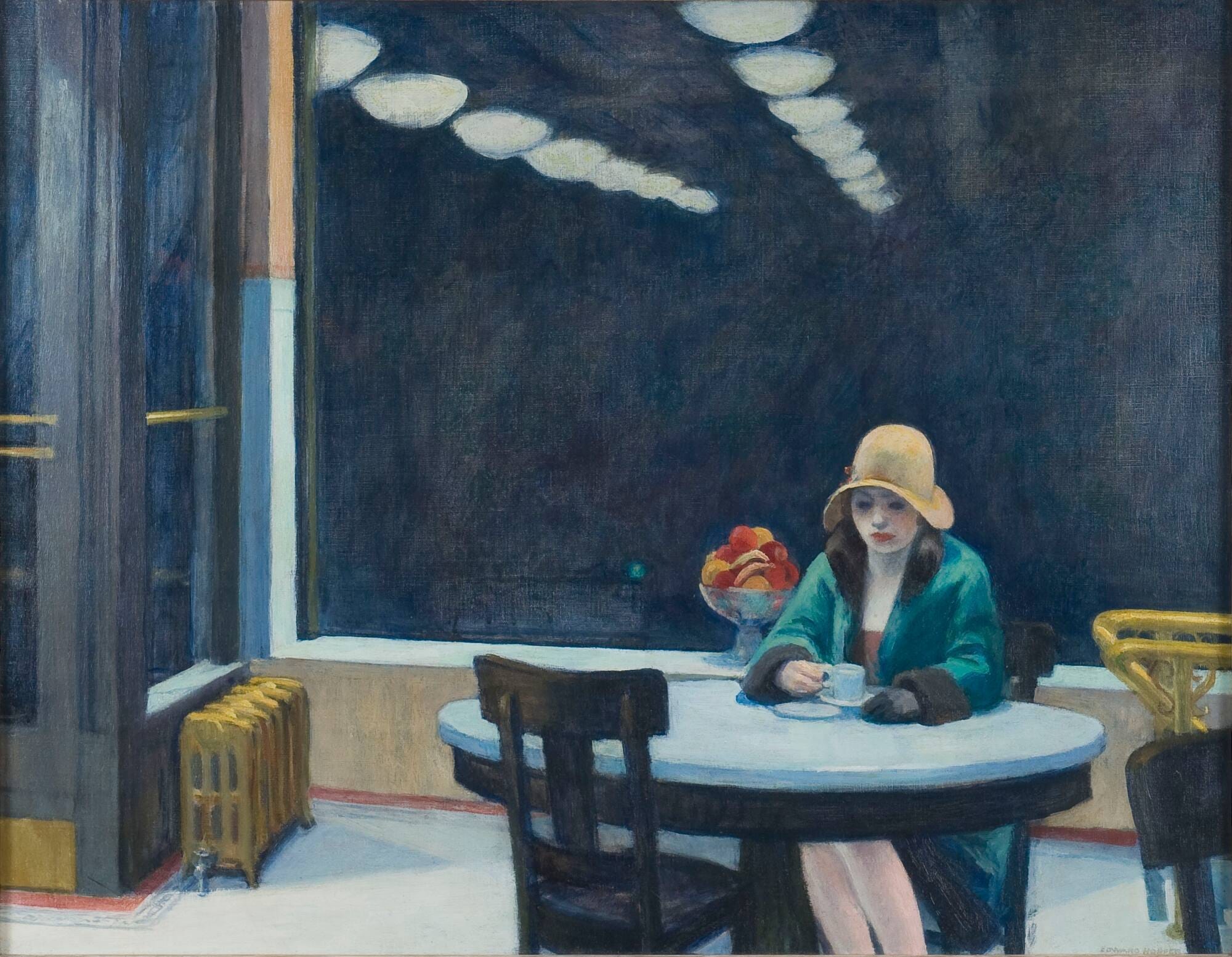
Edward Hopper painted a woman sitting alone at a coffee machine cafeteria in 1927. Behind her, a black window throws back two rows of electric lights that seem to stretch on forever. Nothing else is visible outside. That is the whole point.
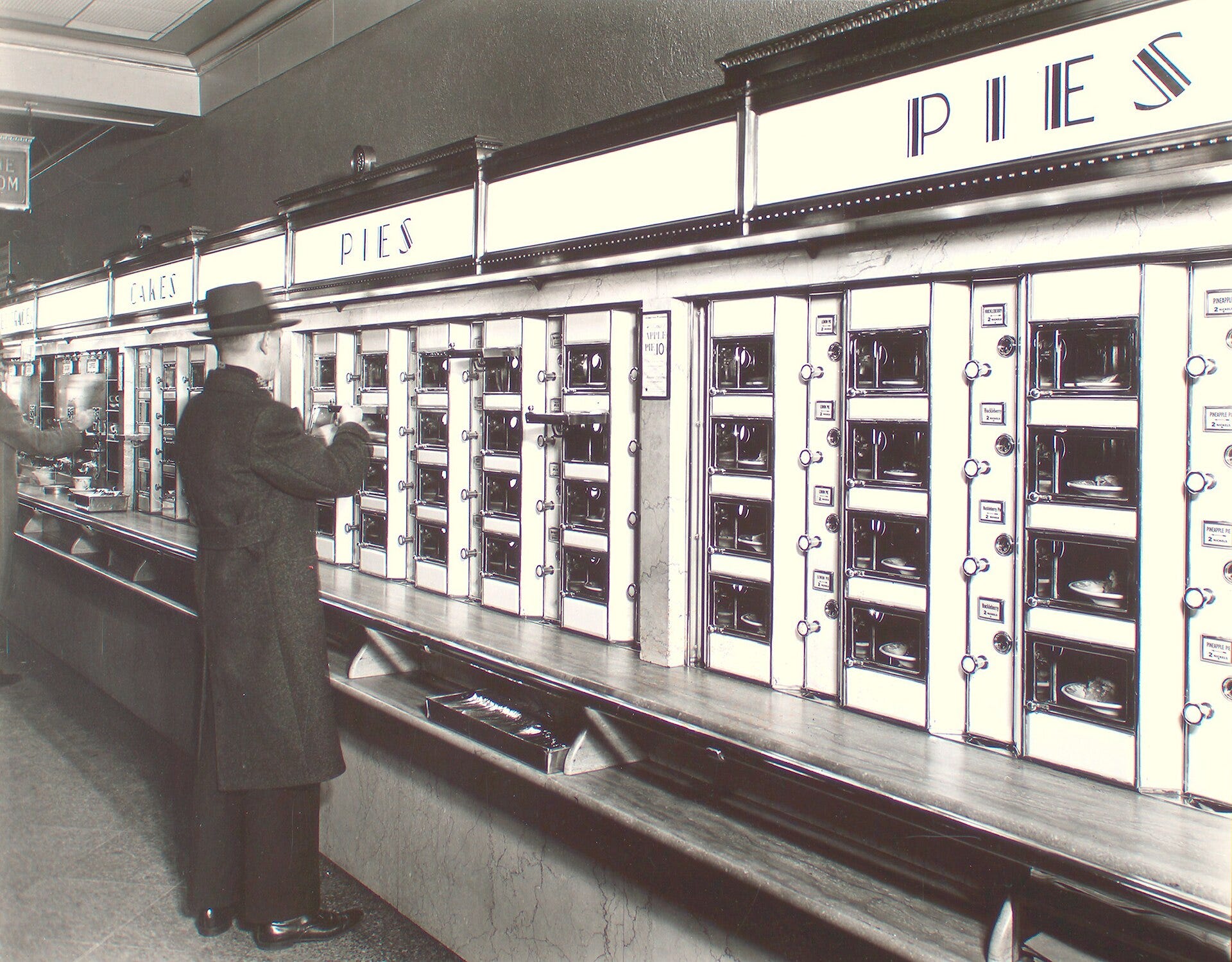
Automats were the fast food of their era, coin operated machines dispensing coffee and pie behind little glass doors, no waiter required. Hopper takes that symbol of modern convenience and turns it into a portrait of being completely alone.
Date: 1927.
Medium and size: Oil on canvas, 71.4 by 91.4 centimeters.
Location: Des Moines Art Center, Iowa.
More American Painters Worth Knowing
Hopper was not working in a vacuum. These stories cover artists cut from the same cloth.
A Restaurant Built on Convenience
Horn and Hardart's automats let customers buy food without ever speaking to a waiter, dropping nickels into small glass compartments that opened to release sandwiches, pie, or coffee. Hopper strips that self service convenience of its novelty in Automat, showing the same efficient setup as a stage for solitude rather than speed.
The automat chain Horn and Hardart put food behind small coin operated glass doors, no server standing between a customer and their meal. It was cheap, fast, and, for the 1920s, almost futuristic.
Hopper sets his scene inside exactly that kind of hall, but strips away every trace of the crowd such a place would usually have.
One Woman, No One Else
Hopper gives the woman in Automat almost no narrative detail: a green coat, a fitted hat, one glove already removed, both hands around a single cup. She looks down at her coffee rather than out at the room, and the empty chair across from her confirms she came in, and will leave, alone.
She sits in a green coat and a close fitting hat, one glove already removed, both hands wrapped around a single cup. She looks down at the coffee, not out at the room.
There is a bowl of fruit on the table and an empty chair across from her. No other customers appear anywhere in the frame.
A Window That Shows Nothing
At night, the automat's window stops working as a window. Instead of the street, it reflects two rows of ceiling lights repeating back into the dark, an effect that turns a transparent surface into something closer to a wall. The woman sits with her back to a city that has vanished behind her own reflection.
Behind her, the window should show the street outside. Instead, because it is night, the glass only reflects two rows of ceiling lights, repeating back into a darkness with no visible end.
There is no city, no passerby, no world beyond the glass. Just a void dressed up in electric light.
What strikes me is that the window is the real subject of the painting, not the woman. It is the thing that tells you there is nothing waiting for her outside either.
Hopper's Favorite Kind of Loneliness
Automat is one of several Hopper interiors built around a single figure inside a space meant for company. He returned to that arrangement in Nighthawks, Room in New York, and Chair Car, using a lit interior against a darkened window to make solitude visible rather than merely implied.
This is not an isolated case in his work. Hopper returned again and again to people alone in public interiors at night, caught in that particular kind of solitude that only shows up in a room built for company.
Automat fits neatly beside his other late night interiors, all sharing the same quiet, unresolved tension.
To me, that repetition is the point, not a limitation. Hopper kept returning to the same room because the loneliness in it never resolved itself.
Painted the Same Year It Was First Shown
Hopper finished Automat in 1927 and exhibited it that year at the Rehn Galleries in New York, part of his second solo show. It sold within weeks, reportedly for $1,200, a modest sum next to the tens of millions his paintings later commanded at auction.
Hopper finished Automat in 1927 and showed it that same year at the Rehn Gallery in New York, part of a one man exhibition that helped cement his reputation.
It has stayed one of his most recognized paintings ever since, reproduced almost as often as Nighthawks itself.
More Stories Behind Famous Paintings
Loneliness dressed up as convenience is not the only trick a painter can pull.
The Automat Was a Real Chain, Not an Invention
The automat format did not start in New York. Horn and Hardart opened their first coin operated cafeteria in Philadelphia in 1902, borrowing the concept from an earlier German machine restaurant, before bringing an improved version to Times Square in 1912, a novelty Hopper would have seen firsthand.
Horn and Hardart opened the first automat in Philadelphia in 1902 and brought the format to New York in 1912. By the time Hopper painted this picture in 1927, the chain ran dozens of coin operated cafeterias across the city, open around the clock.
Customers dropped nickels into small glass windows to release sandwiches, pie, and coffee, with almost no staff visible. For many New Yorkers it was the cheapest hot meal in town and a genuinely new way of eating in public, alone, without ordering from a waiter.
Hopper's Only Model Was His Wife
Josephine Nivison Hopper posed for nearly every woman in her husband's paintings after their 1924 marriage, and Automat is no exception. He painted her younger and slimmer than she actually was at forty four, turning a specific model into a more anonymous, generalized figure.
Josephine Nivison Hopper, a painter in her own right, married Edward Hopper in 1924. From that point on she modeled for nearly every female figure in his paintings, keeping records of her poses and the props used in a set of notebooks she maintained for decades.
The woman at the automat table, in her green coat and hat, was very likely painted from Jo rather than from any professional model or stranger observed in a real cafeteria.
I find that detail changes the picture. This is not a stranger Hopper is observing from across the room. It is his own wife, aged down, sitting inside his idea of solitude.
From New York Gallery Wall to Iowa
Automat sold quickly after its 1927 debut, reportedly for $1,200, and passed through private hands before the Des Moines Art Center acquired it in 1958 using funds from the Edmundson Art Foundation. It remains the museum's signature painting and one of its most frequently loaned works.
Automat was shown publicly in 1927, the same year Hopper painted it, and sold quickly to a private collector. It eventually entered the collection of the Des Moines Art Center in Iowa, where it remains one of the museum's most requested loans.
The painting now travels regularly to Hopper retrospectives around the world, usually returning afterward to the same museum walls in Iowa rather than staying permanently in New York, where it was made.
A Formula Hopper Used Again and Again
Hopper repeated the same visual formula for two decades: a single warm light source inside, a flat darkness outside, and one figure positioned to look smaller than the room around her. Automat, Nighthawks, and Room in New York all share that structure, made a decade and a half apart.
The contrast between warm electric light inside and flat cold darkness outside is not unique to this painting. Hopper used the same formula in Nighthawks, Room in New York, and several other interiors from the same decade, always built around a single artificial light source doing most of the emotional work.
Critics later grouped these pictures into what they call his classic period, running roughly from the mid 1920s to the early 1940s, when Hopper settled into a visual vocabulary he then used with only small variations for the rest of his career.
Frequently Asked Questions
When did Edward Hopper paint Automat?
In 1927.
What is an automat?
A cafeteria style restaurant where food and drink came from coin operated machines, popular in American cities in the early twentieth century.
Why does the window look black instead of showing the outside?
It is set at night, so the glass only reflects the ceiling lights inside rather than any view of the street.
Where is Automat displayed today?
At the Des Moines Art Center in Iowa.
Is Automat similar to Hopper's other paintings?
Yes. It shares his recurring theme of a single figure alone in a public interior at night, also seen in paintings like Nighthawks.
How much did Automat sell for when it was new?
Reportedly $1,200, sold within weeks of its 1927 debut at the Rehn Galleries in New York.