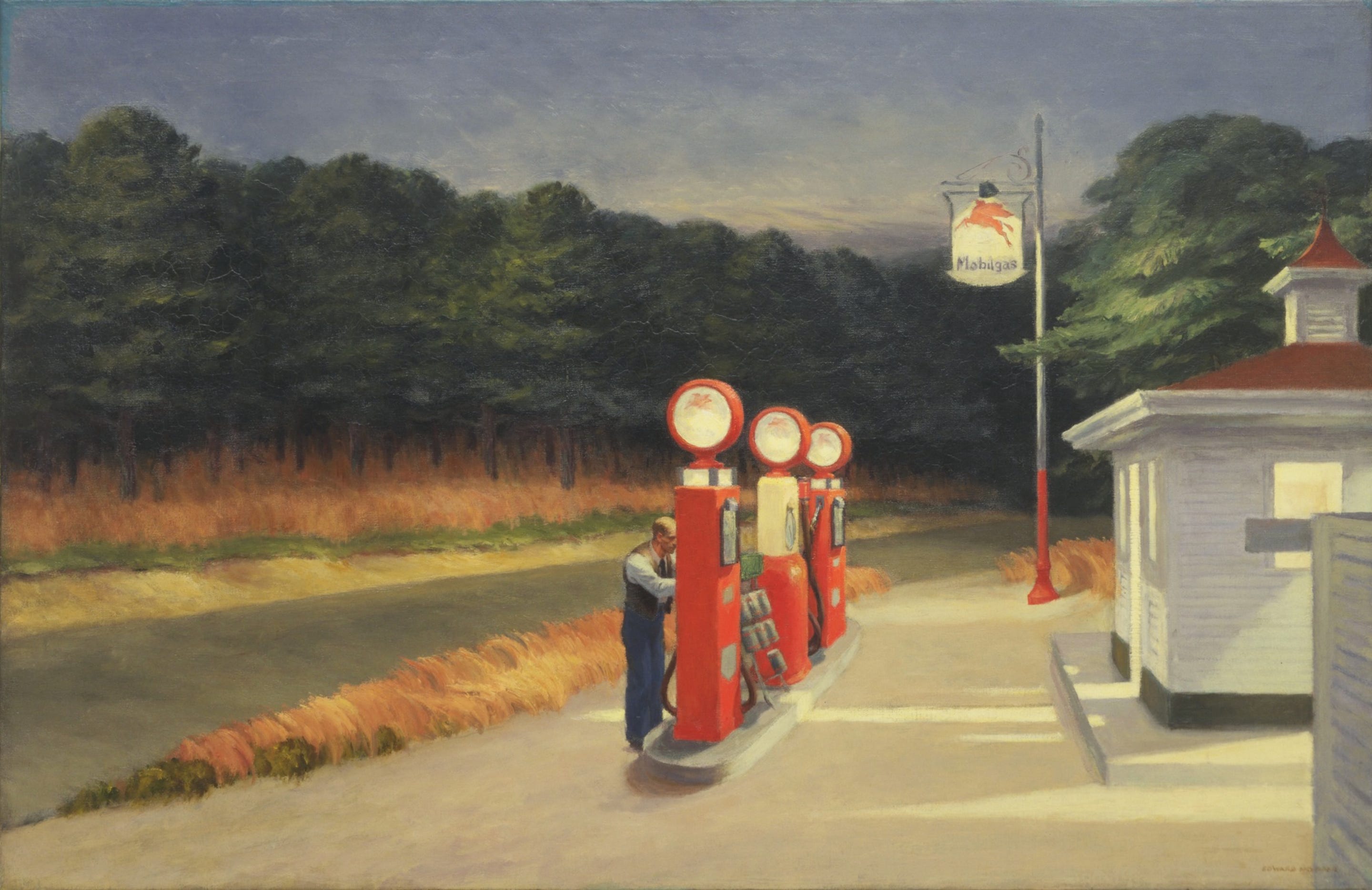
Edward Hopper painted a lone gas station glowing at the edge of dark woods in 1940. Three red pumps line up under a light that reaches nowhere beyond the building. The road curves off into the trees and simply disappears.
This is a Mobilgas station, its flying red horse logo visible on the pumps, painted at dusk on an empty country road. No car sits anywhere in the scene, even though the entire subject is about traveling.
Date: 1940.
Medium and size: Oil on canvas, 66.7 by 102.2 centimeters.
Location: Museum of Modern Art, New York.
More American Painters Worth Knowing
Hopper had company in painting the loneliness of modern American life. These three did too.
A Station at the Edge of the Woods
Gas station meaning, in one line: Hopper set a lit Mobilgas stop right where a paved road meets unbroken forest, painting the exact moment daylight gives way to dusk. The single building holds all the warmth in the scene. Everything past the tree line stays unknown, dark, and unpainted.
The small white station sits between an open road and a wall of dark forest, its three pumps standing in a neat row out front, lit warm and orange against the coming night.
Behind it, the trees give no hint of what lies past them. The road curves right and vanishes into the same darkness.
One Man, No Customers
The attendant in Gas has no name and no customer to serve. He leans over the pumps alone, mid shift, with no car in sight. That absence is deliberate: Hopper turns a business built on strangers passing through into a study of one person waiting for nobody.
Inside the lit doorway, a lone attendant leans over something on the counter, still working even though no car has pulled in. His posture reads as routine, not urgency.
It is a workplace built entirely around serving travelers, caught in the one moment nobody is passing through.
Where the Light Stops
Hopper paints the light around the pumps stopping abruptly at the tree line, with no gradual fade into shadow. That hard edge between the lit station and the black woods carries the picture's real subject, not the gas station itself, but the boundary between what is known and what is not.
Hopper draws a hard line between the warm glow around the pumps and the flat black of the woods just behind them. The light does not fade gradually. It simply stops.
That edge between what is lit and what is not carries most of the painting's tension, more than anything happening inside the station itself.
Painted the Year Hopper Turned to the Open Road
By 1940, the year Hopper painted Gas, the automobile had already reshaped small town America, and gas stations were becoming as common as churches along rural roads. Hopper had spent much of the previous decade painting empty interiors. Gas marked one of his first paintings built entirely around the road itself.
By 1940, cars and highways had reshaped how Americans moved through the country, and gas stations were becoming a fixture of the rural landscape. Hopper picked up on that shift early, painting the road itself as a subject worth this much attention.
A Painting Without a Single Car
No car appears anywhere in Gas, even though a filling station exists only to serve them. Hopper strips the scene of every vehicle on purpose. I read that absence as the clearest sign he wanted a picture about waiting, not a picture about traffic passing through.
Despite the subject, no vehicle appears anywhere in the frame. The absence keeps the painting still, turning a scene built around traffic into one about waiting instead.
More Stories Behind Famous Paintings
A road that goes nowhere is one way to paint stillness. These painters found others.
The Brand on the Pumps Was Real
Socony Vacuum Oil Company introduced the Mobilgas name and the flying red horse Pegasus logo in the 1930s, and both appear accurately on the pumps in Gas. It remains one of the only real, datable, commercial details Hopper allowed into an otherwise invented composite scene.
The three red pumps carry the Mobilgas name and the flying red horse logo that Socony Vacuum introduced in the 1930s. It is one of the few concrete, dateable, commercial details Hopper ever let into one of his paintings.
Everything else about the station, the pine woods behind it, the empty road, the single bulb lit sign, is invented or recombined, but the brand itself anchors the scene to an exact stretch of American commercial history.
Stitched Together From Cape Cod Sketches
Gas is often described online as a specific real station on Cape Cod. It is not. Hopper and his wife Jo settled in Truro, Massachusetts in 1934, and he combined studies made along those back roads into one invented composite, a method he used for most of his mature paintings.
Hopper and his wife Jo built a summer house in Truro, Massachusetts in 1934, and he spent the following years driving the back roads of the Cape, sketching gas stations, houses, and lighthouses directly from life.
Gas is not a portrait of one real station. Hopper combined studies made along those drives into a single composite scene, a working method he used often, building finished paintings in the studio out of pieces gathered outdoors.
Bought by MoMA During the War
The Museum of Modern Art bought Gas in 1943, in the middle of the Second World War, while gasoline itself was rationed across the United States. A painting about a filling station entered a major museum's collection at the exact moment real Americans were being told to ration fuel.
The Museum of Modern Art in New York acquired Gas in 1943, in the middle of the Second World War, when gasoline itself was being rationed across the country the painting depicts.
It has stayed in MoMA's collection ever since, one of the most frequently reproduced images in American painting and a regular presence in the museum's major Hopper exhibitions.
Painted at the Edge of Two Worlds
I read Gas less as a picture about loneliness than about dependency. The station is the only outpost of light and fuel between an open road and unmapped woods. Decades later, critics would call it an early portrait of a country about to build its whole way of life around oil.
The station sits exactly where the paved road meets dark woods, gas pumps and electric light on one side, wilderness on the other. Hopper placed similar thresholds, between the built and the wild, or the lit and the dark, in several of his rural scenes from the late 1930s and 1940s.
The single attendant, alone and turned away from the viewer, appears in a pose Hopper reused with small variations across other paintings of solitary workers, always caught mid task rather than posed for a portrait.
Studies Now Live at the Whitney
More than two thousand Hopper works entered the Whitney Museum after Jo Hopper died in 1968, including the pencil studies behind Gas. Set beside the finished canvas, those sketches show Hopper cutting the composition down, removing extra pumps and clutter until three pumps and one figure remained.
The preliminary studies Hopper made for Gas, quick pencil sketches of the pumps and the roofline, survive today at the Whitney Museum of American Art in New York. The museum received more than two thousand works from Hopper's estate after Jo Hopper's own death in 1968, including working drawings behind most of his major paintings.
Comparing those sketches to the finished canvas shows Hopper simplifying as he went, removing extra pumps and background clutter until only three pumps, one lit sign, and one figure remained.
Frequently Asked Questions
When did Edward Hopper paint Gas?
In 1940.
What brand of gas station is shown?
Mobilgas, identifiable by the flying red horse logo on the pumps.
Why is there no car in the painting?
Hopper leaves the scene empty of vehicles on purpose, turning a subject about travel into one about stillness and waiting instead.
Where is Gas on view today?
At the Museum of Modern Art in New York.
What does the dark forest behind the station represent?
Most readings treat it as the edge of the known world, a hard boundary between the lit, familiar station and whatever lies past the trees.