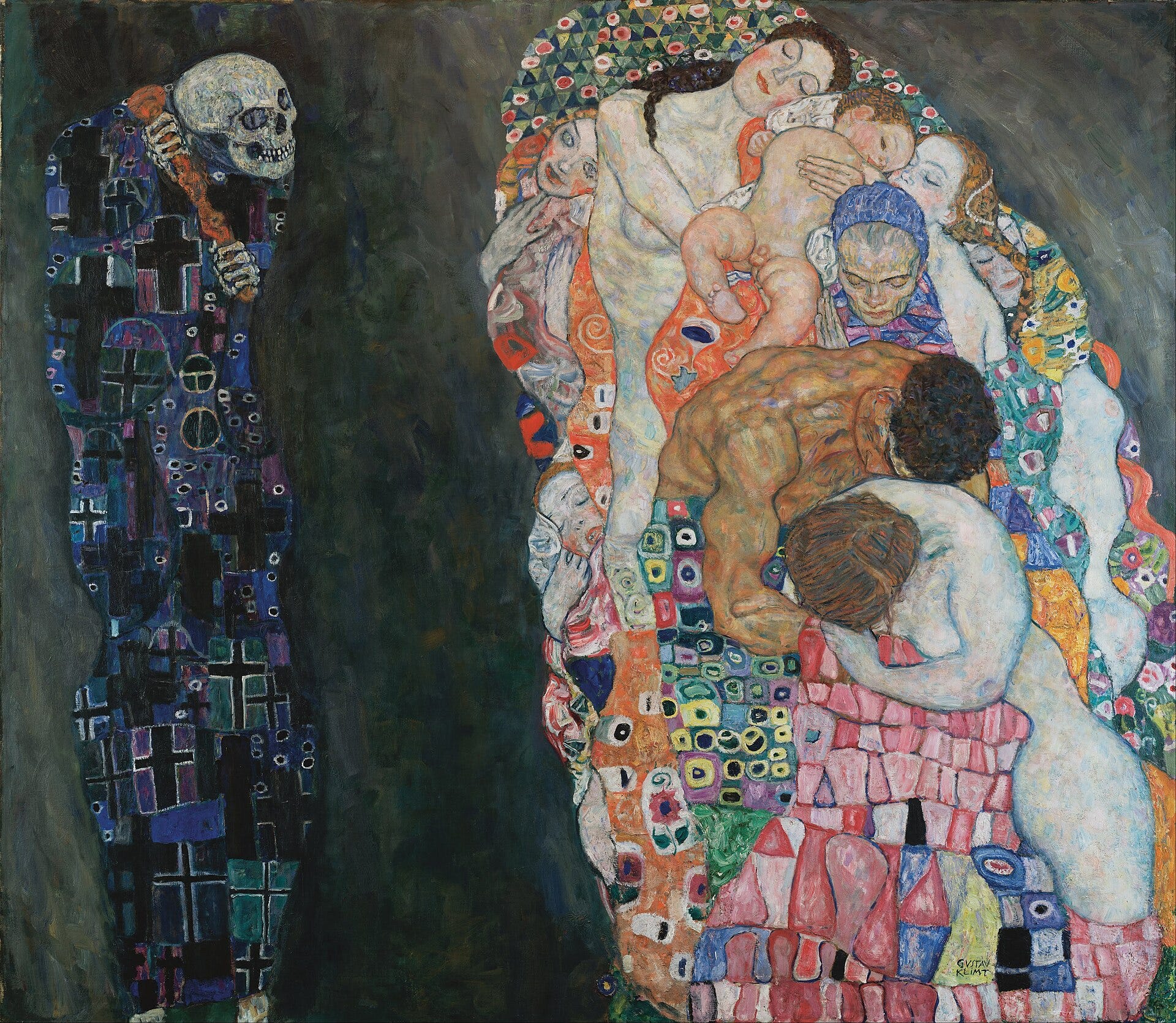
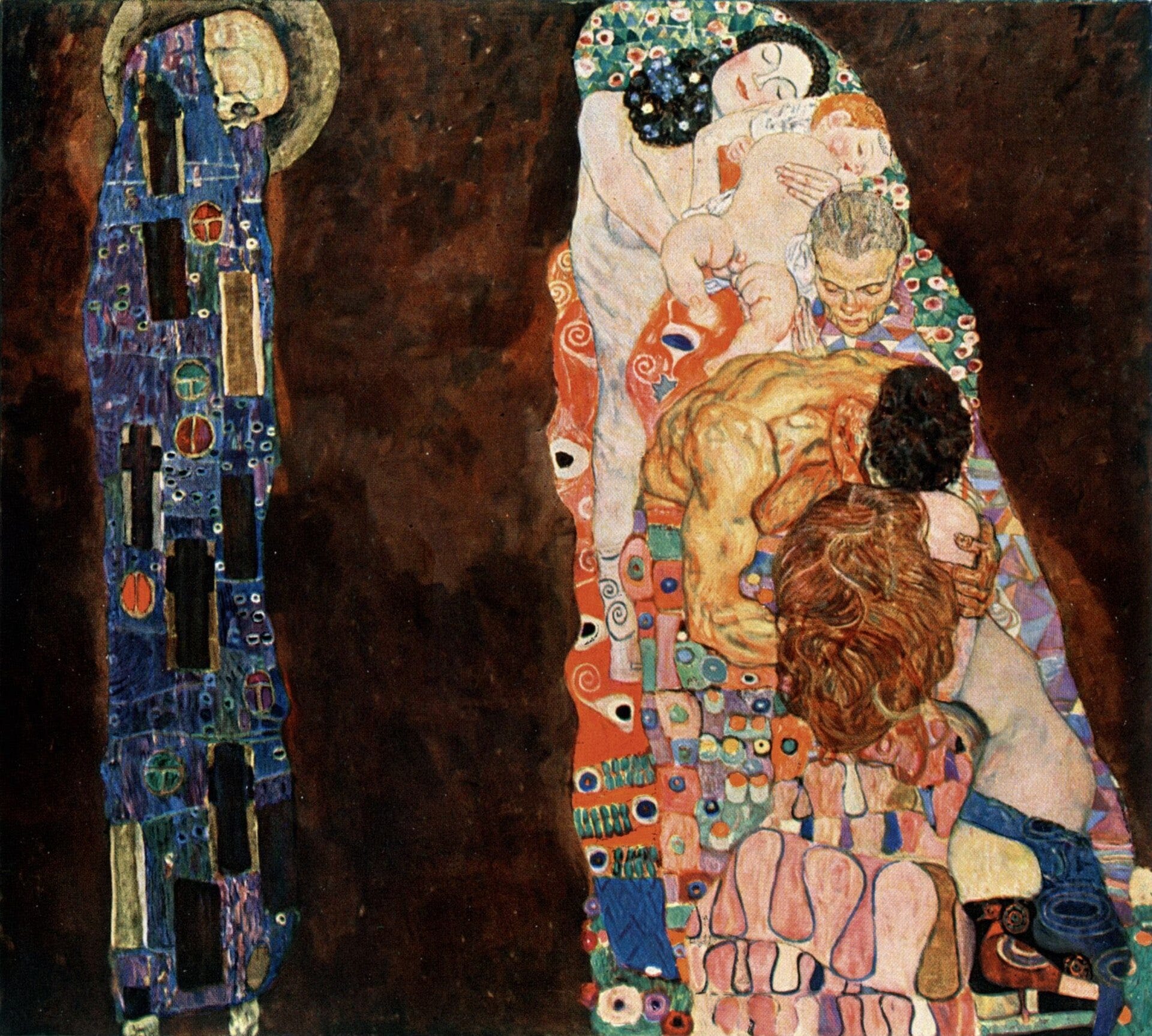
Klimt's Death and Life sets a robed skeleton of Death beside a mass of sleeping bodies representing every age of life. He painted it in 1910, won a gold medal with it in Rome in 1911, then repainted the background from gold to gray in 1915 as war approached.
Most people know Klimt for gold leaf and portraits of society women. Death and Life has neither a single patron nor a single subject. It is two crowds facing each other across a canvas nearly two meters tall.
Date: Sketched in 1908, painted in 1910, then reworked by Klimt in 1915.
Medium: Oil on canvas, about 178 by 198 centimeters.
Location: Leopold Museum, Vienna.
More Klimt and Vienna's Golden Age
If the tension in this painting stayed with you, these stories go further into Klimt and the world around him.
Two Groups, One Canvas
Gustav Klimt built Death and Life around a single confrontation. On the left stands one figure, a skeleton wrapped in a patterned robe. On the right, roughly nine nude bodies are pressed into a single mass, an infant, a couple, an old woman, all asleep, all touching, all unaware of who is watching them.
On the left, Death's whole body is covered by a dark blue robe patterned with black crosses and small circles, a costume closer to a mosaic than a traditional Grim Reaper. Only his skull, two hands, and feet break through the fabric.
He grips a short club, raised and ready, while his gaze stays fixed on the sleeping crowd across from him.
Not The Kiss, a Different Klimt Entirely
Death and Life gets confused with The Kiss, Klimt's other famous crowd of figures. They are not the same work. The Kiss was painted between 1907 and 1908, glowing entirely in gold leaf, and shows a single couple. Death and Life came three years later, uses a gray background, and shows roughly ten figures split between a skeleton and a crowd.
Both paintings share Klimt's habits, flat pattern, ornament standing in for depth, but their subjects point in opposite directions. The Kiss is about desire between two people. Death and Life is about mortality shared by everyone.
The mixup is easy to make from a thumbnail. Look past the color and the two paintings barely overlap.
Why Klimt Changed the Background
Klimt originally painted Death and Life with a gold background in 1910, the same decorative gold he had used for years, a habit traced to the Byzantine mosaics of Ravenna's San Vitale basilica, which he visited in 1903. In 1915, four years after winning a prize in Rome with the gold version, he repainted that background gray.
The change was not cosmetic. A gold ground had made earlier Klimt paintings feel decorative, closer to an icon than a scene. Gray put the figures in a colder, more physical space, one where the confrontation between the two groups reads as immediate rather than eternal.
What strikes me about that switch is how much colder the confrontation becomes. Gold had softened Klimt's subjects for years. Gray refuses to.
No letter or interview survives explaining the decision. What survives is the painting itself, and the record of the 1911 version, which shows exactly how different the gold original looked.
A Gold Medal in Rome, Then a Second Look
Klimt exhibited Death and Life at the 1911 International Art Exhibition in Rome, staged as part of Italy's fiftieth anniversary of unification. The painting won the gold medal, a rare moment of official honor for an artist whose earlier work had been condemned as obscene by university professors in Vienna. Klimt later called it his most important figurative painting.
That condemnation dated back to 1900, when Klimt's ceiling paintings for the University of Vienna were attacked so fiercely that he eventually bought them back rather than let them hang. Rome, eleven years later, read closer to vindication.
He kept working on Death and Life after the prize, which is unusual. Most painters leave a rewarded work alone.
To me, that choice says something. He treated the prize as unfinished business, not a reason to stop.
Life Does Not See Death Coming
None of the sleeping figures in Death and Life look toward the skeleton beside them. A mother holds a baby, an old woman bows her head, a couple embraces, and every one of them keeps their eyes closed or turned away. Klimt paints unawareness rather than fear, which is part of what keeps the image from turning into a simple warning.
I find that unawareness harder to sit with than any skull. Nobody in the crowd is fighting death or fleeing it. They simply have not noticed it yet, which is closer to how most people actually spend their days.
The composition repeats an old subject, the medieval dance of death, but strips out its usual moral. There is no procession of victims being led away. There is only proximity.
Reworked After the Prize, Not Before
Most of Klimt's changes to Death and Life came after 1911, not before. He added figures to the crowd on the right, adjusted the color balance between the two groups, and gave Death's robe its final pattern of black crosses. The version that hangs in the Leopold Museum today is the 1915 revision, not the painting that won in Rome.
Death and Life stayed in Klimt's studio and then in private hands for years after Rome, moving between Austrian collectors after his death in 1918 before the collector Rudolf Leopold acquired it. That collection became the core of the Leopold Museum, which opened in Vienna's MuseumsQuartier in 2001.
The painting rarely travels outside Austria, which is one reason most people only ever see it reproduced rather than in person.
Keep Reading About Art History
A few more stories worth your next ten minutes.
Frequently Asked Questions
What does Death and Life actually show?
A skeletal figure of Death on one side of the canvas, and a tightly packed group of sleeping figures representing every age of life on the other.
When did Klimt paint Death and Life?
He sketched it in 1908, painted it in 1910, then reworked parts of it, including the background, in 1915.
Where can I see Death and Life today?
At the Leopold Museum in Vienna, part of the collection built by Rudolf Leopold.
Did Death and Life win any awards?
Yes. It won the gold medal at the 1911 International Art Exhibition in Rome.
Is Death and Life the same painting as The Kiss?
No. The Kiss dates from 1907 to 1908 and is covered in gold leaf. Death and Life came later, uses a gray background, and shows a much larger group of figures.
Why did Klimt repaint the background in 1915?
No letter or interview explains the decision. He replaced the original gold ground with gray, a change documented by the surviving record of the 1911 version.