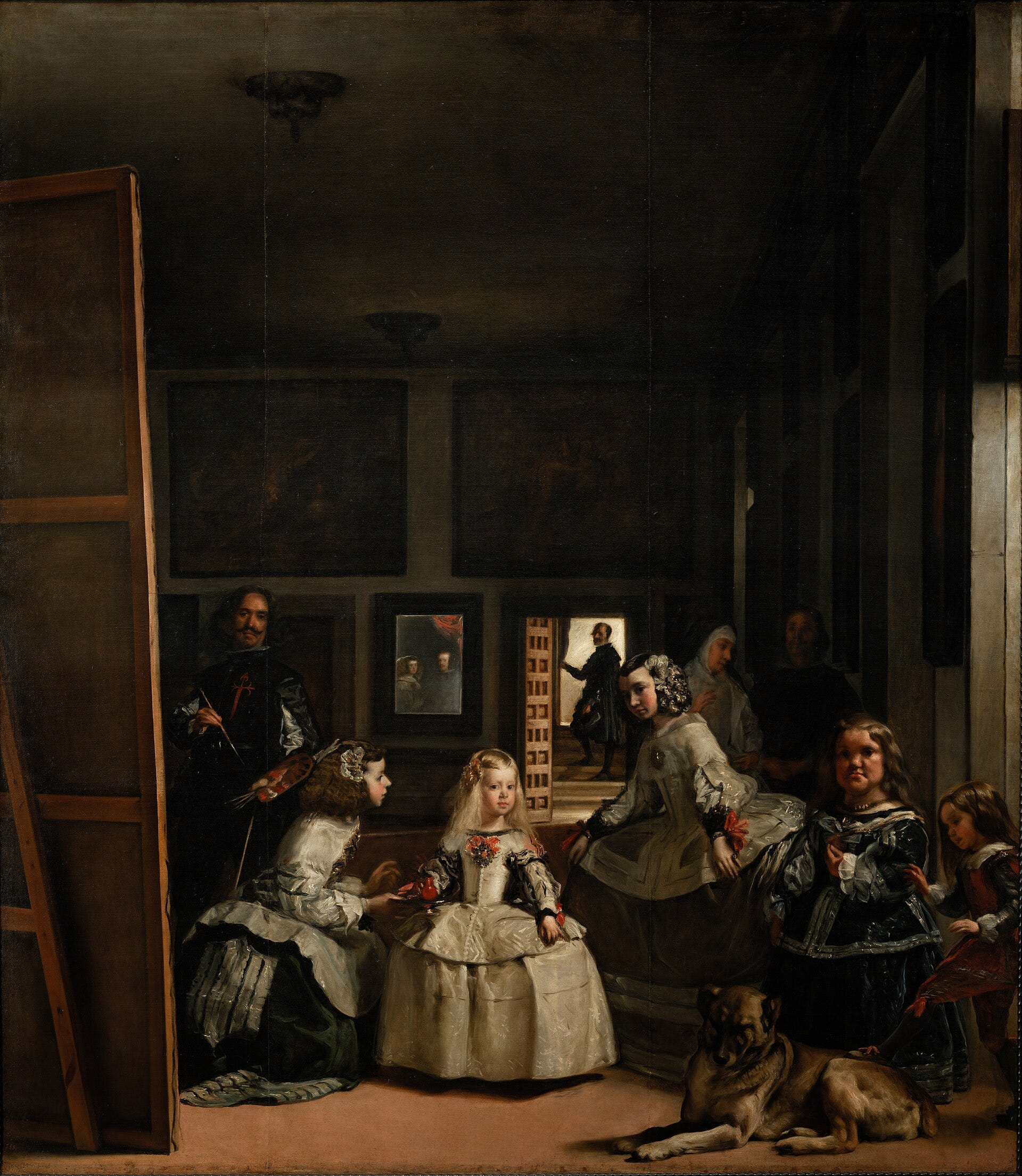
Las Meninas shows Velazquez painting himself inside the Spanish royal household, with a small mirror reflecting King Philip IV and Queen Mariana where the viewer stands.
The scene turns looking itself into the subject: who is watching whom, what the artist is actually painting, and why nobody can confirm the answer stays unresolved after more than three centuries.
What gets lost when people call this painting famous is the actual mechanism inside it. It is not a trick mirror for its own sake. Velazquez set up a loop where the people who commissioned the painting, the king and queen, end up standing exactly where any later viewer stands, looking at the same unfinished canvas he is. I think that is the real subject, more than the Infanta, more than the technical skill: a painter working out, in paint, that watching and being watched are the same act from two different chairs. Foucault did not invent that reading, he just gave it better language than most art historians had used before him.
A Painting About Who Is Watching Whom
Las Meninas 1656 shows Velazquez himself, standing before a large canvas, in the middle of painting, a scene that sits at the heart of the complete story of Diego Velazquez's career at the Spanish court. Around him: the five year old Infanta Margarita Theresa, her maids of honor, a chaperone, a dwarf, a dog, and two more figures in a doorway.
The title, meaning the maids of honor, only names part of what is happening. The painting is less a portrait of the Infanta than a study of the act of looking, arranged so that the viewer becomes part of the scene rather than watching it from outside.
It hangs in the Museo del Prado in Madrid, in a room built around it, not far from the museum's other most argued over painting.

The Mirror At The Back Of The Room
On the back wall, a small mirror reflects two blurred figures identified as King Philip IV and Queen Mariana. They stand roughly where the viewer stands, looking into the same scene.
That placement means the viewer occupies the position of the king and queen while looking at the painting, seeing what they would have seen while posing.
Whether the mirror reflects the royal couple standing in the room, or reflects the canvas Velazquez is working on, is still argued. Both readings change what the painting is actually depicting.
Velazquez Painting Himself Painting
Velazquez placed himself in the scene, brush and palette in hand, facing outward. It is one of the only self portraits by a court painter that shows him mid work rather than posed for a separate portrait.
The canvas he stands before faces away from the viewer, so nobody can confirm what he is actually painting, the Infanta in front of him, or the king and queen reflected in the mirror behind him.
A red cross of the Order of Santiago appears on his chest. Velazquez was not granted that honor until 1659, three years after the painting was finished, and tradition holds that King Philip IV ordered it added afterward.
More Velazquez And Spanish Golden Age Stories
Why The Infanta Is Not Really The Subject
Margarita Theresa stands at the center of the composition, lit brightly, surrounded by her attendants, the classic arrangement of a formal court portrait. She reads as the obvious subject on first look.
But she is not looking at the viewer the way a formal portrait sitter would. She, her maids, the painter, and the mirror are all part of one larger arrangement about vision itself, not a single sitter being honored.
The System Of Gazes
Several figures in the room look outward, toward roughly the same point, the space where the viewer, or the king and queen, would be standing.
That creates a loop. The royals watch the scene being painted, Velazquez watches the royals to paint them, and the viewer, standing where the royals stood, watches everyone watching.
Foucault And The Painting That Cannot Fully Show Itself
Philosopher Michel Foucault opened his 1966 book The Order of Things with an extended reading of Las Meninas, using it to describe how classical era representation worked.
His argument centers on absence. The king and queen appear only as a small blurred reflection, the canvas Velazquez paints is turned away from us, and the true subject of the painting is never fully visible at once.
For Foucault, that gap, a painting that cannot picture its own act of picturing, is the whole point.
Was This Staged Like A Real Room
The setting is Velazquez's actual studio in the Alcazar palace in Madrid, a room previously used by a deceased prince, converted into painting space.
Court records and inventories support that the figures, including the two dwarfs, the mastiff, and the chaperone in the doorway, were real members of the royal household, not invented additions.
Why It Still Gets Called Unsolved
More than three centuries of scholars, from art historians to philosophers, have proposed different answers for what Velazquez is painting, who the true subject is, and what the mirror actually reflects.
No single reading has settled the debate, and that unresolved quality, not just the technical skill, is why the painting keeps being written about instead of simply described.
Wander a little further
Frequently Asked Questions About Las Meninas
What does Las Meninas mean?
The title translates to The Maids of Honor, but the painting is less about the Infanta it names and more a study of looking itself, the mirror, the painter's own presence, and the viewer's position all point back at the act of seeing.Who is reflected in the mirror in Las Meninas?
Two blurred figures identified as King Philip IV and Queen Mariana, positioned where the viewer stands while looking at the painting.What is Velazquez painting in the scene?
Nobody can confirm it. The canvas he stands before faces away from the viewer, so it could be the Infanta in front of him or the royal couple reflected in the mirror.Why is Velazquez himself in the painting?
He placed himself mid work, brush and palette raised, which was unusual for a court painter. It makes the act of painting part of the subject rather than something happening off the canvas.What is the red cross on Velazquez's chest?
It is the cross of the Order of Santiago, an honor Velazquez did not receive until 1659, three years after finishing the painting. Tradition holds it was added later, possibly by royal order.What did Michel Foucault say about Las Meninas?
Foucault opened The Order of Things with an analysis of the painting, using its absent king and queen and hidden canvas to describe how classical era representation could never fully picture its own act of picturing.Is the Infanta Margarita Theresa the main subject of Las Meninas?
She is the visual center, but most readings treat the painting as being about the whole arrangement of watching and being watched, not a single honored sitter.Where can I see Las Meninas today?
It hangs in the Museo del Prado in Madrid, in a gallery built specifically around the painting.