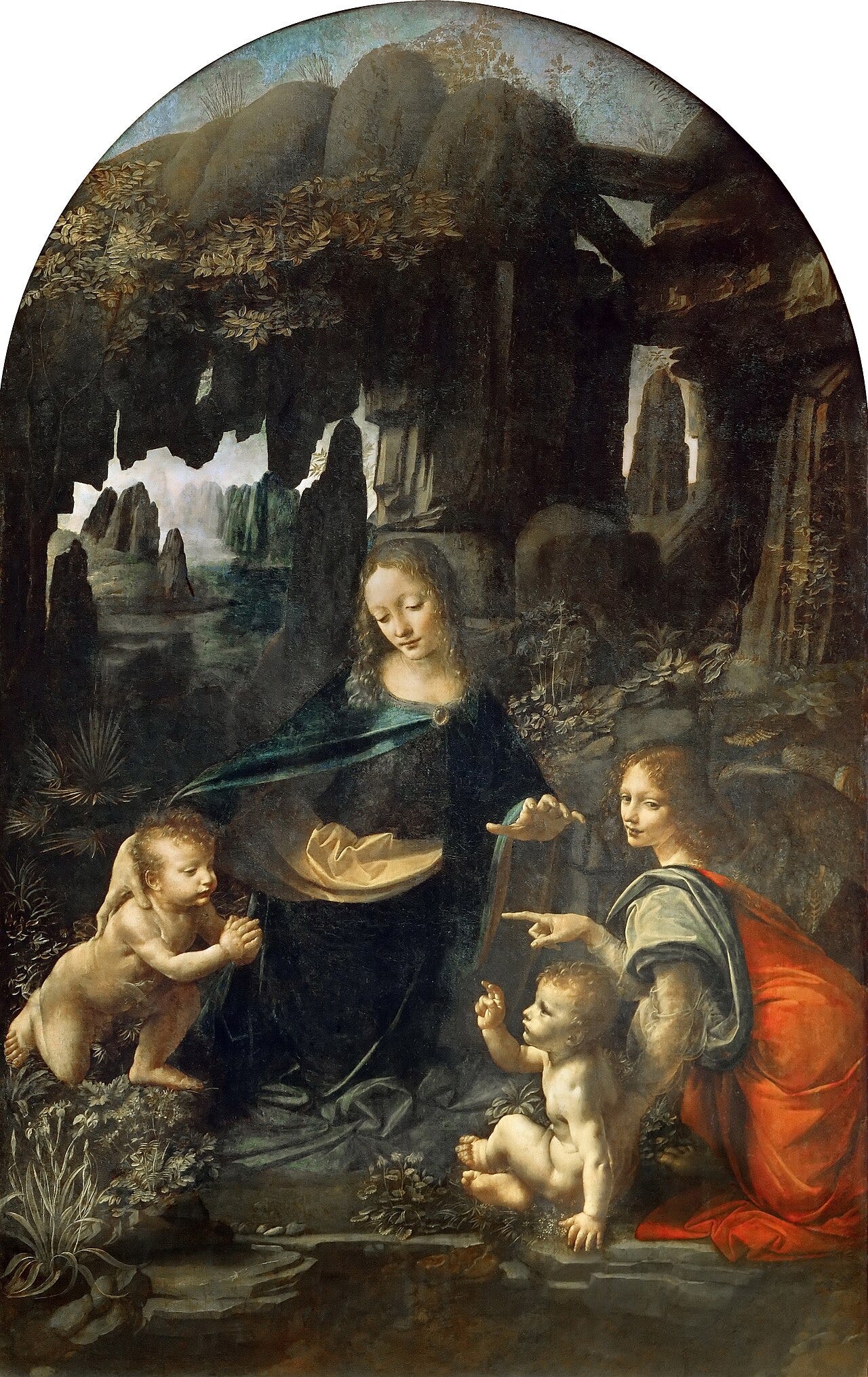
Leonardo painted The Virgin of the Rocks twice, once in the 1480s for a Milan confraternity and again more than twenty years later, after a payment dispute stretched into decades. What most retellings skip: infrared scans now prove the second version is not a workshop copy.
Both paintings show the same scene: Mary, the infant Christ, the infant John the Baptist and an angel, gathered inside a rocky grotto. Only one of them was the one everybody agreed to pay for on time.
Date. Louvre version begun around 1483, the London version finished closer to 1508.
Medium. Oil on panel, the Louvre painting later transferred onto canvas.
Location. The first version hangs in the Louvre, Paris. The second is in the National Gallery, London.
More Leonardo, more mystery
One painting rarely tells the whole story of an artist this restless. These go further.
Two versions, one broken contract
The confraternity of the Immaculate Conception in Milan hired Leonardo and the brothers Ambrogio and Evangelista de Predis to fill an altarpiece for their chapel at San Francesco Grande. Leonardo delivered a painting, then spent years arguing with them over the fee, and the dispute ran long enough that a second version exists, likely finished with workshop help, to close the contract once the money was finally settled.
Confraternities like this one commissioned art the way a modern client commissions a building: a fixed contract, a fixed price, a fixed deadline. Leonardo blew through the deadline and then rejected the price, which put the panel in limbo rather than on the altar.
The second version is not a courtesy copy. It reworks the lighting, the halos and the angel's gesture, evidence of an artist revisiting a subject rather than a workshop tracing his old drawing.
What actually changed between the two
The London version adds halos above every figure and gives the infant John the Baptist a reed cross, both absent from the Louvre painting. Small additions, but they make the second version read as more conventionally devotional, closer to what a cautious client expected from a chapel altarpiece.
The angel's pointing hand, ambiguous and unexplained in the Louvre version, is softened in the later one. Compare the two side by side and the second painting feels safer, less strange, stripped of the detail that made the first one so debated. What strikes me is that softening. The Louvre version keeps a mystery the later one closes off. I prefer the version that leaves the question open.
The gesture everyone argues about
In the Louvre version, an angel points at the infant John the Baptist while looking straight out at the viewer, a gesture with no clear precedent in earlier Milanese painting. Centuries later, novelists turned it into a secret code. Art historians read it more plainly, as a visual aid telling the congregation which infant is which.
Identifying saints correctly mattered in a period when most worshippers could not read the Latin inscriptions accompanying an altarpiece. A pointing finger did the job a caption does today. I think that is the real function of the gesture. It is closer to a label than a symbol, made for a room full of people who could not read the inscription.
Sfumato inside a cave
Leonardo sets the scene inside a grotto, using layered, smoke soft transitions between light and shadow, the technique later called sfumato, to make stone, skin and water dissolve into each other rather than sit inside hard outlines. He had already tested the same soft edges on faces in Milan.
It is the same patience visible in the Mona Lisa and the Last Supper, applied here to a subject that gave him rocks, water and drapery to soften all at once, a rehearsal for techniques he would refine for another twenty years.
A lawsuit that lasted two decades
On 25 April 1483, the confraternity of the Immaculate Conception in Milan signed a contract with Leonardo and the de Predis brothers for an altarpiece in the church of San Francesco Grande. Leonardo judged the agreed price, 800 lire, too low for a panel of this size and complexity, and refused to hand the finished work over on those terms.
The argument dragged on for more than twenty years, moving through petitions and counter offers while the painting itself likely left Milan for a different buyer willing to pay more.
It only closed around 1506, when Leonardo agreed to finish the second version now in London, finally settling an account that had outlived several changes in Milan's own political rulers.
Rock strata a geologist would recognize
Leonardo filled notebooks with observations on rock formation and fossils found far from any sea, and he carried that study straight into the grotto behind Mary. The layered strata in the painting follow real sedimentary patterns, tilted and fractured the way actual rock beds break over time, not the smooth generic cave most painters used as a backdrop.
He was equally exact with the plants at the painting's edges. The iris, the aquilegia and the palm are specific, identifiable species, rendered with a botanist's care rather than a generic bouquet dropped in for decoration. To me, that botanical precision says as much about Leonardo as the figures do. He could not paint a flower he had not actually studied.
Two paintings, two very different homes
The Louvre version entered the French royal collection during the following century and has stayed in French national hands ever since, moving into the Louvre itself after the Revolution. The London version took a longer, stranger road through private English collections.
It passed between private collectors for nearly four centuries before the National Gallery bought it in 1880 from the Earl of Suffolk, more than 370 years after Leonardo first picked up a brush for the commission.
Visitors sometimes assume one city holds the real one and the other a copy. Both hang as fully autographed Leonardo paintings, on opposite sides of the Channel, each with its own restoration history and its own conservation file.
The copy myth, corrected
Because the London version looks cooler and more polished than the Louvre one, some critics long dismissed it as mostly the work of Leonardo's assistants. Infrared reflectography and X ray scans carried out by the National Gallery overturned that reading.
The scans show extensive underdrawing and revisions typical of Leonardo's own working method, not a workshop tracing an existing design onto a fresh panel.
The two paintings are now treated as two original responses to the same commission, painted more than twenty years apart, not an original and a lesser shadow of it.
Where this fits in Leonardo's life
Frequently asked questions
Why are there two versions of the Virgin of the Rocks?
Leonardo's first version, painted for a Milan chapel, led to a payment dispute with the confraternity that commissioned it. The disagreement ran long enough that a second version was made to settle it.
Which version came first?
The Louvre version, started around 1483. The National Gallery version in London was finished later, after the dispute, likely with workshop help.
What is different between the two paintings?
The London version adds halos and a reed cross for John the Baptist, both missing from the Louvre painting. The angel's pointing gesture is also softened in the later version.
What does the angel's pointing hand mean?
Most art historians read it as identifying the infant John the Baptist for the viewer, a visual aid rather than a hidden signal.
Is the London version really by Leonardo, or his workshop?
National Gallery infrared and X ray scans show underdrawing and revisions consistent with Leonardo's own hand, not a workshop copy of an existing design.
Where can I see the Virgin of the Rocks today?
The first version hangs in the Louvre in Paris. The second is in the National Gallery in London.