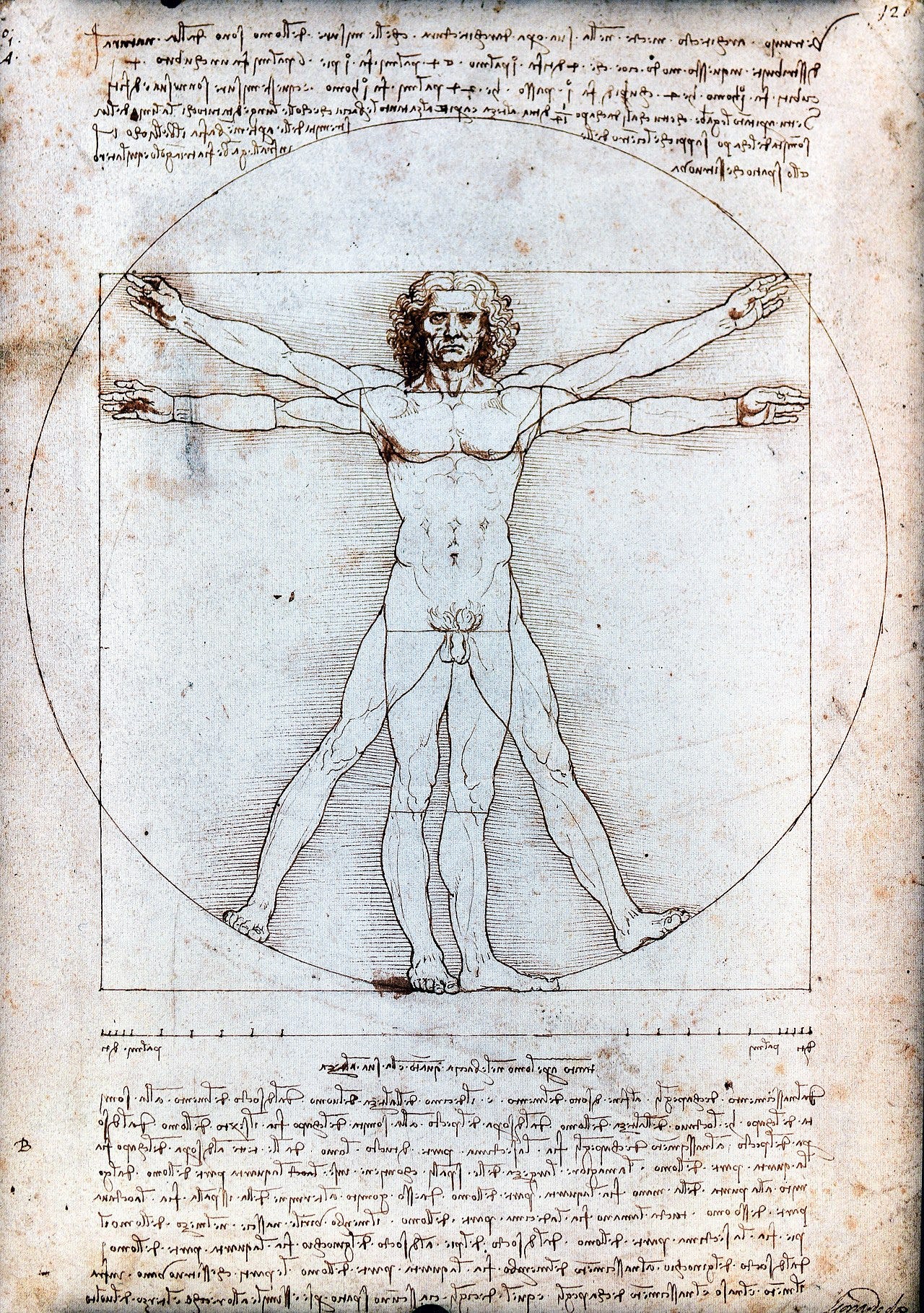
Leonardo's Vitruvian Man fits a human body inside a circle and a square, testing a Roman claim that human proportion mirrors the whole universe. Less repeated: the drawing likely grew out of a direct collaboration with a Milanese friend, a man later erased from the record entirely.
The sheet is barely the size of a notebook page, kept in a drawer for most of its life. Today it is reproduced more than almost any other drawing on earth, printed on coins, textbooks and a hundred science magazine covers.
Date. Drawn around 1490, while Leonardo worked in Milan for Duke Ludovico Sforza.
Medium. Pen, ink and wash over metalpoint on paper, 34.4 by 25.5 centimeters.
Location. Gallerie dell'Accademia, Venice, shown to the public only occasionally to protect the paper from light.
More stories worth your time
If a single drawing can carry this much thinking, imagine what a finished painting hides. Here are three places to start.
A body drawn twice
Vitruvius, a Roman engineer writing under Emperor Augustus around 15 BC, claimed an outstretched man fits perfectly inside a circle and a square sharing the same center point. Real bodies do not cooperate with a single static pose. Leonardo solved the contradiction around 1490 by drawing the figure twice, shifting the square down from the circle, and giving the man eight limbs instead of four.
Vitruvius set out his ratios in De Architectura, a ten book treatise on Roman construction. Four fingers make a palm, four palms make a foot, six palms make a cubit, and four cubits make the height of a man. Leonardo transcribed these ratios almost verbatim on the back of his own sheet. What I find telling is how literally he copied those ratios at first. He was checking Vitruvius before he ever tried to correct him.
Look closely at the figure and count the limbs. There are eight arms and eight legs sharing one head and one torso, two overlapping poses stacked into a single diagram built to survive scrutiny, not to flatter a sitter.
Why proportion obsessed Renaissance Milan
Humanist scholars in Leonardo's Milan had revived an old belief that man is the measure of all things. If the body's own proportions echoed a circle and a square, the same geometry running through architecture, music and astronomy also ran through human flesh. Leonardo treated that belief as a hypothesis to test, not a poem to illustrate.
Duke Ludovico Sforza employed Leonardo from 1482 as painter, engineer and stage designer, work that put him in daily contact with architects arguing over exactly this question. Vitruvius had become required reading for anyone designing a building meant to look correct rather than merely functional.
Leonardo approached the body the same way he approached water currents and bird flight: with a ruler, a compass, and a willingness to redraw the diagram until the numbers actually closed.
A friend's manuscript, and a name history erased
Italian scholar Claudio Sgarbi found a manuscript in the 1980s containing a nearly identical circle and square figure, drawn by Giacomo Andrea da Ferrara, a Milanese architect who worked alongside Leonardo in the 1480s and 1490s. The overlap suggests the two men developed the solution together, not that Leonardo invented it alone in isolation, as most accounts still imply.
Giacomo Andrea was a scholar and architect who had translated and annotated Vitruvius's Latin text, sharing his notes with Leonardo while both worked in Sforza's Milan. Their drawings share the same proportions, the same shifted square, and several of the same habits of the hand. I read that overlap with Giacomo Andrea as proof of a working friendship, not plagiarism. Two men solving the same problem from the same source will land on similar lines.
Giacomo Andrea did not survive to see any of it credited. French forces captured Milan in 1499, and in 1500 they hanged and quartered him for staying loyal to the exiled Sforza family. His manuscript sat unread in a Ferrara library for nearly five centuries before Sgarbi identified it.
The common myth is that Leonardo dreamed up the circle and square from nothing. He was refining a page that a friend, later executed for his politics, had already sketched beside him.
A private page, never made for a client
Unlike Leonardo's altarpieces and portraits, nobody paid for this sheet. It carries his own handwritten notes in mirror script, written from right to left the way he filled every private notebook he kept, and it stayed among his papers rather than in a patron's collection.
The drawing passed through private collectors for roughly three centuries after Leonardo's death in 1519. The Gallerie dell'Accademia in Venice acquired it in 1822, folded into a larger group of drawings bought from the collector Giuseppe Bossi.
Leonardo never saw it become a symbol of anything. To him it was one working page among the thousands he filled with anatomy studies, war machines and river diagrams.
How a study became a global symbol
The drawing resurfaced in the twentieth century as shorthand for the Renaissance genius who moves between art, engineering and science without seeing a wall between them. It now sits on Italy's one euro coin, drives the plot of more than one thriller novel, and appears on medical and engineering diplomas worldwide.
None of that popularity changes what the sheet actually is. It is a working diagram made by a man checking whether an old architectural claim held up under a compass, not a portrait designed to be admired. To me, that is the whole point of the drawing. Nobody draws a checking diagram to be admired. Leonardo was testing a claim, not making a portrait.
A drawing almost nobody sees
The sheet, catalogued as Homo Vitruvianus, lives at the Gallerie dell'Accademia in Venice, where staff keep it in a dark storage box rather than on permanent display. In 2019, Italian heritage groups sued to block a loan to the Louvre for a retrospective marking 500 years since Leonardo's death.
A regional court in Venice allowed the loan but limited it to the length of that single exhibition. Since then the drawing has returned to public view for only a few weeks at a time, roughly once every six years, because paper this fragile fades under ordinary gallery light.
Visitors who do catch it on display are usually surprised by the size. The page measures about 34 by 25 centimeters, smaller than a sheet of office paper, nothing like the poster sized reproduction most people picture.
What the reverse side actually says
The back of the sheet carries Leonardo's own handwriting in mirror script, transcribing Vitruvius's original ratios almost word for word. Conservators use this handwriting, more than the drawing itself, to date the sheet to Leonardo's Milan years, since the letterforms match notebooks he kept for Duke Ludovico Sforza in the 1480s and 1490s.
Most museum labels focus on the front. The back is the proof: without it, historians would have a harder case for placing the drawing so precisely inside Leonardo's Milanese decade.
More paintings, more meaning
Frequently asked questions
Is the Vitruvian Man a painting?
No. It is a drawing in pen, ink and wash on paper, not a painting on panel or canvas.
Where can I see the Vitruvian Man in person?
It belongs to the Gallerie dell'Accademia in Venice, but it is shown to the public only occasionally because paper this old cannot handle constant light exposure.
What do the circle and square mean?
They come from the Roman architect Vitruvius, who claimed the ideal human body fits perfectly into both shapes. Leonardo tested that claim with a compass and a ruler.
Why does the drawing show two overlapping figures?
Vitruvius's proportions do not work with a single pose centered on the navel. Leonardo shifted the square and added a second set of arms and legs to make the geometry agree.
Did Leonardo invent the idea of ideal human proportions alone?
No. A Milanese collaborator named Giacomo Andrea da Ferrara had sketched a near identical figure around the same years, based on a manuscript rediscovered in the 1980s. Leonardo refined a shared problem rather than inventing it from nothing.
How big is the actual drawing?
About 34.4 by 25.5 centimeters, roughly the size of a large notebook page, far smaller than the poster and coin versions most people know.