What Does Matisse's The Dance Mean?

Five red figures, one circle, three colors. Here is what Matisse was after when he painted this mural for a Moscow staircase in 1910.

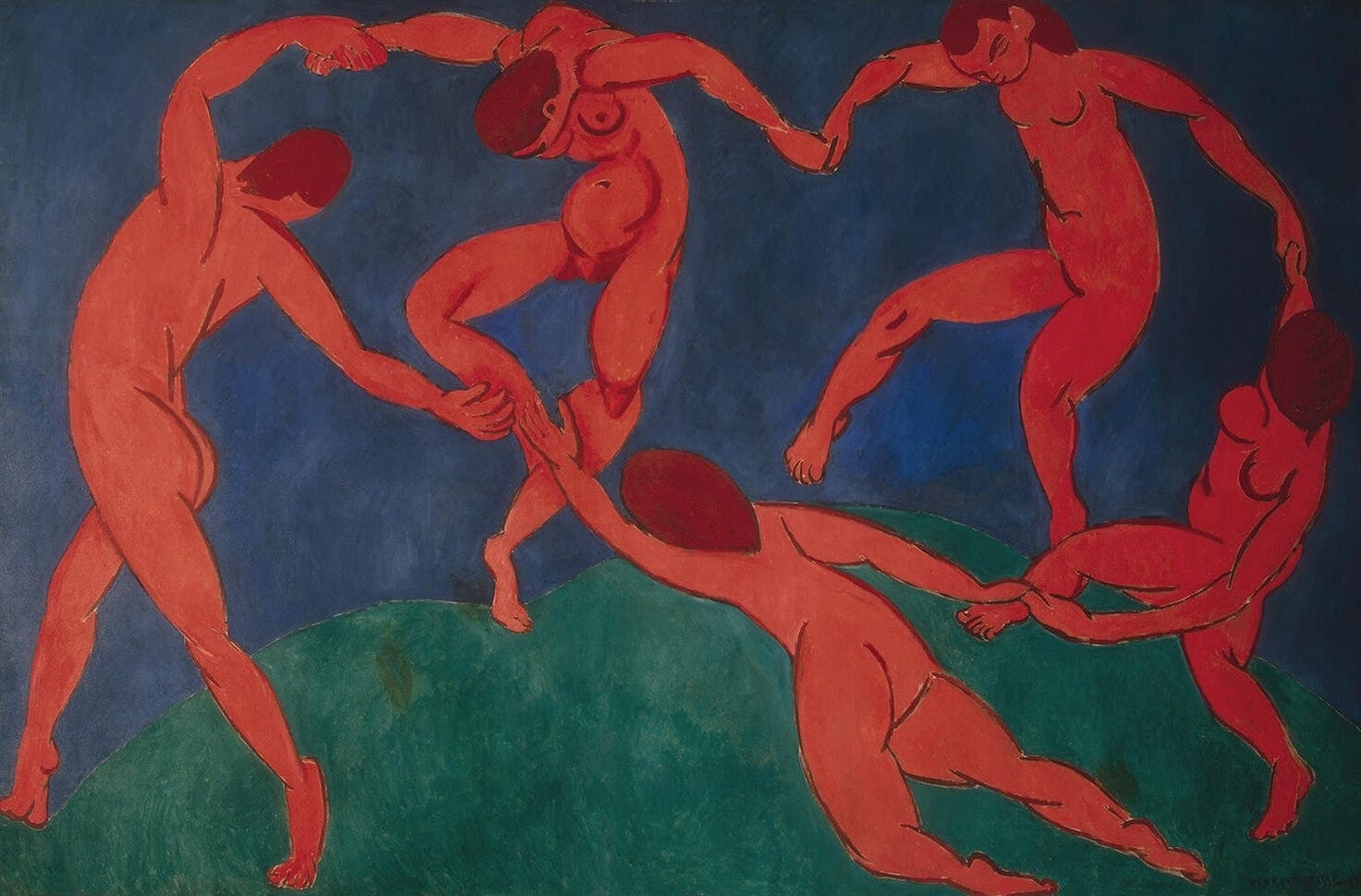
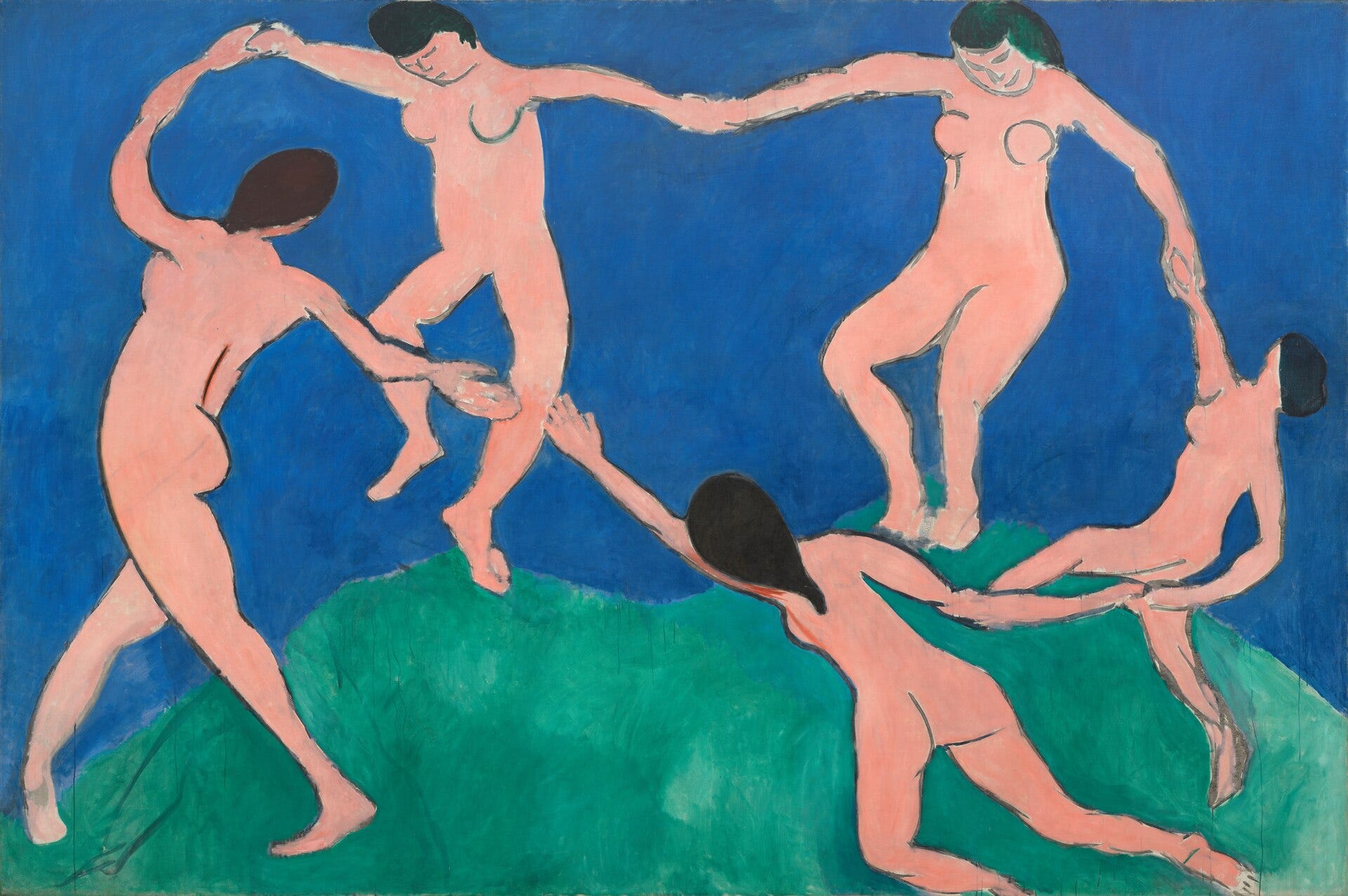
Matisse painted The Dance twice. The paler 1909 study now hangs at MoMA in New York, while the far more intense final version, commissioned by a Moscow collector in 1910, is the one usually meant by the name and now lives in the Hermitage.

Five red figures dancing in a circle
Henri Matisse, The Dance, 1910.

Matisse designed the painting as a mural for a stairwell, meant to be walked past again and again, not studied from an armchair. It had to register at a glance, from across a room full of guests climbing the stairs.

  • Date: Final version painted in 1910, after an 1909 compositional study.

  • Medium: Oil on canvas, about 260 by 391 centimeters.

  • Location: Hermitage Museum, Saint Petersburg. The earlier study is at MoMA, New York.


Learn art the fun way. Join 170,000 readers who get one painting and its story every week.


More Matisse and Fauvism

If the color in this painting hit you first, these stories go further into painters who worked the same way.


Two Versions, One Commission

Matisse painted The Dance twice, not once. The first version, a paler compositional study finished in 1909, now belongs to the Museum of Modern Art in New York. The second, far more saturated canvas followed in 1910 and was made specifically for the Russian collector Sergei Shchukin. It is the one people usually mean.

The 1909 study, known as Dance I, uses softer pink figures against pale green and blue. It reads as a sketch because it was one, a way to test the composition before committing to a monumental mural.

The 1910 version pushes the same figures into brick red, set against a deep blue sky and a dark green hill. Nothing about the color shift is accidental. It is the version most reproductions actually show.

The two are often treated as interchangeable online, which I think undersells how deliberate the change was. If a reproduction looks pale and gentle, it is almost certainly the MoMA study, not the finished Hermitage mural people usually mean when they say The Dance.

Commissioned for a Moscow Staircase

Sergei Shchukin, a Moscow textile merchant and one of the era's most adventurous collectors, ordered The Dance and its companion, Music, in 1909. Both were designed as mural sized panels for the stairwell of his private mansion, meant to greet guests before they reached any other room.

Matisse worked on both canvases together, treating them as a matched pair rather than two separate paintings.

The scale required extra studio space. At roughly 260 by 391 centimeters, The Dance sits closer to architecture than to an easel picture.

Older man in glasses and a coat
Henri Matisse, photographed in 1933.

Matisse rarely explained his intentions in detail, but he later said he wanted an art that felt restful, closer to a good armchair for a tired mind than a demanding subject.

Three Colors, No Shading, on Purpose

Matisse limited the entire canvas to three flat colors: blue for the sky, green for the ground, and brick red for the dancers. There is no shading, no modeling, no attempt at depth anywhere in the composition. For a major Salon painting in 1910, that flatness read as a deliberate provocation, closer to decorative pattern than to traditional figure painting.

The choice was not a shortcut. Matisse had already spent years testing how far color alone could carry a composition, notably in Harmony in Red, where a single hue floods an entire dining room.

Red dining room with patterned walls
Henri Matisse, Harmony in Red, 1908.

Removing shading also removed individuality. The five dancers share no distinguishing features, which keeps attention on the circle they form rather than on any one body.

To me, that is the real trick of the painting. Take away the faces and the dance stops being about five people and starts being about motion itself.

The Nudity That Almost Ended the Deal

When Shchukin received the finished panels, he initially refused them. He sent word that he could not hang nude figures in his stairwell, since he had recently adopted two young girls. Within days he reversed course, kept both paintings, and later called them among the most beautiful in his entire collection.

The reversal came fast, but the hesitation was real. Nudity seen daily by a household with children was a different proposition than nudity in a public gallery.

Shchukin's change of heart mattered more than his first reaction. He hung both panels prominently, kept adding radical paintings to his collection for years afterward, and eventually opened his private galleries to visiting art students on weekends.

What strikes me is how quickly the hesitation passed once it did. He did not just tolerate the panels, he kept building a collection around that same kind of risk.


See art differently. 170,000 readers already found these stories. Here is your turn.


A Dance Borrowed from Collioure

The circle of linked figures echoes the sardana, a traditional Catalan round dance Matisse watched fishermen perform on the beach at Collioure between 1905 and 1906. He had already sketched dancing figures into the background of The Joy of Life before isolating them as the whole subject of The Dance.

Collioure was where Matisse's color first went fully loose, in the summer that produced the paintings critics would soon mock as the work of fauves, wild beasts.

Nude figures resting in a colorful landscape
Henri Matisse, The Joy of Life, 1906.

By the time he returned to the round dance motif for Shchukin, he had stripped away everything else from The Joy of Life, the landscape, the reclining figures, the flute player, and kept only the ring of bodies in motion.

Booed at the 1910 Salon d'Automne

The Dance and Music were shown together at the 1910 Salon d'Automne in Paris before being shipped to Moscow, and the reception was rough. Critics compared the simplified bodies to cave paintings and children's drawings, meant as insults rather than compliments, in an episode that echoed the scandal Matisse had already caused five years earlier.

It was not Matisse's first scandal. Woman with a Hat, shown at the 1905 Salon d'Automne, had already drawn accusations that its colors looked flung at the canvas rather than painted.

Woman in a large decorated hat
Henri Matisse, Woman with a Hat, 1905.

By 1910 the attacks had shifted from color to simplicity itself. Reducing five bodies to red silhouettes struck plenty of viewers as carelessness rather than discipline.

Seized After the Russian Revolution

Shchukin's entire collection, The Dance included, was nationalized by the Bolshevik government after the 1917 revolution. He fled to Paris and never recovered ownership of a single painting. The Dance passed into Soviet state hands and eventually into the Hermitage Museum in Saint Petersburg, where it remains today.

Shchukin had spent roughly two decades building one of the most ambitious private collections of French painting in Europe, gathering Matisse, Picasso, and Gauguin under one Moscow roof, then lost all of it within months.

The painting he almost refused to hang became one of the works I would send anyone to see first, if they only had time for one room at the Hermitage.

Keep Reading About Art History

A few more stories worth your next ten minutes.


No boring lectures, ever. Join 170,000 readers who learn art the fun way, free.


Frequently Asked Questions

  • Where is The Dance located today?

    The finished 1910 version is at the Hermitage Museum in Saint Petersburg. An earlier, paler 1909 study is at the Museum of Modern Art in New York.

  • Why does The Dance use only three colors?

    Matisse wanted to strip the scene to its essentials, blue sky, green ground, red bodies, with no shading to distract from the motion.

  • Who commissioned The Dance?

    The Russian collector Sergei Shchukin, who ordered two large mural panels, The Dance and Music, for the staircase of his Moscow mansion in 1909.

  • Did Shchukin really almost reject the painting?

    Yes. He initially refused the nude figures because he had just adopted two young girls, then reversed his decision within days and kept both panels on display.

  • What inspired the circle of dancers?

    A traditional Catalan round dance called the sardana, which Matisse watched fishermen perform at Collioure between 1905 and 1906.

  • Is there more than one version of The Dance?

    Yes. An earlier, paler compositional study known as Dance I is at MoMA in New York, painted in 1909 before the final Hermitage version.


One painting, ten minutes. That is the deal 170,000 readers already took, free.