What Does Michelangelo's The Last Judgment Mean?

A flayed saint holds his own skin, and the sagging face on it is not his. Here is what Michelangelo actually painted on the Sistine Chapel's altar wall.

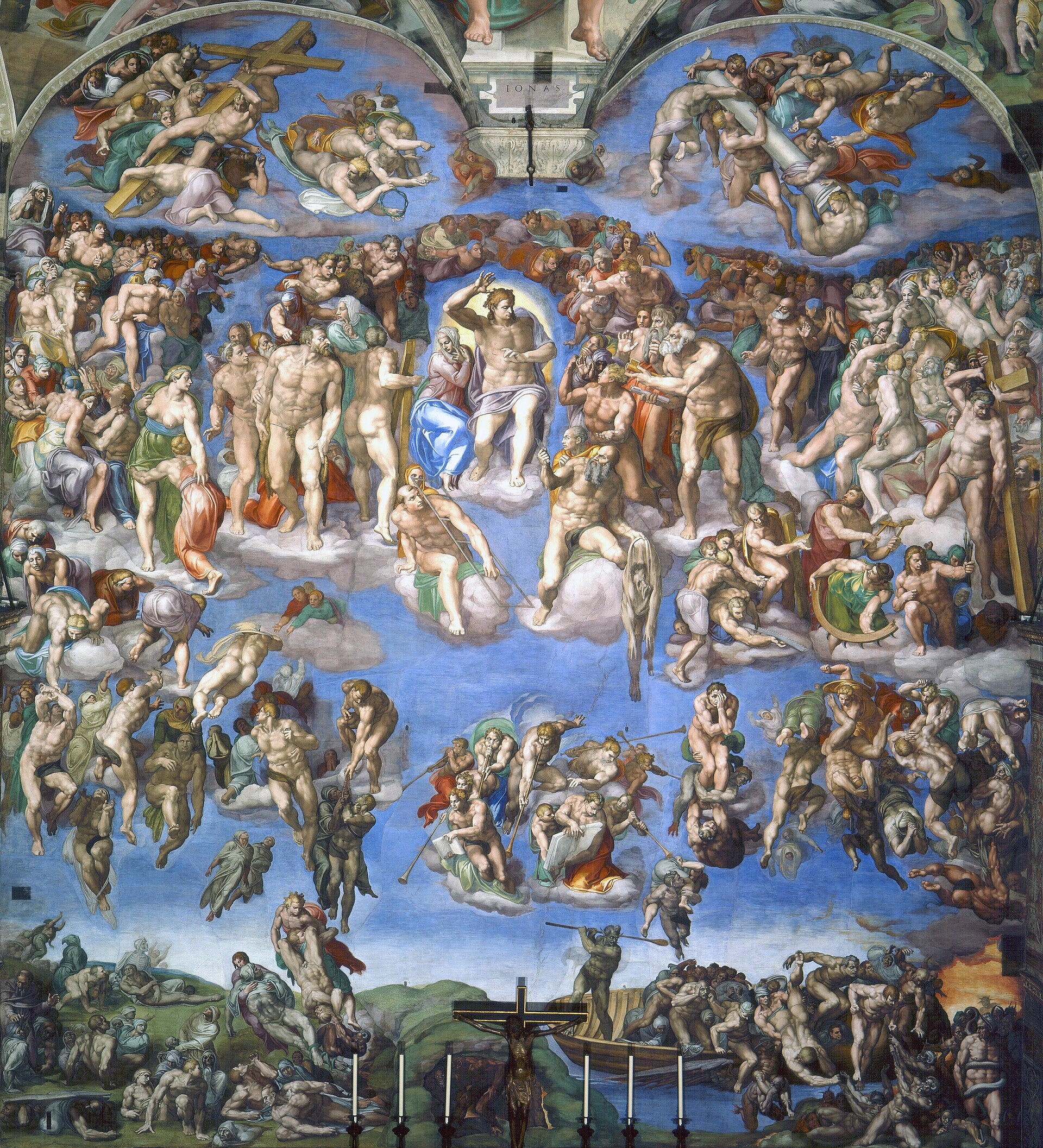
Michelangelo covered the Sistine Chapel's altar wall with over three hundred bodies twisting between heaven and hell. Christ raises one arm to judge. Down in the corner, a flayed saint holds his own skin, and the sagging face on it is Michelangelo's own.

Last Judgment fresco
Michelangelo, The Last Judgment, 1541.

He painted it between 1536 and 1541, more than twenty years after finishing the chapel's ceiling. This time there was no scene by scene narrative. Just one single, overwhelming moment: the end of everything.

  • Date: 1536 to 1541.

  • Medium and size: Fresco, roughly 13.7 by 12.2 meters.

  • Location: Sistine Chapel, Vatican City.


One painting. One story. Every week. Free, with 170,000 readers who never sat through an art history lecture.


Renaissance Rule Breakers Worth Knowing

Michelangelo answered to no one. These three artists took the same approach.


Christ at the Center of Everything

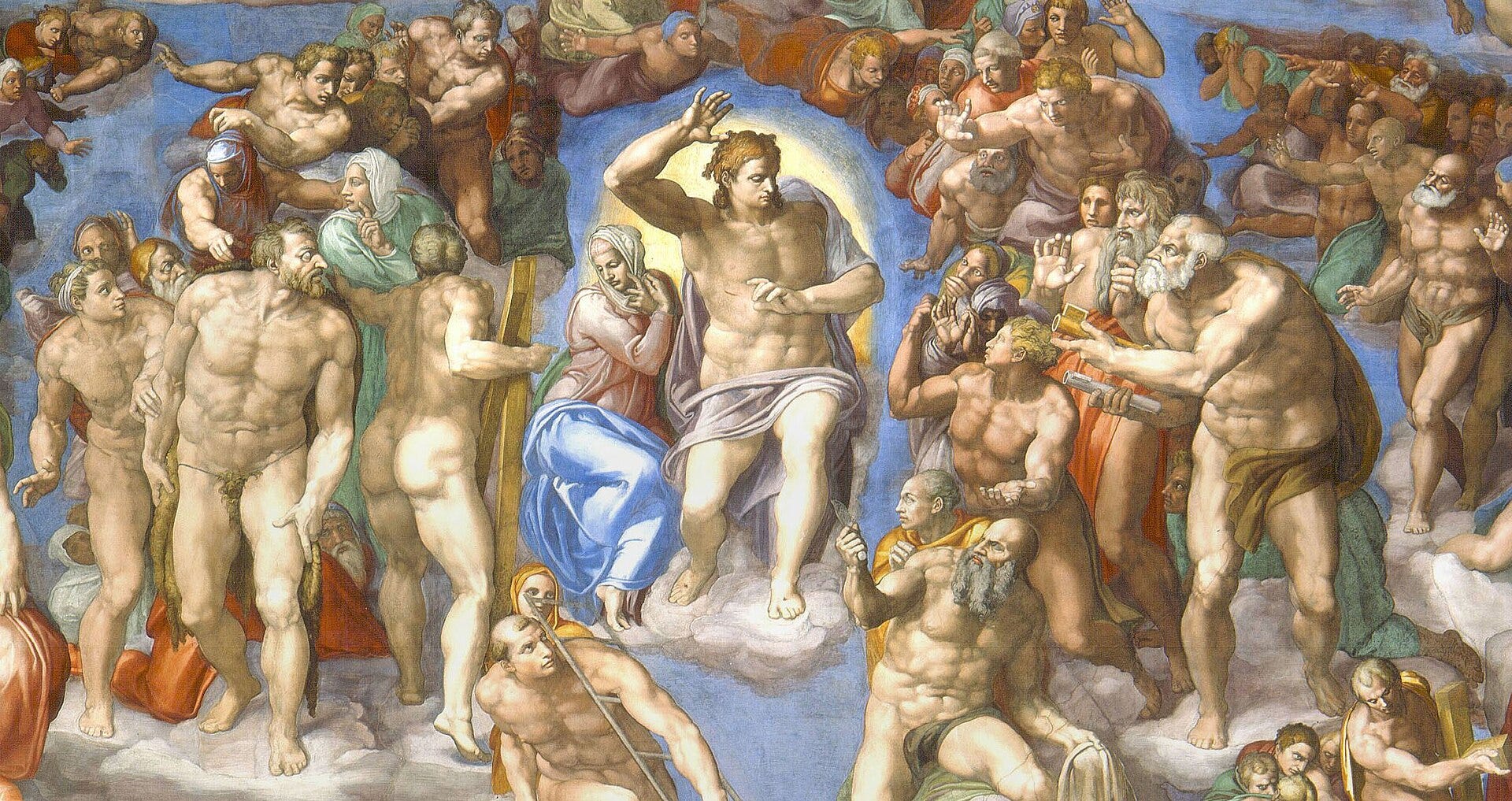
Christ dominates the composition without a throne beneath him, standing bare chested with one arm raised at the exact instant of judgment, closer to a discus thrower than to any earlier image of a seated, merciful judge. Mary sits pressed against his side, turned half away, as if the moment when pleading could still help has already closed.

Christ stands rather than sits, no throne beneath him, one arm raised in the gesture that sets the entire judgment in motion. Mary sits beside him, turned slightly away, as if the moment for pleading mercy has already passed.

Around them, a crowd of saints and martyrs presses in close, more muscle and motion than any earlier painting of the same subject had allowed.

The Saints Carry Their Own Deaths

Michelangelo turns the ring of saints around Christ into a walking inventory of martyrdom. Catherine of Alexandria holds the spiked wheel meant to break her body. Blaise grips the iron combs used to shred his skin before his execution. Every attribute in this crowd is a murder weapon, held up like a badge instead of hidden.

Michelangelo gives each saint the object that killed them. Catherine holds her spiked wheel. Sebastian carries his arrows. Blaise holds the iron combs used to flay him. Lawrence carries the grill he was roasted on.

It turns the crowd around Christ into a kind of catalog of martyrdom, each figure identified by how badly the world had once treated them.

What strikes me is how literal that catalog is. Michelangelo does not let a single saint forget how they died, even in paradise.

Michelangelo Last Judgment saints
The Last Judgment, detail.

A Face Hidden in a Flayed Skin

The empty, sagging skin hanging from Saint Bartholomew's hand carries a second face that does not match his own face in the scene above it. Most historians read that stretched, hollow face as Michelangelo signing the fresco with the one self image he was willing to show: skinned, discarded, folded into someone else's martyrdom.

Most historians read it as Michelangelo's self portrait, worked into the fresco as a stretched, hollowed out version of himself, tucked into the one figure defined by having his skin removed.

I read that detail as the most honest thing in the whole fresco. Everyone else stands triumphant or damned. He paints himself as the one thing left over after the violence.

Last Judgment fresco detail
The Last Judgment, detail.

No boring lectures, ever. Join 170,000 readers learning art the fun way, free.


Charon Rows the Damned to Hell

Michelangelo lifted Charon straight out of Dante's Inferno rather than from any earlier Last Judgment, giving hell a literary source most sixteenth century viewers would have recognized instantly. The demon ferryman beats stragglers off his boat with an oar, the one passage in the whole fresco that looks back at poetry instead of forward at scripture.

It is the one section of the fresco that looks backward, toward literature everyone in the room would have already known, rather than forward toward salvation.

Michelangelo Last Judgment Charon detail
The Last Judgment, detail.

The Fig Leaf Campaign

Within roughly twenty five years of Michelangelo's death, the church that once wanted a fresco no other painter could match was paying someone else to cover parts of it up. The Council of Trent's crackdown on nudity in sacred art turned Daniele da Volterra into a full time censor, working loincloth by loincloth across a wall he had not painted a single figure on.

Volterra spent so long painting fig leaves and loincloths onto Michelangelo's fresco that Rome nicknamed him Il Braghettone, the breeches maker.

Last Judgment figures detail
The Last Judgment, detail.

Learn art the fun way. Join 170,000 readers getting one painting and its story every week.


More Stories Behind Famous Paintings

The Sistine Chapel is not the only place a painter hid something this personal.


Two Popes, One Commission

Two popes with different priorities shaped this fresco before a single figure went on the wall. Clement VII wanted it as a personal legacy project in the last year of his life. Paul III inherited it in the middle of the Counter Reformation and used it to restate papal authority at a moment when Rome badly needed the reminder.

Pope Clement VII asked Michelangelo to paint the altar wall of the Sistine Chapel in 1533, shortly before his own death the following year. It was Clement's successor, Pope Paul III, who pushed the project forward and kept Michelangelo working on it for nearly six years.

Michelangelo painted the fresco between 1536 and 1541, working mostly alone in his late fifties and sixties. The wall was unveiled to the public on the thirty first of October 1541, the eve of All Saints Day.

A Wall Built for a Single Painting

The altar wall itself was rebuilt before Michelangelo touched it, angled twenty six centimeters out of true at the top so dust and candle soot would fall away from the surface instead of settling on it. Two of Michelangelo's own earlier lunette frescoes and two windows were destroyed to make room for one uninterrupted painted wall.

The finished fresco covers about one hundred and thirty square meters and holds more than three hundred figures, nearly all of them nude, arranged around Christ at the moment of final judgment.

The Master of Ceremonies Who Ended Up in Hell

Biagio da Cesena picked a fight with the wrong painter. His complaint that the fresco belonged in a bathhouse, not a chapel, got him painted into hell as Minos, judge of the underworld, donkey ears and all. Even the pope who commissioned the fresco refused to intervene on Biagio's behalf.

Biagio da Cesena, the papal master of ceremonies, complained to Paul III that the nudity was better suited to a bathhouse than a chapel. Michelangelo answered by painting Biagio's face onto Minos, the judge of the underworld, giving him donkey ears and a serpent biting at his groin.

When Biagio asked the pope to have the insult removed, Paul III is said to have joked that his authority did not reach into Hell, so the portrait would have to stay. It remains on the wall today, exactly where Michelangelo put it. A restoration completed in 1994, funded by a Japanese broadcaster and led by restorer Gianluigi Colalucci, removed centuries of soot and old varnish from the fresco and revealed colors far brighter than anyone alive had ever seen on that wall.

To me, that story tells you everything about how Michelangelo saw his own authority in that chapel. Not even the pope would erase what he had put on the wall.

The Last Painting Before He Stopped Painting

The Last Judgment turned out to be close to the end of Michelangelo's painting career, not the middle of it. He finished two more frescoes in the nearby Pauline Chapel by 1550, then in 1546, at seventy one, became chief architect of Saint Peter's Basilica and spent his final eighteen years working almost entirely on architecture, never again taking on a fresco of this scale.

It means the most famous single image of divine judgment in Western art was also its maker's goodbye to painting at this scale, a fact most explanations of the fresco stop short of mentioning.

Frequently Asked Questions

  • When did Michelangelo paint The Last Judgment?

    Between 1536 and 1541, on the altar wall of the Sistine Chapel.

  • Is that really Michelangelo's face on the flayed skin?

    Most art historians read the sagging face on Saint Bartholomew's skin as a self portrait, though Michelangelo never confirmed it in writing.

  • Why are some figures wearing drapery that looks added on?

    Daniele da Volterra painted over a number of nude figures after the Council of Trent objected to the fresco's nudity, years after Michelangelo's death.

  • Who is being dragged down by demons?

    The damned, shown at the bottom right being pulled toward Charon's boat and hell, in a scene inspired by Dante's Inferno.

  • Where can I see The Last Judgment today?

    It covers the entire altar wall of the Sistine Chapel in Vatican City.

  • Did Michelangelo paint anything major after The Last Judgment?

    Two more frescoes in the Pauline Chapel by 1550, then he spent his final eighteen years working almost entirely as an architect on Saint Peter's Basilica.


See art differently. 170,000 people read these free stories. Come find out why.