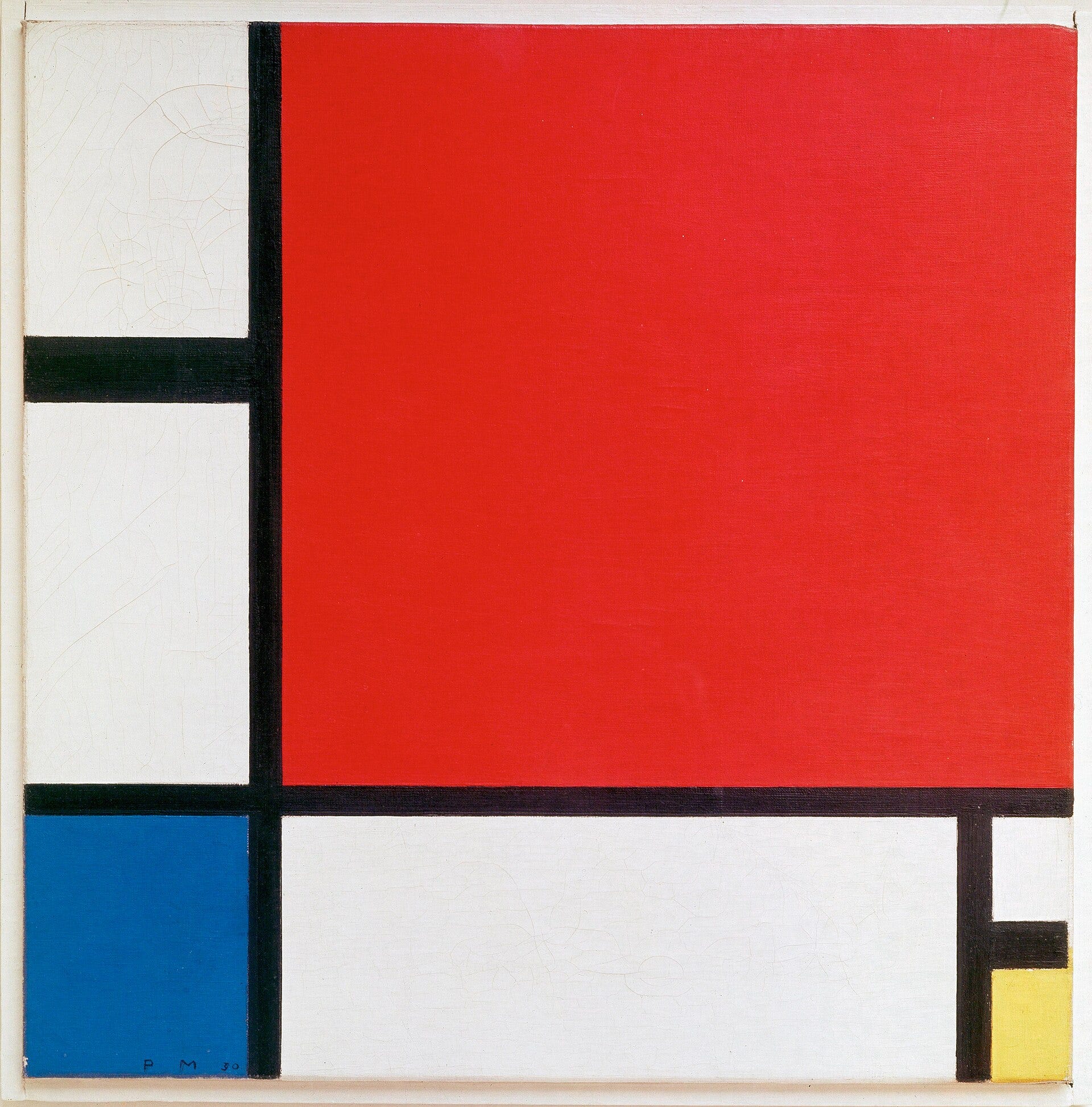
Composition with Red, Blue and Yellow looks like a simple grid of black lines and three colors, roughly forty five centimeters square. Mondrian believed this small canvas held the hidden order underneath the entire universe.
I spent years assuming this was just a cool looking grid, the kind of thing that ends up on a phone case or a tote bag without anyone asking what it actually meant.
Artist: Piet Mondrian, 1872 to 1944
Painted: 1930, oil on canvas
Style: Neoplasticism, De Stijl movement
More Stories From The Archive
Mondrian's grid did not appear out of nowhere. A few more stories from the archive dig into how art actually got here.
What You Are Actually Looking At
It turns out Mondrian would have found that reaction almost correct, in a strange way. He wanted this image everywhere, in furniture, buildings, and daily life, not just hanging in a museum.
Mondrian painted this in 1930. It is small, oil on canvas, and lives today at the Kunsthaus Zurich in Switzerland.
Thick black lines of different widths divide the canvas into unequal sections. A large red square dominates the upper right. A blue rectangle sits in the lower left. A sliver of yellow gets cut off entirely at the bottom edge, as if the grid continues beyond the frame.
Nothing here represents a tree, a face, or a landscape. That absence is not a limitation. It is the entire argument of the painting.
Mondrian's Journey to Abstraction
Mondrian did not start his career anywhere near this style. His earliest paintings from the late 1890s and early 1900s are quiet, realistic Dutch landscapes, windmills, farmhouses, rivers, painted in muted, natural color.
Over the following two decades he pushed those same ordinary subjects through increasingly abstract stages.
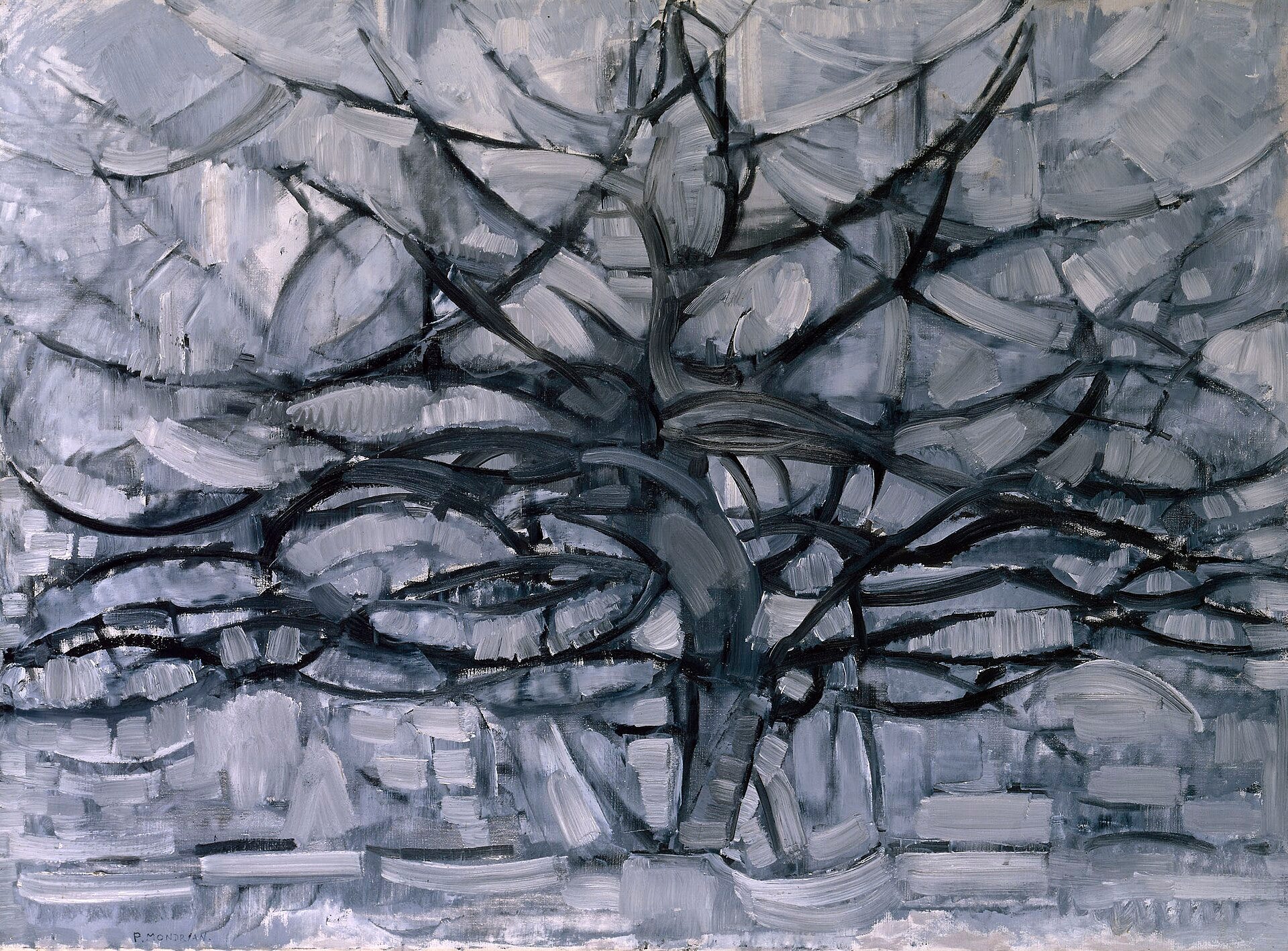
A series of paintings of a single tree, made between roughly 1908 and 1912, shows the branches gradually flattening into overlapping lines and planes until the tree itself becomes almost unrecognizable.
By the time he settled in Paris and encountered Cubism directly, Mondrian had already been moving toward pure abstraction on his own. Cubism gave him the final push.
Within a few years, recognizable subjects disappeared from his work completely, replaced by the grids that would occupy the rest of his career.
The Movement Behind the Grid
Mondrian helped found De Stijl in the Netherlands in 1917, alongside artist Theo van Doesburg, in the middle of a Europe exhausted by the First World War.
The group wanted art stripped down to its most basic elements, straight lines, right angles, and a handful of colors, believing that simplicity could offer a kind of order the outside world had just failed to provide.
The movement's ideas spread well beyond painting almost immediately. Furniture designer Gerrit Rietveld built his Red and Blue Chair around the same three colors and right angle logic in 1917, and later designed the Schroder House in Utrecht using the same principles applied to actual architecture.
By 1930, Mondrian had refined that idea into a personal language he used almost exclusively for the rest of his life: black grid lines on white, filled in occasionally with red, blue, or yellow.
Neoplasticism, Explained Simply
Mondrian called his personal style neoplasticism. The core idea is almost aggressively simple. Paint only straight horizontal and vertical lines, only the three primary colors, and only black, white, and grey.
No curves, no diagonals, no mixed colors, no recognizable objects. Mondrian believed that every extra detail, every curve or gradient, was really just the artist's personal mood getting in the way of something more universal.
The goal was not to show you Mondrian's feelings about the world. It was to strip painting down until only the underlying structure of reality remained visible.
Where the Grid Came From
Mondrian was deeply influenced by Theosophy, a spiritual movement popular in the early twentieth century that searched for a single universal truth underneath every religion.
In Mondrian's private symbolism, the vertical line represents the spiritual, the horizontal represents the material, and their intersection stands for the balance between opposites, spirit and matter, male and female, positive and negative.
This is why a painting that looks purely decorative at first glance is really closer to a diagram of Mondrian's private cosmology, with red, blue, and yellow standing in for the basic forces he believed shaped everything else.
Why the Grid Looks Off Balance on Purpose
Look closely and nothing here is actually symmetrical. The lines vary in thickness. The colored blocks sit at different sizes in different corners. Nothing lines up into a neat, predictable checkerboard.
That imbalance is deliberate. Mondrian spent years adjusting these compositions by eye, sometimes for months, moving a single line by a few millimeters until the whole canvas felt correct to him.
He wanted tension, not symmetry. A perfectly even grid would feel static and dead. An asymmetrical one, carefully balanced anyway, feels alive, like it is holding itself together through effort rather than simple repetition.
Why He Kept Painting the Same Idea for Years
From the early 1920s until his death in 1944, Mondrian painted variations on essentially the same composition many times over, adjusting the number of lines, the placement of color, the width of a single black bar.
That repetition looks strange to modern eyes trained to expect constant reinvention from artists. Mondrian saw it differently. He believed he had found the correct visual language, and the work left to do was refinement, not replacement.
His very last paintings, made in New York in the early 1940s, finally broke that rule. Works like Broadway Boogie Woogie replaced the solid black lines with small blocks of flickering color, inspired by the city's grid of streets and the jazz music Mondrian loved late in life.
Even then, the underlying grid structure never actually left.
From Canvas to Couture
Mondrian's grid escaped the museum world almost completely by the middle of the twentieth century, showing up in architecture, furniture, and graphic design well beyond anything he could have controlled.
The clearest example arrived in 1965, when designer Yves Saint Laurent released a collection of cocktail dresses built entirely from blocks of primary colored fabric stitched together in Mondrian's exact grid pattern, rather than printed onto the cloth.
One of those dresses landed on the cover of French Vogue that year, and cheaper copies flooded stores almost immediately. A painting built to express spiritual order ended up defining a season of high fashion instead.

Why This Small Painting Still Matters
The size always surprises people. This canvas is barely larger than a dinner plate, and yet its influence stretched into skyscraper facades, logo design, and album covers for decades.
I think that gap between scale and impact is the real story here. Mondrian was not trying to overwhelm a room the way a huge history painting does. He was trying to distill an idea small enough to fit on one wall and universal enough to apply to every wall.
Auction houses now treat his work as blue chip material, with paintings from this period regularly landing among the most expensive paintings ever sold at major sales, a strange outcome for an artist who wanted his work to feel as impersonal as architecture.
Mondrian shows up on almost every serious list of the greatest painters of all time, and he belongs on any list of artists you need to know if you want to understand where the clean grids of modern design actually came from.
More Secrets to Unlock
FAQ
When did Mondrian paint Composition with Red, Blue and Yellow?
In 1930, during the mature period of his career when he had settled into his signature style of black grid lines and primary color blocks.
How big is the painting?
It is small, roughly forty five by forty five centimeters, oil on canvas, which surprises many people given how large its cultural influence became.
What does neoplasticism mean?
Mondrian's term for his personal style, limited to straight horizontal and vertical lines, the three primary colors, and black, white, and grey, with no curves or recognizable objects allowed.
What was De Stijl?
A Dutch art movement founded in 1917 by Mondrian and Theo van Doesburg, seeking universal harmony through extreme simplicity of form and color, in the aftermath of the First World War. It also influenced furniture and architecture, including Gerrit Rietveld's Red and Blue Chair.
Why are the colored blocks placed unevenly instead of in a symmetrical grid?
Mondrian deliberately built asymmetrical tension into his compositions, adjusting lines by eye over long periods, believing a perfectly even grid would feel static rather than balanced and alive.
Where can you see the painting today?
At the Kunsthaus Zurich in Switzerland, part of the museum's modern art collection.
How did Yves Saint Laurent use this painting?
In 1965, he released a collection of cocktail dresses built from blocks of primary colored fabric stitched together in Mondrian's grid pattern, one of which appeared on the cover of French Vogue that year.
What philosophy influenced Mondrian's use of horizontal and vertical lines?
Theosophy, a spiritual movement seeking universal truth across religions. Mondrian treated vertical lines as spiritual and horizontal lines as material, with their intersection representing balance between opposing forces.