What Does Napoleon Crossing the Alps Mean?

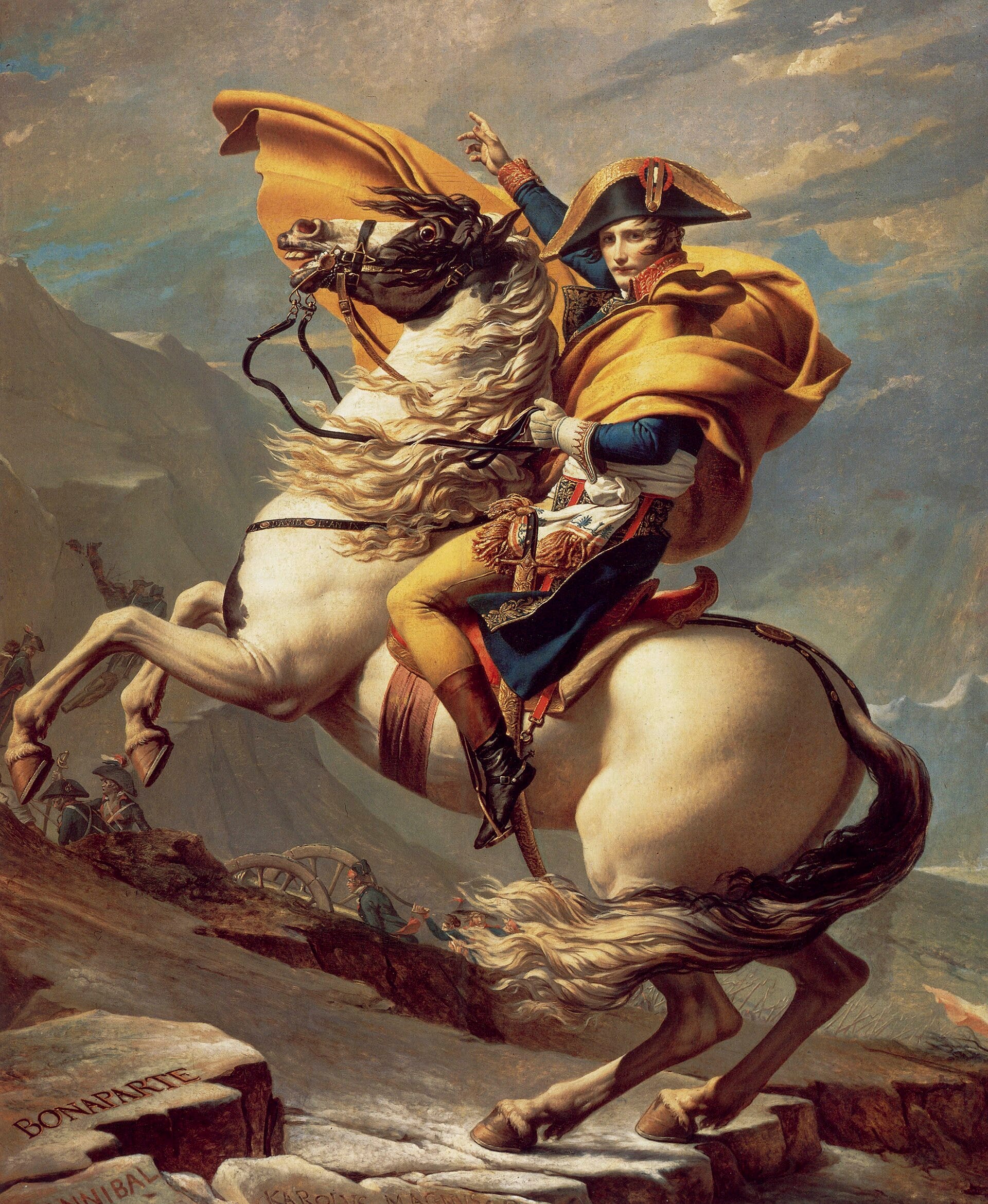
Napoleon Crossing the Alps shows Napoleon Bonaparte calm on a rearing horse during his 1800 crossing into Italy. Jacques-Louis David painted it as propaganda, on Napoleon's own instructions, to be compared with Hannibal and Charlemagne.

In reality Napoleon crossed two days behind his army, in good weather, on a mule.

I get why this image gets used as a hustle poster online. It is not that. David was told exactly how to paint Napoleon, and he obeyed. The result is one of the most effective pieces of political marketing ever put on canvas, five times over.

Napoleon Bonaparte on a rearing horse pointing toward a mountain pass, painted by Jacques-Louis David
The Malmaison version, the first of five nearly identical paintings David made between 1801 and 1805.

Learn art the fun way. Free stories every week, no boring lectures.


A General Posed Like a King

The canvas shows Napoleon Bonaparte on a rearing horse, cloak snapping in the wind, one arm pointed toward the pass above him. Soldiers drag a cannon through the rocks far below, dwarfed by the scale of the mountains.

Nothing about the pose is casual. The horse takes the exact stance used for centuries in royal equestrian portraits, the kind reserved for kings and generals who had already won.

Every choice in the composition, from the angle of the arm to the color of the sky, is built to make one man look like he commands the mountain itself.

Self portrait of the painter Jacques-Louis David
Jacques-Louis David, who painted Napoleon exactly as Napoleon instructed.

Napoleon Wrote the Brief Himself

The commission was not left to David's imagination. Napoleon told him directly how he wanted to appear on canvas.

He reportedly said that nobody checks whether a portrait truly resembles its subject, and asked to be shown calm, sitting on a fiery horse.

David followed that instruction closely. The finished painting is not a record of what happened on the mountain, it is a record of what Napoleon wanted people to believe happened.

The Mule Behind the Horse

Napoleon actually crossed the Great Saint Bernard Pass in May 1800, two days behind his own troops, once the route was already cleared.

He rode a mule, led by a local guide, in weather calm enough for an ordinary crossing.

David replaced that mule with a battle horse rearing against a storm that never happened, turning a safe logistical trip into a moment of raw command.


More Stories Like Napoleon Crossing the Alps


Two Names Carved in the Rock

Look at the boulder in the foreground and three names are cut into the stone beneath Napoleon's route.

Bonaparte appears alongside Hannibal and Karolus Magnus, the Latin form of Charlemagne, two generals who had also led armies across the Alps centuries earlier.

David placed Napoleon in that company on purpose, inviting viewers to read him as the next name in a very old list.

Napoleon Bonaparte on horseback in the Vienna version of Napoleon Crossing the Alps
One of five versions David painted, now held by the Kunsthistorisches Museum in Vienna.

Five Paintings, Not One

David painted five versions of this scene between 1801 and 1805, nearly identical in composition and color.

They now hang in the Chateau de Malmaison, the Palace of Versailles, the Kunsthistorisches Museum in Vienna, and Charlottenburg Palace in Berlin, with a fifth kept in a family collection.

Spreading the same image across several courts was part of the strategy. Repetition made the image feel like settled fact rather than a single artist's choice.

Portrait of King Charles IV of Spain, who ordered the first version
Charles IV of Spain ordered the first version of the painting in 1801.

Cool Stories About Art is a free newsletter. The stories behind the paintings, straight to your inbox.


Commissioned by a Spanish King

The first version was ordered in 1801 by King Charles IV of Spain, an ally of France at the time.

Napoleon then had David produce further copies for his own palaces, extending a design he had not originally commissioned but clearly approved of.

A political image, once it worked, got reproduced like a print run rather than treated as a single unrepeatable work.

Why the Propaganda Worked

David strips away mud, cold, and fatigue. Nothing in the frame suggests a difficult or ordinary march.

The diagonal line from the horse's hoof to Napoleon's raised arm pulls the eye straight up toward the pass, mimicking upward momentum and ambition.

Viewers do not see a general improvising his way through the mountains. They see a man who already knows how the story ends.

What the Image Still Gets Right

Strip away the mule and the calm face, and something true remains. Napoleon really did move an army across the Alps fast enough to surprise Austria.

The ambition the painting sells was real, even if the execution shown is fiction. Napoleon rebuilt his political position on speed and audacity, and this campaign is a clear example of both.

That mix, real ambition wrapped in invented detail, is what makes the painting worth more than a simple lie. It shows how Napoleon wanted to be remembered, and largely succeeded.


More from Cool Stories About Art


Questions About Napoleon Crossing the Alps

  • Is Napoleon Crossing the Alps historically accurate?
    No. Napoleon actually crossed on a mule, two days behind his troops, in calm weather. Jacques-Louis David painted a rearing horse and a storm because Napoleon asked to be shown calm and commanding, not documented as he really traveled.

  • Who commissioned Napoleon Crossing the Alps?
    King Charles IV of Spain ordered the first version in 1801. Napoleon then had David produce several further versions for his own palaces once the image proved effective.

  • How many versions of Napoleon Crossing the Alps exist?
    Five, all painted by Jacques-Louis David between 1801 and 1805. They now hang in Malmaison, Versailles, Vienna, Berlin, and a private family collection, spreading the same image across Europe.

  • What names are carved into the rock in the painting?
    Bonaparte, Hannibal, and Karolus Magnus, the Latin name for Charlemagne, are cut into the boulder in the foreground, linking Napoleon to two earlier generals who also crossed the Alps.

  • Why is the horse rearing in the painting?
    The pose came from Napoleon's own request. He wanted to appear calm and commanding on a fiery horse, and David built the entire composition around that instruction.

  • When did Napoleon actually cross the Alps?
    In May 1800, during the Marengo campaign, as French forces moved through the Great Saint Bernard Pass to surprise the Austrian army occupying northern Italy.

  • What campaign was Napoleon heading toward in the painting?
    The Marengo campaign. French troops crossed the Alps to reach Italy undetected, and the resulting victory weeks later helped secure Napoleon's political power in France.

  • Where can you see Napoleon Crossing the Alps today?
    The five versions are split between the Chateau de Malmaison, the Palace of Versailles, the Kunsthistorisches Museum in Vienna, Charlottenburg Palace in Berlin, and a private collection.


Join 170,000 readers learning art the fun way. Free stories every week, no boring lectures.