What Does Nighthawks by Hopper Mean? Explained

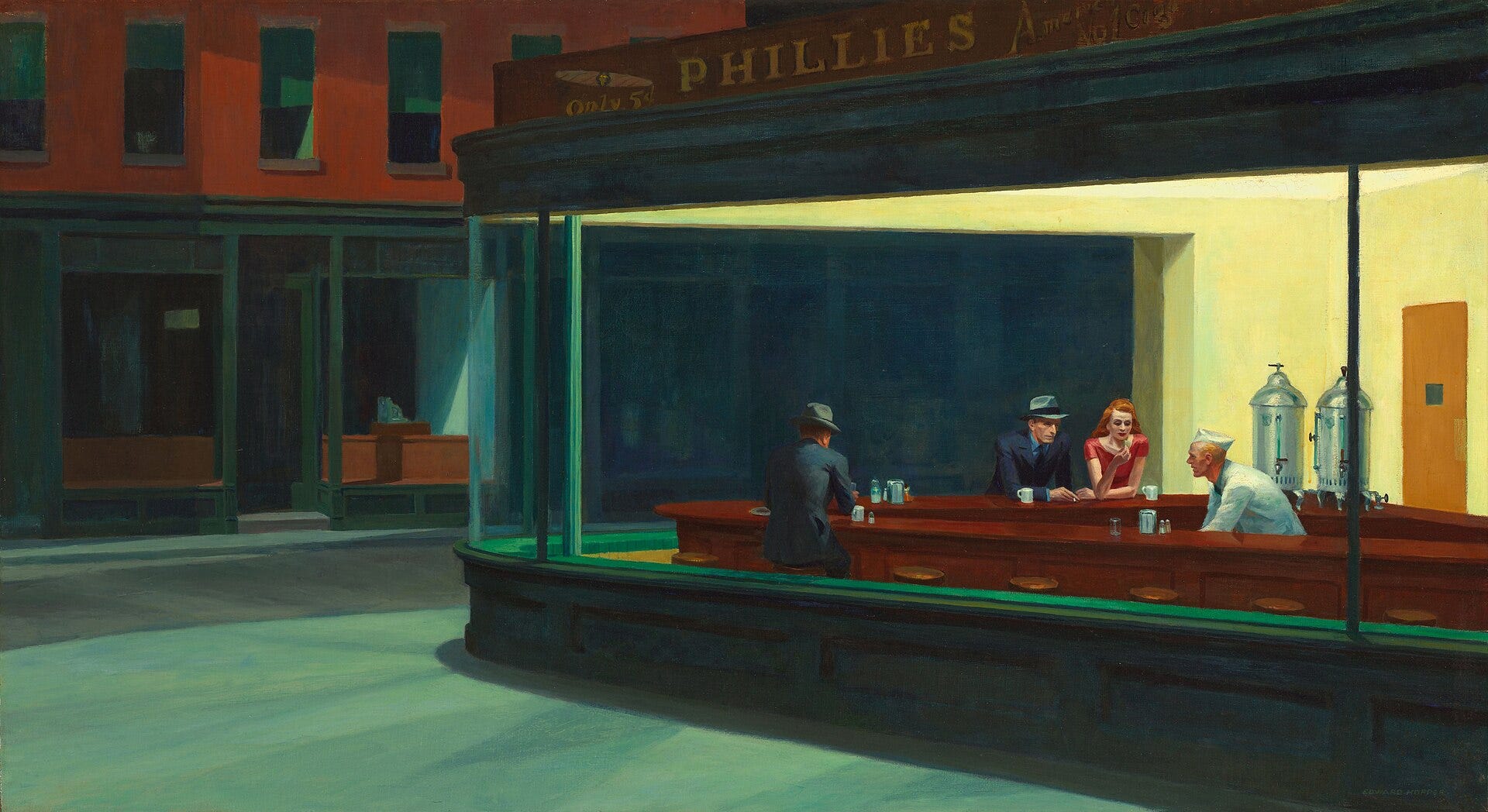
Nighthawks shows four people in an all night diner, cut off from each other and from the dark street outside.

Hopper painted it in early 1942, weeks after Pearl Harbor, and the sealed glass room with no visible door reads as both a wartime blackout scene and a picture of everyday isolation in the city.

I think the loneliness reading gets repeated so often that people forget Hopper pushed back on it. He said he was not consciously painting isolation, and that denial is worth taking seriously, not dismissing as false modesty. What he built is a scene anyone can read a dozen ways, and the picture holds up precisely because he refused to explain it further.

Black and white photograph of a 1940s American diner counter with stools, evoking the scene Hopper painted in Nighthawks
A real 1940s diner counter, the kind of everyday scene Hopper reworked into Nighthawks. This is a period photograph, not the painting itself.

Learn art the fun way. Free stories every week, no boring lectures.


What Nighthawks Actually Shows

Nighthawks is Edward Hopper's 1942 oil painting of a corner diner at night, seen from the street.

Inside sit three customers and a counterman. Two of them sit close but do not look at each other.

Outside the diner is empty. No cars, no other people, just dark storefronts across the street.

Hopper worked from imagination and memory, not from a live model at an actual diner. He built the composition in his studio, piece by piece.

Four People, No Way Out

The couple at the counter are close enough to touch. Their hands rest near each other but do not meet.

The man with his back to the viewer sits alone at the far end of the counter.

Nobody speaks. Nobody looks at anybody else. That silence is the whole subject.

Even the counterman keeps his eyes down on his work. He is inside the glass with the others, but his job keeps him separate too.

Empty New York City street corner at night in the 1940s, storefronts dark
An empty city corner at night, similar to the dead street Hopper painted outside his diner.

The Door That Is Not There

Look for the entrance and you will not find one. The glass wall wraps around the corner of the building without a break.

Hopper never explained the choice, so nobody knows for certain if it was symbolic or just a decision about the composition.

The effect is real either way. The diner reads as sealed, a lit box the customers cannot leave and the street cannot reach.

Some readers see the missing door as proof the diner traps its customers. Others say Hopper simply cropped an ordinary storefront and never thought about a door at all.

A dimmed New York City street during a World War II blackout drill
Coastal cities practiced blackouts like this one in the weeks Hopper was finishing Nighthawks.

More Edward Hopper and American Art Stories


A City Under Blackout

Hopper began Nighthawks in December 1941, right after Pearl Harbor, and finished it in January 1942.

New York and other coastal cities were practicing blackouts, dimming streetlights and storefronts against the fear of air raids.

The empty, darkened street outside the diner matches that mood. Read next to the date, the painting doubles as a wartime scene, not only a timeless one.

The war reference is not a certainty either. Hopper started sketches for the painting before Pearl Harbor, so the timing lines up more than it proves intent.

Hopper Denied Painting Loneliness on Purpose

Hopper said, unconsciously probably, I was painting the loneliness of a large city. That word unconsciously matters.

He resisted the idea that he set out to illustrate a theme. He painted what he saw and left the reading to the viewer.

Treat every confident claim about what Nighthawks means as one reading among several, because the artist himself refused to settle on one.

Compare that caution to how confidently articles online state the painting's meaning today. Hopper himself never spoke with that certainty.


Cool Stories About Art is a free newsletter. The stories behind the paintings, straight to your inbox.


The Diner Was Never Real

There was no single real diner on a real corner. Hopper combined details from Greenwich Village streets he knew into an invented building.

His wife Jo modeled for the woman at the counter, and Hopper based the man partly on himself.

So the scene is staged, not documentary. That matters for the meaning, because Hopper chose every angle and every gap on purpose.

Even the diner's name is invented. There was no Phillies sign glowing over a real Greenwich Village corner in 1942.

The exterior of the Art Institute of Chicago, home to Nighthawks since 1942
Nighthawks has hung at the Art Institute of Chicago since the year it was painted.

Nighthawks as a Symbol of Hope

The Art Institute of Chicago, which owns the painting, has pushed a different reading in recent years, one closer to comfort than despair.

In that version the diner is a small refuge of light in a dark city, and the people inside chose to be there together rather than alone at home.

I find that reading persuasive as an addition, not a replacement. Nighthawks can hold isolation and shelter in the same frame. Hopper played with that same tension years earlier in Soir Bleu, a stranger and less famous painting.

The museum's newer framing does not erase the older one. It just adds a second door into the same room.

Why the Meaning Still Divides People

Ask ten people what Nighthawks means and expect several different answers, and none of them wrong.

The painting gives almost no text to work with, just light, glass, and four figures who will not explain themselves.

That openness, more than any single symbol, is why the image keeps getting reprinted, parodied, and argued over more than eighty years later.

That is also why Nighthawks keeps getting borrowed by illustrators, filmmakers, and advertisers who want an instant shorthand for a certain kind of city night.


More to discover here


Nighthawks questions people ask

  • What does Nighthawks by Edward Hopper mean?
    Most readings center on urban isolation, four people sharing one lit room while staying disconnected from each other and from the dark, empty street outside. Hopper himself gave few details, which is part of why the reading keeps evolving.

  • Why is there no door in Nighthawks?
    The glass wall curves around the corner without a visible entrance. Hopper never explained the choice, so it reads as a deliberate seal or simply a composition decision, nobody can prove which.

  • Did Edward Hopper say Nighthawks was about loneliness?
    He said he was probably painting the loneliness of a large city, but he used the word unconsciously and resisted a fixed reading of the work. Later in life he pushed back even further, saying critics read more into his work than he intended.

  • Is the diner in Nighthawks a real place?
    No. Hopper invented the building from pieces of Greenwich Village streets he knew, so there is no single real corner to visit.

  • When did Hopper paint Nighthawks?
    He began it in December 1941 and finished it in January 1942, in the weeks right after the attack on Pearl Harbor.

  • Does the wartime blackout explain the empty street in Nighthawks?
    It fits the timing. Coastal American cities were dimming streetlights against air raid fears while Hopper finished the painting, and the dark street outside the diner matches that mood.

  • Who are the people in Nighthawks?
    Hopper's wife Jo modeled for the woman at the counter, and Hopper based the man in the hat partly on his own features. The other two figures are unnamed.

  • Where is Nighthawks displayed today?
    It has hung at the Art Institute of Chicago since 1942, the year the museum bought it directly from Hopper for three thousand dollars, roughly his asking price. It remains one of the most requested works in the museum's American art galleries.


Join 170,000 readers learning art the fun way. Free stories every week, no boring lectures.