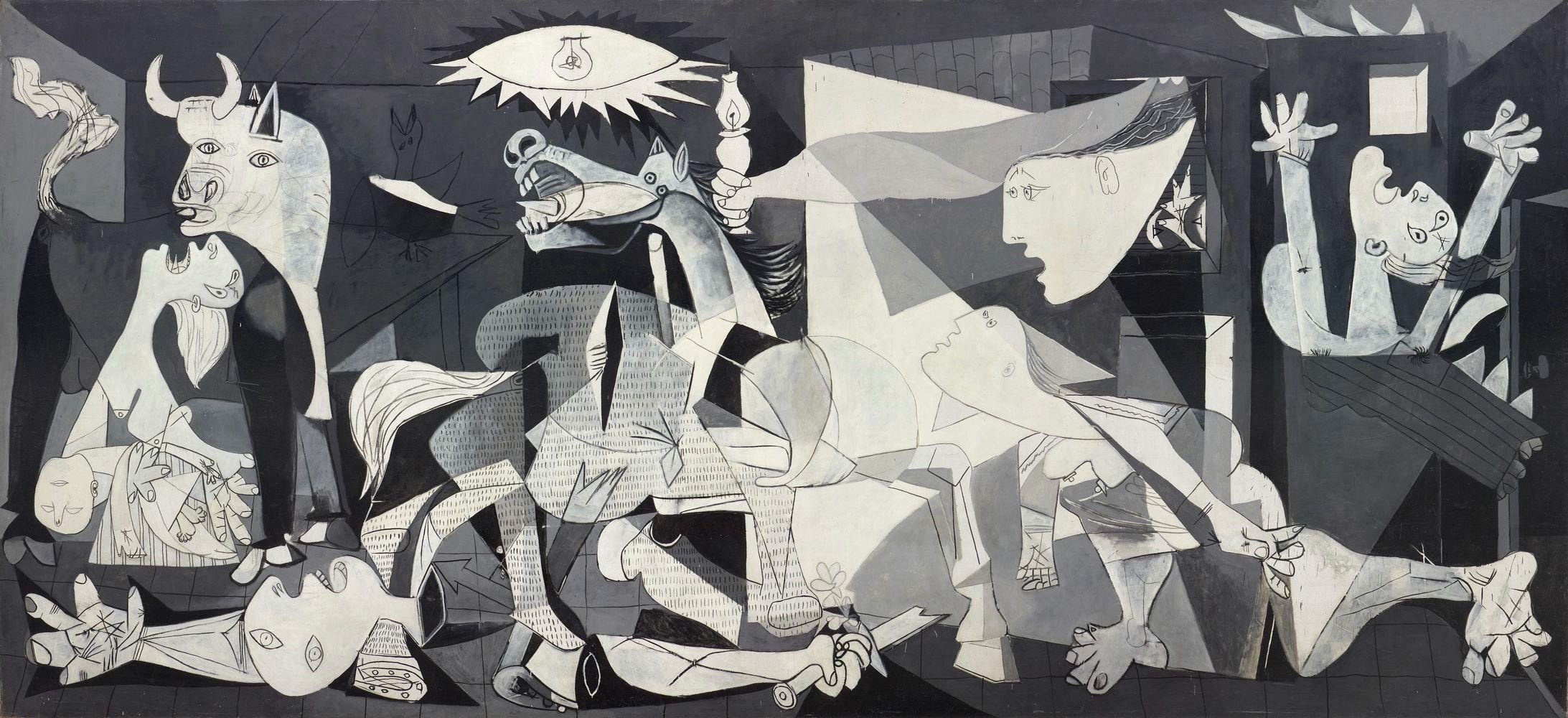
Guernica is Pablo Picasso's 1937 response to the German and Italian bombing of a Basque town during the Spanish Civil War. Painted in stark black, white and gray, it shows a dying horse, a wounded soldier and a screaming mother, and it never explains its own symbols.
What strikes me most about Guernica, next to the rest of Picasso's work, is how little color he needed to make a scene this devastating.
Date: 1937, painted in Paris in a few weeks after the bombing of April 26.
Medium: Oil on canvas, about 3.5 by 7.8 meters.
Location: Museo Reina Sofía, Madrid, since 1981.
More Stories Like This
If Guernica pulled you in, these stories sit close to the same world of Picasso, protest and painted history.
Why the Bombing Happened
German Condor Legion and Italian aircraft bombed the Basque town of Guernica for nearly three hours on April 26, 1937, during the Spanish Civil War. General Franco's Nationalist forces targeted a Republican stronghold that had no anti aircraft defense. News of the attack reached Picasso in Paris within days and gave him the subject for a mural he had already agreed to paint.
Historians still debate the exact death toll. Early Francoist accounts minimized the number of victims, while Basque government estimates from the period ran into the hundreds, and later research has settled on a range rather than one fixed figure.
The attack killed and wounded a large number of civilians, one of the first times a European population was targeted this way from the air.
News of the bombing reached Paris within days, carried by journalists including George Steer, and it landed directly on Picasso's desk while he searched for a subject for his mural.
Reading the Symbols
Guernica's dying horse, wounded bull, grieving mother and screaming figures form a scene painted almost entirely in black, white and gray, echoing newspaper photography of the era. Picasso never assigned the figures one fixed meaning. Most readings connect the horse to civilian suffering, since it is the only figure caught in direct agony at the canvas's center.
Some historians read the untouched bull as a stand in for Spain itself, enduring the violence around it rather than causing it, though Picasso never confirmed that reading either. What strikes me is that Picasso let the ambiguity stand. He gives you a strong candidate for meaning and then declines to confirm it, which keeps the debate alive instead of settling it.
A horse screams at the center, pierced by a spear. A bull stands untouched on the left. A woman on the right leans from a window holding a lamp toward the scene. Below her, a mother cries out over her dead child.
An eye shaped lamp burns above the horse's head, an obvious substitute for the sun, or possibly for a bomb.
Why Picasso Refused to Explain
Picasso deliberately refused to decode Guernica's symbols, telling questioners that a bull was a bull and a horse was a horse, and that viewers could see whatever they wanted in the painting. He believed that pinning down one meaning would shrink a shared image of suffering into a private code only he could unlock.
I think that refusal is itself one of the smartest choices in the painting. A fixed answer would have given people permission to stop looking.
He said the painting spoke for itself, and that explaining it point by point would have reduced a shared image of suffering into something only he could unlock.
Thirty Five Days at 7 Rue des Grands Augustins
Picasso painted Guernica in about 35 days during May and June 1937 in his Paris studio at 7 rue des Grands Augustins, a building old enough that Balzac had set a novel there a century earlier. His partner, photographer Dora Maar, documented the canvas at several stages, capturing a raised fist that appears early and vanishes from the final composition.
Picasso made around 60 preparatory sketches and studies before and during the 35 days of painting, numbering and dating many of them himself, an unusually documented process for a work made under deadline pressure.
The room was tall enough to hold the huge canvas upright while he worked, which mattered given the mural's final size, close to three and a half meters tall and nearly eight meters wide.
Dora Maar's photographs give historians a rare sequential record of a masterpiece changing shape. The bull's position shifts more than once before Picasso settles on the final composition.
Guernica was not the only political statement inside the Spanish Republic's pavilion at the 1937 Exposition. Joan Miro painted a mural for the same building, and Alexander Calder installed a fountain that used real mercury from Spanish mines. Sculptor Julio Gonzalez also contributed work nearby.
A Cool Reception, Then a World Tour
Guernica is oil on canvas, not a mural painted directly onto a wall, though it was built to fill an entire pavilion at the 1937 Paris Exposition alongside work by Miro and Calder. Some visitors found its fractured style difficult at first. Picasso later lent it to New York's Museum of Modern Art on one condition: it could not enter Spain until democracy returned.
The 1937 Paris Exposition drew tens of millions of visitors over its run, yet the Spanish pavilion sat in the shadow of the German and Soviet pavilions facing each other nearby, a physical staging of the era's politics that Guernica quietly answered from inside a smaller building. To me, that placement is the real statement. Guernica did not need to shout next to the German and Soviet pavilions, it just needed to be there.
Some visitors and critics found the fractured, black and white style difficult, and some Republican officials reportedly wanted a more traditional, heroic image instead. Its reputation grew slowly over the following decades.
After the 1937 Exposition, Guernica toured Europe and the United States to raise money and awareness for Spanish refugees. Franco died in 1975, Spain moved toward democracy, and Guernica finally crossed the Atlantic in 1981, arriving at what is now the Museo Reina Sofía in Madrid.
More From Cool Stories About Art
Attacked, Censored, and Still Standing
Guernica has survived one direct attack and one act of diplomatic censorship. In 1974, an artist spray painted the canvas at MoMA to protest a pardoned soldier, and conservators removed the paint without lasting damage. In 2003, a tapestry copy at the United Nations was covered with a blue curtain the day officials argued for war against Iraq in that same hallway.
The United Nations tapestry was a gift from Nelson Rockefeller, woven from a set of Guernica reproductions Picasso approved during his lifetime, which is part of why the 2003 covering struck so many observers as pointed rather than accidental.
The detail I find most unsettling is that a painting this famous survived only because a layer of varnish kept the spray paint from soaking into the canvas.
A large tapestry copy of Guernica, woven in the 1950s, has hung outside the Security Council chamber at the United Nations headquarters in New York for decades. Reports at the time linked the 2003 covering to the awkwardness of announcing war in front of a painting about the horror of bombing civilians.
FAQ
What does the horse in Guernica represent?
Picasso refused to assign it one fixed meaning. Many readings link the horse to the suffering of the Spanish people, since it is the only figure caught directly in agony at the center of the canvas.
Why is Guernica painted only in black, white and gray?
The limited palette echoes newspaper photography and newsreel footage of the period, the way most people actually encountered images of the bombing at the time.
Where can you see Guernica today?
The painting hangs at the Museo Reina Sofía in Madrid, where it has been on permanent display since it arrived from New York in 1981.
Why did Guernica stay in New York for so long?
Picasso set the condition himself. He refused to let it enter Spain while Francisco Franco remained in power, so the Museum of Modern Art held it on loan for over four decades.
Is Guernica based on a real event?
Yes. It responds directly to the bombing of the Basque town of Guernica on April 26, 1937, carried out by German and Italian air forces during the Spanish Civil War.
Is Guernica a mural?
No. It is oil paint on canvas, sized to fill a pavilion wall at the 1937 Paris Exposition, then rolled up and shipped separately once finished, the same way any large canvas painting travels.