What Does Picasso's The Old Guitarist Mean?

The blind guitarist, the poverty behind him, and the paintings Picasso hid underneath.

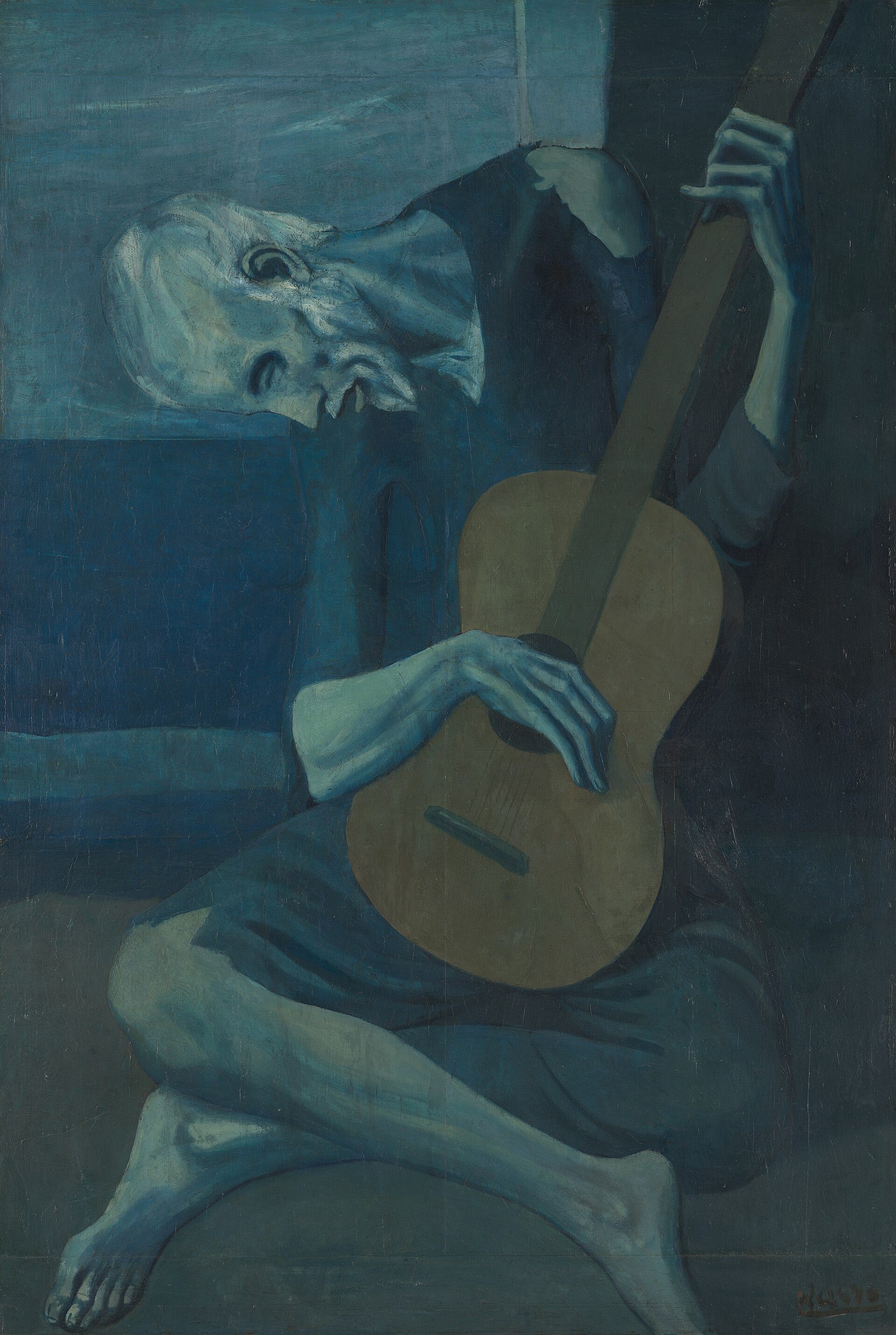
Picasso's The Old Guitarist shows a blind, starving street musician hunched over his instrument, painted in 1903 and 1904 during Picasso's Blue Period. The monochrome blue captures grief after his friend Casagemas died, poverty in Barcelona, and Picasso's fascination with blind and destitute musicians.

Picasso Old Guitarist painting
Pablo Picasso, The Old Guitarist, 1903 to 1904.

The detail that gets me every time is the guitar's warm brown, the one note of color in an otherwise freezing painting.

  • Date: Painted in 1903 and 1904.

  • Medium: Oil on panel.

  • Location: Art Institute of Chicago.


I break down one painting's real story every week. Join 170,000 readers discovering the stories behind the world's greatest paintings.


More stories worth your time

If Picasso's poverty and grief pulled you in, these go further.


Why Picasso Painted in Blue

Picasso's Blue Period ran from 1901 to 1904, beginning after his close friend Carlos Casagemas died by suicide following a failed love affair. Picasso was himself very poor at the time, and his hardship pushed him toward beggars, blind musicians and other outcasts he saw playing in the streets of Barcelona and Madrid, their poses often echoing the elongated figures of El Greco.

Picasso crouching beggar woman
Pablo Picasso, Crouching Beggarwoman, 1902.

Crouching Beggarwoman, painted a year earlier, shows the same interest in figures worn down by hunger and cold, folded inward rather than standing upright.

Picasso Blue Room painting
Pablo Picasso, The Blue Room, 1901.

The flat blues, greys and near blacks of this period create a mood of contemplation and loss. The Old Guitarist sits near the end of that stretch.

The guitarist's eyes are shut, his head bent low over the instrument, a posture Picasso returned to often while sketching the blind musicians he admired.

The Paintings Hidden Beneath the Guitarist

X rays and infrared scans at the Art Institute of Chicago found at least two earlier compositions hidden beneath The Old Guitarist's paint layer: a seated woman with long dark hair, a kneeling child reaching toward her, and an animal, likely a calf or a sheep. A sketch Picasso sent to his friend Max Jacob shows a similar scene, painted only months before he began the guitarist.

Researchers identified the hidden figures through a combination of X ray fluorescence and infrared reflectography, techniques that read the different densities of paint layers without touching the surface itself.

Why he abandoned that composition for the guitarist remains unknown.


New details land in your inbox before most readers ever see them. Join 170,000 readers discovering the stories behind the world's greatest paintings.


More Blue Period Poverty on Canvas

The Old Guitarist was not an isolated subject. Around the same years, Picasso painted The Soup and Melancholy Woman, other studies in hunger and hardship rendered in the same flat blues. Friends recalled him burning some of his own drawings in his unheated Barcelona studio during the winter of 1902 and 1903, simply to stay warm.

That detail sits behind the painting's mood. The hardship on the guitarist's face was not observed from a comfortable distance, and Picasso's own letters from these years describe going without food for days at a stretch.

Picasso The Soup painting
Pablo Picasso, The Soup, 1902 to 1903.

What stays with me is that the poverty in this painting was not observed from a comfortable distance. Picasso was burning his own drawings to stay warm the same winter he painted men who had nothing.

Picasso Melancholy Woman painting
Pablo Picasso, Melancholy Woman, 1902 to 1903.

Melancholy Woman, painted in the same years, shares the same folded posture and downward gaze found in the guitarist.

Painted on Wood, Not on Canvas

The Old Guitarist is painted on a wood panel rather than canvas, a choice tied to money as much as taste, since panels were often cheaper or already on hand. Infrared imaging suggests the hidden mother and child scene beneath it was close to finished before Picasso painted over it, reusing the same support rather than buying a new one.

That same shortage explains why X rays later found entire compositions underneath. Reusing a support already covered in paint saved money Picasso simply did not have during these years.

He kept working on the same wood panel across at least two attempts, changing the subject completely rather than starting over on a fresh support he could not afford.

More From Cool Stories About Art


A Body Bent Past What Anatomy Allows

Look closely at the guitarist's pose and the proportions stop making sense. The neck bends at an angle no real spine could hold, years before Picasso began Cubism. He returned to a blind figure again in 1904, in the etching The Frugal Repast, showing blindness recurring across his Blue Period work as a condition that strips a subject to touch and sound alone.

That distortion, years before Picasso began Cubism, shows he was already willing to bend the human body past realistic anatomy when the mood of a painting called for it.

I think that bent spine is the real giveaway. Picasso was already breaking anatomy on purpose, years before anyone called it Cubism.


Every painting hides a story worth knowing. Join 170,000 readers discovering the stories behind the world's greatest paintings.


From a Donation to a Nearly Life Size Presence

The Old Guitarist entered the Art Institute of Chicago in 1926 as part of the Helen Birch Bartlett Memorial Collection, the same gift that brought Georges Seurat's A Sunday on La Grande Jatte into the museum. The panel measures close to 123 by 83 centimeters, tall enough that the seated guitarist reads close to life size inside the gallery.

Two of the most recognized paintings in the Art Institute of Chicago arrived through that single 1926 gift, a fact many visitors walking between the two galleries never realize.

That scale gives the poverty on display a physical presence rather than a distant illustration, closer to standing in front of the man himself than looking at a small study.

I think that donation detail is easy to miss and worth remembering. Two of Chicago's most visited paintings arrived through the same act of generosity.

Picasso moved away from an almost single color palette once the Blue Period ended around 1904, shifting toward the warmer pinks and oranges critics later called his Rose Period. He never again built an entire canvas around one restrictive color the way he did across these few years in Barcelona and Paris.

FAQ

  • What does the guitar represent in The Old Guitarist?

    The guitar is the only warm color in the painting. It stands for the guitarist's only means of survival, the small income he can earn playing in the street.

  • Where is The Old Guitarist displayed today?

    The painting hangs at the Art Institute of Chicago, part of the Helen Birch Bartlett Memorial Collection.

  • What is hidden underneath The Old Guitarist?

    Infrared imaging and X rays revealed at least two earlier compositions beneath the paint layer, including a seated woman, a kneeling child, and an animal, likely a calf or a sheep.

  • Why is The Old Guitarist part of Picasso's Blue Period?

    Picasso painted almost entirely in blues and blacks between 1901 and 1904, a stretch marked by poverty and the death of his friend Carlos Casagemas. The Old Guitarist sits near the end of that period.

  • Is the guitarist in the painting blind?

    Yes. His eyes are shut and his head is tilted down, a detail that ties him to the blind musicians and beggars Picasso saw and admired in Barcelona and Madrid.

  • Why is the painting on wood instead of canvas?

    Picasso was extremely poor at the time, and wood panels were often cheaper or already on hand, which is also why entire hidden paintings were later found underneath.


Get the next story before anyone else does. Join 170,000 readers discovering the stories behind the world's greatest paintings.