What Does Raphael's The Marriage of the Virgin Mean?

A gentle wedding scene, most assume. Raphael painted it to prove, at twenty one, that he had already outgrown his teacher.

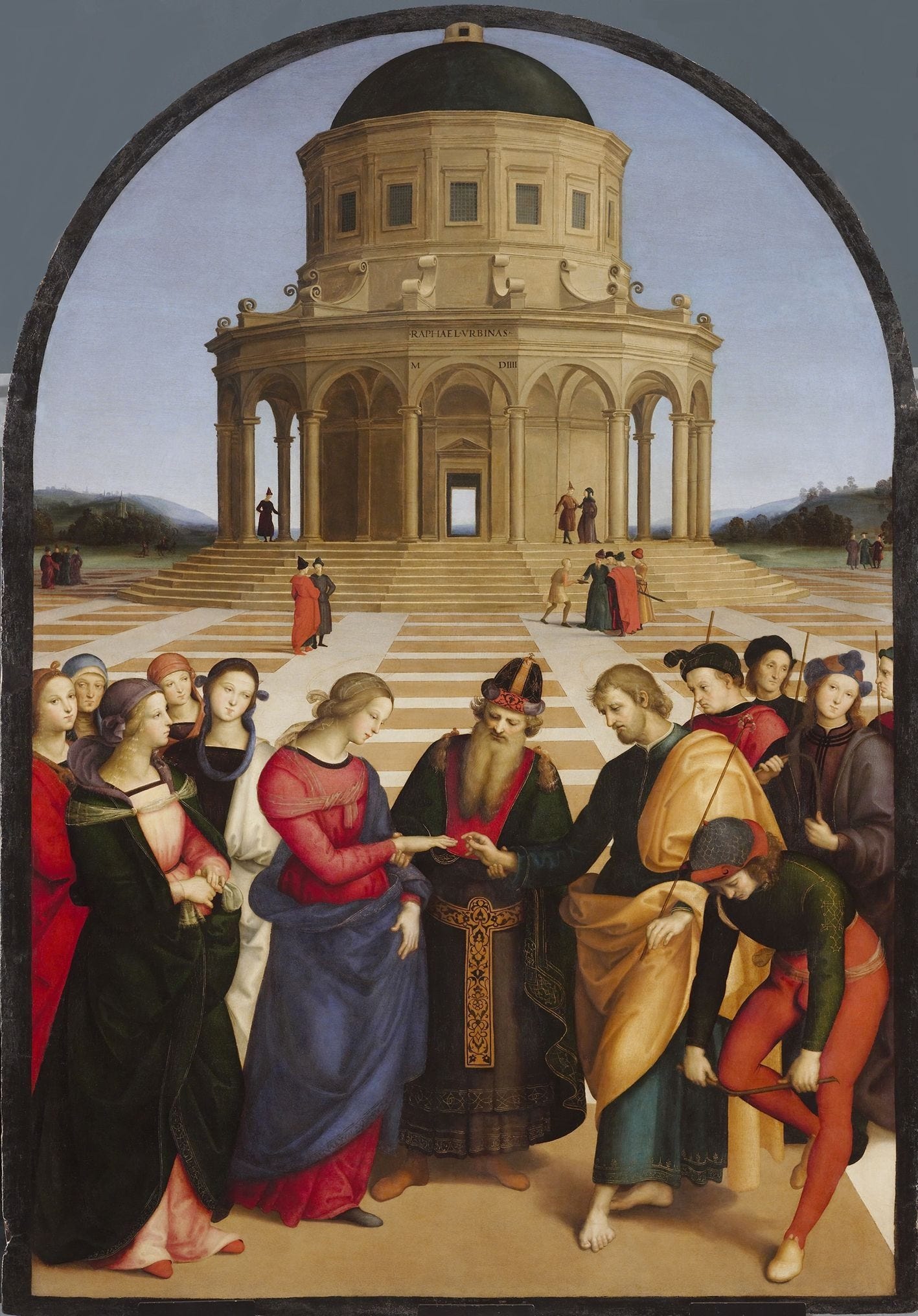
Raphael's The Marriage of the Virgin shows a scene no Gospel describes. Joseph wins Mary's hand because his rod flowers overnight, not because he chooses her. Raphael painted it in 1504, at twenty one, staging the legend as inevitable, not lucky.

The Marriage of the Virgin Raphael painting
Raphael, The Marriage of the Virgin, 1504, Pinacoteca di Brera.
  • Painted: 1504, when Raphael was twenty one

  • Subject: the wedding of Mary and Joseph, chosen by a flowering rod

  • Housed: Pinacoteca di Brera, Milan


One painting. One story. Every week. Free, with 170,000 readers who never sat through an art history lecture.


More Renaissance Stories Worth Your Time

Three that take a single painting apart, properly.


The Legend Behind the Wedding

This scene never appears in the Bible.

It comes from apocryphal texts, mainly the Protoevangelium of James, a second century text that never made it into the official canon, and it was later retold across medieval Europe in Jacobus de Voragine's Golden Legend, which is where most Renaissance painters actually got the story from.

The story goes that Mary grew up inside the Temple in Jerusalem under the care of the priests, dedicated there as a young girl by her parents Joachim and Anne.

When she reached marrying age, the high priest worried about what to do with a young woman who had been raised as a temple servant, so he called together every eligible bachelor descended from the house of David and asked each man to bring a wooden rod.

The rods were left overnight on the altar. In the morning one of them had flowered, and in some versions a dove landed on it or a burst of light surrounded it, and that man was declared Mary's husband by a divine sign rather than by family negotiation or a dowry.

Joseph was older than the other candidates and, by most tellings, the least excited about the whole arrangement, since he was already a widower with grown children in some versions of the legend.

Look at the right edge of Raphael's panel and you will see a disappointed suitor snapping his bare, unflowered rod over his knee, furious that an aging carpenter got the girl instead of him.

Sistine Madonna painting by Raphael
Raphael, The Sistine Madonna, 1512.

A Commission Built Around a Relic

Raphael did not paint this for a museum or a patron's private study. He painted it for the Albizzini family, to hang above the altar in the chapel of Saint Joseph inside the Franciscan church of San Francesco in Città di Castello, a small town near Perugia in central Italy.

The town had its own stake in the legend. Città di Castello claimed to hold a ring believed to be the very one Joseph placed on Mary's finger at their wedding, a relic that drew pilgrims and gave the commission local weight far beyond a simple altarpiece for a side chapel.

That context changes how I read the painting.

This was not an abstract Bible illustration, it was a civic and religious argument that the ring kept in their own church connected this small town directly to the holy family,

and Raphael's job was to make that connection look majestic enough to justify the claim in front of every visitor who came to see the relic.


No boring lectures, ever. Join 170,000 readers learning art the fun way, free.


The Trick With the Temple

The most talked about part of the painting is not the wedding at all, it is the building behind it. Raphael placed a sixteen sided domed temple in the background, ringed by a graceful colonnade, with the doorway open straight down the central axis of the panel.

Every line of pavement and every column recedes toward that open door with a precision that still impresses architects, not just art historians.

Some scholars think Raphael built an actual wood or clay model of the temple before he ever picked up a brush, because the geometry stays consistent from every angle in a way that is difficult to fake freehand.

I find the trick works on you even if you never notice it consciously.

Your eye gets pulled past the wedding party, through the door, into empty sky, which is a strange thing for an artist to do in a painting supposedly about two people getting married, and it is exactly why the picture feels bigger than its actual subject.

Raphael even carved his signature into that architecture rather than tucking it into a corner of the foreground, which tells you the temple was never just a backdrop to him. It was the argument he was making about his own skill, presented as confidently as the wedding itself.

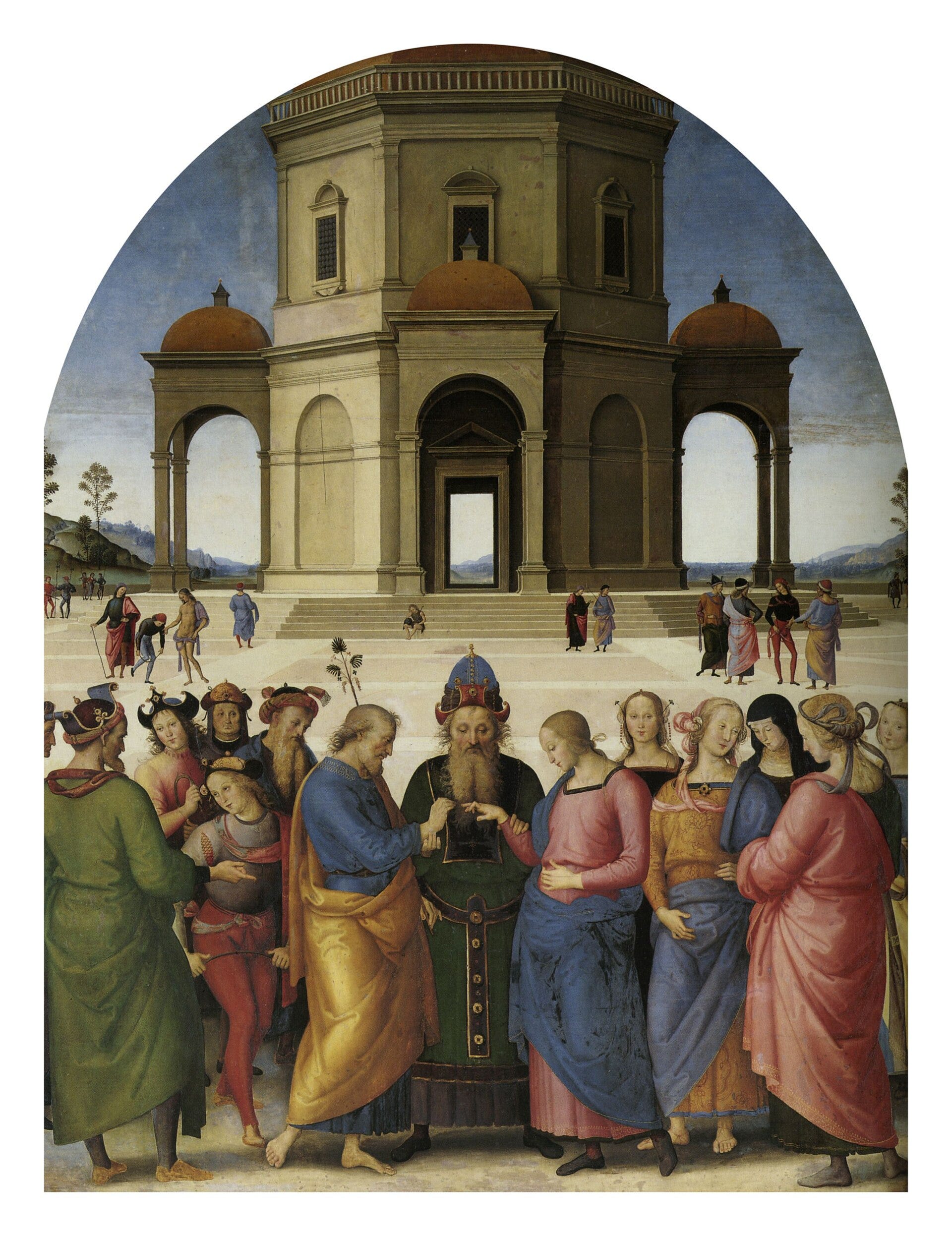
Marriage of the Virgin painting by Perugino
Pietro Perugino, The Marriage of the Virgin, circa 1500 to 1504.

The Teacher Painted It First, and Lost the Comparison

Raphael was not inventing this composition from nothing.

His teacher, Pietro Perugino, had painted his own Marriage of the Virgin for Perugia's cathedral between about 1499 and 1504, and Raphael's version borrows its layout directly from that altarpiece, right down to the temple and the crowd of suitors.

Perugino's temple is octagonal and the whole scene reads as flatter, more like a stage set than a real space you could walk into.

Raphael's version opens the space up, and the historian Giorgio Vasari, writing decades later, said the picture showed Raphael's growing refinement and that it surpasses the manner of Pietro, using Perugino's first name the way people did at the time.

I will not pretend Perugino's picture is bad, plenty of it is graceful and calm in its own right, and you can read more about the painters who shaped this era in the greatest painters of all time.

But standing the two side by side, Raphael's version simply breathes in a way his teacher's does not, and that gap is exactly what convinced Raphael it was time to leave Perugino's workshop for good and head to Florence.

Raphael self portrait
Raphael, Self Portrait, circa 1506.

A Twenty One Year Old Who Signed His Own Work

Here is a detail that tends to get buried in the story. Raphael carved his own signature into the architrave above the temple's central doorway, reading RAPHAEL URBINAS, with the Roman numerals for the date, MDIIII, split across the spandrels on either side of the arch.

Most young painters at that stage of their career did not sign major commissions this openly, because signing was a statement of ownership and confidence, not just a label you added out of habit.

For a twenty one year old finishing his apprenticeship, it reads like Raphael was announcing that this particular painting was entirely his, not a workshop production supervised by Perugino's older hand.

That single decision tells you as much about Raphael's ambition as the perspective does.

If you want the fuller picture of how the artists of this period built their reputations one commission at a time, competing with their own teachers along the way, I wrote about several of them in 10 artists you need to know.


Learn art the fun way. Join 170,000 readers getting one painting and its story every week.


From a Napoleonic General's Hands to a Museum in Milan

The painting stayed in its chapel in Città di Castello for nearly three centuries, largely undisturbed.

Then in 1798, during the Napoleonic campaigns in Italy, the town was forced to hand the painting over to General Giuseppe Lechi as part of the wave of art seized or extracted from Italian churches and towns during that period.

Lechi sold it to a Milanese dealer named Sannazzari, who bequeathed it to Milan's main hospital in 1804.

Two years later the Academy of Fine Arts acquired it and placed it on public display, and by 1806 it had settled at the Pinacoteca di Brera, where it still hangs today, more than two centuries after it left its original chapel.

That whole chain of ownership is a reminder of how much European museum collections were shaped by war and forced transfer rather than clean sale. If that kind of story interests you, I covered a wider set of works with similarly rough journeys in the most stolen paintings in history.

The School of Athens fresco by Raphael
Raphael, The School of Athens, 1511, Vatican.

What Most Top Ten Lists Leave Out

Almost every quick article on this painting repeats the same three facts: Raphael was young, the perspective is impressive, and Vasari praised it.

Few mention that the painting most people assume lives in Rome or Florence, given how tightly Raphael's name is tied to the Vatican and the Uffizi, actually hangs in Milan, a city he barely worked in during his short career.

Fewer still point out how emotionally blunt the losing suitors are allowed to look. Raphael gives them real, ugly frustration, one breaking his rod across his knee in the open, which is an oddly human touch to plant in a painting built around divine selection and perfect architecture.

Most lists also skip the fact that this painting marks a hard professional break, not a gentle graduation. Once Raphael finished it and signed it in his own name, he left Perugino's workshop for Florence within the year, and he never really returned to working under anyone else again.

My honest reaction, looking at this panel again while writing this, is that the temple gets all the credit but the losing suitors are what make the painting feel alive.

Take them out and you have a beautiful diagram, leave them in and you have people reacting to genuinely losing something they wanted, which is the part of the painting that stays with me longer than the architecture does.

For the rest of his short, fast moving career, from this altarpiece to the Vatican frescoes, read Raphael: The Complete Story.


More Secrets to Unlock

Three more paintings that reward a second, closer look.


See art differently. 170,000 people read these free stories. Come find out why.


FAQ

  • What does The Marriage of the Virgin actually depict?

    It shows the wedding of Mary and Joseph as told in apocryphal Christian legend, where Joseph is chosen as Mary's husband because his rod is the only one among all her suitors to flower overnight, a sign read as God's decision rather than a family arrangement.

  • Where is Raphael's Marriage of the Virgin located today?

    The painting hangs in the Pinacoteca di Brera in Milan, where it has been on public display since 1806 after passing through several owners following its removal from Città di Castello in 1798.

  • How old was Raphael when he painted The Marriage of the Virgin?

    He was twenty one, and the painting is generally treated as the work that closes out his apprenticeship under Perugino and marks his move toward independent commissions in Florence.

  • Why did Joseph's staff bloom in the painting?

    In the legend behind the scene, every eligible suitor left a wooden rod overnight at the temple altar, and the rod that flowered by morning identified God's chosen husband for Mary, which turned out to be Joseph's.

  • How does Raphael's version compare to Perugino's?

    Raphael borrowed the composition from his teacher Pietro Perugino's earlier altarpiece on the same subject, but replaced Perugino's flatter octagonal temple with a sixteen sided domed structure and a much deeper sense of space, which Vasari said surpassed his teacher's work.

  • Who commissioned The Marriage of the Virgin?

    The Albizzini family commissioned it for the chapel of Saint Joseph inside the church of San Francesco in Città di Castello, a town that claimed to hold the wedding ring of Mary and Joseph as a relic.

  • What happened to the painting after it left Città di Castello?

    Napoleonic forces took it from the town in 1798, after which it passed through a general, a Milanese art dealer, and Milan's main hospital before the Academy of Fine Arts acquired it and placed it at the Pinacoteca di Brera by 1806.

  • Is the wedding of Mary and Joseph a biblical story?

    No, it is not in the canonical Gospels. It comes from apocryphal sources like the Protoevangelium of James and was popularized later through Jacobus de Voragine's Golden Legend.


Never miss a story. 170,000 readers get one painting explained every week, free.