What Does Rembrandt's The Anatomy Lesson of Dr Tulp Mean?

A dead man on a table, seven paying guild members around it, and a 26 year old painter who became famous overnight.

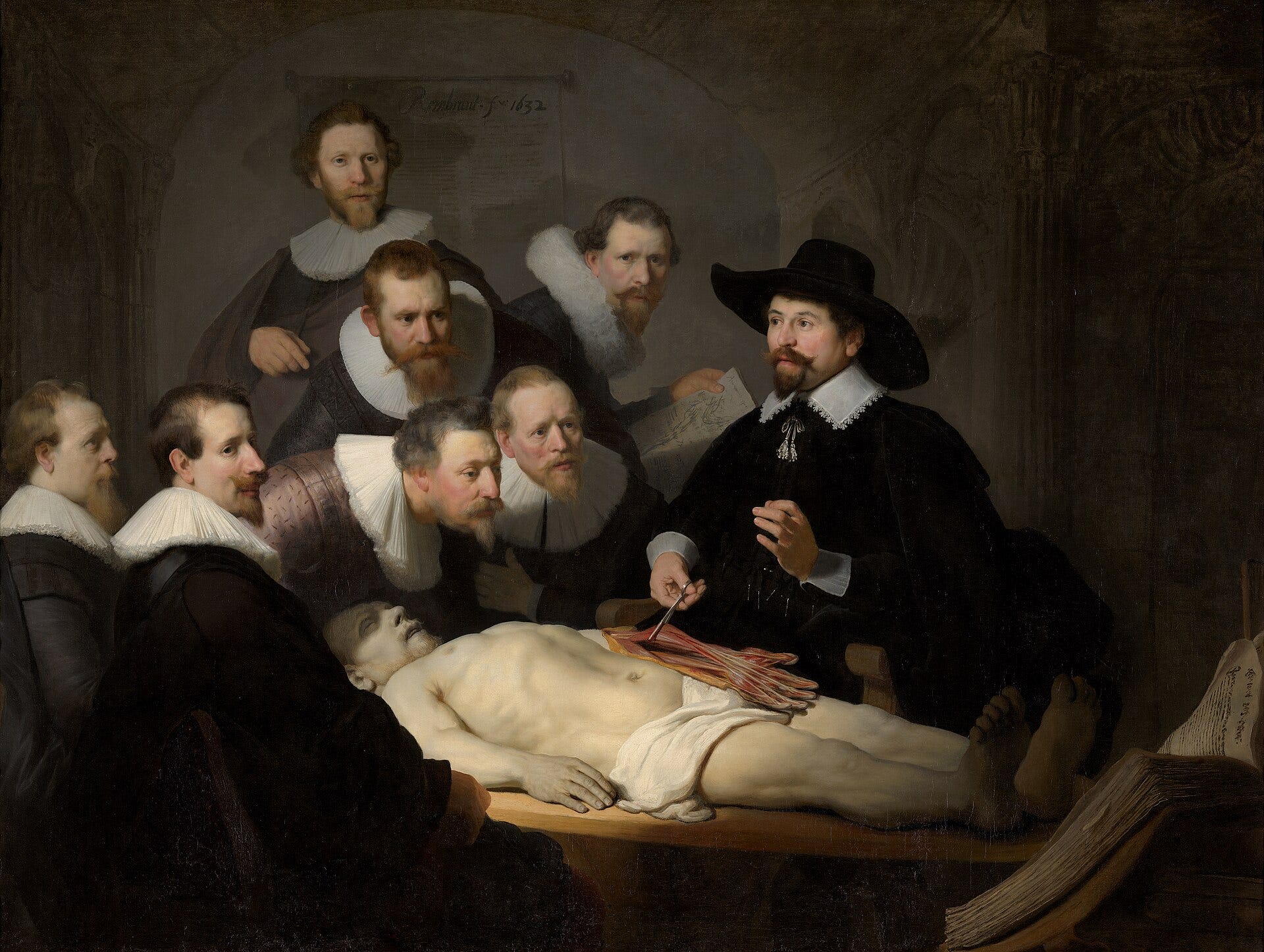
Rembrandt's The Anatomy Lesson of Dr Nicolaes Tulp shows a public dissection of an executed criminal, painted in 1632 when Rembrandt was only 26. Surgeons who studied the canvas closely have long noted the forearm tendons Dr Tulp holds do not match a real dissection, evidence Rembrandt worked partly from a textbook.

Dutch surgeons gathered around a dissected forearm
Rembrandt van Rijn, The Anatomy Lesson of Dr Nicolaes Tulp, 1632.

Group portraits like this one were a genre of their own in the Dutch Republic. Guilds and civic groups paid to appear together on canvas, and painters competed hard for the commissions.

  • Date: painted in 1632.

  • Medium: oil on canvas.

  • Location: the Mauritshuis, in The Hague.


Get one story like this every week. Join 170,000 readers discovering the stories behind the world's greatest paintings.


If Group Portraits Fascinate You

A few more stories from the archive, for readers who like a crowd of faces hiding a single story.


The Body on the Table

The corpse belonged to Aris Kindt, a man hanged that same day for armed robbery. Dutch law allowed surgeons only one public dissection a year, staged in winter when cold slowed decay, and only the body of an executed criminal could legally be used. Paying spectators packed the theater to watch.

Dr Tulp demonstrates the tendons and muscles of the forearm and hand, the part of the body guilds most wanted to understand for their own surgical work.

The demonstration took place in Amsterdam's Waag, the old weigh house, in a room built specifically for public anatomy lessons above one of the city gates.

Seven Men Who Paid to Be There, Looking in Different Directions

The men gathered around the table are not students, they are members of Amsterdam's surgeons' guild, and each paid for the privilege of appearing in the painting. Painting eight men and a corpse in a single sitting was not realistic. Rembrandt likely built the composition from separate studies of each face, which may explain why their gazes point in different directions instead of all following Tulp's demonstration.

Group portraits like this doubled as advertising for the guild's own expertise, and answered to the vanity of the men who commissioned it.

Dutch guild members seated around a table
Rembrandt van Rijn, The Syndics of the Drapers Guild, 1662, another Amsterdam guild portrait painted three decades later.

Rembrandt returned to the same commercial genre near the end of his career, this time for the guild that inspected cloth quality in Amsterdam.

I find the scattered gazes the most human detail in the whole composition. Real attention wanders, even during a dissection everyone paid good money to attend.


See the full picture. Join 170,000 readers who get one painting and its story every week.


Why This Painting Made Rembrandt Famous

Rembrandt was 26 and still relatively unknown in Leiden when he painted this canvas. Within a year of finishing it, he had moved to Amsterdam and was receiving major commissions. The realism was unusual for a guild portrait: individualized faces, dramatic lighting, and a composition that pulls every gaze toward the same dissected forearm.

Portrait commissions followed almost immediately. Within the next few years Rembrandt painted dozens of Amsterdam's wealthiest residents, work that funded the house and print collection he later lost to bankruptcy.

Rembrandt painting of a slaughtered ox carcass
Rembrandt van Rijn, The Slaughtered Ox, 1655, a later study of a carcass that shares the same unflinching attention to flesh.

Rembrandt kept returning to the body as subject matter throughout his career, on a butcher's hook as often as on a surgeon's table.

Young Rembrandt self portrait
Rembrandt van Rijn, Self Portrait, around 1628 to 1629, painted a few years before the Anatomy Lesson.

This self portrait dates from just before the commission, when Rembrandt was still working in Leiden and had not yet made the move to Amsterdam that this painting helped bring about.

An Anatomical Mistake, and the Textbook Behind It

Surgeons and anatomists examining the painting have long noted that the tendons Dr Tulp holds do not match the muscles of a properly dissected forearm. A large book lying open near the corpse's feet, likely referencing Andreas Vesalius's sixteenth century anatomy atlas, may explain why: several historians think Rembrandt copied that detail from an illustration rather than the body itself.

Its presence in the painting argues for authority, printed knowledge placed next to the hands on demonstration Dr Tulp performs live in front of his colleagues.

I think that mistake says something true about the picture. Rembrandt was painting the idea of expertise, not necessarily performing it himself down to the last tendon.

A List of Names Added After the Fact

Technical examination of the canvas found that the paper listing the sitters' names, held in the corpse's own hand, was painted after the rest of the composition was already finished. That detail suggests the guest list was not settled when Rembrandt began the picture, and kept changing as he worked.

X ray and infrared analysis of the canvas in the twentieth century confirmed the change, showing an earlier, blanker version of the paper beneath the visible names.

The Anatomist Who Became a Mayor

Nicolaes Tulp was born Claes Pieterszoon. He adopted the name Tulp and a tulip flower as his family emblem, displayed on the facade of his own house in Amsterdam. Beyond anatomy, Tulp served several terms as one of Amsterdam's four burgomasters later in life, one of the most powerful men in the city he once demonstrated dissection for.

Tulp kept a personal motto, Aliis inserviendo consumor, consumed in service of others, illustrated with a burning candle. He used the same emblem on his own bookplate.

From Guild Hall to National Collection

The painting stayed with the surgeons' guild for close to two centuries after Rembrandt delivered it, until King William I bought it in 1828 for the Dutch national collection. It has hung at the Mauritshuis since. Rembrandt's second anatomy lesson, painted in 1656 for Amsterdam's town hall, was not so lucky: a 1723 fire destroyed most of that canvas.

Rembrandt anatomy lesson painting fragment
Rembrandt van Rijn, The Anatomy Lesson of Dr Jan Deijman, 1656, a later and more damaged work on the same subject.

Only a fragment survived, showing the corpse and the surgeon's hands rather than the full group. It hangs today at the Amsterdam Museum, alongside a preparatory sketch that records how the full composition once looked.

A scene this carefully staged rarely happens by accident twice. Rembrandt returned to the same subject twenty four years later, and only one of the two paintings survived intact.


More Stories Worth Your Time


Frequently Asked Questions

  • What does The Anatomy Lesson of Dr Nicolaes Tulp show?

    It shows Dr Nicolaes Tulp dissecting the forearm of Aris Kindt, a criminal executed by hanging earlier that same day, in front of members of Amsterdam's surgeons' guild.

  • Who commissioned the painting?

    The surgeons' guild of Amsterdam commissioned it as a group portrait. Each of the men shown paid to appear in the painting.

  • Where is The Anatomy Lesson of Dr Nicolaes Tulp located?

    The painting hangs in the Mauritshuis, in The Hague.

  • How old was Rembrandt when he painted it?

    Rembrandt was 26 in 1632, and the painting made him one of the most sought after portraitists in Amsterdam almost overnight.

  • Why was the dissection performed on a criminal's body?

    Dutch law at the time only permitted the dissection of the bodies of executed criminals, which is why public anatomy lessons were tied to the schedule of executions.

  • Did Rembrandt get the anatomy right?

    Not entirely. The forearm tendons Dr Tulp displays do not match a real dissection, a detail several historians think Rembrandt borrowed from a textbook illustration rather than the corpse itself.

  • Why does the composition look staged rather than candid?

    Group portraits like this were usually assembled from separate sittings for each face, then combined into one scene, which historians think explains why the men's attention points in different directions.


Ready for more stories like this one? Join 170,000 readers discovering the stories behind the world's greatest paintings.